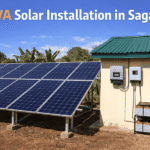
A complete 1kVA solar system in Kenya costs between KSh 55,000 and KSh 130,000 in 2026. A budget setup with gel batteries starts at KSh 55,000, while a premium system with lithium battery and Tier-1 panels costs KSh 110,000–130,000. This includes 2 solar panels (440W each), a 1kVA hybrid inverter, battery storage, and installation. A 1kVA system powers lights, TV, phone charging, laptop, WiFi router, and a small fan — ideal for bedsitters, small apartments, or backup power.
📑 What’s In This Guide
- What Is a 1kVA Solar System?
- 1kVA Solar System Price Breakdown (2026)
- Complete Component List
- What a 1kVA System Can Power (Runtime Table)
- Who Should Buy a 1kVA Solar System?
- 1kVA vs 2kVA vs 3kVA — Which Do You Need?
- Installation Cost & Process
- How Much Will You Save on KPLC Bills?
- Where to Buy in Kenya
- Frequently Asked Questions
What Is a 1kVA Solar System?
A 1kVA (1 kilovolt-ampere) solar system is the smallest complete solar power solution designed for homes and small businesses in Kenya. The “1kVA” refers to the inverter capacity — it can handle up to 1,000 volt-amperes of power, which translates to approximately 800 watts of usable power (at 0.8 power factor).
This is the entry-level solar system that most Kenyans start with, and it’s perfect if your total appliance wattage is under 800 watts. Think of it as solar power for essentials — keeping your lights on, phone charged, TV running, and WiFi working, even when KPLC fails.
A complete 1kVA solar system operates on 12V DC and consists of 4 main components: solar panels, a hybrid inverter with built-in charge controller, a battery bank, and mounting accessories. Let’s break down the exact cost of each.
1kVA Solar System Price in Kenya — Full Breakdown (2026)
The price of a 1kVA solar system in Kenya varies depending on the quality of components you choose. Here’s a detailed breakdown for three budget levels:
| Component | Budget | Mid-Range | Premium |
|---|---|---|---|
| Solar Panels (2x 440W) | KSh 16,000 | KSh 22,000 | KSh 26,400 |
| 1kVA Hybrid Inverter (12V, MPPT) | KSh 12,000 | KSh 25,000 | KSh 45,000 |
| Battery | KSh 12,000 200Ah Gel | KSh 28,000 200Ah Gel (Ritar) | KSh 42,000 100Ah Lithium |
| Mounting & Accessories | KSh 5,000 | KSh 8,000 | KSh 10,000 |
| Installation Labour | KSh 10,000 | KSh 12,000 | KSh 15,000 |
| TOTAL COST | KSh 55,000 | KSh 95,000 | KSh 138,400 |
Complete Component List — What’s Included
Why 12V? Understanding Voltage Matching
A 1kVA system runs on 12V — this means the inverter, battery, and panel configuration must all be matched to 12V. Mixing voltages (e.g., putting a 48V battery on a 12V inverter) will damage your equipment. When you upgrade to a 3kVA system, you move to 24V. At 5kVA and above, systems run on 48V. Always buy matched components or a complete kit.
What Can a 1kVA Solar System Power?
Here’s a realistic breakdown of what a 1kVA system can run, and for how long on a full battery charge:
- 💡6-10 LED bulbs (7W each)10-14 hrs
- 📺LED TV 32″ + Decoder (80W)6-8 hrs
- 📱Phone charging (4 phones)All day
- 💻Laptop charging (65W)6-8 hrs
- 📶WiFi Router (15W)24 hrs
- 🌀Small standing fan (50W)8-10 hrs
- 🔒Security light (20W)12+ hrs
What a 1kVA System Can Power (Visual)
Who Should Buy a 1kVA Solar System?
A 1kVA solar system is the right choice if you fall into any of these categories:
Bedsitter or studio apartment owners — You only need lights, TV, phone charging, and WiFi. A 1kVA system covers all of this comfortably and pays for itself within 12-18 months.
Backup power seekers — You’re connected to KPLC but want reliable backup during blackouts for essential devices. The solar system kicks in automatically when power goes out.
Small shop owners — Mpesa shops, barber shops, or small retail stores that only need lighting, a TV/screen, and phone charging stations.
Students or home office workers — Need guaranteed power for laptop and WiFi to work or study without interruption.
Rural homes without KPLC — Basic electrification with lighting and entertainment (TV, radio, phone charging).
Find Your Perfect Solar System Size & Price
Select your appliances and get an instant recommendation — takes 60 seconds.
1kVA vs 2kVA vs 3kVA — Which Size Do You Need?
| Feature | 1kVA | 2kVA | 3kVA |
|---|---|---|---|
| Max Load | 800W | 1,600W | 2,400W |
| Voltage | 12V | 24V | 24V / 48V |
| Panels | 2x 440W | 4x 440W | 6x 555W |
| Can Run Fridge? | ❌ No | ✅ Yes | ✅ Yes + more |
| Price Range | KSh 55K – 130K | KSh 120K – 210K | KSh 200K – 350K |
| Best For | Bedsitter, backup, small shop | 1-2 bedroom, small office | 3 bedroom, business |
Installation Cost & Process
Installation of a 1kVA solar system in Kenya typically costs KSh 10,000 to KSh 15,000 for labour, depending on your location and roof type. The process takes about 3-5 hours.
Step 1: Site Assessment — The installer checks your roof orientation, shading, and structural strength. South or north-facing roofs receive the best sunlight in Kenya.
Step 2: Panel Mounting — Aluminium rails are secured to your roof, and the 2 solar panels are mounted at the optimal angle (5-15° in Kenya since we’re near the equator).
Step 3: Wiring — DC cables connect panels to the inverter, and AC cables connect the inverter to your DB board. Proper earthing and circuit protection is installed.
Step 4: Battery Connection — The battery is placed in a well-ventilated area and connected to the inverter. For lithium batteries, the BMS is configured.
Step 5: Testing — The system is switched on, settings configured, and you’re trained on basic operation.
How Much Will a 1kVA System Save You?
If your current KPLC bill is KSh 2,000–4,000/month (typical for a bedsitter or small apartment), a 1kVA solar system can reduce it by 60-90%.
| Scenario | Monthly Savings | Annual Savings | Payback Period |
|---|---|---|---|
| Budget (KSh 55K) | KSh 1,500 | KSh 18,000 | ~3 years |
| Mid-range (KSh 95K) | KSh 2,500 | KSh 30,000 | ~3.2 years |
| Premium lithium (KSh 130K) | KSh 3,000 | KSh 36,000 | ~3.6 years |
After the payback period, you enjoy free electricity for 15-25 more years. That’s KSh 300,000–750,000 in lifetime savings from a system under KSh 130,000.
Where to Buy a 1kVA Solar System in Kenya
At Bicity Solar Energy Suppliers, we offer complete 1kVA solar system kits with supply and installation across Kenya. Every system includes:
✅ Tier-1 solar panels with 25-year warranty
✅ Matched inverter and battery (voltage-compatible)
✅ All mounting hardware and accessories
✅ Professional installation by certified technicians
✅ Free system sizing with our online solar calculator
✅ After-sales support and maintenance guidance
✅ Flexible payment plans available
Get Your 1kVA Solar System Quote Today
Call or WhatsApp us for a free quote. We deliver and install across Kenya.
Frequently Asked Questions About 1kVA Solar Systems
How much does a 1kVA solar system cost in Kenya?
A complete 1kVA solar system in Kenya costs between KSh 55,000 (budget gel battery) and KSh 130,000 (premium lithium) in 2026. This includes solar panels, inverter, battery, accessories, and installation.
What can a 1kVA solar system power?
A 1kVA system can power 6-10 LED bulbs, a 32″ TV with decoder, phone and laptop charging, WiFi router, a small fan, and security lights. It produces up to 800W of usable power. It cannot run a fridge, iron, kettle, or AC.
How many solar panels does a 1kVA system need?
A 1kVA system typically uses 2 solar panels of 440W each (880W total). This provides enough generation to fully charge the battery during Kenya’s 5 peak sun hours per day.
How long does the battery last at night?
With a 100Ah lithium battery, expect 6-10 hours of power for lights + TV. With a 200Ah gel battery, expect 4-8 hours depending on load. The battery recharges fully the next day from solar.
Is a 1kVA solar system enough for a 2 bedroom house?
For a 2 bedroom house with a fridge, we recommend at least a 2kVA or 3kVA system. A 1kVA is best for bedsitters, single rooms, or backup power for essentials only. Use our calculator to find your exact size.
Can a 1kVA solar system run a fridge?
A standard fridge draws 150-350W. While a 1kVA inverter can technically handle a small fridge, the battery will drain within 3-4 hours. For reliable fridge operation, you need at least a 2kVA system with a larger battery.
Gel battery vs lithium — which is better for 1kVA?
Lithium costs more upfront (KSh 42,000 vs KSh 28,000) but lasts 3-5x longer (10+ years vs 2-3 years), charges faster, and has deeper discharge (90% vs 50%). Over 10 years, lithium is actually cheaper.
Do I need a permit for a 1kVA solar system in Kenya?
For off-grid systems (not connected to KPLC), no permit is needed. If connecting to the grid for net metering, you need EPRA approval. Most 1kVA systems are standalone and require no permits.
Can I upgrade from 1kVA later?
Upgrading from 1kVA (12V) to 3kVA (24V) or 5kVA (48V) usually means replacing the inverter and adding batteries, since the voltage changes. However, your solar panels can often be reused. We recommend sizing correctly from the start.
🧮 Not Sure If 1kVA Is Right For You?
Our free solar calculator sizes your system based on your actual appliances — try it now!
Bicity Solar Energy Suppliers — Kenya’s trusted solar partner since 2022.
📞 +254 794 917 789 | 📧 sales@solarenergysuppliers.co.ke
Related: 2kVA Solar System Price • 3kVA Solar System • 5kVA Solar System • Solar Calculator