
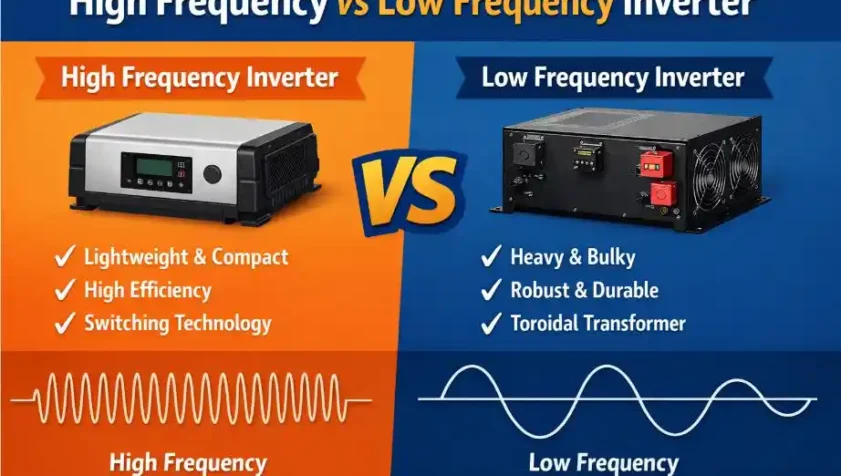
High Frequency vs Low Frequency Inverter: Which One Do You Actually Need in Kenya?
You’re shopping for a solar inverter in Kenya. One seller tells you to buy a high-frequency inverter — “it’s lighter, cheaper, more efficient.” Another insists you need a low-frequency inverter — “it’s more powerful, handles surges better, lasts longer.”
Both are telling partial truths. Neither is explaining what actually matters for your home, your appliances, and Kenya’s power conditions.
We’ve installed both types across 47 counties. Here’s the honest breakdown — no jargon, no sales pitch, just what works and what doesn’t in the Kenyan context.
⚡ The Short Answer
High frequency → Best for homes with standard appliances (lights, TV, fridge, laptop, WiFi). Lighter, cheaper, 93-97% efficient. Good for 1kVA-5kVA systems.
Low frequency → Best for homes or businesses running heavy inductive loads (borehole pumps, welding machines, large compressors, industrial motors). Heavier, more expensive, but handles 3× surge capacity. Ideal for 5kVA-20kVA+ systems.
For 90% of Kenyan homes, a quality high-frequency inverter is the right choice. Read on to find out if you’re in the 10% that needs low frequency.
What’s in This Guide
What Do These Terms Actually Mean? · Head-to-Head Comparison · The Surge Capacity Difference · Kenya’s Grid: Why It Matters · Which Appliances Need Which? · Decision Guide · 3 Myths Debunked · FAQ
What Do “High Frequency” and “Low Frequency” Actually Mean?
These names refer to how the inverter converts DC power (from your solar panels and battery) into AC power (what your appliances use). The difference is inside the machine — specifically the transformer and switching speed.
HIGH FREQUENCY
Uses tiny, lightweight transformers (or no transformer at all) switching at 20,000-50,000 Hz. The fast switching allows the components to be much smaller. Think of it as a hummingbird’s wings — tiny, fast, efficient.
LOW FREQUENCY
Uses a large, heavy iron-core transformer operating at 50 Hz (same frequency as Kenya’s grid). The heavy transformer stores energy magnetically and handles massive surges. Think of it as an elephant — heavy, strong, unstoppable.
Head-to-Head Comparison
| Feature | High Frequency | Low Frequency |
|---|---|---|
| Switching speed | 20,000-50,000 Hz | 50 Hz |
| Transformer type | Small ferrite core or transformerless | Large iron-core transformer |
| Weight (5kVA example) | 8-15 kg ✅ | 35-60 kg |
| Size | Compact — wall-mountable ✅ | Large — needs floor space or strong wall mount |
| Efficiency | 93-97% ✅ | 88-93% |
| Surge capacity | 2× rated power (brief) | 3× rated power (sustained) ✅ |
| Handling inductive loads | Adequate for home appliances | Excellent — motors, pumps, compressors ✅ |
| Grid isolation | Limited (especially transformerless models) | Full galvanic isolation via transformer ✅ |
| Noise level | Near silent ✅ | Slight hum from transformer (30-45 dB) |
| Price (5kVA, Kenya) | KSh 45,000-80,000 ✅ | KSh 85,000-160,000 |
| Lifespan | 8-12 years (quality brands) | 12-20 years ✅ |
| Voltage fluctuation tolerance | Moderate — sensitive to severe spikes | High — transformer absorbs fluctuations ✅ |
| Output waveform | Pure sine wave | Pure sine wave |
The Surge Capacity Difference: Why It Matters in Kenya
Surge capacity is how much extra power the inverter can deliver for a few seconds when an appliance starts. This is the single biggest practical difference between the two types.
| Appliance | Running Watts | Surge Watts (start-up) | High Freq 5kVA (10kW surge) | Low Freq 5kVA (15kW surge) |
|---|---|---|---|---|
| Fridge compressor | 150W | 450W | ✅ | ✅ |
| Washing machine | 500W | 1,500W | ✅ | ✅ |
| Air conditioner (1.5HP) | 1,200W | 3,600W | ✅ | ✅ |
| Water pump (1HP) | 750W | 3,000-4,500W | ✅ | ✅ |
| Borehole pump (2HP) | 1,500W | 6,000-9,000W | ⚠️ Marginal | ✅ |
| Welding machine | 3,000W | 9,000-15,000W | ❌ Will trip | ✅ |
| Large industrial compressor | 4,000W | 12,000-20,000W | ❌ Will trip | ✅ |
Kenya’s Grid: Why This Matters More Here Than in Europe
Here’s something the global comparison articles don’t tell you: Kenya’s grid is rough. Voltage swings from 180V to 260V are common in many areas. Neutral-earth faults, surges during reconnection after outages, and brownouts during peak demand are daily realities.
| Grid Issue | High Frequency Response | Low Frequency Response |
|---|---|---|
| Voltage drops to 180V | Electronic regulation compensates — usually fine | Transformer naturally handles it — rock solid |
| Voltage spikes to 260V+ | MOSFETs can blow on severe spikes — needs good surge protection | Transformer absorbs spikes — very resilient |
| Power reconnection surge | Can cause MOSFET failure if surge protection is weak | Transformer provides galvanic isolation — protected |
| Neutral-earth fault | Potentially dangerous on transformerless models | Full isolation — safe |
Which Kenyan Appliances Need Which Inverter?
✅ HIGH FREQUENCY handles these fine:
LED lights (any number)
TVs, decoders, sound systems
WiFi routers, laptops, phones
Fridges (all home sizes)
Deep freezers (home size)
Electric kettle
Iron
Microwave
Washing machine
AC (up to 1.5HP)
Water pump (up to 1HP)
CCTV, electric fence
Power tools (small drills, grinders)
⚡ LOW FREQUENCY recommended for:
Borehole pump (1.5HP+)
Submersible pump (2HP+)
Welding machine
Maize mill / posho mill
Industrial compressor
Large commercial freezer room
Multiple ACs (3+ units)
Elevator / lift motor
Large workshop equipment
3-phase industrial loads
Basically: anything with a big motor that surges hard on startup
Decision Guide: Answer These 4 Questions
Yes → Low frequency. These loads have extreme start-up surges (5-7× running watts) that can trip high-frequency inverters.
No → High frequency handles everything else.
Yes → Low frequency offers better natural protection through transformer isolation.
No (or moderate) → High frequency with proper surge protection works perfectly.
Yes → Low frequency becomes more practical at larger sizes. The weight penalty matters less for permanent installations, and the reliability advantage matters more.
No (1kVA-8kVA) → High frequency is the standard choice for residential systems.
Yes → High frequency saves you KSh 40,000-80,000 on the inverter alone, and is lighter (cheaper shipping and easier installation).
No → If reliability for 15-20 years with zero maintenance is your priority, low frequency is the premium choice.
3 Myths Debunked
False. A quality high-frequency 1kVA inverter (2,000W surge) handles any home fridge. The fridge compressor surges to 2-3× its rated watts — a 150W fridge surges to 450W. That’s nothing for a 1,000W inverter with 2,000W surge capacity. We’ve installed hundreds of high-frequency systems running fridges 24/7 without issue.
False. A cheap low-frequency inverter with poor components will fail faster than a quality high-frequency inverter from a reputable brand. The technology type doesn’t determine quality — the manufacturer, components, and build quality do. Don’t let anyone sell you an expensive low-frequency unit just because “low frequency = premium.”
Mostly false. Kenya’s grid is unstable compared to Europe, yes. But a quality high-frequency inverter with a built-in AC voltage regulator and external surge protection handles Kenyan conditions perfectly for residential use. We wouldn’t sell thousands of high-frequency systems across 47 counties if they couldn’t handle it. The exception is areas with extreme instability or heavy industrial loads — that’s where low frequency earns its premium.
What We Install (and Why)
| System Size | Inverter Type | Why |
|---|---|---|
| 1kVA (KSh 95,000) | High frequency | Bedsitter/studio loads are light — no inductive motors |
| 2kVA (KSh 185,000) | High frequency | 1-bedroom apartment — fridge, iron, kettle all handled |
| 3kVA (KSh 350,000) | High frequency | 2-3 bedroom home — full household including washing machine |
| 5kVA (KSh 420,000) | High frequency | 3-4 bedroom home — handles AC, water pump (1HP), all appliances |
| 8kVA (KSh 600,000) | High frequency | Large home, Airbnb, small business — high surge capacity at this tier |
| 10kVA (KSh 900,000) | High or Low frequency | Depends on loads — standard commercial = HF; borehole/industrial = LF |
| 15kVA+ (KSh 1.45M+) | Low frequency recommended | At this scale, loads are heavy, reliability is critical, weight is irrelevant |
Frequently Asked Questions
Get the Right Inverter for Your Exact Needs
Tell us your appliances. We’ll match you with the right inverter type, size, and complete solar system.
* Specifications and prices reflect typical market values. Actual inverter selection depends on load requirements, grid conditions, and system configuration. Contact us for personalised advice.