
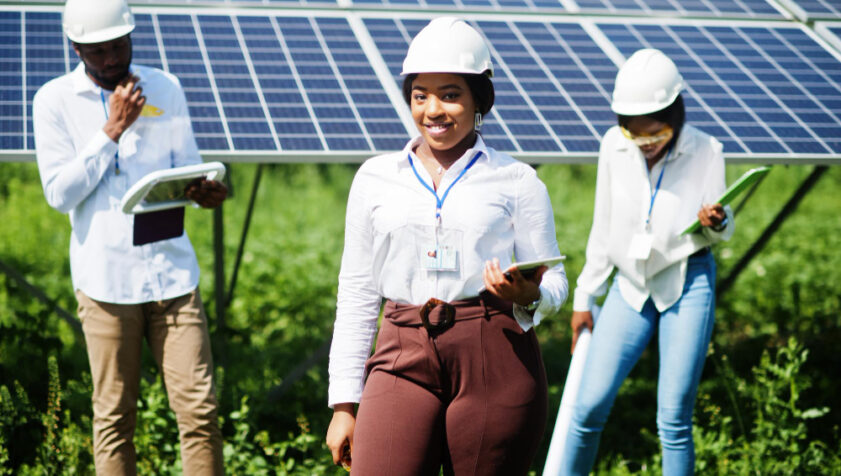
The Kenyan solar market has spent the past decade focused almost exclusively on grid-connected residential systems in urban centres. That’s a real and growing market, but it’s not the whole picture. Tens of thousands of installations every year happen in places where the conversation is different: rural farms, borehole pump houses, security installations, telecom shelters, and homes far from any power line. For these projects, the Canadian Solar 410W HiKu6 is often the right answer where the bigger panels in the catalogue are wrong.
Application 1: Solar Borehole Pumping
Solar water pumping is one of the fastest-growing segments of Kenyan solar — and one of the least well-served by mainstream panel selection. Most pumping installations use small 48V or 96V DC submersible pumps that draw 200–800W. Pairing these pumps with 550W or larger panels is awkward because the panel voltage doesn’t match the pump controller’s input range cleanly.
The 410W solves this elegantly. Two panels in series produce ~74V Vmp (well within the 48V controller’s MPPT range) at the right current for small pumps. Three panels can drive larger 96V DC pumps. The Voc of 37.2V is low enough to avoid voltage protection trips on cold mornings.
Practical example: a 2-panel array (820W front-rated) directly coupled to a 48V DC submersible pump can lift roughly 1,000–2,000 litres per day from a 30–50 metre borehole. No batteries, no AC inverter, no grid connection. The pump runs whenever the sun shines and stops when it doesn’t — perfectly aligned with the natural cycle of livestock watering and crop irrigation.
Application 2: Off-Grid Rural Homes
For a rural home with no grid connection — common across northern, eastern, and parts of western Kenya — the energy needs are usually modest. Lights, phone charging, a small TV, a radio, sometimes a small refrigerator. Total daily consumption is often 1.5–4 kWh.
A system designed for this load doesn’t need 5kW of solar. Two or three 410W panels paired with a Vestwood 3.5kW hybrid inverter and a 5kWh lithium battery covers everything comfortably. The smaller panel format also makes the install easier on hand-built timber roofs that wouldn’t support the load of larger modules.
Application 3: Security and Telecoms
CCTV cameras, perimeter alarms, electric fence energisers, and small radio repeaters all share a common power profile: low average draw (50–200W continuous), but the systems must run 24/7 even during cloudy periods. The 410W is well-matched here because:
- One or two panels meet the daily energy budget with comfortable headroom for cloudy days
- The compact form factor fits small mounting frames on perimeter walls or guard houses
- The lower current is easier on small charge controllers and avoids over-sizing equipment
- Single-panel-per-string designs simplify maintenance and fault isolation
Application 4: Logistics-Constrained Sites
Some installations happen in places where the panel literally can’t physically reach the site if it’s too big. Mount Kenya foothills, parts of Turkana, the Aberdares, the cliffs of the Rift Valley — these are all places where solar systems are installed using piki-pikis, donkeys, or human porters as the final transport step.
The 410W panel’s 22.5 kg weight and 1.7-metre length is the practical limit for piki-piki transport. The 550W panel’s 28.6 kg and 2.3-metre length frequently isn’t transportable to the same destinations without specialised vehicle access.
The Inverter and Controller Compatibility Advantage
The 410W’s electrical characteristics are friendly to a wider range of equipment than larger panels. Here’s the comparison with the 550W on key parameters that affect equipment selection:
| Parameter | 410W | 550W | Why It Matters |
|---|---|---|---|
| Voc | 37.2V | 49.6V | Lower Voc fits 48V DC equipment without intermediate stages |
| Imp | 13.06A | 13.20A | Similar — both work with standard MPPT inputs |
| Max panels per 500V string | 13 | 10 | More flexibility for asymmetric or long strings |
| Max panels per 250V string | 6 | 5 | Compatible with budget inverters that have lower input ranges |
| Compatible with 48V DC pumps | Yes (2-3 in series) | Marginal | Direct DC pumping is the killer application |
What the 410W Won’t Do Well
Don’t specify the 410W if you’re building a grid-tied residential system on an unconstrained rooftop. For that purpose, the 550W or 580W is more efficient per square metre, and the per-panel cost difference is offset by the reduced installation labour from fewer modules.
The 410W also isn’t the right choice for commercial systems where you’re trying to maximise kilowatts on a fixed roof area. Use the 670W HiKu7 or 580W TOPHiKu6 for those projects.
The Rural Kenya Case
If you’ve made it this far, here’s the summary: the 410W HiKu6 is the panel for installations where the obvious metrics (cost-per-watt, kilowatts-per-square-metre) aren’t the main constraints. It exists for the engineer designing a school water pump in Marsabit, the entrepreneur powering a security camera grid on a Naivasha flower farm, the homeowner running lights and a small TV in Keiyo. For these jobs, the smallest HiKu6 is the most practical tool in the box.
Order the Canadian Solar 410W HiKu6
Compact format. Off-grid friendly. Delivery to all 47 counties.