
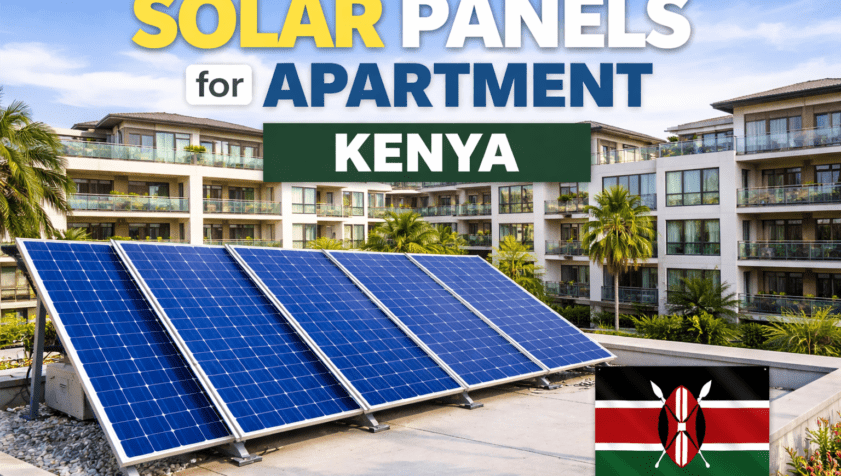
Solar Panels for Apartment in Kenya: The Only Guide That Deals with Shared Roofs, Management Politics & Cable Routing (2026)
You want solar. You live in an apartment. And every guide you’ve read assumes you have your own roof, your own compound, and full control of your property.
You don’t. You have a shared roof. A management committee. Neighbours who will notice panels going up. Cables that need to run down 3 floors. A landlord who may or may not care. And a meter that’s either prepaid tokens or a shared billing nightmare.
This is the guide that solves all of that.
Complete apartment solar — studio (1kVA) to 3-bedroom penthouse (5kVA) fully installed
What’s in This Guide
Apartment Type → System Size · The Shared Roof Problem · Getting Approval · Floor-by-Floor Realities · Cable Routing · Landlord Building Model · FAQ
Your Apartment Type → Your Solar System Size
Kenyan apartments come in predictable sizes. Your electricity usage follows the same pattern. Here’s the exact match:
Kilimani, Westlands, South B, Kasarani · Token bill: KSh 800-2,000/month
| Typical appliances: 3 LED lights, 32″ TV, decoder, WiFi, phone chargers, bar fridge, kettle | ~2.1 kWh/day |
| Panels needed on roof | 2 panels (4 m²) |
| System & Price | 1kVA — KSh 95,000 |
Langata, Embakasi, Ruaka, Donholm · Token bill: KSh 2,000-4,000/month
| All of studio + iron, washing machine (occasional), microwave, bigger fridge, more lights | ~3.5 kWh/day |
| Panels needed on roof | 4 panels (8 m²) |
| System & Price | 2kVA — KSh 185,000 |
2-Bedroom Apartment
Syokimau, Athi River, Kitengela, Ruiru, Juja · Token bill: KSh 3,500-6,000/month
| Full family load: 8+ LED lights, 2 TVs, fridge, iron, kettle, microwave, washing machine, CCTV viewer | ~5.0 kWh/day |
| Panels needed on roof | 6 panels (12 m²) |
| System & Price | 3kVA — KSh 350,000 |
Kilimani, Lavington, Kileleshwa, Nyali · Token bill: KSh 5,000-10,000/month
| Heavy load: 12+ lights, 3 TVs, large fridge, deep freezer, water dispenser, home office, iron, washing machine | ~7.5 kWh/day |
| Panels needed on roof | 8 panels (16 m²) |
| System & Price | 5kVA — KSh 420,000 |
The Shared Roof Problem (And How to Solve It)
This is the #1 reason apartment dwellers don’t go solar. The roof doesn’t belong to you alone. Here’s how the roof space actually works in Kenyan apartment buildings:
| Building Type | Typical Roof Size | Usable Solar Space | How Many Units Can Fit? |
|---|---|---|---|
| 4-storey, 8 apartments | ~200 m² | ~120 m² (after water tanks, staircase) | All 8 units — 15 m² each |
| 6-storey, 24 apartments | ~300 m² | ~180 m² | ~18 units — 10 m² each (not all) |
| 8+ storey high-rise, 48+ units | ~400 m² | ~250 m² | ~25 units — first-come, first-served |
Getting Approval: The 3 Scenarios
Who you need to convince depends on your building’s ownership structure:
This is the most common scenario in Kenya. You need one person’s permission — the landlord (or their property manager/caretaker).
What works: Explain that panels are mounted on rails (no roof drilling on flat concrete roofs), cables run through existing conduit or external trunking, the system is yours and leaves when you leave, and it reduces load on the building’s wiring. Most landlords agree within one conversation. Some even offer to split the cost.
You own your apartment but the roof is a “common area” managed by the management company or residents’ association. You need committee approval.
What works: Write to the management company requesting roof access for solar installation. Include: your unit number, number of panels (e.g., “6 panels, occupying 12 m² of roof space”), confirmation that a certified installer will do the work, proof of insurance, and an offer to allocate your panels to a specific section of the roof. Present it at the next AGM or request a special approval. If one neighbour has already done it, approval for you becomes almost automatic.
You own the entire building. No permission needed — just good planning.
Your best option: Install a central system for the whole building (see Landlord Building Model below). Or allocate roof zones per unit and let tenants install their own systems.
Floor-by-Floor: How Your Apartment Floor Affects Installation
| Your Floor | Panel Location | Cable Run | Difficulty |
|---|---|---|---|
| Top floor / Penthouse | Directly above you on roof | Shortest — through ceiling or external wall (3-5 metres) | ✅ Easiest |
| 2nd from top | Roof (1 floor above) | External trunking down 1 floor (5-10 metres) | ✅ Easy |
| Middle floor | Roof (2-3 floors above) | External trunking down 2-3 floors (10-20 metres) | ⚠️ Moderate — longer cable, more trunking |
| Ground floor | Roof (3-6 floors above) OR ground-mounted in compound | Longest cable run (15-30 metres) or short run if ground-mounted | ⚠️ Moderate to difficult — cable losses increase |
Cable Routing: The Part Nobody Talks About
Getting panels on the roof is only half the job. Getting power from the roof into your apartment is where apartment solar gets tricky. Here are the proven routing methods used in Kenyan apartments:
| Method | How It Works | Best For | Extra Cost |
|---|---|---|---|
| External trunking | PVC cable trunking fixed to the outside wall, entering your apartment through a small drilled hole near the window | Most apartments — clean, visible, easy to maintain | KSh 2,000-5,000 |
| Existing conduit/riser | Run solar cables through the building’s existing electrical riser shaft alongside mains wiring | Buildings with accessible risers — cleanest look | KSh 1,000-3,000 |
| Through balcony | Cable drops from roof to your balcony, enters through balcony door frame or wall | Top 2 floors with balconies — shortest external run | KSh 1,000-2,000 |
| Ceiling penetration (top floor only) | Drill through the ceiling slab directly from roof to apartment — seal waterproof | Top-floor apartments — zero external cables | KSh 3,000-6,000 |
Landlord Building Model: Solar as a Rental Income Booster
If you own an apartment building, solar isn’t just about saving electricity — it’s about charging more rent, attracting better tenants, and reducing vacancy.
| Building Size | Recommended System | Investment | Monthly Return |
|---|---|---|---|
| 8 bedsitters | 5kVA (KSh 420,000) | KSh 420,000 | +KSh 2,000 rent × 8 = KSh 16,000/month Payback: 26 months |
| 12 one-bedrooms | 8kVA (KSh 600,000) | KSh 600,000 | +KSh 2,500 rent × 12 = KSh 30,000/month Payback: 20 months |
| 16 two-bedrooms | 10kVA (KSh 900,000) | KSh 900,000 | +KSh 3,000 rent × 16 = KSh 48,000/month Payback: 19 months |
| 24-unit mixed (studios + 1BRs) | 15kVA (KSh 1,450,000) | KSh 1,450,000 | +KSh 2,500 avg × 24 = KSh 60,000/month Payback: 24 months |
Bonus: Solar for Common Areas (Security, Lighting, Water Pump)
Many apartment buildings waste KSh 10,000-25,000 per month on electricity for common areas alone. A separate solar system for common areas pays for itself fast:
| Common Area Load | Watts | Daily kWh |
|---|---|---|
| Staircase & corridor LED lights (12-20 bulbs) | 120-200 | 1.4-2.4 |
| Compound security lights (4-6 floodlights) | 100-240 | 1.2-2.9 |
| CCTV system (6 cameras + NVR) | 60-120 | 1.4-2.9 |
| Electric fence energiser | 10-20 | 0.2-0.5 |
| Borehole/booster pump (1HP, 2hrs/day) | 750 | 1.5 |
| Gate motor (automated, 20 cycles/day) | 200 peak | 0.2 |
| Total common area | — | 5.9-10.4 kWh/day |
A 3kVA system (KSh 350,000) or 5kVA system (KSh 420,000) covers all common areas. Split the cost across 12-24 tenants through service charge — each tenant contributes KSh 15,000-35,000 once — and common area electricity bills drop to zero permanently.
Frequently Asked Questions
Solar Works in Apartments. We Prove It Every Week.
Tell us your apartment type, floor, and building situation. We’ll handle the rest — including helping with approval.
* Prices are estimates based on current market rates. Actual consumption varies by household. Roof access and cable routing may vary by building. Contact us for a personalised quote and site assessment.