
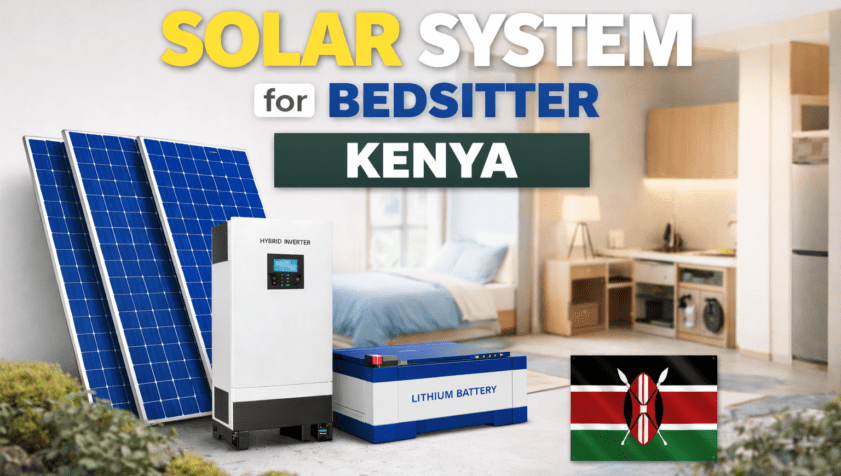
Solar System for Bedsitter in Kenya: The Complete Guide for Tenants & Landlords (2026)
You live in a bedsitter. You spend KSh 800-2,500 per month on electricity tokens. The power goes off 2-4 times a week — sometimes in the middle of cooking, sometimes while you’re charging your phone for tomorrow, sometimes at 2am when the fridge stops and your milk goes bad by morning.
You’ve thought about solar. But then the questions hit: Can I even install solar in a rental? Where do I put panels on a flat with no roof access? What happens when I move? Will my landlord allow it?
Good news — solar for bedsitters works. It’s different from house solar, but it works. And it can move with you.
Complete solar system for a bedsitter — 1kVA (essentials) to 2kVA (everything) fully installed
What’s in This Guide
What a Bedsitter Actually Uses · Tenant vs Landlord · Budget Tiers · Space Constraints · Portability · Token Bill Math · FAQ
What a Bedsitter Actually Uses: Honest Numbers
A bedsitter is typically one room — sleeping, sitting, cooking, everything in 12-20 m². Your appliance list is short but mighty:
| Appliance | Watts | Daily Hours | Daily Wh |
|---|---|---|---|
| LED lights (×3) | 30 | 6 | 180 |
| TV (32″ LED) | 50 | 5 | 250 |
| Decoder (DSTV/Startimes) | 25 | 5 | 125 |
| WiFi router | 12 | 24 | 288 |
| Phone charger (×2) | 20 | 3 | 60 |
| Laptop charger | 65 | 4 | 260 |
| Small fridge (bar fridge or 120L) | 80 | 24 (cycles) | 650 |
| Electric kettle (small, 1L) | 1,200 | 0.15 | 180 |
| Iron (once a week avg.) | 1,200 | 0.07 | 84 |
| Daily total | ~2,100 Wh (2.1 kWh) | ||
Tenant or Landlord? Your Solar Path is Different
| Factor | You’re a Tenant (Renting) | You’re the Landlord (Own the Building) |
|---|---|---|
| Panel placement | Need landlord permission for roof. Alternative: balcony, window ledge, or ground (if ground floor) | Full control — install on roof for all units or per unit |
| System type | Portable / plug-and-play (can disconnect and move) | Permanent installation (adds property value) |
| Panel count | 1-2 panels (limited space) | 2-4 panels per unit (roof array) |
| Budget | KSh 95,000-130,000 (1kVA) | KSh 95,000-185,000 per unit (1kVA or 2kVA) |
| When you leave | Take it with you — it’s your property | Stays with the building — charge higher rent |
| ROI | Save KSh 1,500-2,500/month on tokens | Charge KSh 2,000-3,000 more rent/unit + attract quality tenants |
Three Budget Tiers: Pick What Fits
KSh 95,000
| What you get | 2× 555W panels, 1kW hybrid inverter (WiFi), 1.2kWh lithium battery (12V 100Ah), mounting, accessories, installation |
| Daily generation | 2.7-3.3 kWh |
| Powers | Lights, TV, decoder, WiFi, phone charging, laptop, small fridge, kettle (during solar hours) |
| Overnight backup | 3-5 hours (lights + TV + WiFi + fridge + phone charging) |
| Best for | Single person or couple, basic appliances, no iron/microwave |
Tier 2 — “The Full Power” (2kVA)
KSh 185,000
| What you get | 4× 555W panels, 2kW hybrid inverter (WiFi), 2.56kWh lithium battery (24V 100Ah), mounting, accessories, installation |
| Daily generation | 5.5-6.6 kWh |
| Powers | Everything in Tier 1 + iron, microwave, larger fridge, hot plate — all simultaneously |
| Overnight backup | 6-8 hours (lights + TV + WiFi + fridge + phone charging) |
| Best for | Person who cooks at home, uses iron regularly, wants zero tokens, or plans to move to a 1-bedroom |
KSh 420,000 = KSh 42,000-52,500 per unit
| What you get | 8× 555W panels, 5kW hybrid inverter (WiFi), 5.12kWh lithium battery — powers entire building |
| Daily generation | 22-27 kWh (enough for 8-10 bedsitters) |
| ROI | Charge KSh 2,000-3,000 extra rent × 10 units = KSh 20,000-30,000/month. Pays for itself in 14-21 months. |
Space Constraints: Where Do Panels Go in a Bedsitter?
| Your Situation | Panel Placement | Works? |
|---|---|---|
| Ground floor with outdoor space | Ground mount on frame outside your door or on fence | ✅ Best option |
| Upper floor with flat roof (landlord allows) | Roof mount directly above your unit | ✅ Ideal |
| Upper floor with mabati roof (landlord allows) | Roof rails clamped to mabati ridges — no drilling | ✅ Good |
| You have a balcony or terrace | Lean panels against balcony railing at angle, or wall-mount | ⚠️ OK for 1-2 panels if sun-facing |
| No roof access, no balcony, no outdoor space | Window panel (small 100-200W) + indoor battery kit | ⚠️ Very limited — lights + phone only |
Moving Houses? Your Solar System Moves with You
This is the biggest concern for tenants — and the simplest to solve:
| Component | How to Move It | Reinstall Cost |
|---|---|---|
| Solar panels (1-2 units) | Unclamp from rails — 15 minutes. Transport flat on a pickup or matatu roof rack | KSh 5,000-10,000 (reinstall at new location) |
| Inverter + battery | Unplug, carry like a small suitcase (15-25 kg total) | |
| Mounting rails | Unbolt from roof — reuse at new place | |
| Cables | Disconnect MC4 connectors. May need new cable runs at new location |
The Token Bill Math: When Does Solar Pay for Itself?
| Your Monthly Token Spend | Annual Savings | 1kVA Payback | 2kVA Payback |
|---|---|---|---|
| KSh 800/month | KSh 9,600 | ~10 years | ~19 years |
| KSh 1,500/month | KSh 18,000 | ~5.3 years | ~10 years |
| KSh 2,000/month | KSh 24,000 | ~4 years | ~7.7 years |
| KSh 2,500/month | KSh 30,000 | ~3.2 years | ~6.2 years |
Frequently Asked Questions
Stop Buying Tokens. Start Owning Your Power.
Complete bedsitter solar systems from KSh 95,000. Portable. Takes it with you when you move.
* Prices are estimates based on current market rates. Actual consumption varies by individual. Contact us for a personalised quote.