
Six Months Without Power: A 6kVA Solar Installation in Kehancha, Migori County
The client at this site had been without electricity for six months before we arrived.
Six months is long enough to stop treating it as a temporary problem and start rearranging your life around it. Phones charged somewhere else. Nothing kept cold. Every evening activity finishing when the daylight does. By the time somebody has lived that way for half a year, they are no longer shopping for a discount. They are looking for something that will work and keep working.
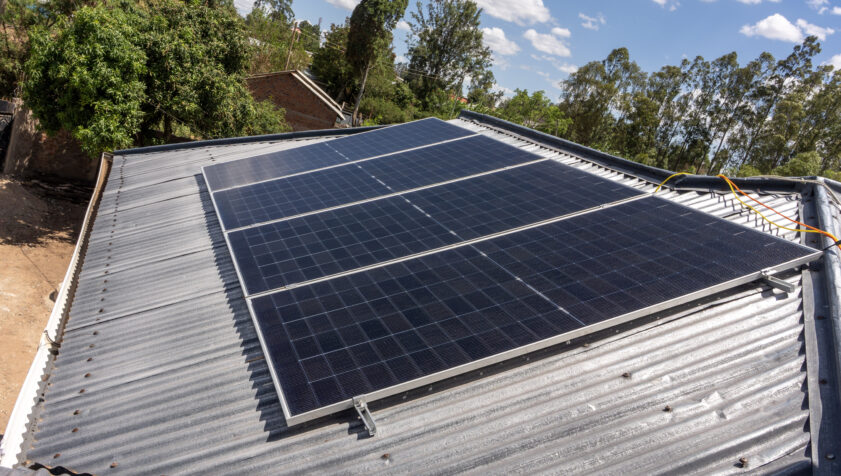
In late September 2026, Bicity Solar Energy Suppliers installed a 6kVA hybrid solar system at a home in Kehancha, Migori County. This post walks through the whole system, component by component, including the parts that never appear in photographs and never come up in a sales conversation.
We publish our installations in this level of detail for a specific reason. Most solar quotes in Kenya list panels, an inverter, and a battery, then stop. The remaining thirty or so items on the bill of materials are where the difference between a system that lasts a decade and a system that fails in its second rain season actually lives. A buyer comparing two quotes cannot see that difference unless somebody shows them. So here is everything.
The system at a glance
| Element | Specification |
|---|---|
| Location | Kehancha, Kuria West, Migori County |
| Site type | Residential, hybrid with battery backup |
| Solar array | 6 bifacial monocrystalline panels at 620W each, 3.72 kWp total |
| Array layout | Two rows of three, wired as one series string |
| Inverter | 6kVA hybrid, pure sine wave |
| Battery storage | 5.12 kWh lithium iron phosphate (LFP) |
| Roof type | Pitched |
| Earthing | Two earth rods with dedicated earthing conductor |
| Surge and lightning protection | Lightning arrestor plus surge protection device |
| Grid protection | Automatic voltage switcher rated 30A |
| Isolation | Three separate breakers across the DC and AC sides |
| Time on site | Two days |
| Installer | Bicity Solar Energy Suppliers, EPRA certified |
The array: six 620W bifacial panels, two rows of three
Six bifacial monocrystalline panels at 620 watts each gives a 3.72 kilowatt peak array. That is a large panel format, and the choice matters more than the headline number suggests.
- Fewer failure points. Fewer, larger panels means fewer roof penetrations, fewer clamps, fewer connectors, and fewer joints. Every connector in a solar array is a place where water can eventually get in and where resistance can slowly build. Reducing the count is a reliability decision, not only a cost one.
- Less roof area consumed. Reaching 3.72 kilowatts with smaller panels would have needed ten to twelve modules and considerably more roof, which matters on a pitched roof where only one face has the right orientation.
- Faster installation. Six modules go up in a fraction of the time twelve would take, which is part of why this system was commissioned in two days.
The panels went up in two rows of three on a pitched roof. You can read that layout straight off the mounting hardware: four end clamps and four mid clamps. A row of three panels needs two end clamps, one at each end, and two mid clamps, one at each junction between neighbouring panels. Two rows of that arrangement uses exactly four of each, which is what the bill of materials shows. Eight mini rails carry the rows, four to a row.
Electrically, though, the six panels are wired as a single series string rather than as two separate strings. That distinction matters and it is worth explaining, because the physical layout and the electrical layout are two different decisions and they do not have to match.
Wiring panels in series adds their voltages together while the current stays the same. Six panels of this class in one series string puts the array in the region of three hundred volts open circuit. Wiring them as two strings of three would have halved that, putting the array near the bottom of the voltage window that a hybrid inverter can track. Inverters have a minimum voltage at which they will start working at all, and an array that sits close to that threshold is slow to wake on overcast mornings and gives up early on dull afternoons.
The higher series voltage also means lower current for the same power, and lower current means less energy lost as heat in the cable run between the roof and the inverter. That is why the array runs on four millimetre cable rather than something heavier.
The pitched roof helps in a way that a flat roof does not. The slope gives the panels a natural tilt, so rain runs off and takes dust with it. Flat mounted panels collect a film of dust that rain alone will not clear, and on a site where nobody is going to climb up and wash them regularly, that film quietly costs a meaningful share of output over a dry season.
Panels at this wattage are monocrystalline as a matter of physics rather than preference. Reaching 620 watts in a standard module footprint needs cell efficiency of roughly twenty two percent. Polycrystalline cells top out several points below that, so a 620 watt polycrystalline module would have to be impractically large and is not made. Anyone offering you a 620 watt polycrystalline panel is describing something that does not exist.
What bifacial panels actually do on a pitched roof
A bifacial panel generates from both faces. The front does the main work. The rear picks up light that has bounced off whatever sits behind the panel. Marketing for these modules often quotes gains of twenty or thirty percent, and buyers should understand where that figure comes from before paying for it.
Rear side output depends on two things: how much light the surface behind the panel reflects, and how much air gap sits between the panel and that surface. Those big numbers come from elevated ground mounted arrays over pale gravel, concrete, or sand, where plenty of light reaches the back of the module. A roof mounted array sitting close on rails is a different situation. The gain is real but modest, usually a few percent, and it varies with how bright and how clean the roof surface underneath happens to be. A newer, lighter roof reflects more than an old darkened one.
So if a supplier tells you bifacial panels will add a third to your roof mounted output, that is not what will happen. We would rather say so than let a client work out the shortfall themselves after paying for it.
The reason bifacial still makes sense on this installation is construction rather than rear gain. Bifacial modules are normally built with glass on both faces instead of glass on the front and a polymer backsheet behind. That backsheet is the component that ages worst in equatorial conditions: continuous ultraviolet exposure and humidity make it brittle and eventually let moisture into the cells. Replacing it with a second sheet of glass removes that failure route entirely. Glass on both sides also resists the voltage stress that degrades cells over time, and these modules usually carry longer performance warranties with slower rated annual degradation. On a roof in Migori County, expected to sit untouched for twenty years or more, that durability is worth considerably more than a few percent of rear side yield.
Migori County sits in the Lake Victoria basin, which is one of the better parts of Kenya for solar irradiance. An array of this size in this region can be expected to produce in the region of thirteen to sixteen kilowatt hours on a clear day, with less during the long rains and more in the dry months. That is a working estimate based on regional sun hours and normal system losses, not a guarantee, and actual output at any site depends on shading, orientation, and how clean the panels are kept.
The inverter: why 6kVA for a 3.72 kilowatt array
A 6kVA inverter paired with a 3.72 kilowatt array looks mismatched to anyone comparing the two numbers directly. It is deliberate, and it is worth explaining because the same question comes up on almost every quote we issue.
The inverter is not sized to the array. It is sized to the load. The array decides how much energy the system harvests across a day. The inverter decides how much power the building can draw at any single moment. A property that runs a welding machine, a borehole pump, a large refrigeration unit, or several motors that may start at the same time needs inverter capacity to handle that instantaneous demand, regardless of how many panels sit on the roof.
There is a second reason, which is headroom. A 6kVA inverter running a 3.72 kilowatt array has substantial unused capacity on the solar input. That means the array can grow later without replacing the inverter, which is the most expensive way to expand a system. Adding panels to an existing installation is straightforward. Replacing an undersized inverter two years in means paying twice for the same component and redoing the wiring around it.
Hybrid, in this context, means the inverter manages three power sources at once: the solar array, the battery, and the national grid. It decides moment to moment whether to run the building from the panels, draw from the battery, or pull from the grid, and it charges the battery from whichever source makes sense. That is the function that keeps the lights on when the grid drops, and it is the reason a basic grid tied inverter would have been the wrong choice here.
Storage: a 5.12 kilowatt hour lithium battery
One lithium battery at 5.12 kilowatt hours handles the evening and overnight load. The panels carry the building through the day and charge the battery at the same time. When the sun goes and when the grid drops, the battery takes over.
Lithium iron phosphate is what we install for this application rather than lead acid, and the reasoning is straightforward. A lead acid bank should not be drained past roughly half its capacity if you want it to last, so half of what you paid for is not really available to you. Lithium iron phosphate runs comfortably much deeper, so far more of the rated capacity is genuinely usable. Cycle life is the larger difference again. Good lithium is rated for thousands of cycles across more than a decade, where lead acid under daily cycling in Kenyan conditions typically needs replacing every few years. Over the life of an installation, the cheaper battery is usually the more expensive decision.
Storage is also the easiest part of this system to expand. Batteries of this type parallel together, so a second unit can be added later if the evening load grows, without touching the array, the inverter, or the wiring that is already in place.
How the system fits together
Power flows through the installation in one direction, with protection at every transition.
| Solar array, 3.72 kWp 6 panels in one series string |
| 4mm² DC cable |
| ▼ |
| 12 way combiner box 32A string breaker, 63A DC isolator, surge protection |
| ▼ |
| 6kVA hybrid inverter grid input guarded by AVS 30A |
| ▼ |
| 5.12 kWh lithium battery |
| ▼ |
| Household distribution 63A AC isolator |
| Two earth rods bond the array frame and system earth throughout |
Protection and earthing: the part nobody photographs
This is the section we would ask any buyer comparing quotes to read twice, because this is where quotes differ most and where buyers can see the difference least.
The installation carries two earth rods with a dedicated twenty metre earthing conductor, a lightning arrestor, a surge protection device, an automatic voltage switcher rated at thirty amps, and three separate circuit breakers: a two pole sixty three amp breaker on the DC side, a two pole sixty three amp breaker on the AC side, and a single pole thirty two amp DC breaker.
Every one of those items can be left out. The system will switch on and run perfectly well without any of them, on the day of commissioning and for months afterwards. That is exactly why they get quietly dropped from cheaper quotes. The customer cannot tell, until the day it matters.
Why the earthing matters here in particular. Migori County lies in the Lake Victoria basin, a region with some of the most intense thunderstorm activity in Kenya. An array of solar panels is a large conductive surface mounted at the highest point of a building. Proper earthing gives surge energy a deliberate low resistance path into the ground rather than leaving it to find its own route through the inverter, the battery, and whatever else is connected. Two rods rather than one lowers the resistance of that path.
What the arrestor and surge protector actually do. They are not the same device and they are not interchangeable. The arrestor handles the large, fast energy of a nearby strike. The surge protection device handles the smaller voltage spikes that arrive far more often, including those that come down the grid connection rather than out of the sky. Most equipment damage comes from the second category, not the first.
What the automatic voltage switcher does. It watches the incoming grid supply and disconnects the system when the voltage drifts outside safe limits, reconnecting once it is stable again. In areas where the supply sags and spikes, this device does more day to day protective work than anything else on the list.
Why three breakers rather than one. Isolation points exist so the system can be worked on safely and so a fault in one section does not propagate through the rest. DC and AC require separate isolation because they are different circuits with different behaviour, and DC in particular does not break as cleanly as AC, which is why DC rated breakers are not optional and why an AC breaker must never be substituted on a DC circuit.
None of this hardware is expensive relative to the panels and the battery. Leaving it out saves a small fraction of the project cost and puts the entire investment at risk. We do not quote systems without it.
Mounting and roof work
Eight mini rails carry the two rows, fixed to the roof structure with six millimetre wall plugs and two inch screws. Panels are held by four end clamps and four mid clamps. The rails do the structural work, spreading the load of each panel across the roof structure rather than concentrating it at the fixing points.
Glass on both faces makes a bifacial module heavier than a conventional glass and backsheet panel of the same size. On a pitched roof that is a structural question, not a detail. The rails spread each panel’s load across the roof structure rather than concentrating it at the fixing points, and the fixings go into the structure itself rather than into sheeting. Both of those matter more with the heavier module.
Two details on this stage are worth naming because they cause most of the roof problems we are called out to fix on other people’s installations. The first is fixing into the roof structure itself rather than into sheeting alone. Sheeting will hold a panel in still air and will not hold it in the wind that arrives with a storm. The second is that every penetration must be sealed properly at the time it is made. A leak that starts above a ceiling is usually discovered long after the installer has gone, and by then the damage is to the building rather than to the solar system.
Cable management, conduit, and why it looks the way it does
The DC side runs on four millimetre solar cable, twenty metres of red and twenty metres of black, terminated with four pairs of MC4 connectors, two string ends into a twelve way combiner box. The AC side runs on six millimetre flexible cable. Earthing runs on six millimetre single core green. Everything is carried in twenty five millimetre conduit with couplers, four way circular boxes, saddle clips at regular intervals, two by one trunking on the surface runs, and cable ties throughout.
Conduit is not decoration. Solar cable carries direct current continuously for decades in full equatorial sun, and unprotected cable degrades: the insulation hardens, cracks, and eventually fails. Conduit takes the ultraviolet exposure instead. It also keeps rodents off the cable, which in rural and peri urban installations is a more common cause of failure than most people expect.
Colour discipline matters as much as protection. Red for positive, black for negative, green for earth, consistently, on every run. The next technician to open that system, possibly years from now and possibly not us, needs to read the installation correctly at a glance. A system that cannot be safely understood by the person maintaining it is a hazard regardless of how well it performs.
The complete bill of materials
Everything that went into this installation, in full.
| Component | Quantity | Function |
|---|---|---|
| Solar panels, 620W bifacial monocrystalline | 6 | Generation, 3.72 kWp total |
| Hybrid inverter, 6kVA | 1 | Manages solar, battery, and grid |
| Lithium battery, 5.12 kWh | 1 | Evening and outage storage |
| Combiner box, 12 way | 1 | Brings strings together, houses protection |
| PV cable, 4mm red | 20 m | DC positive runs |
| PV cable, 4mm black | 20 m | DC negative runs |
| MC4 connectors | 4 pairs | String terminations |
| Flexible cable, 6mm | 10 m | AC side |
| Single core green, 6.0mm | 20 m | Earthing conductor |
| DC breaker, 2 pole 63A | 1 | DC isolation |
| DC breaker, 1 pole 32A | 1 | String level isolation |
| AC breaker, 2 pole 63A | 1 | AC isolation |
| Surge protector | 1 | Voltage spike protection |
| Lightning arrestor | 1 | Strike energy diversion |
| Automatic voltage switcher, 30A | 1 | Grid over and under voltage protection |
| Earth rods | 2 | Ground path |
| Mini rails | 8 | Array support structure |
| End clamps | 4 | Secure row ends |
| Mid clamps | 4 | Secure panel junctions |
| Conduit, 25mm | 10 | Cable protection |
| Couplers | 12 | Conduit joints |
| Circular boxes, 4 way | 5 | Junction points |
| Trunking, 2 by 1 | 1 | Surface cable runs |
| Saddle clips, 25mm | 20 | Conduit fixing |
| Wall plugs, 6mm | 1 packet | Rail and equipment fixing |
| Screws, 2 inch | 1 packet | Rail and equipment fixing |
| Cable ties | 1 packet | Cable dressing |
| 3m | 3 | Supporting materials |
How this system grows
The installation was specified so that it can expand without anything being torn out. Three routes are open.
More panels. The inverter has solar input capacity well beyond the 3.72 kilowatts currently fitted, and the combiner box is twelve way, so additional strings can be brought in without replacing it. Additional rails and clamps extend the existing rows.
More storage. A second battery parallels with the first for roughly double the evening capacity. This is the usual first upgrade, because evening load tends to grow before daytime load does.
More load. Because the inverter was sized to load rather than to the current array, there is room to bring additional circuits onto the system without reaching its limit.
Specifying for expansion at the outset costs very little. Retrofitting expansion into a system that was specified tightly to the initial load usually means replacing the inverter, which is the component you least want to buy twice.
Two days on site
The whole installation took two days, and it is worth saying what that actually involves, because installation time is something clients ask about and rarely get a straight answer on.
Day one is the work that cannot be rushed and cannot be undone easily. Setting out the rail positions on a pitched roof so the two rows sit square and the fixings land in the roof structure rather than in sheeting alone. Driving the earth rods and running the earthing conductor. Getting the panels up, clamped, and wired into their series string. Every penetration sealed as it is made rather than at the end, because a leak found later is a building problem, not a solar problem.
Day two is the equipment and the finishing. Mounting the inverter and the battery, the combiner box, the breakers, the surge protection and the voltage switcher. Running conduit and trunking, dressing cables, then commissioning: checking string voltage and polarity before anything is energised, bringing the system up in sequence, confirming the inverter is reading the battery correctly, and testing what happens when grid power is removed.
Two days is a normal timeline for a system of this size when the materials are all on site and the roof is straightforward. It stretches when something has to be fetched, which is the main argument for a full bill of materials agreed before anyone travels. On a job several hours from the nearest supplier, one missing component costs a day.
What happened after commissioning
The measure of an installation is not whether it works on the day the team drives away. Anything works on that day. The measure is what the client does next.
In this case, the client referred us to somebody in their own circle, and we are scheduled to return to the area for a 2kVA installation at that second site. That is the outcome we work toward on every project, and it is worth being plain about why it matters more to us than any advertising we could buy.
A referral is somebody putting their own name behind you. It happens when a system performs the way it was described, when nothing needed to be revisited, and when the person paying feels they were told the truth about what they were buying. It does not happen because of a discount, and it does not happen because of a clever quote. It happens because the thing works and the person who sold it was straight with them.
The second job being a 2kVA system rather than another 6kVA is worth noting too. We size to the building, not to the last job we did. A smaller property with a lighter evening load does not need a 6kVA inverter, and selling one would be taking money for capacity that will never be used. The right system is the one matched to that site, and part of earning the referral in the first place is being willing to quote smaller when smaller is correct.
Working in Migori County
Bicity Solar Energy Suppliers installs across Kenya, and we travel for projects in the western counties regularly. Kehancha and the wider Kuria West area, Migori town, Rongo, Awendo, Uriri, and the surrounding settlements all sit within our service area, as do the neighbouring counties of Homa Bay, Kisii, and Narok.
Two things shape how we specify systems in this part of the country. The first is the thunderstorm activity described earlier, which is why our earthing and surge protection specification is not negotiable on projects here. The second is that grid supply in much of the region is present but intermittent, which makes hybrid systems with storage the right architecture for most sites rather than a luxury. A building that only needs daytime power can be served by a simpler system. A building that needs power in the evening and through outages needs the battery and the hybrid inverter, and there is no way around that.
Planning a solar installation in Migori County or anywhere else in Kenya? Comparing quotes and unsure why one is cheaper than another?
Send us the quotes. We will tell you what is on one and missing from the other, including the protection hardware that rarely appears on the cheaper document. To get a sense of the system size your building needs before you speak to anyone, start with the Solar Calculator, then send your requirements through My Quote for a full specification covering array, inverter, storage, protection, mounting, and cable management, itemised the way this project has been itemised above.