
20kVA Solar System Price in Kenya: The Industrial-Strength Investment That Pays for Itself
If you’re researching the 20kVA solar system price in Kenya, you’re no longer comparing solar quotes — you’re making a capital investment decision worth KSh 1.8-2.5 million. At this scale, a wrong decision wastes hundreds of thousands. A right decision saves your business KSh 10-25 million over 25 years.
The 20kVA system is Kenya’s workhorse for medium-to-large commercial operations. It’s where hotels stop paying generators, factories slash production costs, and supermarkets turn their biggest expense (electricity) into their biggest competitive advantage.
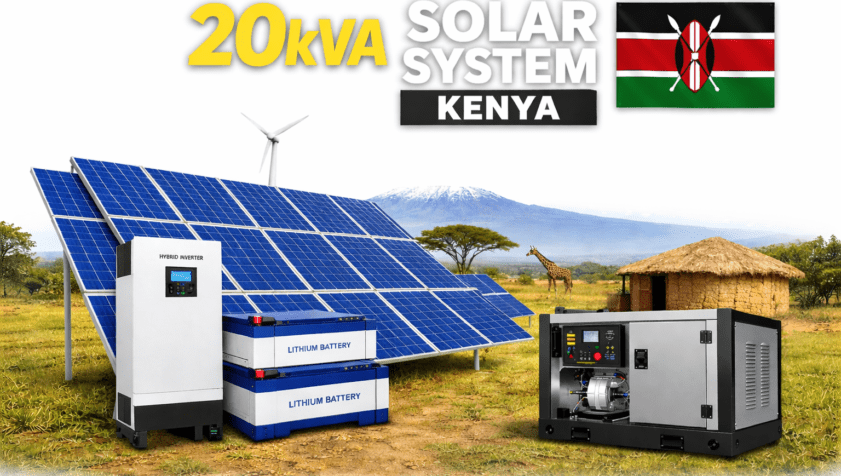
Complete 20kVA system: 24× 555W panels, 20kW hybrid inverter(s), 20.48kWh lithium battery, 3-phase integration, all accessories & professional installation
What’s in This Guide
Energy Audit: Do You Actually Need 20kVA? · Price Breakdown · Load Scheduling & Optimization · Diesel Generator vs Solar TCO · Insurance, Permits & Compliance · Phased Installation Strategy · EV Charging Readiness · FAQ
Energy Audit: Do You Actually Need 20kVA?
Before spending KSh 1.8M+, every buyer should answer one question: what is your actual peak demand? Oversizing wastes money. Undersizing causes blackouts. Here’s how to know if 20kVA is right:
| Method | How It Works | Accuracy |
|---|---|---|
| Electricity bill analysis | Divide your monthly kWh by 30 days. If daily usage is 50-90 kWh, 20kVA is your range. | Good (±15%) |
| Appliance load audit | List every appliance, its wattage, and hours of daily use. Sum the kWh. We provide a free spreadsheet. | Better (±10%) |
| Clamp meter reading | Our technician clamps a meter to your main feed for 24-48 hours and records actual consumption patterns. | Best (±3%) |
| Business Type | Typical Peak Demand | Typical Daily kWh | Right Size |
|---|---|---|---|
| Hotel (20-40 rooms) | 14-20kW | 60-100 kWh | 20kVA ✅ |
| Factory / workshop (light manufacturing) | 12-18kW | 55-85 kWh | 20kVA ✅ |
| Supermarket (large) | 15-20kW | 65-95 kWh | 20kVA ✅ |
| Warehouse + cold storage | 12-20kW | 70-110 kWh | 20kVA ✅ |
| Office complex (30-50 staff) | 13-19kW | 55-80 kWh | 20kVA ✅ |
| Shopping centre / mall unit | 15-20kW | 60-90 kWh | 20kVA ✅ |
| Apartment building (8-16 units) | 14-20kW | 65-100 kWh | 20kVA ✅ |
| Hospital / clinic (medium) | 15-20kW | 70-100 kWh | 20kVA ✅ |
20kVA System Price Breakdown
| Component | Specification | Price (KSh) |
|---|---|---|
| Solar Panels | 24× 555W Mono N-type (JA Solar / Jinko / Longi) — 13,320W total | 310,000 – 400,000 |
| Hybrid Inverter(s) | 20kW total — single 3-phase unit OR 4× 5kW parallel, dual MPPT per unit, WiFi | 240,000 – 340,000 |
| Lithium Battery | 48V 400Ah LiFePO4 (20.48kWh usable) — 6,000+ cycles, BMS, 10-year warranty | 260,000 – 340,000 |
| Mounting Structure | Commercial-grade galvanised steel / aluminium (24-panel array, roof, ground, or carport) | 55,000 – 80,000 |
| Electrical Protection | DC isolators, AC breakers, SPDs (class I + II), combiner box, ATS, earth leakage, DB modifications | 40,000 – 60,000 |
| Cabling & Trunking | 6mm², 10mm², 16mm², 25mm² PV cables, MC4 connectors, battery cables, conduit, cable trays | 28,000 – 45,000 |
| Installation & Commissioning | Certified team, 4-5 days, commissioning certificate, system training, documentation | 65,000 – 100,000 |
| Total (Fully Installed) | KSh 1,850,000 – 2,500,000 | |
Load Scheduling: How Smart Businesses Squeeze 30% More Value from 20kVA
Most commercial solar systems are installed and forgotten. Smart businesses configure time-of-use load scheduling to maximise the solar hours and minimise battery drain. Here’s how:
| Time Block | What Solar Is Doing | Smart Load Schedule |
|---|---|---|
| 6am – 9am Sunrise ramp-up | Panels producing 3-8kW. Battery still has overnight charge. | Run lights, computers, security. Avoid water heaters & heavy pumps. |
| 9am – 3pm ⚡ PEAK SOLAR | Panels at full 13kW+. More than enough for everything. | Run everything: water heaters, washing machines, welders, pumps, AC. Battery charges simultaneously. |
| 3pm – 6pm Afternoon decline | Panels producing 5-10kW. Battery should be 80-100% by now. | Reduce heavy loads. Complete battery charging before sunset. |
| 6pm – 6am Battery only | No solar. Battery powers essential loads. Grid as backup. | Essentials only: lights, fridges, security, TVs, WiFi. Timer off: water heaters, heavy machinery. |
Diesel Generator vs 20kVA Solar: The 10-Year Cost of Ownership
Most commercial properties running 20kVA generators don’t realise they’re burning through KSh 3-6 million every 5 years. Here’s the full breakdown:
| Cost Item | 20kVA Diesel Generator (10 Years) | 20kVA Solar System (10 Years) |
|---|---|---|
| Equipment purchase | KSh 450,000 – 800,000 (may need replacement at year 5-7) | KSh 1,850,000 – 2,500,000 (one-time) |
| Fuel (6 hrs/day × 25 days/month) | KSh 3,600,000 – 6,000,000 | KSh 0 |
| Servicing & oil changes | KSh 360,000 – 600,000 | KSh 50,000 – 80,000 (panel cleaning) |
| Repairs & replacement parts | KSh 200,000 – 500,000 | KSh 0 – 30,000 |
| Generator replacement (year 7-8) | KSh 450,000 – 800,000 | Not needed |
| Noise complaints / tenant turnover | Indirect cost: lost tenants, noise violations | Silent operation — zero complaints |
| 10-YEAR TOTAL | KSh 5,060,000 – 8,700,000 | KSh 1,900,000 – 2,610,000 |
| 10-YEAR SAVINGS WITH SOLAR | KSh 3,160,000 – 6,090,000 | |
Insurance, Permits & Compliance for Commercial Solar
At 20kVA, your solar system is a major asset that needs proper documentation. Here’s what commercial buyers should know:
| Requirement | Detail | Our Role |
|---|---|---|
| Insurance coverage | Add the system to your property insurance as a fixed asset. Covers theft, fire, storm damage. Premium increase is typically KSh 3,000-8,000/year. | We provide valuation certificate and serial numbers for your insurer |
| County permits | Most Kenyan counties do not require permits for rooftop solar under 50kW. Ground-mount may need a structural/planning permit in some areas. | We advise on local requirements and assist with applications |
| EPRA notification | For systems above 10kW connected to the grid, notification to the Energy and Petroleum Regulatory Authority may apply. | We handle all paperwork and compliance |
| Commissioning certificate | Essential for warranty claims, insurance, and asset registration. Documents system specs, test results, and safety compliance. | Included free with every installation |
| KRA asset documentation | For tax deductions: proper invoicing, delivery notes, and installation certificate needed. | We provide VAT-compliant invoices and asset documentation |
Phased Installation: Build 20kVA in 2 or 3 Stages
Don’t have KSh 1.85M upfront? Our parallel inverter architecture lets you install in phases without wasting a single shilling:
| Phase | What You Install | Output | Approximate Cost |
|---|---|---|---|
| Phase 1 Month 1 | 2× 5kW inverters + 12 panels + 10.24kWh battery + mounting + protection | 10kVA / 33-40 kWh daily | KSh 900,000 – 1,100,000 |
| Phase 2 Month 6-12 | Add 2× more 5kW inverters + 12 more panels + 2nd battery (10.24kWh) | 20kVA / 66-80 kWh daily | KSh 750,000 – 950,000 |
| Total | Full 20kVA system with 20.48kWh storage | KSh 1,650,000 – 2,050,000 | |
EV Charging Readiness: Future-Proof Your 20kVA System
Electric vehicles are coming to Kenya faster than most businesses realise. Hotels, offices, and shopping centres with solar-powered EV charging will have a significant competitive advantage:
| EV Charging Level | Power Draw | How 20kVA Handles It |
|---|---|---|
| Level 1 (trickle charge) | 2.3kW | Easily — barely noticeable on a 20kW system |
| Level 2 (standard AC charge) | 7.4kW | Schedule during peak solar hours (9am-3pm) for free EV charging |
| Level 2 (dual chargers) | 14.8kW | Two vehicles charging simultaneously during solar hours |
Frequently Asked Questions
Ready to Slash Your Commercial Energy Costs?
24 panels, 20kW inverter(s), 20.48kWh lithium battery, energy audit & professional installation.
* Prices are estimates based on current market rates. Final pricing depends on energy audit results. Tax deductions depend on business structure — consult your accountant. Contact us for a personalised commercial proposal.