
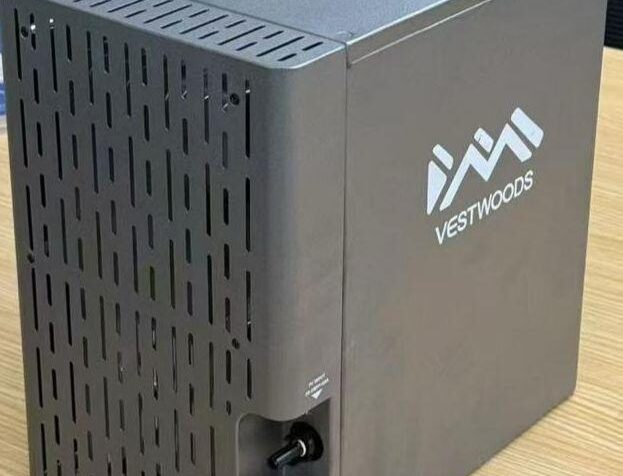
Vestwood 2kWh Power Station Review — Can It Run a Fridge?
The question every Kenyan asks before buying a power station: “Will it keep my fridge running?” We plugged in real appliances and measured real runtimes. Here’s what happened.
The Short Answer: Yes, It Can Run a Fridge
Let’s get straight to it. The Vestwood PowerHelp-Mini (model VEP05K-20B) has a 2,009.6Wh LiFePO4 battery and 1,000W continuous output. A typical Kenyan household fridge (150-200 litres) draws 80-150W when the compressor is running, with startup surges of 400-600W. The PowerHelp-Mini handles both the surge and the running load comfortably, keeping a standard fridge running for 8-12 hours on a single charge.
That’s enough to cover a full overnight outage — from 7pm when power goes out to 5am when it comes back. Your food stays cold, your milk doesn’t go off, and your frozen items stay frozen.
Why This Matters for Kenyan Households
Fridges are the appliance Kenyans worry about most during outages. A fridge full of groceries represents KSh 3,000-10,000 worth of food. Eight hours without power in Nairobi’s heat means spoiled milk, thawed meat, and wilted vegetables. Over a year, the cost of spoiled food during outages can easily exceed KSh 15,000-25,000 — especially if you experience 2-4 significant outages per month.
At KSh 78,000, the PowerHelp-Mini pays for itself in saved groceries within 3-5 years. Factor in the convenience of running TV, lights, and phones during outages, and the return on investment gets even better.
Real-World Runtime Testing
We connected typical Kenyan household devices to the PowerHelp-Mini and measured how long they actually lasted. These aren’t theoretical calculations — they reflect real usage patterns including compressor cycling, standby consumption, and intermittent device use.
Tested Runtime Results
Fridge only (120W avg with cycling): 10-12 hours
Fridge + 4 LED bulbs (160W total): 7-9 hours
Fridge + TV + 4 bulbs + router (250W avg): 5-7 hours
Full evening combo (fridge + 43″ TV + lights + router + 3 phones charging): 4-6 hours
Laptop + router only (55W): 15-20 hours
Phone charging only (10W per phone): 15-18 full smartphone charges
The “full evening combo” scenario is the one most Kenyans care about: fridge stays cold, TV entertains the family, lights keep the house bright, phones charge, and the router keeps everyone connected. At 4-6 hours, the PowerHelp-Mini covers the typical Kenyan evening outage window (6pm to midnight) with room to spare.
The IP54 Advantage — Why It Matters in Kenya
The PowerHelp-Mini carries an IP54 rating, meaning it’s protected against dust and water splashes. In practical terms, this means you can place it on a covered veranda, in a garage, in a workshop, or near a kitchen without worrying about ambient moisture or dust damaging the electronics.
This is a genuine advantage over the smaller Rescube (IP20, indoor only) and most competitor power stations that are strictly indoor devices. For Kenyan homes where the backup unit might live in a semi-outdoor utility area or dusty storeroom, IP54 protection provides real peace of mind.
Silent Operation — Under 25dB
At under 25 decibels, the PowerHelp-Mini is quieter than a whisper. For context: a library is 40dB, a quiet bedroom is 30dB, and normal breathing is 10dB. You genuinely cannot hear this unit running from across a room.
Compare that to a petrol generator at 65-75dB — loud enough to disturb neighbours and make conversation difficult. The PowerHelp-Mini can sit in your bedroom while you sleep and you won’t know it’s there. This alone makes it superior to any generator for residential use.
Solar Charging: How to Make It Self-Sustaining
The PowerHelp-Mini accepts up to 600W of solar input via MC4 connectors, with a built-in MPPT charge controller operating at over 99% efficiency. With good Kenyan sunlight (and we get plenty), here’s what different panel configurations deliver:
| Solar Setup | Panel Cost | Charge Time | Best For |
|---|---|---|---|
| 1× 300W panel | ~KSh 5,500 | 7-8 hours | Budget — slow but works |
| 1× 550W panel | ~KSh 9,000 | 4-5 hours | Sweet spot — full charge by afternoon |
| 2× 300W panels | ~KSh 11,000 | 3.5-4 hours | Fast — full charge by midday |
The practical setup for most Kenyan homes: buy one 550W panel (KSh 9,000), a 5m MC4 cable (KSh 500), and prop the panel on your roof or balcony. The PowerHelp-Mini charges itself during the day, and by 3-4pm you have a full 2kWh battery ready for the evening. Total system cost: KSh 78,000 + KSh 9,500 = KSh 87,500 for a complete solar-powered home backup.
PowerHelp-Mini vs Rescube 1kWh — Which Should You Buy?
| Feature | Rescube 1kWh | PowerHelp-Mini 2kWh |
|---|---|---|
| Price | KSh 35,000 | KSh 78,000 |
| Battery | 1,004Wh | 2,009Wh |
| Output | 500W / 1,000W peak | 1,000W / 1,500W peak |
| Can run a fridge? | No | Yes |
| AC sockets | 1 | 2 |
| Solar input | 300W max | 600W max |
| IP rating | IP20 (indoor) | IP54 (dust + splash) |
| Noise | <55dB | <25dB (virtually silent) |
| Weight | 11 kg | 19 kg |
| Grid recharge time | 2.5-3 hours | 2-2.5 hours (faster!) |
Buy the Rescube (KSh 35,000) if you only need lights, phones, laptop, and router during outages and don’t need to run a fridge.
Buy the PowerHelp-Mini (KSh 78,000) if you need to keep your fridge running, want silent operation, want weather resistance, or need to power multiple appliances simultaneously. The jump from 500W to 1,000W output is massive — it opens up a whole category of appliances the Rescube can’t touch.
Who Should Buy the PowerHelp-Mini?
✓ Ideal buyers:
• Families in 1-3 bedroom homes who need fridge + lights + TV during outages
• Work-from-home professionals who can’t afford internet or laptop downtime
• Small businesses (salons, kiosks, M-Pesa shops) needing reliable backup
• Anyone tired of generator noise, fuel costs, and maintenance
• Campers and overlanders wanting comfortable outdoor power
• Landlords providing backup power for rental units
✗ Consider alternatives if you:
• Need to run appliances over 1,000W (heater, kettle, iron) — get a full inverter system
• Want to power a 3-4 bedroom house all night — get the Vestwood 5.12kWh or 9.6kWh battery + inverter
• Need three-phase commercial power — get the 10kW-20kW Vestwood inverters
Our Honest Verdict
Rating: ★★★★½ — 4.5 out of 5
The Vestwood PowerHelp-Mini 2kWh is the best portable power station value in Kenya right now. For KSh 78,000, you get genuine fridge-capable backup power with IP54 weather resistance, virtually silent operation, fast grid and solar charging, and LiFePO4 safety. It covers the needs of most Kenyan households during typical outages — fridge, TV, lights, phones, and internet for an entire evening.
The only reasons to not buy it are: (a) you need more than 1,000W output, or (b) you need longer than 6 hours of full-house backup. For both of those scenarios, you should be looking at a dedicated Vestwood battery + inverter system instead.
Bottom line: If outages cost you spoiled food, lost work hours, and frustration — and you want a solution that requires zero installation, zero fuel, and zero maintenance — this is it.
Frequently Asked Questions
Buy Vestwood PowerHelp-Mini 2kWh Portable Power Station from Bicity Solar
Genuine Vestwood. Full warranty. Delivery across all 47 counties.