
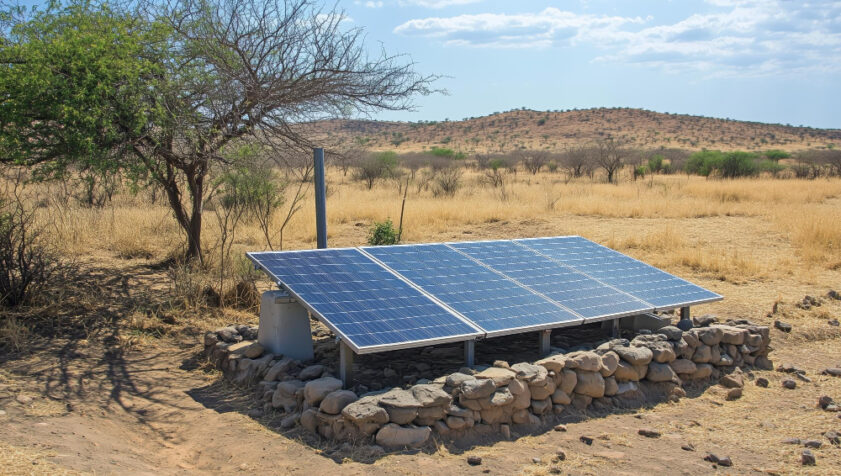
Walk into any solar shop from Eldoret to Malindi and ask for “a good 550W panel.” Nine times out of ten, the installer will quote you the Canadian Solar HiKu6. It’s the panel everyone has, everyone trusts, and everyone defaults to. But popularity doesn’t always mean it’s the right panel for your specific situation.
This review answers the question installers rarely volunteer: who should actually buy the 550W HiKu6, and who would be better off with something else? No marketing fluff, just honest analysis based on the panel’s real specifications and how it behaves under Kenyan conditions.
The Three Things That Make This Panel a Default Choice
Before getting into where the 550W HiKu6 falls short, let me explain why it’s earned its market position. There are three specific reasons installers keep coming back to it:
First, the supply chain is consistent. Canadian Solar has a permanent presence in East Africa and the panels are available in volume year-round. There’s no waiting six weeks for a container — your installer can usually source them within days. For commercial projects with deadlines, this matters more than a 1% efficiency advantage from some boutique brand.
Second, the spec sheet is rock solid. 21.5% module efficiency, -0.35%/°C temperature coefficient, 0.55% annual degradation, 25-year linear warranty. Nothing extraordinary, nothing alarming. Every number sits comfortably in the “modern Tier-1 P-type” range. There are no surprises in the field.
Third, system designers know it. The Voc of 49.6V and Imp of 13.20A are familiar values. String sizing is predictable. MPPT matching is straightforward. Engineers don’t need to redesign templates every time they specify it.
Output You Can Actually Expect in Kenya
STC ratings are measured at 25°C cell temperature. The reality on a Kenyan rooftop in March is closer to 50–60°C. Here’s what that means for the 550W in practice:
| Condition | Cell Temp | Power Loss vs STC | Real Output |
|---|---|---|---|
| Lab (STC) | 25°C | 0% | 550W |
| Cool morning, Nairobi | 30°C | -1.75% | 540W |
| Midday, Nairobi (Aug) | 45°C | -7% | 511W |
| Hot rooftop, Mombasa (Jan) | 60°C | -12.25% | 483W |
| Extreme, dark mabati | 65°C | -14% | 473W |
The annual energy yield in Nairobi works out to roughly 850–970 kWh per panel — meaning a 6-panel system on a typical home generates around 5,100–5,820 kWh per year. At today’s KPLC tariffs, that’s worth approximately KSh 117,000–134,000 every year in avoided electricity costs.
Who Should Buy the 550W HiKu6
This panel is the right choice for you if:
- You want a proven, low-risk specification. The HiKu6 has been in production for years. Field data is abundant. There are no surprises.
- You’re sizing a system between 2.5kW and 8kW. This is the sweet spot where the 550W’s combination of size, weight, and power output produces clean, simple string designs.
- You need parts availability for future expansion. Buying the most popular panel means you can add identical modules in 2–3 years without compatibility headaches.
- Your installer already has stock. Lead time matters. Same-week delivery on a familiar specification beats waiting for a “better” panel that’s two months away.
Who Should Look Elsewhere
Be honest about your situation. The 550W HiKu6 is not the right panel for everyone:
- If your roof gets exceptionally hot (mabati in Mombasa, Kisumu, Garissa, or Lodwar), the -0.35%/°C temperature coefficient will cost you noticeable energy in midday hours. Step up to the 580W TOPHiKu6 (N-type TOPCon, -0.29%/°C) for about 2% better hot-weather performance.
- If you have a small or oddly-shaped roof, the 2,278mm × 1,134mm footprint may not fit cleanly. The 450W or 410W HiKu6 use the same technology in a smaller frame.
- If you’re building for a 30-year horizon, consider the N-type TOPCon range. The 5 extra warranty years and slower degradation curve compound meaningfully over decades.
- If you have limited roof space and need maximum kW per square metre, the 670W HiKu7 (M12 cells, 21.6% efficiency) packs more power per panel.
String Design With the 550W in Kenya
This is where most DIY buyers go wrong. The Voc of 49.6V at STC rises to about 56V at the lowest expected cell temperatures (around 5°C in highland areas like Nyandarua or Limuru at dawn). On a 500V MPPT input, this means a maximum theoretical string of 8 panels — but practical sizing typically uses 6–7 panels per string to leave headroom.
If you’re using a Vestwood 6kW hybrid inverter with two MPPT inputs, the cleanest layout is two strings of 5 panels each (10 panels total, 5.5kW). For an 8kW Vestwood inverter, two strings of 7 (14 panels, 7.7kW) hits the sweet spot.
Long-Term Outlook
The HiKu6 platform is mature. That’s both a compliment and a warning. P-type Mono PERC has approximately reached its physics ceiling — efficiency improvements over the next 5 years will be incremental. Canadian Solar’s roadmap, like the rest of the industry, is shifting toward N-type TOPCon and HJT (heterojunction). The HiKu6 will remain in production and supported, but it represents the end of an era rather than the beginning of one.
For a system you plan to install in 2026 and run until 2051, the 550W HiKu6 is a solid, defensible choice. For a system you plan to expand significantly in 2028, consider whether starting with N-type now might give you better module compatibility down the line.
Verdict
The Canadian Solar 550W HiKu6 is the right panel for the largest single category of Kenyan solar buyers: people who want a proven, supported, mid-range Tier-1 module without overthinking it. It’s not the most efficient, not the most cutting-edge, and not the highest power. It’s the panel you specify when you want a system that just works for the next 25 years.
If that describes you, stop researching and buy six of them. If you have edge-case requirements — extreme heat, limited space, or a long-term commercial project — read the reviews of the 580W TOPHiKu6 or 670W HiKu7 before committing.
Order the Canadian Solar 550W HiKu6
Genuine modules, manufacturer warranty, delivery to all 47 counties.