
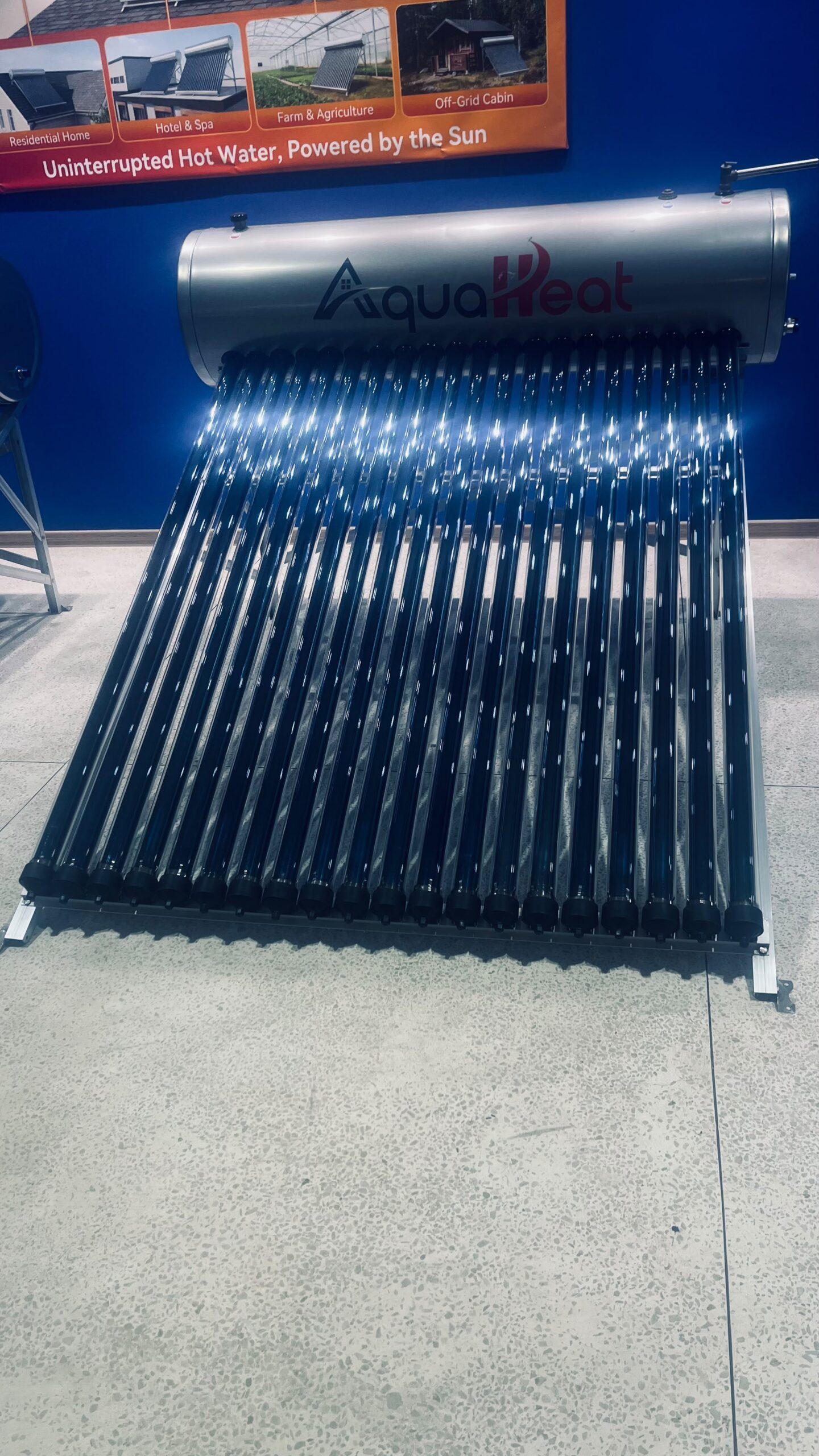
Description
A pressurized heat pipe solar water heater holds 200 litres and runs at mains pressure, which means showers behave normally rather than trickling from a gravity tank. What makes it different from the systems most commonly sold in Kenya is simpler than the name suggests, and it is worth understanding before you compare quotations.
Your water never goes into the glass tubes.
Each evacuated tube contains a sealed copper heat pipe with a small charge of fluid inside it. Sunlight boils that fluid, the vapour rises to a bulb at the top of the pipe, and that bulb sits in a dry socket in the manifold. Heat crosses into the water there. The fluid condenses, runs back down, and the cycle repeats. The tube itself stays dry inside.
Every practical advantage of this design follows from that one fact.
- The tubes are not holding pressure, so the tank can take mains pressure
- A cracked tube does not empty the system, because it was never full
- A tube can be replaced without draining the tank
- Scale cannot build up inside the tubes, only where water actually flows
- A cold night cannot freeze and burst water in a tube that holds none
Set that against the familiar low pressure system, where water fills every tube directly. Those need a header tank above them, deliver weak pressure, lose their whole contents when one tube cracks, and silt up inside each tube in hard water areas. They are cheaper, and in some situations that is the right trade. Section eleven sets the two side by side honestly.
200L Pressurized Heat Pipe Solar Water Heater: How It Works, Sizing and Kenyan Compliance
1. How The Heat Pipe Arrangement Works
Inside a single tube
- A double walled glass tube with a vacuum between the walls
- The vacuum stops heat escaping by conduction or convection
- A selective coating on the inner wall absorbs sunlight and resists radiating it back
- A sealed copper heat pipe runs up the centre of the tube
- A small fluid charge inside that pipe boils at low temperature
- Vapour carries the heat upward to a bulb at the tip
Where the heat crosses over
- Each bulb seats into a dry socket in the manifold at the top
- Water flows through the manifold, around the outside of those sockets
- Heat passes through the metal, while the water stays in the manifold
- Warmed water rises into the insulated tank behind the collector
- Cooler water from the bottom of the tank takes its place
- The cycle runs on its own whenever the sun is on the tubes
Because heat only ever travels one way along a heat pipe, the collector also stops drawing heat back out of the tank after sunset, which a direct flow collector can do on a cold clear night.
2. Technical Specifications
The figures below describe the standard configuration for a 200 litre pressurized heat pipe system. Rows marked typical vary between suppliers, so confirm them against the documentation for the unit you are quoted.
| Parameter | Value |
|---|---|
| Tank capacity | 200 litres |
| System type | Pressurized, indirect, heat pipe evacuated tube |
| Circulation | Thermosiphon, needing no pump on a standard roof install |
| Water path | Through the manifold only, never through the tubes |
| Collector tubes | 24, typical at this capacity |
| Tube dimensions | 58mm diameter by 1,800mm, typical |
| Tube construction | Double wall borosilicate glass, vacuum sealed, selective coating |
| Heat pipe | Copper, sealed, one per tube |
| Manifold | Copper, insulated |
| Gross collector area | About 2.5 square metres at 24 tubes |
| Inner tank | Stainless steel, grade and thickness per supplier |
| Outer shell | Coated steel or stainless, per supplier |
| Insulation | Polyurethane foam, typically 50 to 55mm |
| Working pressure | Typically 0.6 MPa, which is 6 bar |
| Electric backup | Immersion element, typically 1.5kW or 2kW |
| Corrosion protection | Magnesium anode rod, replaceable |
| Safety fittings | Pressure and temperature relief valve, non return valve |
| Mounting | Frame for pitched or flat roof, per supplier |
| Heat to raise a full tank 40 degrees | About 9.3 kWh |
| Suitable household | Three to four people in typical use |
3. Key Points
- Potable water passes through the manifold and never enters a tube
- Mains pressure operation, so no header tank and no weak showers
- One broken tube neither drains the system nor stops it working
- Individual tubes can be exchanged without emptying the tank
- Scale is kept out of the collector entirely in hard water areas
- Dry tubes cannot freeze and split on a cold highland night
- Heat travels one way, so the collector does not cool the tank overnight
- About 9.3 kilowatt hours of heat per full tank raised 40 degrees
- An electric element covers long cloudy spells and heavy evening use
- New building designs in Kenya must now provide for solar water heating
4. Hard Water, And Why This Design Suits Kenya
Water across much of Kenya carries a good deal of dissolved mineral, and borehole supply often carries a great deal. That is the single biggest cause of early failure in solar water heating here, and the collector type decides how badly it bites.
What happens in a direct flow system
- Water sits inside every glass tube and is heated there directly
- The hottest surfaces in the system are exactly where scale forms fastest
- Deposits build on the inside of each tube over months and years
- Scale insulates the glass from the water, so output quietly falls away
- There is no practical way to clean the inside of a sealed tube
- Performance declines steadily and the cause is invisible from outside
What happens here instead
- The tubes stay dry, so no deposit can form in them at all
- Water contacts only the manifold and the tank
- Those are serviceable, and the anode rod protects the tank
- Collector output does not fade as the water works on it
- Where supply is very hard, pretreatment protects the tank as well
If your supply is borehole, or if kettles and shower heads in the building scale up quickly, this difference matters more than any other item on the specification.
5. The Energy It Actually Replaces
Water heating is heavy work, and the arithmetic is worth seeing because it is usually underestimated.
Raising 200 litres by 40 degrees takes about 9.3 kilowatt hours of heat. A household drawing a full tank each day is therefore asking for roughly 279 kilowatt hours a month, or close to 3,400 a year.
| Volume heated | Temperature rise | Heat required |
|---|---|---|
| 150 litres | 40 degrees | About 7.0 kWh |
| 200 litres | 30 degrees | About 7.0 kWh |
| 200 litres | 40 degrees | About 9.3 kWh |
| 200 litres | 45 degrees | About 10.5 kWh |
| 300 litres | 40 degrees | About 14.0 kWh |
A well sited system in Kenya will typically carry most of that through the year, with the element covering the rest. At a solar contribution of between 60 and 80 percent, somewhere around 2,000 to 2,700 kilowatt hours a year stops coming from the meter.
Why a collector beats panels for this particular job
It is a fair question why you would not simply add solar panels and heat the water electrically, especially if you are installing panels anyway. The answer is roof area.
- Making 9.3 kilowatt hours a day from panels needs roughly 2.6 kilowatts peak
- That is about twelve square metres of panel on a Kenyan roof
- This collector does the same job in around two and a half square metres
- So the thermal route uses something like a fifth of the roof
- Turning sunlight into heat directly simply wastes less than converting it twice
Where a hybrid inverter can divert surplus generation into an immersion element, that is a sensible use of power you would otherwise export for little. It works best as a supplement to a collector rather than as a replacement for one, because the roof area required to carry the whole hot water load electrically is substantial.
6. Is 200 Litres The Right Size
| Household | Usual capacity | Notes |
|---|---|---|
| One or two people | 100 to 150 litres | Couple or small flat |
| Three or four people | 200 litres | The common family size |
| Five or six people | 250 to 300 litres | Larger household |
| Guest houses and small institutions | Multiple units or a centralised system | Different design rules apply |
Things that push you up a size
- Baths rather than showers, which use far more per person
- Everyone washing within the same hour of the morning
- A rain shower head or more than one bathroom in use at once
- Hot water taken to a kitchen and a laundry as well
- Visitors staying regularly
Things that let you stay smaller
- Showers spread across the day rather than bunched
- Efficient shower heads
- A household that is out most of the day
- Willingness to use the element occasionally on heavy days
Oversizing is not free, since a larger tank loses more heat overnight and costs more to install. Undersizing shows up as cold showers for whoever washes last.
7. What Kenyan Regulations Now Require
This area changed materially in July 2025 and a good deal of published advice still describes the previous position, so it is worth setting out plainly.
Where the law stands
- Rules made in 2012 required premises using over 100 litres of hot water daily to install solar water heating
- Parliament repealed those rules in 2018
- Several draft replacements followed and did not come into force
- The Energy (Solar Water Heating) Regulations 2025 were gazetted in July 2025 and are now in force
What the current rules require
- New premises must provide for solar water heating at the design stage, as part of design approval
- Anyone installing, testing, commissioning, maintaining or repairing a system must hold a valid EPRA licence
- Individual workers are licensed in classes covering standalone systems and centralised systems separately
- Companies manufacturing, importing, vending or contracting hold their own licence classes
- Contractors must work with licensed people and must carry valid insurance
- Licences run for a maximum of three years
- County governments take part in enforcement
What you should receive as the owner
- A system design declaration before work begins, assessing your hot water demand
- System specifications and an installation timeline within that declaration
- A workmanship warranty of at least one year
- Component warranties running up to five years
- A documentation pack on completion
- Evidence that whoever did the work holds the right licence class
The short version for a homeowner is that the paperwork is now part of the product. Ask for the licence and the design declaration before accepting a quotation, because an installation done outside this framework is a problem that surfaces later, at sale or at insurance.
This is a summary for buyers rather than legal advice. Where a project depends on compliance, confirm the current position with EPRA or your own adviser.
8. Installation And Roof Requirements
Weight, which is the one people miss
- Two hundred litres of water alone weighs 200 kilograms
- The tank, collector, frame and fittings add to that
- All of it lands on a small part of the roof structure
- Older timber roofs and long unsupported spans need checking
- Mounting should transfer load into rafters or purlins, never into sheeting
- On a flat roof the frame spreads load differently and needs its own assessment
Orientation and tilt
- Face the collector towards the equator, which means roughly north across most of Kenya
- South facing suits sites below the equator, and both work near it
- Keep some tilt even at low latitude, so circulation runs properly and dust sheds
- The tank must sit above the collector for thermosiphon flow
- Avoid shading from water tanks, parapets, aerials and trees as they grow
Plumbing and protection
- Pressure and temperature relief must be fitted and must discharge safely
- A non return valve prevents hot water migrating back into the cold supply
- Mixing at the outlet protects against scalding and stretches the stored volume
- Dead legs between tank and taps waste both water and heat, so keep runs short
- Insulate the hot run, since uninsulated pipe undoes a good deal of collection
- The element needs its own protected circuit and earthing
9. Care And Operations
- Rinse dust from the tubes during long dry spells, as film cuts output
- Have the anode rod inspected periodically and replaced when consumed
- Check the relief valve operates rather than assuming it will
- Watch for a drop in performance, which usually means scale or shading
- Keep vegetation from growing into the collector’s line of sight
- Use the element deliberately rather than leaving it on permanently
- Replace a damaged tube promptly, even though the system still runs
- Keep the handover documents, since warranty claims will ask for them
10. Do’s And Don’ts
Do
- Check your water hardness before choosing a collector type
- Confirm the roof structure can carry the filled weight
- Ask for the installer’s EPRA licence class in writing
- Insist on the design declaration before work starts
- Size against how your household actually bathes, not the floor plan
- Insulate the hot water run properly
- Keep the element as backup rather than as the main source
Don’t
- Assume a low pressure system will give acceptable shower pressure
- Fit a direct flow collector on hard borehole water
- Mount onto roof sheeting rather than into the structure beneath
- Site it where a tank or tree will shade it later in the day
- Leave the relief discharge pointing somewhere it can scald
- Accept an installation with no paperwork behind it
11. Pressurized Heat Pipe Or Low Pressure Direct Flow
Both are sold widely in Kenya and the cheaper one is not always the wrong one. The honest comparison is about water quality, water pressure and what happens when something breaks.
| Consideration | Low pressure direct flow | Pressurized heat pipe |
|---|---|---|
| Water inside the tubes | Yes | No |
| Operating pressure | Gravity from a header tank | Mains pressure |
| Shower performance | Depends on tank height | Normal mains behaviour |
| If one tube cracks | System drains and stops | Keeps running |
| Replacing a tube | Drain the system first | No draining needed |
| Hard water | Scale builds inside every tube | Scale confined to manifold and tank |
| Overnight heat loss through collector | Possible on cold clear nights | Heat travels one way only |
| Freezing risk in the tubes | Water can freeze and split them | Tubes hold no water |
| Installed cost | Lower | Higher |
| Best suited to | Soft water, gravity plumbing, tight budgets | Hard water, mains plumbing, long service life |
If the building is already plumbed for gravity, the water is soft and the budget is the binding constraint, a low pressure system is a reasonable buy. Where the supply is hard, where the plumbing is pressurised, or where the owner expects the system to still be working properly in ten years, the extra outlay here is usually recovered in output that does not fade and in tubes that can be changed without an emptying exercise.
12. Why Buy From Bicity Solar
- Water hardness considered before a collector type is recommended
- Roof structure checked for the filled weight, not just the footprint
- Sized against how your household actually uses hot water
- The current regulatory position explained, including what you should receive
- A design declaration provided before work begins, as the rules require
- Correct licence class confirmed for the type of system being installed
- Relief, non return and mixing valves fitted properly rather than skipped
- Hot runs insulated, because uninsulated pipe wastes what the roof collected
- Honest advice when a low pressure system would serve you just as well
- Honest advice when PV diversion is the better answer than a second collector
- Spare tubes and anode rods available later, not just at the point of sale
- Handover documentation kept on file in case you need it for a claim
- Delivered and installed countrywide, with servicing afterwards
Two questions settle whether this is the right system for you. How hard is your water, and is your plumbing on mains pressure or a gravity tank? Hard water and pressurised plumbing both point here. Soft water on a gravity system often does not, and we will say so.
Tell us your household size, how everyone bathes, whether your supply is mains or borehole, and what the roof is built from. We will size the tank, confirm the roof can carry it and set out what the current rules require you to be given. Work out your wider energy picture in the Solar Calculator, or send your site details through My Quote.