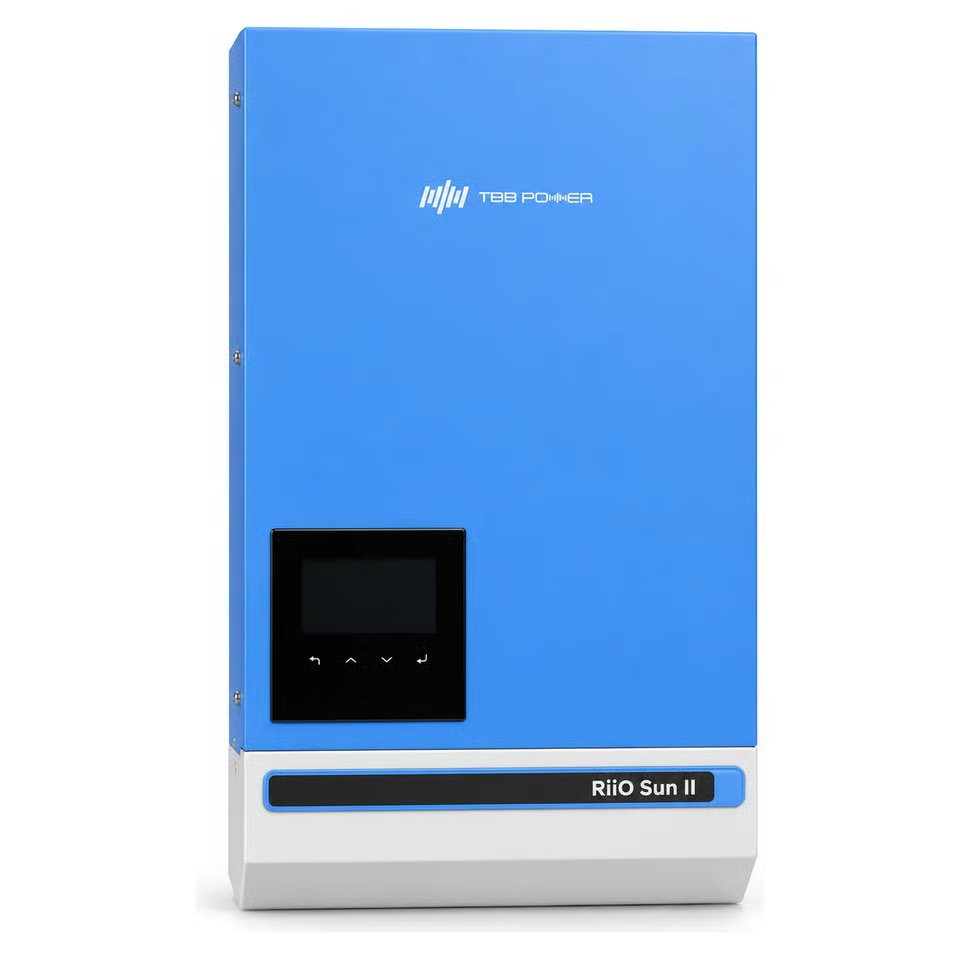
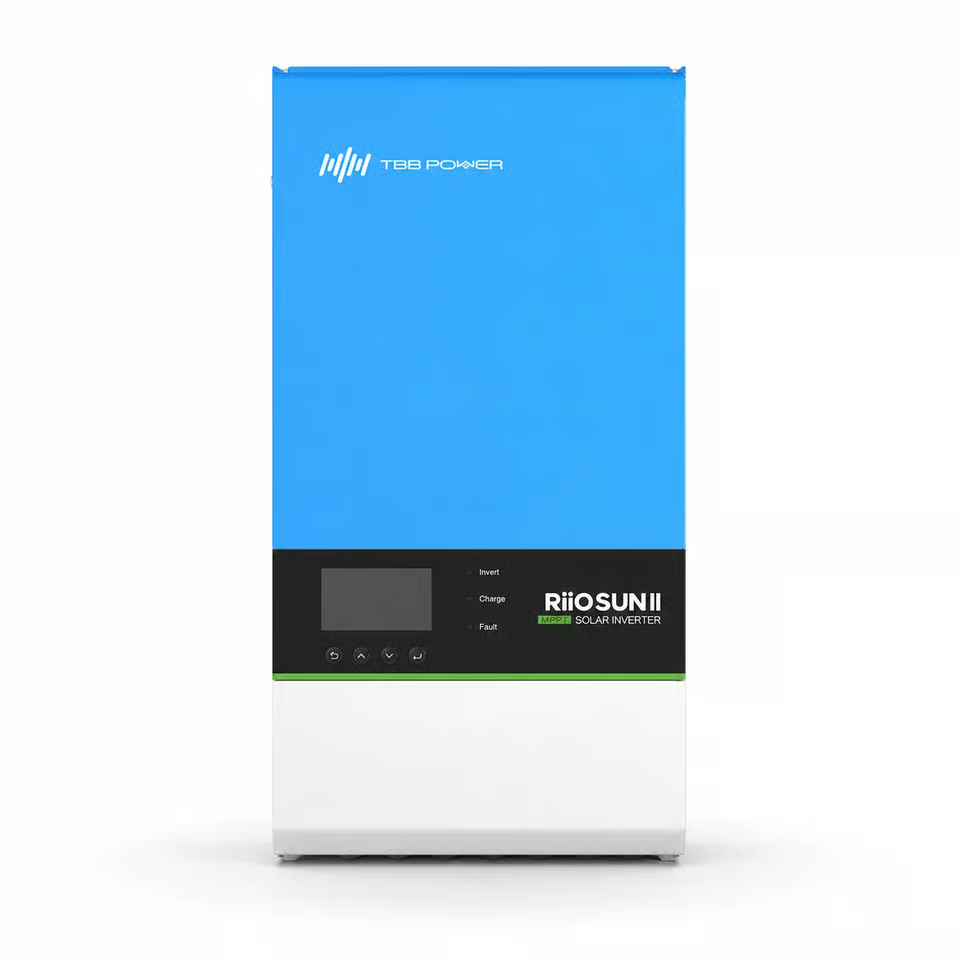
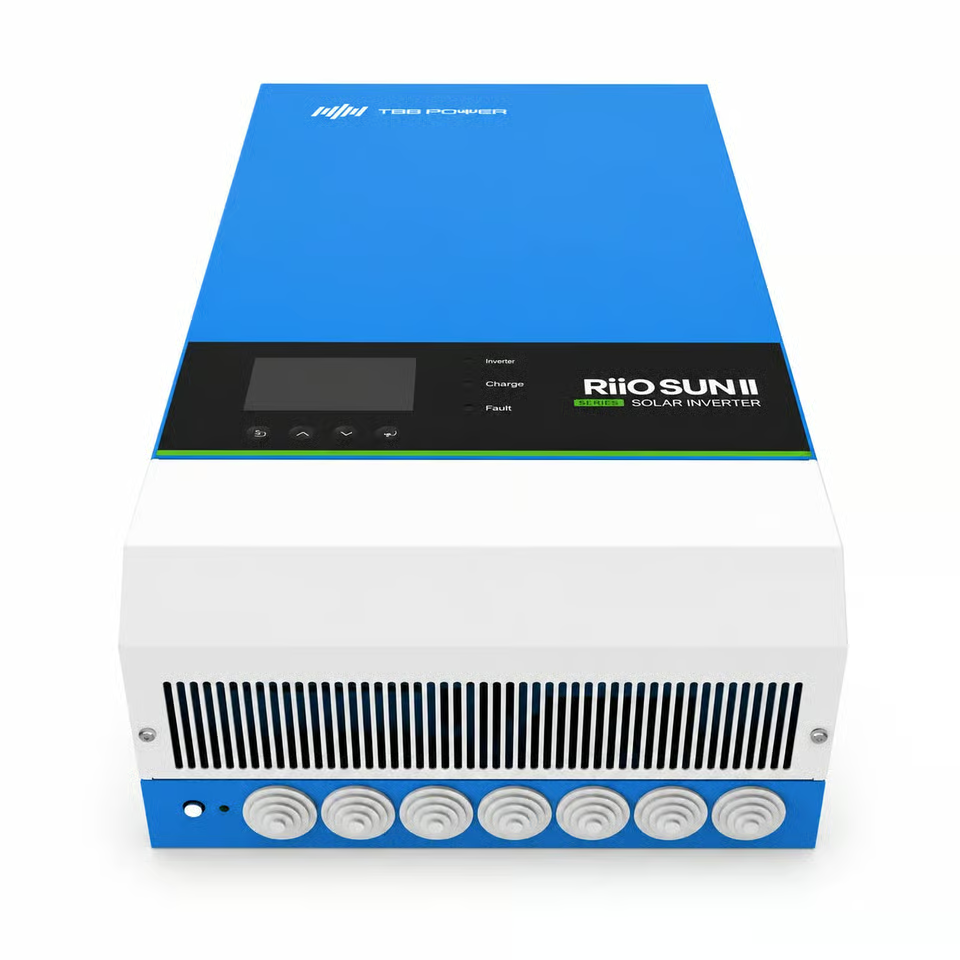
Description
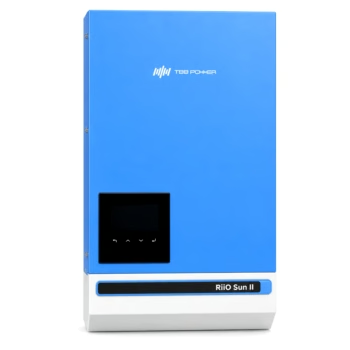
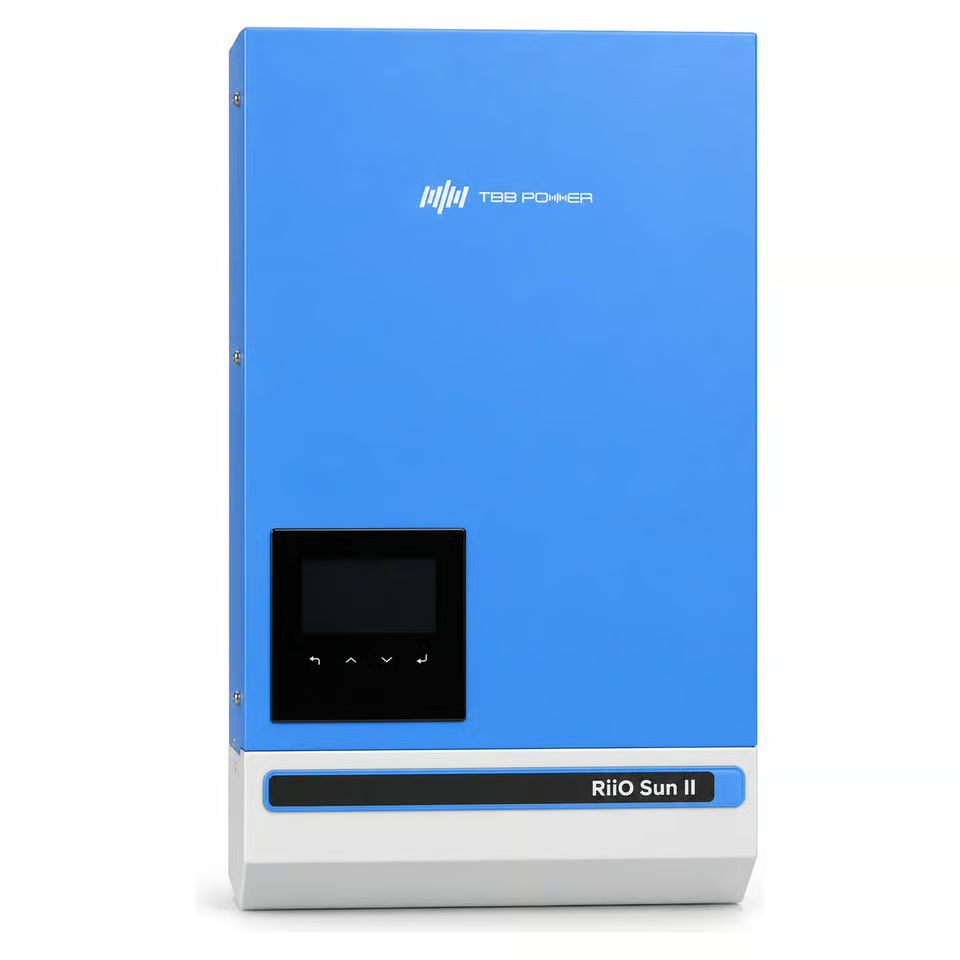
The TBB RiiO Sun II 3KVA-S delivers 3000 VA at 230 volts from a 48 volt battery, using a transformer based output stage. Inverter, 35 ampere mains charger and solar controller share one wall mounted case, and a wireless data logger comes in the box.
It is the better half of a pair. TBB build the same 3 kilovolt ampere inverter in a 24 volt version, and the two share a chassis, a weight, an output rating, a surge figure and an idle draw. Everything that differs follows from doubling the bus voltage, and all of it moves in your favour.
| At 3 kilovolt amperes | 24 volt version | This 48 volt version |
|---|---|---|
| Battery current, full load | About 137 A | About 67 A |
| Battery current on surge | About 275 A | About 134 A |
| Peak efficiency | 91 percent | 93 percent |
| Heat at full output | About 297 W | About 226 W |
| Array voltage ceiling | 150 V | 250 V |
| Solar into the battery | 2300 W | 3450 W |
| Allowable array | 3600 W | 5200 W |
Halving the current is the point. Thinner cable, smaller fuses, less heat at every joint, and a battery that is not being pushed near its limit to keep the lights on. A 48 volt lithium battery of 100 ampere hours supplying 67 amperes is working at about two thirds of its capacity per hour, which almost any unit manages comfortably. The same inverter on 24 volts asks for nearly one and a half times capacity, which most batteries will not sustain.
Unless you already own a 24 volt bank worth keeping, this is the version to buy.
TBB RiiO Sun II 3KVA-S: Battery Current, Array Limits and What Is Actually Fitted
1. What The Battery Will Be Asked For
With conversion running at 93 percent, the unit takes about 3,226 watts from the bank to put 3,000 into the load. Divide by whatever the bank happens to be sitting at and you have the current your cable, fuses and battery must handle.
| Bank voltage | State | At full output | During a 6kW surge |
|---|---|---|---|
| 57.6 V | Absorption, fully charged | About 56 A | About 112 A |
| 51.2 V | Lithium nominal | About 63 A | About 126 A |
| 48.0 V | Nominal | About 67 A | About 134 A |
| 42.0 V | At the cutoff | About 77 A | About 154 A |
Choosing a battery against those figures
- Read the continuous discharge rating in amperes, not only the stored energy
- Sixty seven amperes is a comfortable ask of almost any 48 volt lithium unit
- Check the peak rating covers 134 amperes for the length of a motor start
- Confirm the battery cutoff is not above the inverter’s 42 volt floor
- Lead acid banks should still be sized generously, as heavy draw costs capacity
- Paralleled units share the load and ease the requirement further
This is the quiet advantage of the higher bus voltage. On the 24 volt version the battery specification does a lot of work and often falls short. Here it rarely becomes the limiting factor at all.
2. Technical Specifications
| Parameter | Value |
|---|---|
| Model | RiiO Sun II 3KVA-S |
| Nominal battery voltage | 48 V, accepted range 42 to 68 V |
| Continuous output at 25C | 3000 VA and 3000 W |
| Peak power | 6000 W |
| Maximum efficiency | 93 percent |
| Zero load power | 17 W |
| Output waveform | Pure sine wave |
| AC output voltage | 220, 230 or 240 VAC, within 2 percent |
| AC output frequency | 50 or 60 Hz, within 0.1 percent |
| Harmonic distortion | Below 2 percent |
| AC input range | 175 to 265 VAC, 45 to 65 Hz |
| AC input current, transfer switch | 32 A |
| AC output current | 32 A |
| Transfer time | 4 ms, or under 15 ms in weak source mode |
| Maximum AC charge current | 35 A |
| Charge voltage, absorption and float | 57.6 V and 55.2 V |
| Battery types | Lithium, AGM, gel, OPzV, lead carbon, flooded, traction |
| Temperature compensation | Yes |
| Solar controller output current | 60 A |
| Maximum array open circuit voltage | 250 V |
| MPPT voltage range | 65 to 245 V |
| Number of trackers | 1 |
| Maximum array input current | 36 A |
| Maximum array short circuit current | 40 A |
| Maximum solar charge power | 3450 W at 57.6 V |
| Allowable array power | 5200 W |
| Controller conversion efficiency | 98 percent |
| MPPT tracking efficiency | Above 99.5 percent |
| Smart port | Not fitted on this model |
| Communication | RS485, with mobile data and wireless options |
| Local setup | Bluetooth, through the manufacturer’s application |
| Programmable relay | One, 30 VDC at 3 A or 250 VAC at 3 A |
| Operating temperature | minus 20C to 65C |
| Maximum altitude | 2,000 metres |
| Dimensions | 499 by 272 by 144 mm |
| Net weight | 18 kg |
| Cooling and protection | Forced fan, IP21 |
| Safety standards | EN-IEC 62477-1, 62109-1 and 62109-2 |
Supplied in the box
- The inverter and its wall mounting hardware
- The wireless data logger, stated as standard rather than optional
- An earthing terminal and fixings
- The user manual
The data logger matters when comparing offers, because remote monitoring is a priced accessory on a good many competing inverters and here it is part of the standard supply.
A note on the surge figure
Two surge numbers appear in the manufacturer’s literature. Peak power is given as 6000 watts, which against 3000 watts continuous is double. The same document also describes a 300 percent surge capability. No durations accompany either figure, so the two cannot be reconciled from what is published, and the likelihood is that they describe different timescales. Size your starting loads against the 6000 watt figure, since that is the one expressed in watts.
3. Key Points
- Three kilovolt amperes and three kilowatts are the same number here, so unity power factor
- About 67 amperes drawn from the bank at full output
- Ninety three percent peak conversion, against ninety one on the 24 volt model
- A 250 volt array ceiling, which leaves ordinary panel choices open
- A single tracker passing as much as 3450 watts to storage
- Thirty five amperes of mains or generator charging
- Four millisecond transfer, so sensitive equipment rides through outages
- Seventeen watts consumed while idle, with an economy mode available
- Wireless monitoring supplied rather than sold as an extra
- A 2,000 metre ceiling that a number of upcountry towns sit above
4. Sizing The Array
Two ceilings apply and they are more generous than on the 24 volt variant, which changes what you can build.
The voltage ceiling, and why it stops being a problem here
The array must stay below 250 volts open circuit, allowing for the lift that cold mornings give. That is a comfortable limit, and unlike the 150 volt restriction on the 24 volt model it does not force you towards particular panels.
| Panel | Typical open circuit | Panels in series | Strings within 36A | Array reached |
|---|---|---|---|---|
| 550 W | About 49.5 V | 4 | 2 | About 4,400 W |
| 450 W | About 41 V | 5 | 2 | About 4,500 W |
| 400 W | About 37.5 V | 6 | 2 | About 4,800 W |
Every one of those combinations lands inside the 65 to 245 volt tracking window and under the 36 ampere input limit. On the 24 volt version the large modules everyone is buying today become awkward, and the smaller panel builds the bigger array. That trap disappears here.
The power ceiling, which is where the thinking goes
- The controller puts at most 3450 watts into the battery
- The allowable array is 5200 watts, so oversizing is expected
- Around 4,400 watts gives a sensible ratio, clipping roughly a fifth at midday
- Taking it to 5,200 watts clips about a third at peak
- Clipped midday output buys earlier starts, later finishes and better cloudy yield
- The right amount of oversizing depends on when your demand actually falls
5. What This Model Does Not Have
Published feature lists for this range describe the whole family, and two items on them belong to the larger units only. It is better to know before ordering.
- No smart port. The 5, 6 and 8 kilovolt ampere units carry a programmable port rated at 50 amperes for generator input or controllable loads. This model does not have one.
- One tracker, not two. The larger units have dual trackers, so they can take arrays on two different roof planes. Here a single tracker means one orientation, or an accepted compromise between two.
- Generator starting needs confirming. Automatic generator start is listed as a family feature and this unit does have a programmable relay, which is the usual means of producing a start signal. Confirm the arrangement for this model before promising it to a customer.
None of these is a fault at this output. They are simply where the model sits in its range, and a buyer who needs two roof planes or a managed generator input should be looking at the 5 kilovolt ampere unit instead.
6. Charging, Generators And Power Assist
- Charging draws up to 35 amperes, around two kilowatts at the absorption voltage
- Input is accepted from 175 to 265 volts, which tolerates a sagging supply
- Anything between 45 and 65 hertz is accepted, which forgives a labouring genset
- Power assist adds battery power to a weak supply instead of tripping it
- That lets a smaller generator or a modest incoming breaker serve larger loads
- A weak source mode relaxes the transfer behaviour for rough generator output
- Charge current should be matched to the bank rather than left at maximum
Power assist is the feature that earns its keep on Kenyan sites with a limited supply. Rather than letting a surge trip the incoming breaker, the inverter contributes the difference from storage for as long as the surge lasts.
7. Choosing The Right Operating Mode
Where the unit draws power from is configurable, and leaving that setting at its factory value is one of the commonest reasons a system fails to deliver the savings its owner expected.
| Setting | Behaviour | Appropriate when |
|---|---|---|
| USB | Generation refills the bank before it serves the house, with mains assisting both. Shipped as the default. | Outages are frequent and a charged bank matters more than the bill |
| SUB | Generation serves the house first and banks only the surplus. Mains supports the load, and charges only once the bank falls low. | Most consumption happens while the sun is up |
| SBU | Stored and generated power take priority while the grid remains connected to cover any shortfall. | Cutting purchased units is the main objective |
| SB | Mains is left alone entirely until the bank runs low, the unit overheats or it is overloaded. | Running as independently as the storage permits |
| TC | Scheduled switching between the first and fourth behaviours by time of day. | Tariffs that vary by hour, or planned generator windows |
Note how close the first two names are and how different they behave. One fills the battery before anything else; the other sends daylight generation straight to whatever is running. A shop open through the day usually wants the second. A home that loses supply most evenings usually wants the first.
Scheduling cannot be configured from the front panel and needs the manufacturer’s software or its online platform. We set the behaviour to match how the building actually runs and note it in the handover file.
8. Growing The System, And What 72 Kilovolt Amperes Really Means
This range can be paralleled, and the headline figure quoted for it deserves unpacking because it does not describe this model.
- Up to three units combine in a single phase arrangement
- Up to nine units combine in a three phase arrangement
- A parallel module is required, and it replaces the lithium communication module
- The 72 kilovolt ampere figure quoted for the range assumes nine of the 8 kilovolt ampere units
- Nine of these 3 kilovolt ampere units come to 27 kilovolt amperes, not 72
| Unit used | Nine in three phase |
|---|---|
| 3 kVA, this model | 27 kVA |
| 5 kVA | 45 kVA |
| 6 kVA | 54 kVA |
| 8 kVA | 72 kVA |
If a specification table on a 3 kilovolt ampere product tells you it reaches 72 kilovolt amperes in parallel, it has borrowed a number from the top of the range. Plan growth against what nine of the unit you are actually buying will deliver, and remember that paralleling also means matching units and planning the communication arrangement from the outset.
9. Exporting To The Grid
- Grid feed-in is supported and can be limited by an external meter
- The manufacturer asks that local grid rules be confirmed before enabling it
- Running without a battery halves the permitted export against the solar rating
- Roughly 1,725 watts in the case of this particular unit
- The declared grid codes are European, Spanish and South African
- None of them is a Kenyan approval
Exporting in Kenya requires an arrangement with the distributor under the net metering framework rather than a setting on a screen, and exported energy is credited at fifty percent of the unit under those rules. For almost every installation we quote, consuming the generation on site is worth considerably more than sending it out.
10. Siting, Altitude And Ventilation
Position
- Indoors only, since IP21 resists dripping water and nothing more
- On a wall that will carry 18 kilograms securely
- Never inside a sealed enclosure that also holds the batteries
- Out of children’s reach, as the case and heat sink get hot
- Off flammable surfaces and clear of stored fuel
- With space around the fan and its outlet unobstructed
- Close to the bank, which keeps the heavy conductors short
Altitude, which affects several Kenyan towns
Maximum rated altitude is 2,000 metres. Thin air carries heat away less effectively, so equipment above its rated height is normally derated rather than prohibited.
- Nairobi, around 1,795 metres, sits under the limit
- Kericho sits right on the boundary, as does Kipkelion
- Eldoret, around 2,100 metres, is above
- Limuru, Nyahururu, Timau and Molo are higher still
- For sites above the limit, request the derating figure in writing
- Then plan the continuous load beneath the badge rating accordingly
11. The Transformer Trade
At 93 percent this converts a little more efficiently than its 24 volt sibling and rather less than a modern transformerless hybrid, which generally reaches the middle nineties. At full output it sheds about 226 watts as heat.
The transformer earns that back in other ways.
- Six kilowatts available for starting surges, twice the continuous rating
- Motors, pumps, compressors and power tools start without complaint
- The winding isolates your output from the DC side electrically
- A wide input window that copes with poor supply and generator output
- Physical robustness that lighter designs do not match
Where loads are light and constant, a high frequency inverter converts better and costs less. Where the day includes a borehole pump, a workshop or a large freezer cycling on and off, the surge headroom is the whole reason to choose this design.
12. Care And Operations
- Keep the fan path clean, since dust accumulation raises running temperature
- Go round the DC terminals with a torque wrench on handover, then revisit them
- Look for heat marks or discolouration around the battery lugs
- Programme the charge profile for the chemistry actually installed
- Hold charge current to what the bank is specified to accept
- Enable the economy mode where the connected equipment tolerates it
- Restart manually after three overload shutdowns in succession
- Keep the installation dry, as the enclosure is not weatherproof
- Save the settings and the handover file for whoever services it next
13. Why Buy From Bicity Solar
- Advised towards 48 volts rather than 24 wherever you have the choice
- We calculate the draw your loads create, then choose storage to match
- Storage specified that comfortably supplies what the inverter will draw
- Strings laid out against the real array ceiling and tracking window
- Oversizing and the clipping it brings explained in advance
- Told plainly that this model has one tracker and no smart port
- Parallel capacity quoted for the unit you are buying, not for the range
- Derating flagged for any site standing higher than the rated ceiling
- Operating mode configured around how the building actually runs
- Export discussed in terms of what Kenya actually permits
- The supplied data logger commissioned rather than left in its box
- Settings recorded and handed over with the installation
- EPRA licensed installation, with support across the country afterwards
If you are weighing this against the 24 volt version of the same inverter, the decision is usually simple. This one draws about half the battery current for identical output, converts two points better and accepts a far more flexible array. Choose the 24 volt model only if you already own a 24 volt bank worth keeping.
Tell us your heaviest loads, what motors start on the system, the battery you have or intend to buy, the panels you are being quoted and the altitude of the site. We will confirm the bank suits the draw, lay out the strings against the voltage ceiling and set the operating mode to match how you actually use power. Size the whole system in the Solar Calculator, or send your details through My Quote.