Description
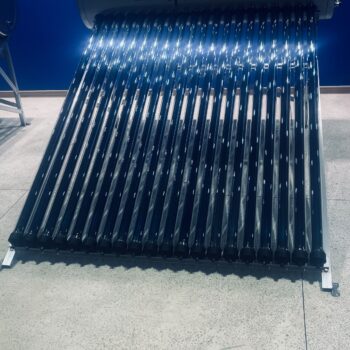
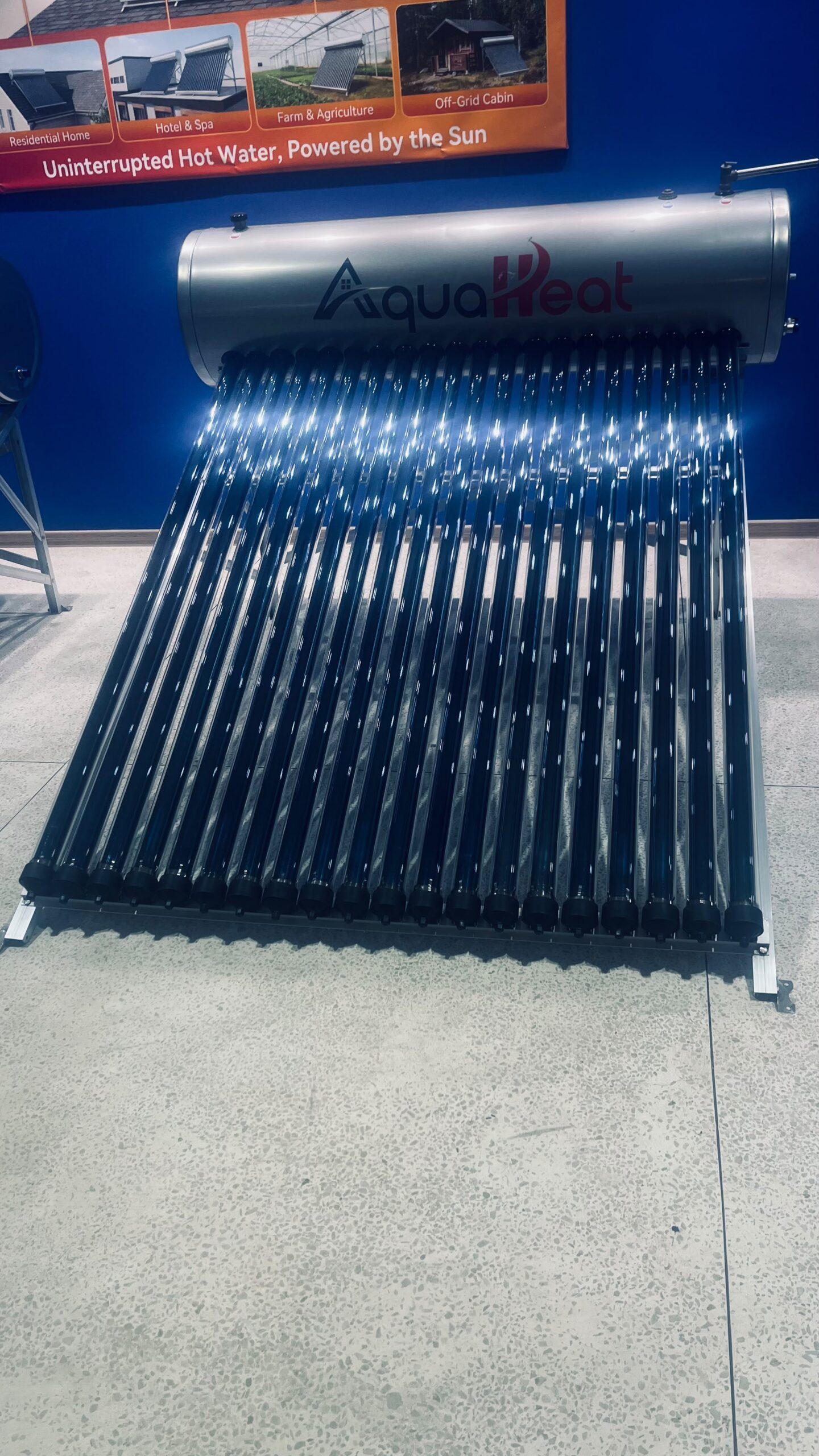
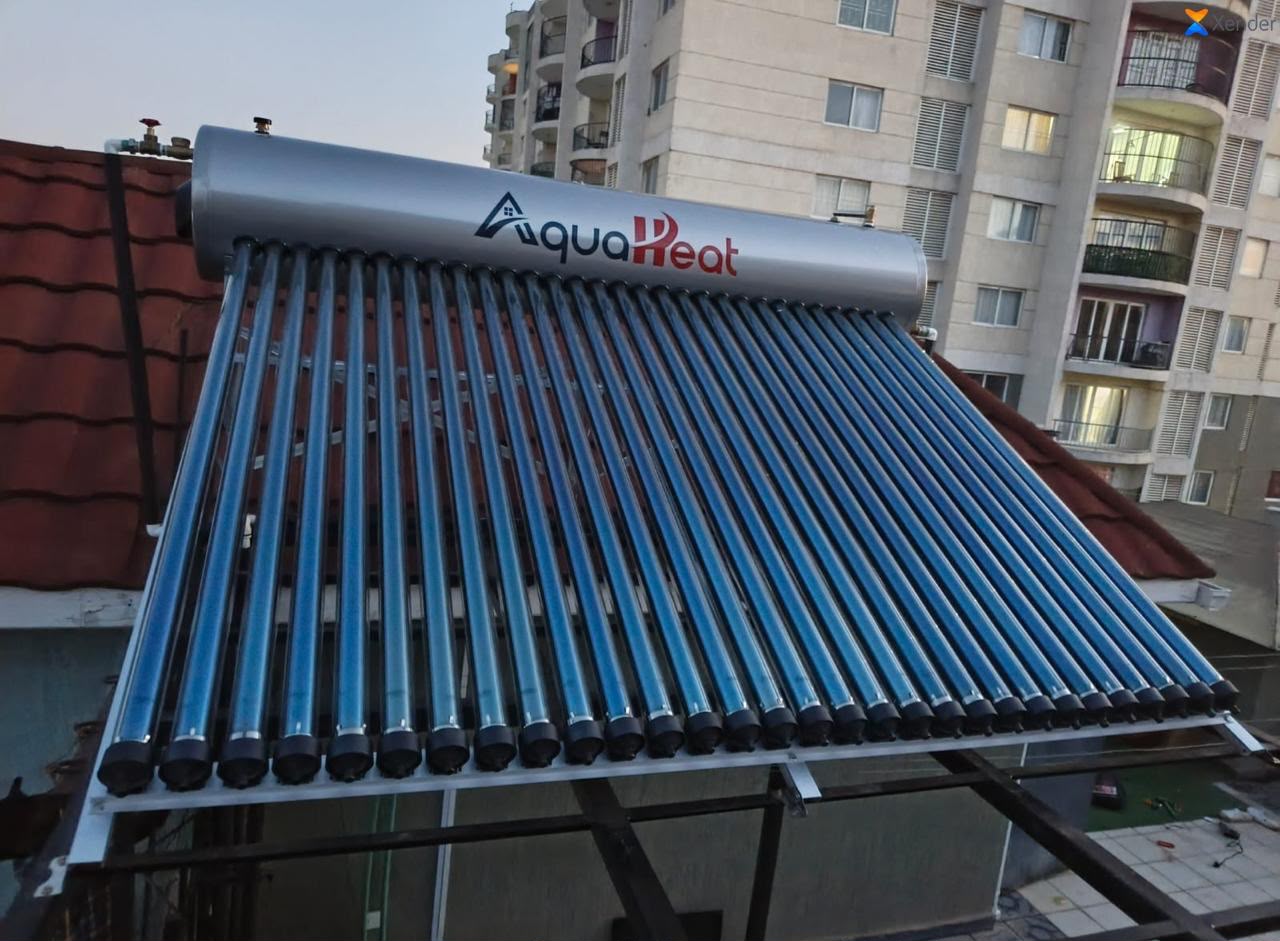
The Aquaheat AH-P-T300L is a 300 litre pressurized solar water heater using heat pipe evacuated tubes. It is the size most often specified for a large family, a guest house, a hostel wing or a small clinic, where several people need hot water within the same part of the day.
Start with the model code, because it matters more than it looks. Aquaheat build two different 300 litre pressurized systems and their codes differ by a single letter. The T in AH-P-T300L denotes the tube collector described on this page. There is also an AH-P-F300L, which is a flat plate collector of the same capacity and a genuinely different piece of equipment.
Order by capacity and brand alone and you can receive the wrong technology on a correct looking invoice. Order by the full model code.
- Both are Aquaheat, both are pressurized, both hold 300 litres
- The tube model collects through evacuated glass tubes with sealed copper pipes inside
- The flat plate model uses a glazed absorber panel instead
- They behave differently in hard water, in cold conditions and when damaged
- They are not interchangeable and should never share a product listing
On this tube model, the water you draw never travels inside the glass. Each tube contains a sealed copper heat pipe whose tip sits dry in the manifold, and heat crosses there into water flowing through the manifold alone. That arrangement is what allows mains pressure, keeps scale out of the collector entirely, and means a cracked tube neither empties the system nor stops it working.
Aquaheat AH-P-T300L: Model Code, Real Capacity and Roof Loading
1. Reading The Model Code
| Part of the code | Meaning |
|---|---|
| AH | Aquaheat, the brand |
| P | Pressurized, so it runs on mains supply rather than a gravity tank |
| T | Tube collector, meaning evacuated heat pipe tubes |
| 300L | Tank capacity in litres |
Why the letter matters when ordering
- An F in that position denotes a flat plate collector instead
- Flat plate panels carry water through the absorber itself
- Tube collectors keep the water in the manifold and out of the glass
- In hard water the difference shows up over years, not weeks
- A delivery note reading 300L Aquaheat pressurized does not tell you which arrived
- Check the full code on the carton and on the tank label at handover
2. Technical Specifications
The rows below describe the configuration consistently reported for this model. Where sellers disagree, which happens more than it should on this product, the row is marked and should be confirmed against your own supplier’s documentation.
| Parameter | Value |
|---|---|
| Model | AH-P-T300L |
| Tank capacity | 300 litres |
| System type | Pressurized, indirect, heat pipe evacuated tube |
| Circulation | Thermosiphon, with the tank mounted above the collector |
| Water path | Manifold only, never through the tubes |
| Tube dimensions | 58mm by 1800mm, three layer vacuum |
| Tube count | 30, typical, and worth confirming |
| Gross collector area | About 3.1 square metres at 30 tubes |
| Heat pipe | Copper, sealed, one per tube |
| Inner tank | SUS304 food grade stainless steel |
| Outer casing | Stainless or coated steel, varies by batch |
| Insulation | Polyurethane foam, typically 50 to 55mm |
| Working pressure | Typically 6 bar, and worth confirming |
| Mounting frame | Aluminium, offered flat or at 25 degrees |
| Controller | Intelligent controller supplied with the system |
| Electric backup | Immersion element included |
| Corrosion protection | Magnesium anode rod, replaceable |
| Safety fittings | Temperature and pressure valve, relief valve, vacuum safety valve |
| Pipe connections | Three quarter inch or one inch, by variant |
| Heat to warm a full tank 40 degrees | About 14 kilowatt hours |
| Water weight when full | 300 kilograms, before the equipment itself |
3. Key Points
- The T in the model code means tube collector, not flat plate
- Drawn water stays in the manifold and never enters the glass
- Scale therefore cannot build up inside the collector
- A broken tube leaves the system running and the tank full
- Mains pressure throughout, so no header tank is needed
- Around seven or eight showers between heating cycles in normal use
- Roughly 14 kilowatt hours of heat to warm a full tank by 40 degrees
- Over 400 kilograms on the roof once filled
- Electric element covers cloudy spells and unusually heavy days
- Sized for large households, guest houses, hostels and small clinics
4. How Many People It Actually Serves
Published guidance for 300 litre systems varies widely, with sellers claiming anything from five people to more than eight. All of those can be true, because they quietly assume different washing habits. Here is the arithmetic instead.
A tank at 60 degrees mixed with cold at 20 degrees to give a comfortable 40 degrees at the shower head means roughly half of what comes out is tank water. The rest is cold. So the question becomes how much mixed water each person uses.
| Washing habit | Mixed water used | Drawn from the tank | Draws per full tank |
|---|---|---|---|
| Brisk shower, 5 minutes, efficient head | 45 litres | About 23 litres | About 13 |
| Ordinary shower, 7 minutes | 63 litres | About 32 litres | About 8 |
| Long shower or a powerful head | 84 litres | About 42 litres | About 7 |
| A bath | 80 litres | About 40 litres | About 6 |
Those counts already allow for the fact that a tank cannot be drained to the last litre at full temperature, since incoming cold mixes in as hot water leaves.
So a realistic figure is seven or eight ordinary showers between heating cycles. Eight or more users is achievable where showers are short and the heads are efficient. Five or six is the honest number where the household takes baths. The claim is less important than the assumption behind it, and the assumption is what sellers leave out.
What pushes the real number down
- Everyone washing inside the same hour, before the sun has recovered the tank
- Rain shower heads, which can double the flow of an ordinary one
- Draw-off at sinks and washing machines on top of the bathroom demand
- Long pipe runs, where the first litres go cold down the drain
- Cloudy spells, when recovery depends on the element rather than the sun
5. What A Heat Retention Figure Actually Tells You
Solar water heaters are commonly advertised with a heat preservation time, and the numbers in circulation for 300 litre systems range from twelve hours to beyond seventy. That spread should make a buyer suspicious, because a retention figure means nothing on its own.
The missing part is how much the water is allowed to cool. A well insulated 300 litre tank sitting 40 degrees above the air around it loses heat steadily and predictably.
| Time standing unused | Heat lost | Temperature fall | Still usable? |
|---|---|---|---|
| 12 hours, overnight | Around 1 to 1.4 kWh | About 3 to 4 degrees | Yes, barely noticeable |
| 24 hours | Around 2 to 3 kWh | About 6 to 8 degrees | Yes, noticeably cooler |
| 72 hours | Around 6 to 9 kWh | About 17 to 25 degrees | Not really hot any more |
So a claim of twelve hours or better describes exactly what matters: water that is still properly hot the next morning. A claim stretching to three days is only true if you accept water some twenty degrees cooler than you put in, which most people would not call hot water at all.
The useful question to ask any supplier is not how many hours, but how many degrees are lost overnight. If nobody can answer that, the number on the brochure is decoration.
6. Roof Loading At 300 Litres
This is where a 300 litre system differs most from the smaller sizes, and it is the item most often skipped at survey.
- Three hundred litres of water weighs 300 kilograms on its own
- The tank, collector, frame and fittings bring the total past 400
- The tank sits high on the frame, so its weight bears on a few points
- Collector and frame spread their load more evenly across the roof
- The structure must be assessed as built, not assumed from its appearance
- Fixings must reach rafters or purlins, never relying on roof sheeting
- On a flat roof the frame needs its own base and load spreading
Older timber roofs, long unsupported spans and roofs already carrying a water tank all deserve a proper look before anything is ordered. A 300 litre system that cannot be mounted where the customer wants it is an expensive discovery to make on delivery day.
7. Hard Water And Why The Tube Model Suits Kenya
Mineral content is the quiet killer of solar water heating here, and it is the strongest technical argument for this collector type over a flat plate or a direct flow system.
- The glass tubes hold no water, so nothing can deposit inside them
- Only the manifold and the tank see your supply at all
- Each of those is reachable for servicing, with the sacrificial rod guarding the vessel
- Collector performance therefore does not quietly decline year by year
- On borehole supply, pretreatment protects the tank as well
- Scale in kettles and shower heads is the warning sign to look for
Where a collector carries water through the absorber, the hottest surfaces in the system are exactly where deposits form, and sealed collectors cannot be cleaned out afterwards. That is the practical difference between the two Aquaheat 300 litre models, beyond the one letter in the code.
8. The Energy It Replaces
Warming 300 litres by 40 degrees takes roughly 14 kilowatt hours of heat. A household drawing a full tank each day is asking for something near 419 units a month, or around 5,090 a year.
| Volume warmed | Temperature rise | Heat needed |
|---|---|---|
| 300 litres | 30 degrees | About 10.5 kWh |
| 300 litres | 40 degrees | About 14.0 kWh |
| 300 litres | 45 degrees | About 15.7 kWh |
| 200 litres | 40 degrees | About 9.3 kWh |
Kenya’s sunshine barely varies across the year, so a correctly oriented system carries most of that load month after month rather than collapsing in a winter. The element exists for the remainder, and the less it runs the better the system is performing.
9. Where 300 Litres Sits In The Regulations
Solar water heating in Kenya is governed by regulations that came into force in July 2025, and the detail that matters at this capacity concerns who is allowed to install it.
- Installation, testing, commissioning, repair and maintenance all require an EPRA licence
- Individual workers are licensed in separate classes
- One class covers standalone single unit systems
- A second class covers centralised systems in larger buildings
- A 300 litre unit can fall either side depending on what it serves
- A single large home is a different proposition from a hostel wing
- The installer’s class has to match the system actually being fitted
Alongside that, new premises must provide for solar water heating at design stage, and the owner is entitled to a system design declaration before work begins, a workmanship warranty and a documentation pack at completion. Our 200 litre page sets out the full picture for domestic buyers.
Treat the above as orientation for a purchaser, not as a legal opinion. Anyone whose project turns on compliance should put the question to EPRA directly, or to their own professional adviser.
10. Installation Notes
Position and orientation
- The collector faces towards the equator, which is broadly north across Kenya
- Some tilt is retained even at low latitude, for circulation and for shedding dust
- Circulation relies on the vessel being mounted higher than the collector
- We trace shadows through the day from any cistern, wall, mast or maturing tree nearby
- The frame option, flat or inclined, is chosen to suit the roof it lands on
Plumbing and safety
- Temperature and pressure relief must discharge somewhere safe
- A non return valve stops hot water migrating into the cold supply
- A blending valve both prevents scalds and makes the stored litres go further
- Pipe runs are kept short, because long runs waste water and heat together
- Hot pipework is insulated, or much of the day’s collection is lost on the way
- The element is given its own protected circuit and proper earthing
11. Care And Operations
- Rinse the glass when the dry season coats it, because a dusty film costs yield
- Have the anode rod checked periodically and renewed when it is consumed
- Operate the relief valve at service visits rather than assuming it works
- Investigate any fall in performance, which usually means shading or scale
- Keep branches and new structures out of the collector’s view of the sky
- Replace a cracked tube promptly, even though the system continues running
- Switch the element on deliberately rather than leaving it permanently live
- Retain the handover paperwork, since warranty claims will ask for it
12. Do’s And Don’ts
Do
- Order by the full model code, including the letter before the capacity
- Check the code on the carton and the tank label when it arrives
- Have the roof assessed for over 400 kilograms before ordering
- Size against how your household actually washes, not its headcount
- Ask what the overnight temperature drop is, not how many hours it holds
- Confirm the installer holds the licence class your system requires
- Insulate the hot pipework properly
Don’t
- Assume a 300 litre tank serves everybody regardless of how they bathe
- Accept a heat retention figure with no temperature drop attached
- Mount into roof sheeting instead of the structure beneath it
- Put a tube collector on a roof that will be shaded within a few years
- Leave the backup element running continuously through sunny weather
- Let a supplier substitute the flat plate model without telling you
13. Why Buy From Bicity Solar
- Supplied against the exact model code, with the collector type confirmed
- Capacity matched to how your household actually washes
- Roof structure assessed for the filled weight before anything is ordered
- Water hardness considered when the collector type is recommended
- Retention and performance claims explained rather than repeated
- Specifications confirmed against supplier documentation, not reseller copy
- The correct licence class confirmed for the system being installed
- The written design declaration handed to you ahead of any work starting
- Relief, non return and blending valves fitted rather than left out
- Hot runs insulated so the roof’s work is not lost in the pipe
- Honest advice when 200 litres would serve you perfectly well
- Spare tubes and anode rods available in later years, not only at purchase
- Installed and serviced countrywide under a current EPRA licence
Two things decide whether this is the right system for you. Does your household genuinely need more than eight showers between heating cycles, and will your roof carry over 400 kilograms where you want it mounted? If the answer to the first is no, 200 litres will serve you better and cost less to install.
Tell us how many people wash, whether they shower or bathe, roughly when they do it, what your roof is built from and whether your supply is mains or borehole. We will confirm the capacity, check the structure carries it and order against the exact model code so the right collector arrives. Our Solar Calculator covers the broader system, and My Quote is where to send the particulars of your building.