
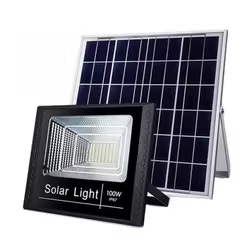
Description
A genuine 100 watt solar flood light produces somewhere near 13,000 lumens, which at a useful security level covers about 455 square metres, or a yard roughly 21 metres on a side. That is a serious piece of equipment and it looks nothing like the small sealed fittings sold under the same wattage.
It bears no relation to the small sealed fittings that carry the same wattage on their packaging. Those draw a couple of watts and light a doorway. This one draws a hundred and lights a yard, and the hardware behind it reflects that.
The lamp is only part of the specification. A 100 watt head draws 100 watts whenever it is lit, so the storage and generation behind it are set by how many hours of that output the installation calls for. Across the four patterns below the head never changes while the rest of the system varies nearly eightfold.
| How you run it | Energy per night | Panel to refill it |
|---|---|---|
| Full output, dusk to dawn, twelve hours | 1,200 watt hours | About 320 watts |
| Full for four hours, then a fifth output | 560 watt hours | About 149 watts |
| Full for two hours, then a tenth output | 300 watt hours | About 80 watts |
| Motion triggered, about an hour at full in total | 155 watt hours | About 41 watts |
Each of those is a 100 watt flood light. The head is identical in all four and only the battery and panel change, which is why two installations of the same lamp can look so different on paper.
What separates one installation from another is therefore the run time rather than the lamp: how many hours at full output, and what the light does for the remainder of the night.
Genuine 100W Solar Flood Light: Duty Cycle, Coverage And How To Specify It
1. Specify The Duty Cycle, Not The Wattage
Start by deciding what the light is for, because that determines the operating pattern, and the pattern determines everything else.
Dusk to dawn at full output
- Appropriate where an area must be continuously lit all night
- Loading yards, fuel stations, anywhere with activity through the night
- Needs around 1,200 watt hours of storage for a single night
- And roughly 320 watts of panel to put that back each day
- This is the most expensive way to run the light by a wide margin
Full output early, then dimmed
- Full brightness through the active evening, reduced output afterwards
- Suits a compound, a yard or a business closing in the evening
- Around 560 watt hours for four hours full and eight at a fifth output
- Roughly 149 watts of panel
- The best balance for most Kenyan sites and the pattern we usually recommend
Motion triggered
- Dim standby all night, full output only when something moves
- Excellent for security, since a light that changes draws attention
- Around 155 watt hours, assuming an hour at full across the night
- Roughly 41 watts of panel
- Cuts the battery requirement by around eight times against continuous running
- The sensor’s range and angle then matter as much as the lamp
Motion sensing is the single biggest lever on cost in this product category. If the job tolerates it, the saving on battery and panel is larger than any other decision you will make.
2. What Coverage You Actually Get
Lumens tell you how much light leaves the fitting. Where it lands depends on mounting height and beam angle, and the difference is dramatic.
| Mounting height | Beam | Area covered | Average light level | Suitable for |
|---|---|---|---|---|
| 4 metres | Narrow, 90 degrees | 50 square metres | About 180 lux | Work or loading area |
| 4 metres | Wide, 120 degrees | 151 square metres | About 60 lux | Work or loading area |
| 6 metres | Narrow | 113 square metres | About 81 lux | Work or loading area |
| 6 metres | Wide | 339 square metres | About 27 lux | Good security lighting |
| 8 metres | Narrow | 201 square metres | About 45 lux | Good security lighting |
| 8 metres | Wide | 603 square metres | About 15 lux | Yard and parking |
| 10 metres | Wide | 942 square metres | About 10 lux | Perimeter, minimum useful |
What those light levels mean
- Five to ten lux lights a perimeter or a path adequately
- Ten to twenty suits a yard, a parking area or general security
- Fifty to a hundred is what a loading bay or work area wants
- Two hundred and above is for detailed task work
The same fitting is therefore a work light at four metres and a thin perimeter wash at ten. Raising the pole spreads the light over four times the area and divides the level by four. Decide the light level you need first, then choose the height that delivers it.
3. Specification
The system is defined across the following. Each line affects how it behaves on site, and several of them depend on the duty cycle chosen in section one.
| Item | Specification |
|---|---|
| Light output | Around 13,000 lumens, measured |
| Power draw | 100 watts at full output |
| Duty cycle | Set per installation: hours at full, hours dimmed, dimmed level |
| Battery energy | 155 to 1,200 watt hours, by duty cycle |
| Battery chemistry | Lithium iron phosphate, which tolerates enclosure heat |
| Battery serviceability | Cells replaceable without discarding the fitting |
| Panel rating | 41 to 320 watts, sized to refill the battery daily |
| Panel mounting | Separate bracket, aimed independently of the head |
| Charge controller | MPPT, which recovers more than a simple regulator at this size |
| Beam angle | Typically 90 or 120 degrees, which decides coverage |
| Colour temperature | 5000K to 6500K, a cool white suited to security work |
| Ingress rating | IP65 or better for an exposed position |
| Motion sensor | Optional, with its own detection range and angle |
| Autonomy | One or two nights of storage, sized at design stage |
| Warranty | Covered separately for the battery and for the fitting |
The battery, panel and duty cycle move together. Changing any one of the three changes the other two, which is why they are specified as a set rather than individually.
4. Key Points
- Around 13,000 lumens from a genuine 100 watt head
- Covers roughly a 21 metre square yard at a useful security level
- The battery ranges from 155 to 1,200 watt hours by duty cycle alone
- The panel ranges correspondingly from about 41 to 320 watts
- Motion sensing cuts the storage requirement around eightfold
- The panel mounts separately and is aimed independently of the lamp
- Mounting height changes coverage and light level dramatically
- Lithium iron phosphate is the chemistry that survives a hot enclosure
- A replaceable battery decides whether you own this for three years or ten
- It can be bought sealed or built from four separate parts
5. One Sealed Unit, Or Four Parts
At this output an all in one solar flood light is really a small off grid power system inside a casing. That raises a fair question: why not build it from components you can service?
| Consideration | Sealed all in one | Built from components |
|---|---|---|
| Installation | Quick, one assembly | Longer, several mountings and cabling |
| Appearance | Tidy and self contained | More visible hardware |
| Initial cost | Usually lower | Usually higher |
| Battery replacement | Often impossible | Straightforward |
| Panel replacement | Usually whole unit | One panel |
| Adding autonomy later | Not possible | Add battery capacity |
| Aiming the panel properly | Limited | Fully adjustable |
| Life expectancy | As long as the sealed cell | Indefinite with part renewal |
The four parts, if you go that way
- A solar panel sized to the duty cycle, aimed for best yield
- An MPPT charge controller, which recovers noticeably more than a basic regulator
- A lithium iron phosphate battery in a ventilated enclosure
- A direct current flood head at the output and beam angle you need
Each is an ordinary stock item, each fails independently, and each can be replaced without discarding the others. For a permanent installation at a business or an institution that usually wins over ten years. For a quick, tidy fitting on a domestic compound, the sealed unit is the sensible buy.
6. Sizing To Your Actual Area
- Measure the area in metres rather than estimating it
- Decide the light level you need from the benchmarks in section two
- Multiply area by lux to get the lumens that must land on it
- Add roughly a third, since not all output reaches the target
- Divide by 13,000 to see how many heads the job takes
- Then check the mounting height available actually gives that spread
Two moderate heads frequently beat one large one, because light arriving from two directions fills the shadows that a single source leaves behind every obstacle. On a yard with vehicles, containers or machinery in it, that matters more than raw output.
7. Autonomy Through The Rains
- Kenyan sun is reliable, but the rains bring runs of heavily overcast days
- Storage matched precisely to a single night leaves you nothing in hand
- Double that and the typical run of grey days passes without trouble
- Motion sensing extends autonomy by the same factor it saves energy
- A dimmed standby between triggers does much the same
- Dust on the panel compounds the problem during dry spells beforehand
- Autonomy is sized in nights of storage and fixed at design stage
Where lighting matters for safety or security rather than convenience, two days of autonomy is the figure worth paying for. It roughly doubles the battery and it is the difference between a system that works all year and one that works most of it.
8. Installation
The pole and the head
- Mounting height is a design decision, not whatever is convenient
- A pole needs a foundation sized for wind load on the panel as well as the head
- Aim the head down at the area, not outward across it
- Light thrown horizontally becomes glare and trespasses onto neighbours
- Check the beam does not dazzle drivers on an adjacent road
- Leave access for servicing, because the battery will need attention one day
The panel and battery
- Aim the panel towards the equator at a tilt that sheds dust
- Keep it clear of the shadow the pole itself casts through the day
- Mount the battery enclosure where it stays as cool as the site allows
- Shade on the enclosure costs nothing and buys battery life
- Protect cable runs from rodents and from strimmers at ground level
- Earth the installation properly, particularly on an exposed mast
9. Battery Life, Which Sets The Real Cost
- The cell is the shortest lived part of the system by a wide margin
- Heat is what ages it, and an enclosure in Kenyan sun runs hot
- Iron phosphate chemistry tolerates that far better than ordinary lithium
- Shading the enclosure measurably extends service life
- Leave some charge in reserve, because emptying a cell nightly wears it out faster
- Oversizing the battery slightly means shallower cycles and longer life
- A serviceable battery is what separates a ten year installation from a three year one
10. Do’s And Don’ts
Do
- Settle the duty cycle first, because the battery and panel follow from it
- Treat lumens, battery watt hours and panel watts as one set of figures
- Use motion sensing wherever the application permits it
- Choose mounting height from the coverage you need
- Allow two nights of storage where the lighting is there for security
- Mount the panel on its own bracket so it can be aimed for yield
- Keep the battery serviceable, since it is the shortest lived part
Don’t
- Judge the system by its lamp wattage, which says nothing about run time
- Accept an integrated panel on a high output fitting
- Mount high and then wonder why the light seems thin
- Aim the head outward, which produces glare rather than illumination
- Let the pole shade its own panel in the afternoon
- Choose a sealed unit for an institution, where parts renewal matters most
11. Where A Smaller Fitting Does The Job
Not every outdoor lighting task needs this much output. Seeing a padlock, a keyhole or a step takes around 200 lumens, which is a sixty fifth of what this produces, and a small sealed unit with an integrated panel covers that at a fraction of the size and cost.
The dividing line falls at roughly 900 lumens. Below it the job is orientation, being able to find a lock or place a foot, and a compact fitting handles it. Above it the job is illumination, covering ground so that activity on it is visible, and that is where equipment of this class begins.
12. Why Buy From Bicity Solar
- The duty cycle written into the design rather than left open
- Lumens, battery watt hours and panel watts sized as one set
- Coverage calculated for your mounting height and your area
- Motion sensing proposed wherever it saves you real money
- Autonomy specified in days and written into the offer
- Told when two smaller heads will serve better than one large one
- Sealed and component builds both costed, so the choice is yours to make
- Iron phosphate cells, serviceable rather than sealed in
- Panels aimed properly rather than fixed facing the lamp
- Glare and light trespass considered, not just output
- Pole foundations sized for the wind load the panel adds
- Told plainly when a much smaller light is all you actually need
- Fitted anywhere in the country, with servicing to follow, under EPRA licence
The duty cycle decides this installation. A 100 watt head running all night carries eight times the battery of the same head running on motion, so the run time is settled before anything else is sized. Coverage then follows from mounting height, and autonomy from how many overcast nights the site has to survive.
Send the area in metres, the mounting height available, whether motion triggering suits the site and how many overcast nights it has to ride out. Back comes the lumens the area needs, the storage and panel that duty cycle requires, and the figure both as a sealed unit and as components. Size a wider system in the Solar Calculator, or send the details through My Quote.