Description
The Practical Sweet Spot in Solar Street Lighting
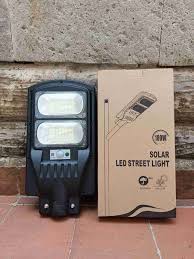
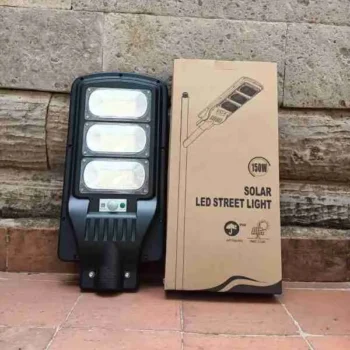
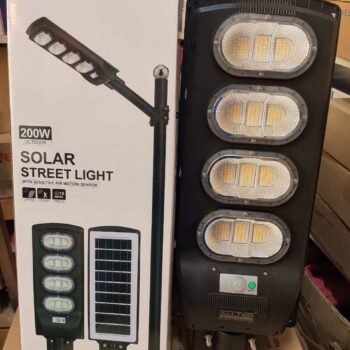
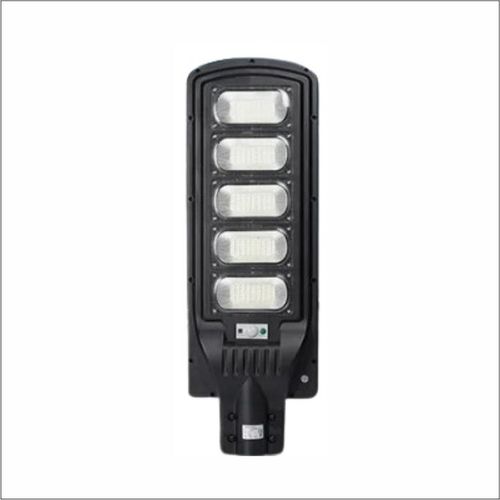
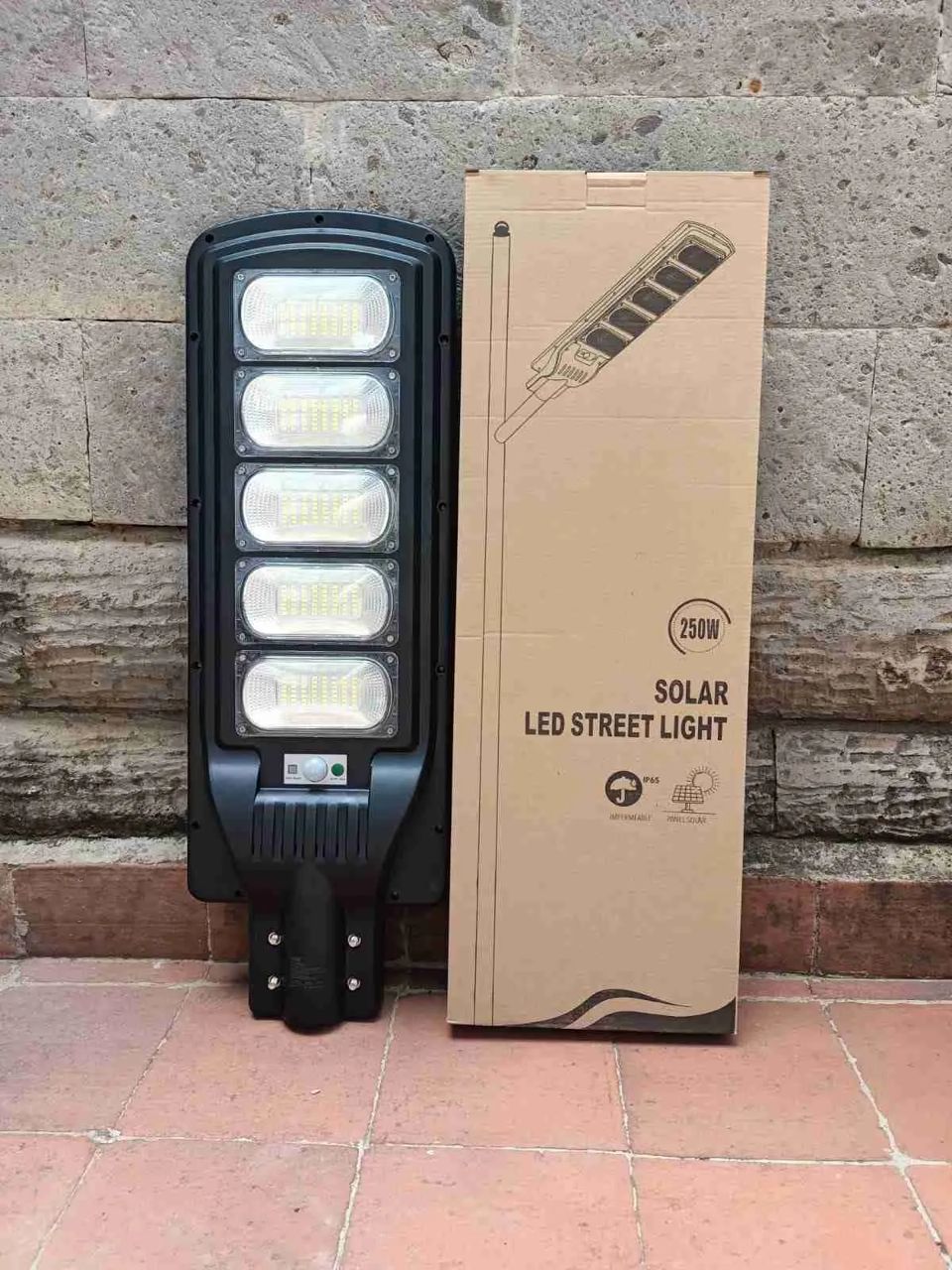
The Bicity Solar 250W Solar Street Light sits in the sweet spot of Kenya’s outdoor lighting market — meaningfully brighter than residential 200W units, more affordable than full-commercial 300W deployments, and correctly sized for the most common in-between properties our customers ask us about. If you’ve been browsing the smaller units and felt they’d struggle to cover your space, or browsing the bigger units and worried about overspending on excess capacity, the 250W is engineered exactly for your situation.
This unit covers approximately 165–200 square metres of usable nighttime brightness — the right scale for a large residential compound with mature grounds, a church courtyard hosting evening services, a primary school’s pupil-drop-off area, a guesthouse driveway with parking for 4–6 vehicles, or an NGO compound that needs perimeter lighting without the cost overhead of a commercial 300W roll-out. We built this product around what mid-budget customers have been asking us for: a properly-specified LiFePO4 unit that’s brighter than the basics but not commercial-overkill.
Technical Specifications
| Specification | Detail |
|---|---|
| Product Type | Integrated all-in-one solar street light, mid-range |
| Rated Wattage | 250W system rating |
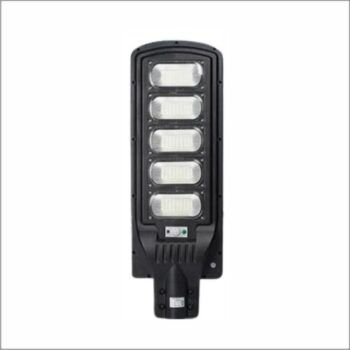
| LED Configuration | 5 high-output LED pods, ~120 SMD chips total |
| Luminous Flux | 25,000+ lumens at full brightness |
| Colour Temperature | 6000K cool white daylight |
| Luminous Efficiency | 160 lm/W |
| Solar Panel | 28W monocrystalline, 15V |
| Panel Adjustment | 180° tilt |
| Battery | LiFePO4 lithium iron phosphate, 3.2V 36Ah |
| Battery Cycle Life | 2,000+ deep cycles (5+ years typical service) |
| Charging Time | 6–8 hours full sunlight |
| Working Time (Full Charge) | Up to 13 hours (lab spec) / 10–12 hours (real-world Kenyan conditions) |
| Motion Sensor | PIR, 9m radius, 180° detection arc |
| Ambient Light Sensor | Photocell — auto dusk-to-dawn activation |
| Operating Modes | 4 modes — auto dusk/dawn, motion sensor, timer, manual |
| Remote Control | Included |
| Ingress Protection | IP66 — dust-tight and rain-resistant |
| Housing Material | Aluminium alloy with PMMA optical lens |
| Operating Temperature | -20°C to +60°C |
| Installation Height | 5–8 metres recommended |
| Pole Diameter Compatibility | 60–80mm (also wall-mountable) |
| Net Weight | Approximately 5.3 kg |
| Product Dimensions | Approximately 720 × 270 × 80 mm |
| Warranty | 2 years |
Where the 250W Fits Better Than Either Alternative
There’s a specific customer profile that walks away unsatisfied from both the 200W and the 300W options, and we built this unit specifically for them. Three situations where 250W is the right answer rather than a compromise:
Situation 1: Your compound exceeds 150 square metres but isn’t commercial
A typical Kenyan urban compound with the house, a paved drive, garden, and parking for 2–3 vehicles often measures 180–220 square metres. The 200W unit would light it adequately but with weak spots at the perimeter. The 300W unit would light it brilliantly but waste 30% of its output on the neighbour’s wall. The 250W matches the coverage area precisely.
Situation 2: Church or school courtyards
Church compounds typically have a main church building plus a fellowship hall, choir room, pastor’s office, and parking area for 8–15 cars. Total ground area is 200–280 square metres. School courtyards (primary school assembly grounds with surrounding classrooms) hit similar dimensions. One 250W unit at the centre or two at corners handles either layout. Going bigger doesn’t add useful light; going smaller leaves dim corners during evening activities.
Situation 3: Mid-size businesses and guesthouses
A small hotel driveway, a clinic forecourt, a mid-tier salon with frontage parking, or a guesthouse with 4–6 parking bays all fit the 250W coverage envelope cleanly. These are properties where appearance matters (the lighting is part of the customer-facing first impression) but commercial-scale installation budgets aren’t justified.
Microwave + PIR Dual-Sensor Detection
One feature that sets the 250W apart from the 200W variant is the dual-sensor motion detection. The unit combines a passive infrared (PIR) sensor with an ambient-light photocell, giving it three operating intelligences working together:
- Photocell — detects dusk falling and triggers the light to activate automatically. Detects dawn and switches off.
- PIR motion sensor — detects human or vehicle movement within a 9-metre radius at 180° forward arc. Triggers full brightness for 30 seconds after motion stops.
- Smart controller logic — combines both sensor inputs with the time-of-night data to manage four operating modes intelligently.
What this means in practical operation: the light is smarter than a basic dusk-to-dawn unit. During quiet periods of the night it idles at 30% ambient brightness (still useful for security and navigation, but conserving battery). When someone or something moves into the detection zone — a vehicle pulling in, a person walking up to a gate, livestock moving in a yard — the LED array ramps to 100% brightness automatically. After the area is still again for 30 seconds, it returns to the 30% standby. This pattern uses roughly 40–50% less battery capacity per night versus permanent full-brightness operation, which translates to longer runtime through cloudy weeks and longer battery cycle life over the years.
Choosing Between Sensor Modes for Your Property
The 4-mode remote control lets you pick the operating intelligence that matches your property’s nighttime activity pattern:
- Auto Dusk-to-Dawn (full brightness all night). Recommended for properties with continuous nighttime activity — guesthouses, 24-hour clinics, security-sensitive perimeters where steady illumination is non-negotiable.
- Motion Sensor (energy-saving smart mode). Recommended for the majority of residential, church, and school applications. Most of the night is quiet; the smart mode saves battery for the moments when light actually matters.
- Timer Mode (defined duration). Recommended for commercial properties with defined closing hours. Set the unit to run 4, 6, or 8 hours after sunset, then automatically shut down. Useful for shops, hair salons, and small offices that close by 8pm or 10pm.
- Manual (remote override). Use the remote for events, emergencies, security incidents, or maintenance access during the day.
How the 250W Specification Was Built
Component sizing matters more than wattage labels. The 250W rating is honest because every component scales appropriately:
- LED count — 5 pods with ~120 chips delivers 25,000 lumens output. That sits exactly between the 4-pod 200W (20,000 lumens) and the 6-pod 300W (30,000 lumens) — proportional to the wattage step.
- Battery capacity — 36Ah LiFePO4 is the correctly-sized storage for a 250W LED running 12 hours of mixed-mode operation, with reserve capacity for 2-3 cloudy days.
- Solar panel — 28W monocrystalline charges the 36Ah battery within Kenya’s typical 5.5 peak sun hours per day, with capacity to recover from depletion within 2 sunny days after a cloudy week.
- Housing — Aluminium alloy with the same IP66 sealing as our 200W and 300W units; same warranty cover; same operating temperature envelope.
What we’ve avoided is the common Kenyan-market trick of upgrading the LED count to “250W” while keeping the battery and panel sized for a 200W unit. That produces a brighter light for the first few hours of the night, then a dim afterthought for the rest of the night. Our 36Ah battery + 28W panel combination keeps the full brightness through the entire dusk-to-dawn cycle.
Installation Notes for 250W Properties
Installation considerations sit between the residential simplicity of the 200W and the commercial planning of the 300W. Key practical points:
- Mounting height: 6 metres is the universal sweet spot for 250W applications. Lower than 5m and the light cone narrows below useful coverage; higher than 8m and ground-level brightness drops too much.
- Wall mount vs pole mount: For most 250W deployments wall-mount on the side of the house, church, or business building works well — saves the cost of a separate pole. Reserve pole-mount for properties where the wall doesn’t face the area you need to illuminate.
- Two units vs one: Properties exceeding 250 square metres are better served by two 250W units at opposite corners than by one 300W in the centre. The two-unit layout eliminates shadow gaps from buildings and trees and provides redundancy if one unit needs servicing.
- Solar panel orientation: Tilt the integrated panel slightly toward the north (south of the equator) at roughly 10–15 degrees from horizontal to maximise daily charging. The unit’s built-in 180° bracket handles this in seconds.
- Cable routing: None required. The unit is fully self-contained — the only “wire” is the optional 12V manual override input on the back panel.
Cross-Sell Components
- Galvanised mounting poles: 5m, 6m, 8m heights available — request with quote
- Two-unit perimeter bundle: Discounted pricing for paired installations on opposite corners
- Compare with smaller / larger: Browse the 200W residential variant or the 300W commercial variant
- Full property solar: Combine outdoor lighting with solar panels, hybrid inverters, and lithium batteries for off-grid operation
- Project quote: Request a quote for site survey, sizing, and professional installation