Description
Next-Generation Cell Technology, Available Today
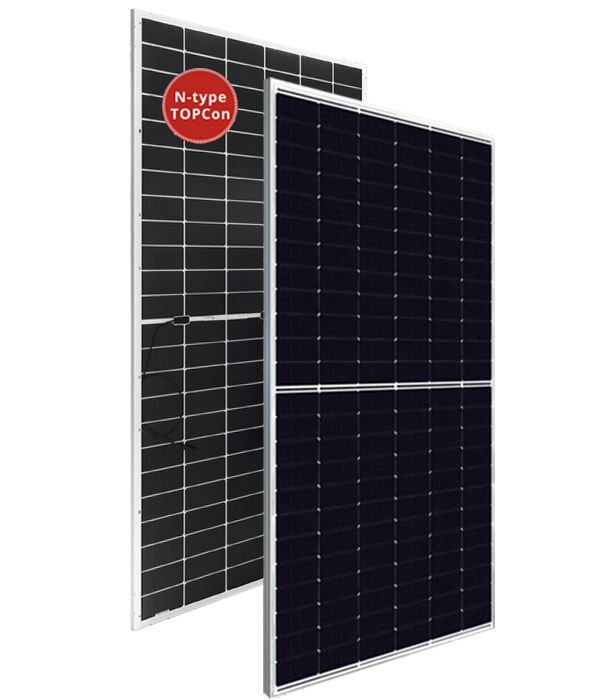
The TOPHiKu6 580W is Canadian Solar’s answer to the N-type revolution sweeping the global solar industry. While most panels sold in Kenya still use P-type silicon — a technology developed in the 1980s — this module uses TOPCon (Tunnel Oxide Passivated Contact) cells, the same architecture that holds the current world efficiency records for commercial-scale solar production.
The “N” in N-type refers to the dopant: phosphorus instead of boron. This single change in semiconductor chemistry eliminates the boron-oxygen defect that causes light-induced degradation in P-type cells, raises the open-circuit voltage by approximately 40 millivolts per cell, and reduces sensitivity to temperature.
The Engineering Behind TOPCon
The “tunnel oxide passivated contact” name describes the cell’s defining feature: an ultra-thin (about 1.5 nanometres) silicon oxide layer between the silicon wafer and the rear metal contact, capped with a doped polysilicon layer. This architecture solves a fundamental problem of conventional cells — recombination losses where charge carriers meet the rear contact and lose their energy as heat instead of becoming useful current.
In plain terms: TOPCon cells leak less power. More of the electrons knocked loose by sunlight actually make it out of the panel as electricity. The result is a measurable boost in efficiency, voltage, and stability.
What This Means for Kenyan Installations
Theory aside, here’s how the TOPCon advantages translate to a panel sitting on your roof:
- Hot weather is less punishing. The Pmax temperature coefficient of -0.29%/°C means the panel loses about 17% less power per degree above STC than a comparable P-type module. On a 55°C rooftop (not unusual in Kenya), you keep an extra ~9W per panel.
- First-year degradation is halved. Where P-type panels can lose up to 2% in year one, TOPCon panels are warranted to lose no more than 1%. Over a 25-year system life, that early advantage compounds.
- Annual degradation is 27% lower. The 0.40%/year linear curve means more energy in years 10, 15, 20, and beyond.
- Low-light response improves. The higher open-circuit voltage helps the panel start producing useful power earlier in the morning and continue later in the evening.
- The warranty extends to 30 years. Canadian Solar backs the technology with 5 additional years of guaranteed performance compared to P-type panels.
System Configurations for Common Kenyan Setups
Because each TOPHiKu6 produces 30W more than a 550W HiKu6, system designs typically need one or two fewer panels to hit the same target capacity:
- Compact apartment system: 2 panels (1.16kW) with a Vestwood 3.5kW hybrid inverter and 5kWh battery
- Standard family home: 5 panels (2.9kW) with a Vestwood 6kW hybrid inverter and 10kWh battery
- Larger home with high consumption: 7–8 panels (4.06–4.64kW) with a Vestwood 8kW inverter and 15kWh battery
- SME / commercial: 10–18 panels with a Vestwood 10kW or 15kW three-phase inverter
Electrical Characteristics
Measured under standard test conditions (1000W/m², 25°C, AM1.5):
- Maximum power: 580W
- Open-circuit voltage: 51.5V
- Short-circuit current: 14.42A
- Maximum power voltage: 43.4V
- Maximum power current: 13.36A
- Module efficiency: 22.5%
- Maximum system voltage: 1500V DC
- Operating temperature range: -40°C to +85°C
Use our Solar Calculator to size your system, or request a personalised quote.