
Description
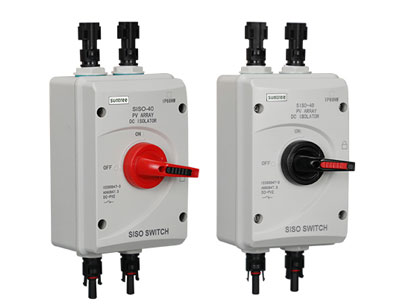
SISO-40 DC Isolator Switch Kenya — Suntree 4P 1000VDC 32A Solar PV Array Isolation Switch (IP66)
The SISO-40 DC Isolator Switch from Suntree — known across the Kenyan solar market under several names including Suntree DC Isolator Switch 1000V 32A, Solar PV Disconnect Switch, Solar Array Disconnect, the Suntree Rotary DC Isolator, and the 4 Pole DC Isolation Switch — is the mandatory array-side disconnection device that every EPRA-compliant Kenyan solar installation requires. This is the switch that sits on the roof beside the panel array, ready to be operated by a maintenance technician, a fire-fighter responding to a building emergency, or an installer commissioning the system for the first time.
This product is fundamentally different from the DC circuit breakers (DC MCBs) that protect the distribution board. A DC MCB is a thermal-magnetic device that trips automatically on overcurrent or short-circuit faults — it’s a protection device that happens to provide a manual switch. The SISO-40 is a switch only — a high-quality rotary disconnect housed in an IP66 outdoor enclosure, designed for rapid manual operation when human intervention requires the array to be disconnected from the rest of the system. The two products complement each other rather than substituting: every solar installation needs both, in different positions, for different purposes.
Most Kenyan installers and homeowners discover the SISO-40 requirement during EPRA inspection rather than during initial system design. The inspector arrives, looks at the installation, and asks where the array-side isolator is mounted. Without one, the installation fails inspection. With this product properly mounted near the array within the cable run between the panels and the combiner (or directly between the panels and the inverter for smaller installations), the EPRA documentation closes cleanly.
Why every Kenyan solar installation needs an array-side DC isolator
Solar PV arrays generate DC voltage whenever sunlight strikes the panels. There is no off switch on the array itself — disconnecting the inverter or opening a breaker downstream still leaves the DC cables between the array and that breaker fully energised at full string voltage. Five specific scenarios require array-side isolation as a regulatory and practical safety matter:
- Fire response to building emergencies: If a building catches fire, emergency responders need a way to disconnect the solar generation source before applying water to the structure. With no array-side isolator in place, the array goes on feeding live DC cables throughout the structure no matter what state the downstream breakers are in. The SISO-40 supplies the quick manual cut-off that fire-response procedures depend on.
- Maintenance technician access: A technician opening the inverter or working on the combiner box needs the DC cables genuinely dead before touching anything. With the SISO-40 in the OFF position the cables are dead; without an array-side isolator they sit at full string voltage even when downstream equipment looks isolated.
- Panel cleaning and roof maintenance: Anyone working on the roof — cleaning panels, replacing roof tiles near the array, clearing gutters, servicing a chimney — has a much safer task when the array can be isolated locally. The SISO-40 makes that local isolation possible from the roof itself rather than from a distant ground-level breaker.
- Storm and lightning response: Large lightning storms can push surge currents above the capacity of the SPD inside the combiner box. Manually isolating the array through the SISO-40 ahead of an approaching storm is a recognised protective measure that complements the automatic surge protection.
- EPRA regulatory compliance: Kenyan electrical regulations for solar PV installations require accessible disconnection of the DC source at the array. The SISO-40 is the standard product fulfilling this regulatory requirement in IP66 outdoor-ready format.
What makes the SISO-40 specifically right for this role
Several engineering choices in the SISO-40 design address the specific demands of array-side outdoor DC isolation. Seven features distinguish it from generic rotary switches that lack the necessary specification for solar PV duty:
- 4-pole common-trip rotary mechanism for 1000V DC interruption: The four contact pairs arrange in series so each pair handles approximately 500V during opening — within the safe envelope of the internal arc-quench geometry. A 2-pole rotary switch cannot reliably interrupt 1000V DC arcs; the 4-pole arrangement is engineering necessity at this voltage class.
- IP66 outdoor-rated enclosure: The UV-resistant ABS housing keeps water, dust, and direct sunlight exposure away from the internal switch mechanism. IP66 means complete dust ingress protection plus protection against powerful water jets — appropriate for rooftop installation in Kenyan rainy season and coastal salt-air conditions.
- 2-millisecond shut-off time: Once the rotary handle reaches the OFF position, the internal contacts separate within approximately 2 milliseconds — substantially faster than typical contactor or breaker operation. The fast shut-off time matters for fire-response scenarios where minimising the duration of continued generation matters.
- Lid removable only in OFF position: The enclosure cover physically cannot be removed while the switch is in the ON position. This safety interlock prevents service personnel from opening an energised enclosure. Combined with the lockout/tagout padlock provision, the safety architecture supports rigorous maintenance discipline.
- Earth terminal included: Dedicated earth terminal inside the enclosure connects to the grounding system, providing the bonding point that EPRA inspectors look for as part of the complete protective earth scheme.
- Fire resistance to 960°C: The enclosure material withstands 960°C flame for 5 seconds without sustained burning (substantially better than the IEC 60695 standard’s 10-second threshold). This fire-resistance margin matters because the device is typically mounted on a roof where structural fires could otherwise propagate through cable entries.
- Optional MC4 pre-wiring: The Suntree SISO-40 is available with pre-installed MC4 solar connectors for plug-and-play installation directly into the solar string circuit. This reduces installation time and eliminates the wiring error category that affects field-terminated installations.
How the SISO-40 fits in the Bicity Solar DC protection ecosystem
The complete DC protection scheme for a Kenyan solar installation typically combines three product categories working together — each with a distinct function and position in the system architecture:
| Product Category | Function | Position | Bicity Range |
|---|---|---|---|
| DC Isolator Switch — this product | Manual disconnection only; rapid array-side isolation | On the roof, near the panel array | SISO-40 4P 1000VDC 32A |
| DC Combiner Box | Combines parallel strings; houses fuses + SPD + main MCB | Between array and inverter | SHLX 550V and 1000V combiners |
| DC MCB (Circuit Breaker) | Manual switching plus thermal-magnetic overcurrent and short-circuit protection | Inside combiner box and/or at inverter DC input | SL7N-63 family — 2P 550V (20A/32A/63A) and 4P 1000V (20A/32A/63A); SL7N-125D 4P 1500V 80A |
A complete residential solar installation typically uses one SISO-40 on the roof, one combiner box at the array side (with internal MCB, fuses, SPD), and one or more DC MCBs at the inverter DC input. A complete commercial installation may use multiple SISO-40 isolators (one per parallel string or per roof section), multiple combiner boxes, and multiple DC MCBs in the protection scheme.
Where the SISO-40 belongs in Kenyan solar installations
The specific application contexts for the SISO-40 4P 1000V 32A cover a clearly defined range of Kenyan installations. Nine common deployment scenarios:
- Residential rooftop solar (3-8 kW) array-side isolation: The most common application — a single SISO-40 mounted on the roof near the panel array, in the cable run between the panels and the ground-floor inverter or combiner. Provides EPRA-compliant disconnection accessible at the array location.
- Larger residential solar (8-12 kW) array-side isolation: Larger residential systems with multiple parallel strings may use one SISO-40 per string at the array, with all strings then converging at a ground-side combiner box before the inverter. Maximum flexibility for service work on individual strings.
- Small commercial solar (8-15 kW) array isolation: Commercial premises with rooftop arrays use the SISO-40 between the panel array (or rooftop combiner) and the cable run to the ground-floor inverter. Provides the EPRA-required isolation at the array end of the long cable run.
- Mid-commercial and larger commercial solar (15-30 kW) array isolation: Larger commercial installations frequently use multiple SISO-40 isolators across different roof sections, with each section having its own array-side disconnection point. Supports section-by-section service work without taking the entire array offline.
- Off-grid weekend home and cabin solar: Off-grid installations at Naivasha, Maasai Mara, Aberdares, Mount Kenya foothills, and similar locations use the SISO-40 between the array and the charge controller or hybrid inverter. Particularly valuable for properties left unoccupied for periods, where rapid isolation supports security and maintenance routines.
- Solar carport installations: Canopy-mounted PV at office complexes, shopping centres, hospitals, and educational facilities uses the SISO-40 at the carport structure, providing local isolation accessible at the carport level rather than requiring a trip to the building’s electrical room.
- Religious institution and community facility solar: Churches, mosques, and community centres install the SISO-40 between rooftop arrays and the building’s distribution architecture, supporting the safety protocols these public-access facilities require.
- School and educational facility solar: Primary schools, secondary schools, tertiary colleges, and university campuses install the SISO-40 as part of the solar safety architecture, providing the rapid disconnection required for emergency response and maintenance access.
- Lake Victoria basin and highland lightning-exposed installations: Solar systems in Kisumu, Siaya, Migori, Busia, Bungoma, and central highland counties where lightning frequency is high benefit particularly from the SISO-40’s rapid manual isolation capability during major thunderstorm events.
How the SISO-40 differs from DC MCBs
Buyers new to solar protection sometimes confuse DC Isolator Switches with DC MCBs. Both products switch DC circuits, both use 4-pole arrangements at the 1000V class, both carry industrial-grade certifications. The differences matter for selecting the right device for each position in the system architecture:
- Function — switch vs. protection device: The SISO-40 is a manual switch; it does not detect overcurrent and does not trip automatically. A DC MCB is a protection device that switches manually AND trips automatically on overcurrent or short-circuit faults. Use the SISO-40 where you need manual isolation; use the DC MCB where you need automatic protection.
- Mounting position — on the roof vs. in the distribution board: The SISO-40 is designed for outdoor IP66 mounting near the array. DC MCBs are designed for indoor DIN rail mounting inside distribution boxes or inverter cabinets. They serve different positions in the system architecture.
- Operating mechanism — rotary handle vs. toggle: The SISO-40 uses a rotary handle for positive-engagement manual operation in field conditions. DC MCBs use a smaller toggle handle typical of DIN rail breakers. The rotary handle of the SISO-40 supports lockout/tagout discipline and operates reliably in gloved-hand outdoor conditions.
- Enclosure — integrated IP66 vs. separate enclosure required: The SISO-40 ships in its IP66-rated enclosure ready for outdoor installation. DC MCBs are bare devices requiring a separate enclosure (typically the combiner box or distribution board).
- Compliance category — IEC 60947-3 vs. IEC 60947-2: The SISO-40 complies with IEC 60947-3 (the international standard for switches, disconnectors, switch-disconnectors and fuse-combination units). DC MCBs comply with IEC 60947-2 (the international standard for circuit-breakers). Different standards for different device categories.
- Connection — MC4 pre-wiring option vs. DIN rail terminals: The SISO-40 supports MC4 connector pre-wiring for plug-and-play solar string connection. DC MCBs use terminal screws requiring field-stripped cable termination.
- Price tier — higher than DC MCBs: The SISO-40 sits at a higher price point than DC MCBs because of the integrated IP66 enclosure, the rotary handle assembly, the safety interlock, and the additional certification testing. Both products are necessary in a complete solar installation; they’re not substitutes for one another.
Technical Specifications
| Specification | Value |
|---|---|
| Bicity SKU | BC-DCI-1000V-32A-4P |
| Manufacturer brand | Suntree — registered trademark of XinChi Electric Group Co., Ltd |
| Model series | SISO-40 solar isolator switch family |
| Device category | Solar PV DC isolator switch — manual disconnection only, no overcurrent protection |
| Rated operating voltage Ue | 1000V DC continuous |
| Maximum voltage Umax | 1200V DC absolute peak |
| Rated current Ie | 32A continuous DC at full pole capacity |
| Pole configuration | 4-pole rotary, common-trip mechanism |
| Utilization categories | DC-PV1, DC-PV2 (photovoltaic switching duty); DC-21B (general DC switching) |
| Polarity sensitivity | None — current flows either direction safely |
| Operating handle | Rotary lever — quarter-turn between ON and OFF positions |
| Position indication | Front-face ON/OFF marking visible at any angle of approach |
| Lockout/tagout | Padlock hole through operating handle in OFF position |
| Lid safety interlock | Enclosure cover cannot be removed while switch is ON |
| Shut-off time | Approximately 2 milliseconds from handle reaching OFF position |
| Mechanical life | Approximately 10,000 operations before mechanism wear-out |
| Enclosure rating | IP66 — complete dust protection, protection against powerful water jets |
| Enclosure material | UV-resistant ABS plastic, fire-resistant to 960°C for 5 seconds |
| Enclosure colour | Grey housing with red rotary handle (high visibility) |
| Cable entry | M20 and M25 cable glands; MC4 solar connector pre-wiring available |
| Earth terminal | Dedicated internal earth terminal for grounding connection |
| Operating ambient temperature | -25°C through +85°C |
| Storage temperature | -40°C through +85°C de-energised |
| Operating altitude | Up to 2,000 metres above sea level (covers all Kenyan installation locations) |
| Compliance standards | IEC 60947-3; AS/NZS 60947.3:2015; TUV (Germany); CE (Europe); SAA (Australia); ROHS |
| Mounting method | Standalone enclosed format — surface mount via integrated brackets on enclosure rear |
| Enclosure dimensions | Approximately 130mm × 90mm × 75mm (exact dimensions vary by specific variant) |
| Net weight | Approximately 0.5 kg |
Engineering Features That Matter for Kenyan Rooftop Installations
- UV-resistant outdoor enclosure for tropical exposure: Kenyan rooftop installations face year-round high UV exposure at equatorial latitudes. The SISO-40 enclosure uses UV-stabilised ABS plastic that resists degradation over the 20-25 year project lifetime, unlike generic plastic enclosures that yellow and embrittle within 5-7 years.
- IP66 waterproof rating for rainy-season conditions: The full IP66 rating handles direct rain exposure during Kenyan long-rains and short-rains seasons. The enclosure cover seals against dust ingress in the dry seasons and powerful water jets in the rains. Suitable for direct rooftop mounting without additional weather protection.
- Fire resistance for rooftop deployment: The 960°C flame resistance specification (5 seconds without sustained burning) provides margin against roof-fire propagation scenarios — particularly important for installations on commercial buildings where adjacent roofing materials may catch fire.
- Rapid 2ms shut-off for emergency response: Emergency-response procedures benefit from the fastest possible disconnection of solar generation when responders are dealing with a building emergency. The 2ms internal contact separation time minimises the period of continued generation during the response window.
- Lid safety interlock prevents energised opening: Maintenance personnel cannot accidentally open an energised enclosure because the lid cannot be removed while the switch is in the ON position. The interlock supports safe maintenance discipline and reduces installation-error risk.
- Earth terminal for protective bonding: Dedicated internal earth terminal supports the bonding scheme that EPRA inspectors verify as part of the complete protective earth architecture for solar installations.
- Padlock-able handle for lockout/tagout: The operating handle accepts a standard maintenance padlock when in the OFF position, supporting the lockout/tagout discipline required during professional service work. Commercial maintenance procedures and insurance requirements increasingly mandate this capability.
- MC4 pre-wiring option eliminates field termination errors: Available with pre-installed MC4 solar connectors, the SISO-40 enables plug-and-play installation directly into the solar string circuit. Field installers connect via the MC4 connectors without stripping or terminating cables, eliminating a category of installation error common in time-pressured Kenyan rooftop installations.
- Four-certification compliance package: TUV (Germany), CE (Europe), SAA (Australia), and IEC 60947-3 international compliance provide the documentation evidence that EPRA inspectors and commercial insurance assessors look for in larger installations.
- Operates from -25°C to +85°C ambient: The temperature range covers all Kenyan installation locations from coastal heat to highland cool-morning conditions, with substantial margin at both ends of the operating envelope.
Typical Kenyan Installation Scenarios for the SISO-40
- Residential rooftop solar across Kiambu, Limuru, Tigoni, Karen, Runda, Lavington, Muthaiga, Westlands, and Spring Valley properties — mounted on the roof near the array as the EPRA-required array-side disconnection device
- Coastal residential solar in Mombasa Nyali, Bamburi, Shanzu, Diani, Watamu, Malindi, and Kilifi properties where salt-air conditions make the IP66 outdoor rating particularly valuable for long-term reliability
- Highland residential solar in Murang’a, Nyeri, Embu, Meru, Nyandarua, Nanyuki, Mount Kenya, and Aberdares foothill installations where cool morning temperatures and occasional frost conditions reward the wide operating temperature envelope
- Lake Victoria basin residential solar in Kisumu, Siaya, Migori, Busia, and Bungoma where high lightning frequency means the rapid manual disconnection capability matters for storm-event response
- Off-grid weekend home solar at Naivasha, Maasai Mara, Aberdares, Mount Kenya foothills, Loitokitok, Lake Baringo, and Lake Magadi locations where remote properties need accessible isolation for security and maintenance
- Small commercial solar at retail shops, restaurants, hotels, clinics, religious institutions, and educational facilities across all Kenyan towns where 8-15 kW rooftop installations require array-side isolation between the panels and the building’s electrical distribution
- Larger commercial solar at supermarkets, hotels, hospitals, university campuses, and corporate offices where multi-string arrays use multiple SISO-40 isolators across different roof sections
- Solar carport installations at office park, shopping centre, hospital, and educational facility car parks where canopy-mounted arrays use the SISO-40 at the carport structure for local isolation
- Religious institution solar at churches, mosques, cathedrals, and temples where weekend congregational use makes the safety architecture (lid interlock, lockout/tagout) particularly relevant
- School and educational facility solar where the SISO-40 supports the safety protocols required when public-access buildings have rooftop solar installations
- EV charging infrastructure solar at workplaces, hotels, restaurants, fuel retailer forecourts, and dedicated EV charging network sites where the array-side isolation is required as part of the complete EV-plus-solar architecture
- Light industrial and agricultural processing solar at smaller factories, food processing facilities, dairy operations, and horticultural pre-cooling centres where rooftop solar feeds operational loads
Pairing the SISO-40 with Bicity Solar ecosystem components
The SISO-40 works alongside several other Bicity Solar products to build the complete protection scheme. Four common integration patterns appear in Kenyan installations:
- Residential 3-5 kW: SISO-40 + 2P 550V combiner + DC MCB + inverter: A residential string of 6-8 modern panels feeds through the SISO-40 at the array (providing EPRA-required isolation), then via solar PV cable to a SHLX 550V combiner box near the ground-floor inverter, then through a 2P 550VDC DC MCB at the inverter input. The complete protection scheme covers manual isolation, fuse protection, surge protection, main breaker switching, and overcurrent protection.
- Small commercial 8-15 kW: SISO-40 + 4P 1000V combiner + DC MCB + commercial inverter: A commercial string of 12-15 modern panels on 1000V architecture uses this same SISO-40 at the array (the device works equally well in residential and small commercial applications), feeding through a SHLX 1000V combiner box and a 4P 1000VDC DC MCB at the commercial inverter input.
- Larger commercial multi-string: Multiple SISO-40 + combiner + 4P 63A MCB: Larger commercial installations with multiple parallel strings (or multiple roof sections each carrying a string) use one SISO-40 per string at the array, with all strings then converging at a ground-side combiner box. Combined output protected by the 4P 1000V 63A DC MCB before the larger commercial inverter.
- Off-grid: SISO-40 + charge controller + battery + inverter: Off-grid installations use the SISO-40 between the array and the MPPT charge controller, providing isolation for charge controller service work. Particularly valuable in unoccupied properties where rapid array isolation supports remote management protocols.
Installation Notes for Kenyan Rooftop Mounting
Installation of the SISO-40 must be performed by an EPRA-registered solar electrician with documented rooftop installation experience. The work involves heights, weather exposure, and live DC voltages — not appropriate for DIY installation. Seven practical considerations apply specifically to SISO-40 installations:
First, mounting position selection — the SISO-40 should be mounted on the roof near the panel array but accessible to a person standing on the roof safely. Common positions include: adjacent to the array on the same roof slope (most common); on a parapet wall near the array; on a dedicated equipment stand near the array. The mounting position must be reachable without requiring the installer to walk on fragile roof sections, and must be accessible during emergency response from a roof access point.
Second, cable entry orientation — mount the enclosure so that the cable glands face downward or sideways rather than upward. Downward-facing cable glands prevent water accumulation at the entry points; upward-facing glands collect rainwater that may eventually overcome the IP66 rating over years of weather exposure.
Third, polarity convention — although the SISO-40 is polarity-tolerant and works correctly in either direction, the rest of the system depends on predictable conventions, so the installer should still mark positive and negative consistently across all conductors entering and leaving the enclosure for the benefit of future maintenance work.
Fourth, terminal torque — apply manufacturer-specified torque to all four conductor terminations using a calibrated torque wrench. The terminals are larger than typical DIN rail breaker terminals; verify the torque value applies to the specific terminal type. Document torque values in commissioning records.
Fifth, MC4 connector engagement — if using the MC4 pre-wiring option, verify the MC4 connectors are fully engaged before commissioning. Listen for the audible click that confirms full insertion; visually verify the locking detent is engaged. Loose MC4 connections create progressive resistance that damages connectors over time.
Sixth, cable selection — solar PV cables connecting to the SISO-40 must be PV-rated or TUV-rated for the operating voltage class. For 1000VDC installations, cable insulation must carry explicit 1000VDC rating. For typical 20A continuous operation with cable runs of 5-15 metres typical of array-to-isolator distances, 4mm² stranded copper PV cable handles the ampacity with voltage drop within target.
Seventh, commissioning documentation — record the SISO-40 location, model, and SKU in the system commissioning documentation alongside insulation resistance testing at the operating voltage, polarity verification, manual operation testing, and earth-loop impedance measurement at the earth terminal. EPRA inspectors look for documentation evidence that the array-side isolation requirement is met by the correct product properly installed and tested.
Building an EPRA-compliant solar installation in Kenya — residential, commercial, or off-grid?
Specify the SISO-40 DC Isolator Switch (Suntree 4P 1000VDC 32A, SKU BC-DCI-1000V-32A-4P) as the mandatory array-side isolation component of your complete DC protection scheme. Combine with combiner boxes, DC MCBs, solar-PV-rated cables, and inverter pairings for the full system — open the Solar Calculator to scope the complete protection requirements, or describe your project through My Quote for a full EPRA-ready bill of materials with installation and commissioning recommendations.