Description
Renergy iPower 14.34 kWh Lithium Battery — Wheeled 51.2V LiFePO4 Storage at the Right-Sized Cell Capacity
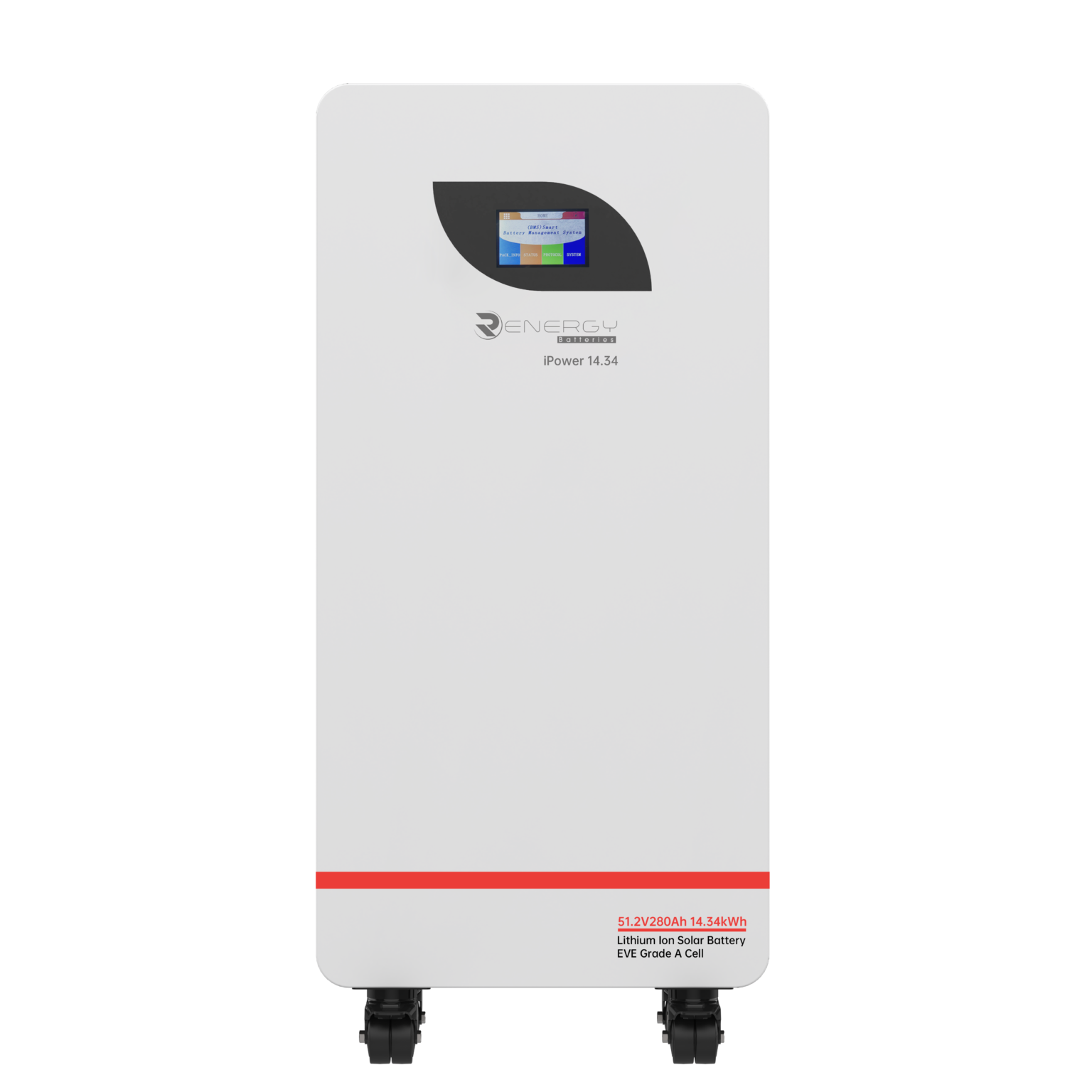
Two Renergy products share the same wheeled-flagship enclosure: the 16.07 kWh top-of-line model and the Renergy iPower 14.34 kWh Lithium Battery. Identical dimensions at 825 × 413 × 233 mm, identical 110 kg net weight, identical built-in wheel base, identical 150A continuous current envelope — the two products are mechanically and electrically twins. What separates them is the cell capacity inside the otherwise-matched enclosure: where the 16.07 specifies 314Ah cells totalling 16.07 kWh of stored energy, the 14.34 specifies 280Ah cells totalling 14.34 kWh. The right-sized cell capacity makes the 14.34 the natural choice for buyers wanting the wheeled-flagship infrastructure at acquisition cost reflecting a smaller-capacity cell investment. Local installer references include Renergy iPower 14.34, the iPower 14.34, the Renergy 14 kWh battery, the Renergy 280Ah single-cell unit, and the Renergy 14.34 kWh wheeled storage.
This shared-form-factor pairing is unusual in the residential battery market. Most manufacturers space their product line so each capacity tier carries different physical dimensions, different installation infrastructure requirements, and different operational characteristics. Renergy’s approach with the 14.34 and 16.07 deliberately gives buyers two cell-capacity choices inside the same physical product — letting the buyer match cell capacity precisely to actual load profile rather than choosing between mismatched form factors at different capacity points. The decision criterion shifts from “which form factor fits my space and load combination” to the simpler “which cell capacity matches my consumption profile” — a more focused buying decision.
What the 280Ah cell capacity translates to operationally is a useful capacity envelope for the premium residential mid-bracket. Households consuming 8-10 kWh during evening hours operate the iPower 14.34 at 56-70% Depth of Discharge — comfortably within the cycle life optimisation range that protects long-term capacity retention. Households consuming 10-12 kWh operate at 70-84% DOD — still within healthy daily-cycling parameters. Above 12 kWh consumption, the 14.34 starts running near the 100% DOD daily, at which point the larger 16.07 sibling delivers better cycle life economics through reduced daily depth utilisation.
Cell capacity choice as the buying decision
Inside any 51.2V LFP battery, sixteen cells in series produce the system voltage. The total stored energy depends entirely on the capacity of each individual cell — multiply per-cell Ah by 16 series cells, then multiply by 51.2V system voltage to get watt-hours, then divide by 1000 for kWh. The Renergy iPower 14.34 reaches 14.34 kWh through 280Ah cells; the iPower 16.07 reaches 16.07 kWh through 314Ah cells; the iPower 10.24 reaches 10.24 kWh through 200Ah cells.
Per-cell economics favour the smaller cells in cost-per-Ah terms but penalise the smaller cells in total cells-needed terms. The 14.34’s 280Ah cells carry lower per-cell cost than the 16.07’s 314Ah cells but produce less total energy per pack. For the buyer, the question is whether the additional 1.73 kWh of capacity in the 16.07 (about 12% more storage) is worth the corresponding price premium — a question that depends entirely on the buyer’s actual consumption profile.
Buyers consistently consuming under 11 kWh during the evening backup window typically find the 14.34 the right match — the additional 1.73 kWh in the 16.07 represents capacity the household will not use, which means paying for storage that delivers no operational benefit. Buyers consistently consuming above 13 kWh find the 16.07 the right match — the additional capacity matters for cycle life economics at the higher daily DOD. The 11-13 kWh consumption bracket sits in the decision boundary where either model can work; buyer preference for cycle life margin (favouring 16.07) versus acquisition cost economy (favouring 14.34) becomes the deciding factor.
Position in the Bicity battery range
| Capacity | Bicity option | Form factor / physical class |
|---|---|---|
| 1.28-2.56 kWh | Vestwood 12V/24V, Suness EV-2.56N, iPower 2.56 | Small wall-mount or shelf-mount |
| 4.8 kWh | Vestwood 48V 100Ah, Jinko JKS-B48100-HI | Standard wall-mount or rack-mount |
| 5.12 kWh | Renergy iPower 5.12, Vestwood 51.2V 100Ah | Standard wall-mount |
| 9.6 kWh | Vestwood 48V 200Ah | Larger wall-mount |
| 10.24 kWh | Renergy iPower 10.24 | Wall or ground mount (no wheels) |
| 14.34 kWh — this product | Renergy iPower 14.34 | Wheeled wall-mount (shared form with 16.07) |
| 15.36 kWh | Suness EV-15.36N | Commercial wall-mount |
| 16.07 kWh | Renergy iPower 16.07 | Wheeled wall-mount (shared form with 14.34) |
Within the Renergy range, the 14.34 sits one step below the 16.07 flagship. Within the broader Bicity catalog, the 14.34 occupies the 14 kWh capacity bracket that no other single-unit option fills — the Vestwood family caps at 9.6 kWh single-unit, the Suness commercial unit jumps to 15.36 kWh, and the Jinko residential option sits at 4.8 kWh. For buyers wanting single-unit storage in the 13-15 kWh capacity bracket, the iPower 14.34 is the only catalog option.
Where the iPower 14.34 fits the buyer profile
The 14.34 kWh capacity targets the upper-mid premium residential bracket — slightly below the top of the residential demand curve but above standard suburban consumption. Three buyer profiles consistently match this bracket cleanly.
The first profile is the larger family home in established premium suburban locations. Property characteristics: 4-6 bedroom configuration, typical fitment of electric water heating across multiple bathrooms, central or zoned air conditioning, two or more refrigeration appliances, modest pool circulation pump cycles where applicable, irrigation system pumping during dry season, substantial lighting plus entertainment plus computing load through evening hours. Daily evening-and-overnight consumption typically reaches 8-11 kWh — well-matched to the 14.34 capacity operating at 56-77% DOD daily.
The second profile is the country property or boutique guest house operating in the upper-mid backup demand bracket. Properties hosting modest guest numbers (3-6 guest rooms typically) carry evening operational loads including guest-room amenities, restaurant or kitchen operation, exterior lighting and security infrastructure, water pumping cycles for guest supply, and operational rooms (reception, office, staff areas). The 9-12 kWh evening consumption bracket that these operations typically reach fits the 14.34 envelope with operational margin for cloudy-day recovery and occasional consumption spikes.
The third profile is the smaller commercial premises with elevated backup demand but not quite full commercial scale. Mid-sized professional services premises (10-20 staff), smaller multi-doctor clinics, smaller diagnostic laboratories, smaller veterinary practices with surgery facilities, smaller dental practices with multiple chairs. Daily operational consumption during backup hours reaches 9-12 kWh in these contexts. The 150A continuous current handles the concurrent operation of office HVAC, diagnostic equipment, lighting, and computing infrastructure.
Where the 14.34 is over-specified or under-specified
For mainstream Kenyan suburban residential homes consuming 3-6 kWh during evening hours, the 14.34 represents substantial overcapacity. The household will operate the unit at 20-42% DOD daily — well below the cycle life optimisation point and paying for capacity that delivers no practical operational benefit. The right-sized choice for this consumption profile is the iPower 5.12 at the 5 kWh tier, or the iPower 10.24 if the buyer specifically wants future-proofing margin against load growth over 3-5 years.
For top-tier premium homes with substantial electric water heating, EV charging, central air conditioning, and elevated appliance load reaching 13-15 kWh during evening hours, the 14.34 runs near 100% DOD daily — which is operationally acceptable but trades cycle life headroom for capacity economy. Buyers in this consumption bracket typically prefer the iPower 16.07 at the same physical form factor but with the additional 1.73 kWh of capacity that brings daily DOD down to 75-93%. The two products share enough operational characteristics that the upgrade decision turns purely on the consumption profile and cycle life sensitivity.
For dedicated commercial premises consuming 20+ kWh during operational hours, the 14.34 is undersized. Two units in parallel reach 28.68 kWh which suits many smaller commercial scenarios; three units reach 43.02 kWh covering larger commercial backup requirements. Beyond 30-40 kWh of total capacity, the Renergy commercial HV series at higher voltage architecture typically delivers better installation economics than residential-tier parallel-stacking.
What 150A continuous current delivers for premium residential loads
- Concurrent multi-appliance operation without protection trips: Premium residential homes routinely operate multiple high-draw appliances simultaneously during evening peak — electric water heating for evening showers across multiple bathrooms, central air conditioning across multiple zones, refrigeration cycling, possibly EV charging starting overnight, cooking equipment for dinner preparation, and the standard lighting plus entertainment baseline. Concurrent demand frequently exceeds 5 kW, occasionally reaching 6-7 kW during peak coincidence. The 14.34’s approximately 7.68 kW continuous output (51.2V × 150A) handles these compound peaks within continuous rating rather than requiring surge operation.
- Motor inrush handling for residential pumps and compressors: Water pumps, refrigeration compressors, air conditioning compressors, swimming pool circulation pumps, washing machine motors, and similar motor-driven loads draw 3-7× their steady-state current rating during the first 50-500 milliseconds of motor startup. Sequential motor starts (multiple appliances coming online after grid outage restoration) create compound surge events. The 150A continuous current rating provides sufficient headroom to absorb these motor-start events without nuisance protection trips.
- EV charging without curtailment: Standard residential EV charging at 7.4 kW (single-phase 32A) draws approximately 150A from a 48-51V battery system — which exactly matches the 14.34’s continuous current rating. The battery handles EV charging without throttling to lower current rates. Faster EV charging at 11 kW or above three-phase rates pushes beyond the single-unit envelope and requires either parallel-stacked battery configuration or sourcing EV charging directly from solar generation rather than battery.
- Light commercial concurrent equipment load: Smaller commercial premises operating concurrent equipment groups — office HVAC plus computing infrastructure plus refrigeration plus lighting plus point-of-sale or diagnostic equipment — typically generate 4-6 kW of concurrent demand during operational hours. The 14.34’s continuous power capacity covers this commercial load profile without approaching the current limit.
Engineering features that justify the wheeled flagship investment
- Grade A LFP cells at 280Ah per cell capacity: The 280Ah cell capacity represents commercial-grade large-format cell sourcing applied to residential-tier deployment. Cells receive Renergy’s Grade A designation after passing all manufacturer specifications on first factory inspection — capacity matching, voltage consistency, internal resistance, self-discharge rate, and cycle life pre-screening. The combination of large-format cell sourcing plus Grade A quality screening produces the cycle life envelope that the 14.34 is rated to deliver.
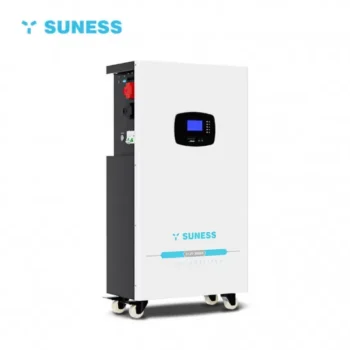
- Built-in wheel base for mobility logistics: The wheeled enclosure design eliminates the lifting infrastructure requirement that fixed-mount alternatives at the 110 kg weight class create. Installation positioning happens by rolling rather than lifting; operational-life repositioning is feasible without dismantling mount infrastructure; service access to surrounding equipment benefits from temporary battery relocation rather than working around fixed-position infrastructure.
- Cycle endurance specification across three operational DOD points: Renergy publishes three cycle life figures — 8,000 cycles when daily depth holds at 50%, 6,000 cycles at 80% depth, 4,000 cycles at 100% depth — letting buyers match the rating against their actual operating profile rather than picking the most favourable single-DOD point. For typical 14.34 buyers operating at 56-77% DOD daily, realised cycle life sits between the 6,000 and 8,000 cycle points.
- Greater than 98% round-trip efficiency: The high efficiency rating means daily solar energy that flows through the battery storage stage emerges with minimal conversion loss — preserving 98% of stored energy through the charge-and-discharge cycle. Across the operational life of the installation, the efficiency advantage compounds substantially compared to lower-efficiency battery chemistries.
- Dual RS485 plus CAN bus protocol for inverter pairing flexibility: Both communication protocols are available from the same unit, giving installer flexibility to use whichever protocol the connected inverter manufacturer specifies. The dual-protocol design avoids the protocol-lottery problem that single-protocol batteries create when paired with inverters expecting the alternative protocol.
- Bluetooth plus WiFi connectivity standard: Wireless monitoring functions are integrated into the base product rather than requiring optional accessory modules. Bluetooth supports smartphone connection for in-room monitoring; WiFi supports home-network or cloud-platform connection for remote monitoring and historical data review. Both wireless features pair through the colour touch LCD menu during commissioning.
- Sixteen-unit parallel scaling for capacity expansion: The maximum parallel configuration extends to 16 paralleled units, taking aggregate system capacity to approximately 229 kWh at the 51.2V architecture. Practical residential and light-commercial installations rarely exceed 4-6 paralleled units (57-86 kWh aggregate) before the wall or ground space requirement becomes operationally significant, but the architectural ceiling permits substantial capacity scaling within one product family.
Inverter pairing — protocol selection at commissioning
The dual-protocol communication architecture (RS485 plus CAN bus) covers the major hybrid inverter brands available in the Kenyan 48V/51.2V market. During commissioning, the installer determines which protocol the connected inverter supports — typically by consulting the inverter manufacturer’s battery compatibility documentation — then configures the matching channel on the iPower 14.34 through the colour LCD touch menu. The 51.2V output voltage aligns with the input voltage range that mainstream hybrid inverter products are designed around, simplifying the inverter selection decision.
For matched-brand operation, the Renergy hybrid inverter range (RPI-LV series for low-voltage residential applications, RPI-HV series for high-voltage variants) pairs natively with the iPower battery family. Mixed-brand installations using other hybrid inverter manufacturers should reference the inverter manufacturer’s documented compatible battery list against the iPower 14.34 specification to confirm protocol parameters before commissioning. The 150A continuous current rating means inverter battery input handling must support currents up to this level — most modern residential and light-commercial hybrid inverters handle this comfortably.
Specifications — confirmed from the Renergy iPower 14.34 datasheet
| Specification | Value |
|---|---|
| Brand | Renergy Power Limited (UK) |
| UK Companies House registration | 10115425 (England and Wales) |
| Product family | iPower Wheeled Flagship — Residential |
| Model | iPower 14.34 |
| Form factor pairing | Shared physical enclosure with iPower 16.07 (distinguished by cell capacity) |
| Cell chemistry | LFP (Lithium iron phosphate) — Grade A cells |
| Cell architecture | 16 cells in series at 280Ah per cell |
| Rated voltage | 51.2V |
| Rated capacity | 280Ah |
| Rated energy | 14.34 kWh |
| Output voltage range | 43.2V – 58.4V |
| Charging voltage | 57.6V – 58.4V |
| Cut-off voltage | 43.2V |
| Max charge current | 150A |
| Recommended charge current | 50A |
| Max discharge current | 150A |
| Continuous power output (51.2V × 150A) | Approximately 7.68 kW |
| Round-trip efficiency | Greater than 98% |
| Cycle life @ 50% DOD (0.2C, 25°C) | 8,000 cycles |
| Cycle life @ 80% DOD (0.2C, 25°C) | 6,000 cycles |
| Cycle life @ 100% DOD (0.2C, 25°C) | 4,000 cycles |
| Manufacturer design life | Greater than 10 years |
| Enclosure dimensions (L × W × H) | 825 × 413 × 233 mm |
| Approximate weight | 110 kg |
| Mounting modes | Wheeled standing or wall-mounted |
| Charging temperature | 0°C to 55°C |
| Discharging temperature | -20°C to 60°C |
| Long-term storage temperature | -10°C to 30°C |
| Operating humidity | 5% – 95% relative humidity |
| Local user interface | Front-panel colour touch LCD screen |
| Wireless monitoring | Bluetooth (short range) and WiFi (network/cloud) |
| Inverter communication | RS485 plus CAN bus (dual protocol) |
| Maximum parallel configuration | Up to 16 units (approximately 229 kWh aggregate) |
| Operating mode selection | Touch screen menu navigation |
| BMS scope | Cell temperature, current, voltage, State of Charge, State of Health |
| Inverter compatibility | Wide range of hybrid inverter brands operating at 51.2V architecture with RS485 or CAN bus support |
Where the iPower 14.34 typically deploys in Kenyan installations
- Larger family homes in established premium suburbs: 4-6 bedroom properties in Karen, Runda, Spring Valley, Muthaiga, Tigoni country estates, Lavington premium plots, premium Mombasa coastal homes, and equivalent residential locations — homes consuming 8-11 kWh during evening hours from combined water heating, refrigeration, lighting, entertainment, and modest air conditioning load.
- Boutique guest house and country property hospitality: Smaller hospitality operations with 3-6 guest rooms typically — country lodges, conservancy boutique accommodation, mission station guest blocks, religious institution retreat facilities — running evening guest operational loads plus night-time security and refrigeration.
- Mid-sized professional services premises: Architectural practices, engineering consultancies, legal firms, accounting practices with 10-20 staff — commercial offices operating full business hours during grid outages, with the 14.34 covering operational consumption plus extended-day overflow.
- Smaller diagnostic laboratories and multi-room clinics: Smaller pathology labs, smaller imaging centres, smaller multi-doctor clinics, smaller dental practices with multiple chairs and X-ray equipment — healthcare contexts where critical-load backup must cover diagnostic equipment plus refrigeration plus office infrastructure.
- Religious institution mid-sized facilities: Mid-sized congregational facilities, mid-sized mosque installations, theological college residential blocks, mission-affiliated school administration buildings — religious institution backup matching the 9-12 kWh consumption bracket.
- Off-grid sites in the mid-bracket consumption range: 2-unit parallel installations reaching 28.68 kWh of total capacity covering smaller off-grid commercial operations, larger off-grid residential properties consuming 18-25 kWh daily, and similar mid-bracket off-grid scenarios.
- Premium homes specifying single-EV charging integration: Properties combining standard residential evening loads with overnight charging of one electric vehicle — adding 6-10 kWh of nightly charging that pushes total daily consumption into the 12-14 kWh bracket the 14.34 covers cleanly.
- Premium residential staged toward future capacity expansion: Buyers starting with one iPower 14.34 for immediate 14.34 kWh capacity, anticipating expansion to two paralleled units (28.68 kWh) over 3-5 years as household electrical demand grows through appliance additions or electric mobility adoption.
Commissioning checklist — the workflow that brings the 14.34 online
An EPRA-registered electrician with experience in larger residential battery installation handles the iPower 14.34 commissioning. The wheeled-flagship form factor simplifies some installation steps that fixed-mount alternatives complicate at the 110 kg weight class, but introduces commissioning checkpoints worth verifying carefully:
Site preparation before delivery. Confirm the access route from delivery vehicle to final installation position handles the 825 mm × 413 mm enclosure footprint plus reasonable manoeuvring clearance. Narrow corridors, tight doorways, stair access, and similar route constraints should be verified before delivery rather than discovered on installation day. The wheeled design simplifies horizontal transport substantially but doesn’t eliminate the route-planning requirement.
Floor surface verification at the installation position. The wheeled positioning depends on a reasonably level floor surface with the structural capacity to support 110 kg distributed across the wheel contact points. Concrete slab, solid tile on adequate sub-floor, or purpose-built equipment platforms all suit; suspended timber flooring or thin tile over inadequate sub-floor may flex under sustained loading and should be reinforced before installation. The colour LCD interface presumes vertical-orientation viewing, so substantially uneven floors may produce minor display angle considerations.
Wheel lock engagement after final positioning. Once the battery has been rolled into its operating position and the cable routing has been finalised, the wheel locking mechanisms should be engaged before any electrical connection completes. Unlocked wheels allow the unit to roll under cable tension or accidental contact, potentially stressing the DC and communication cable terminations. The locked-wheel state converts the wheeled unit into stationary infrastructure for operational purposes while preserving the future relocation capability.
DC cable specification matched to the 150A continuous envelope. Between battery and hybrid inverter, the DC cable must handle 150A maximum continuous current at 51.2V system voltage. For typical residential cable runs of 2-5 metres, solar PV stranded copper at 25-35 mm² cross-section handles the load after ambient temperature derating. Where conductors run further or where the equipment room operates at elevated ambient temperatures, step up to a larger cross-section to manage voltage drop and thermal margin appropriately.
Communication protocol configuration during initial power-on. The dual RS485 plus CAN bus availability gives flexibility, but the installer needs to verify which protocol the connected hybrid inverter supports and configure the matching channel on the iPower 14.34 through the colour LCD touch menu. Confirming communication establishment before final commissioning prevents non-obvious operational issues that may present as unrelated faults later in the operational life.
Wireless feature commissioning during handover. Bluetooth pairing with the buyer’s smartphone and WiFi configuration to the buyer’s home or office network should be completed during the commissioning handover rather than left as buyer self-service. Pairing the smartphone Bluetooth, configuring WiFi network credentials through the LCD touch interface, and verifying Renergy monitoring app connectivity at handover delivers the full wireless monitoring functionality from day one.
BMS configuration confirmation. Cell-level monitoring parameters, protection thresholds, and operating mode selection happen through the touch LCD menu during commissioning. Verifying the State of Charge display reads accurately, the cycle count starts at zero, the alarm and protection mode indicators are clear, and the operating mode matches the installation context before handing the system over to the buyer prevents misconfiguration issues from surfacing later.
Looking for the wheeled-flagship infrastructure at right-sized cell capacity for actual residential load? Specifying a premium home installation in the 8-12 kWh evening consumption bracket where the 16.07 overshoots demand and the 10.24 undershoots? Building a boutique guest house or mid-sized professional services backup at the 14 kWh capacity tier?
The Renergy iPower 14.34 kWh Lithium Battery delivers the same wheeled physical infrastructure as the larger 16.07 sibling — same enclosure, same weight, same wheels, same 150A current envelope — at 280Ah cells producing 14.34 kWh of stored energy right-sized to upper-mid premium residential and light-commercial demand. Run your evening kWh load through the Solar Calculator to verify the capacity match, then drop the design into My Quote for a costed package covering the iPower 14.34 quantity, compatible hybrid inverter selection, DC protection components matched to the 150A current envelope, and the wheeled installation logistics workflow appropriate to the 110 kg enclosure handling.