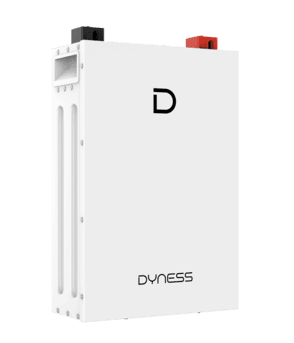
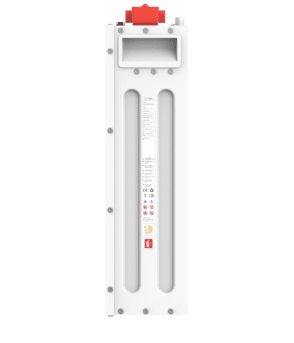
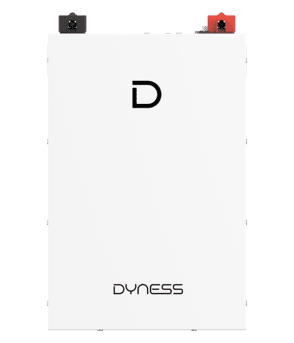
Description
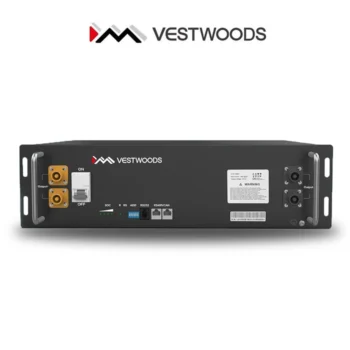
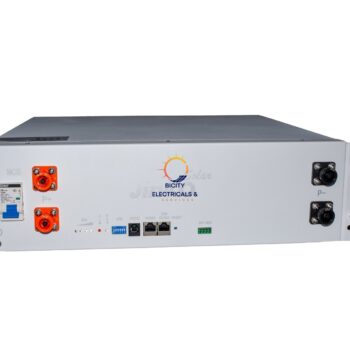
The Dyness DL5.0F is a 5.12kWh lithium iron phosphate battery built around a 100 ampere hour cell stack at 51.2 volts. It suits homes, shops, clinics and small commercial premises running a 48 volt hybrid inverter, and it stacks to considerably larger banks where a site needs them.
Three current figures are published for it, and they are not the same in both directions. That asymmetry is the thing to understand before deciding how many modules a system needs.
| Rate | Current | Power per module |
|---|---|---|
| Recommended, in either direction | 50A | 2.56kW |
| Maximum charge | 75A | 3.84kW |
| Maximum discharge | 100A | 5.12kW |
A module gives out 5.12kW but will only take in 3.84kW. Size a bank from the discharge figure alone, as most quotations do, and it will be correctly specified for the evening and under specified for the middle of the day. The symptom is surplus solar going unused at noon on a system that looks right on paper, and because nothing faults or warns, it is rarely traced back to the battery.
Two other things are worth settling early.
It carries aerosol fire suppression inside the module. Not an external measure to be specified separately, but suppression built into the pack itself. In this class that remains uncommon, and on a battery installed inside an occupied building it is a meaningful difference rather than a specification footnote.
It is rated IP20, which means strictly indoors. That rating covers solid objects larger than about twelve millimetres and offers no water protection whatsoever, not even against water dripping straight down. A covered veranda is not enough, nor is a store open at one side, nor a damp outbuilding. It wants a dry room.
Dyness DL5.0F Specifications and Inverter Pairing
1. System Architecture and Configuration
Cell and Capacity
- Lithium iron phosphate cells, in a cell to pack construction
- 5.12 kilowatt hours of nominal energy per module
- 4.864 kilowatt hours of that genuinely usable
- Ninety five percent depth of discharge, which is generous for the chemistry
- One hundred ampere hours at 51.2 volts nominal
- A working window from 44.8 volts up to 57.6 volts
Charge and Discharge
- Fifty amperes recommended in either direction, which is 2.56kW
- Seventy five amperes of charge at most, which is 3.84kW
- One hundred amperes of discharge at most, which is 5.12kW
- One hundred and ten amperes available for fifteen seconds at 25C
- Charging permitted between 0C and 55C
- Discharging permitted from -20C up to 55C
Safety and Management
- Aerosol fire suppression built into the pack
- Management reporting over CAN or RS485
- Wireless connection and a phone application, both optional
- Certified to UN38.3, IEC 62619 and IEC 63056 among others
- Restriction of hazardous substances and chemical registration both met
Physical and Mounting
- Forty one kilograms, 345mm wide by 548mm tall by 146mm deep
- Four mounting options: wall, floor standing, bracket or rack
- Nineteen inch rack cabinets accommodated directly
- Bracket mounting limited to six modules
- Up to fifty modules in parallel, reaching 256 kilowatt hours
- IP20, which confines it to a dry indoor position
2. Technical Specifications
| Parameter | Value |
|---|---|
| Battery type | Lithium iron phosphate |
| Nominal energy | 5.12kWh |
| Usable energy | 4.864kWh |
| Depth of discharge | 95% |
| Nominal capacity | 100Ah |
| Nominal voltage | 51.2V |
| Operating voltage range | 44.8V to 57.6V |
| Recommended charge and discharge rate | 0.5C, which is 50A |
| Maximum charge rate | 0.75C, which is 75A |
| Maximum discharge rate | 1C, which is 100A |
| Peak discharge current at 25C | 110A for 15 seconds |
| Recommended charge and discharge power | 2.56kW |
| Maximum charge power | 3.84kW |
| Maximum discharge power | 5.12kW |
| Charge temperature range | 0C to 55C |
| Discharge temperature range | -20C to 55C |
| Cycle life | 8000 cycles or more, on the published test conditions |
| Communication | CAN or RS485 |
| User interface | Wireless and application, optional |
| Safety protection | Built in aerosol fire extinguisher |
| Protection level | IP20, indoor positions only |
| Net weight | 41kg |
| Dimensions | 345mm wide, 548mm tall, 146mm deep |
| Installation methods | Wall, floor standing, flexible bracket, rack |
| Bracket mounting limit | 6 modules |
| Expansion | Up to 50 modules in parallel, 256kWh |
| Warranty period | 7 years, with 10 years available |
| Certification | UN38.3, CE-EMC, CE-RED, IEC 62619, IEC 63056, RoHS, REACH |
Cycle life is quoted at a 0.2C charge and discharge rate, 25C, 95% depth of discharge, and an end of life point of 70% remaining capacity. Section 11 explains what that actually promises.
3. Key Features
- Ninety five percent of the nameplate genuinely usable, not seventy or eighty
- Fire suppression built into the pack rather than specified around it
- Cell to pack construction, which is what keeps the module this compact
- One hundred amperes of discharge, enough for a 5kW inverter from one module
- A fifteen second peak above that, for motor and compressor starting
- Four ways to mount it, including straight into a nineteen inch rack
- Fifty modules in parallel where a site grows to commercial scale
- Reporting over CAN or RS485, which suits the common hybrid inverters
- Monitoring by application and web, available as an option
- Seven years of warranty as standard, with ten available
- Discharge permitted down to -20C, which covers any Kenyan night
- Module count matched to your inverter by Bicity Solar before quotation
4. Applications and Use Cases
- Homes on a 48 volt hybrid: the mainstream case, usually two to four modules
- Shops and salons: keeping tills, lighting and refrigeration through outages
- Clinics and surgeries: where the fire suppression is worth having indoors
- Offices and co-working spaces: daytime solar stored for the evening
- Guest houses: several modules racked rather than hung on a wall
- Phased installations: start with two modules and add more later
- Sites replacing lead acid: the usable depth roughly doubles per nameplate kWh
- Small commercial premises: racked banks reaching tens of kilowatt hours
5. Installation and Engineering Notes
Size the bank for charging, not only for discharging
This is the calculation that gets skipped. Each module absorbs 3.84kW at most and delivers 5.12kW at most, so the charging side runs out first. A bank sized to cover the evening load will frequently be unable to swallow the array at noon.
| Surplus solar to absorb | Modules needed at 3.84kW each |
|---|---|
| Around 5kW | 2 |
| Around 8kW | 3 |
| Around 10kW | 3 |
| Around 14kW | 4 |
Work out how much the array is likely to produce beyond what the building consumes during the brightest hours, and make sure the bank can take it. Where it cannot, the surplus is simply not harvested, and nothing in the system reports a problem.
A dry indoor position, and nothing less
- IP20 offers no water protection at all, not even against dripping
- A covered veranda, an open sided store and a damp outbuilding are all unsuitable
- Keep it out of dusty workshops unless it is given its own cabinet
- Allow airflow around the casing and keep items from being stacked against it
- Forty one kilograms is a two person lift onto masonry or fixed steel
- Bracket mounting is limited to six modules; beyond that use a rack or the floor
Temperature, which has one real limit here
Discharge is permitted from -20C, which no Kenyan location approaches. Charging, though, stops below 0C. That is almost never a constraint at the coast, in Nairobi or around the lake, but a clear night in the high country can come close, so a battery in an unheated outbuilding at altitude is worth a thought at design stage. In a normal indoor position it does not arise.
Circuit sizing
Protective devices sit a quarter above the continuous current the circuit carries, then round up to a size that is manufactured. Cable length as measured, grouping and ambient heat all move the final answer.
| Circuit | Design current | Device | Cable, short run |
|---|---|---|---|
| One module to the busbar | 125A | 125A DC | 35mm² |
| Two modules combined | 250A | 250A DC | 95mm², or paired runs |
| Three modules combined | 375A | 400A DC | Paired 95mm² runs |
- Give each module its own run to a common busbar rather than daisy chaining
- Keep every module’s cable the same length, so current shares evenly between them
- Crimp lugs with the matching die and torque every termination to figure
- Bring the communication link up and confirm the inverter reads real pack data
- Check polarity twice before closing any isolator
- Commissioned and certified by a licensed technician
6. Care, Maintenance and Operations
- Keep the room dry, since the casing offers no protection against moisture
- Brush the casing clean and confirm nothing rests against the enclosure
- Retighten terminations annually, more often on a bank working hard
- Compare module currents in the monitoring, since a drift means one is carrying more
- Watch the reported state of health rather than only the charge level
- Review the charge rate settings if modules are added to the bank later
- Keep the fire suppression path clear of stored items
- Record commissioning figures, so later decline can be measured against them
7. Do’s and Don’ts
Do
- Size the bank against charging power as well as discharge
- Give each module its own cable run to a shared busbar
- Keep all module cables equal in length
- Fit it indoors somewhere dry, leaving the casing free to breathe
- Bring up the data link and confirm the inverter is reading the pack
- Use a rack once the bank passes six modules
- Plan the module count around the inverter you actually have
Don’t
- Assume it charges as fast as it discharges, because it does not
- Put it anywhere damp, since IP20 resists no water at all
- Hang more than six on a bracket
- Pair it with a high voltage inverter, as the voltages are incompatible
- Daisy chain modules and hope current shares evenly
- Attempt the lift alone at forty one kilograms
- Read the cycle figure as a promise of calendar years
8. Compatibility
- Hybrid inverters taking a 40 to 60 volt battery, which is everything up to 18kW in the Solis range
- Growatt hybrid inverters on the same low voltage platform
- Most major inverter manufacturers, though the specific model should be confirmed
- Management communication over CAN or RS485
- Nineteen inch rack cabinets, directly
- Banks from one module up to fifty, reaching 256 kilowatt hours
- Monitoring by application and web, where the optional interface is fitted
Confirm the exact inverter model against the manufacturer’s compatibility list before ordering, because support is published per model rather than per brand, and a brand appearing on the list does not mean every unit it makes is covered.
9. How Many Modules Your Inverter Needs
This is the question every quotation turns on, and the honest answer has two columns. Delivering an inverter’s rated output takes a given current, and that current can come from fewer modules worked at their maximum or more modules worked at the recommended rate.
| Inverter | Current at 51.2V | Minimum, at full discharge rate | At the recommended rate | Usable energy at the minimum |
|---|---|---|---|---|
| 5kW | About 98A | 1, at its ceiling | 2 | 4.9kWh |
| 6kW | About 117A | 2 | 3 | 9.7kWh |
| 8kW | About 156A | 2 | 4 | 9.7kWh |
| 10kW | About 195A | 2 | 4 | 9.7kWh |
| 12kW | About 234A | 3 | 5 | 14.6kWh |
| 14kW | About 273A | 3 | 6 | 14.6kWh |
| 16kW | About 313A | 4 | 7 | 19.5kWh |
| 18kW | About 352A | 4 | 8 | 19.5kWh |
The single module against a 5kW inverter deserves a caveat rather than a tick. It needs about 98 amperes against a 100 ampere ceiling, so it works, but only by running the battery at its absolute maximum whenever the inverter is at full output. Two modules is the configuration we would quote. Note also that these counts are driven by power, not by storage: a bank sized purely for current may hold less energy than the household actually wants overnight, and the right answer is usually whichever number is larger.
10. Which Inverters It Will Not Work With
This is a 51.2 volt module with a working range of 44.8 to 57.6 volts, so it belongs to the low voltage platform and nothing else.
| Inverter platform | Battery voltage it expects | This module |
|---|---|---|
| Single phase, 5kW to 16kW | 40V to 60V | Compatible |
| Three phase, 12kW to 18kW | 40V to 60V | Compatible |
| Three phase, 30kW and 50kW | High voltage | Not compatible |
| Three phase, 80kW and 125kW | 300V to 950V | Not compatible |
The larger three phase machines run high voltage lithium banks, which are a different and more costly class of hardware. Fifty of these modules in parallel still produce 51.2 volts, not 300, so no number of them will serve a high voltage inverter. If the project is at that scale, the battery is specified from the high voltage range instead and we will say so rather than quoting modules that cannot be connected.
11. Mini FAQ
How much of the 5.12kWh can I actually use?
4.864kWh, which is ninety five percent. That depth is better than much of this class allows.
Why does it charge slower than it discharges?
Charging is capped at 75 amperes and discharging at 100. Size the bank against the lower figure.
Can it go outside or in a store?
No. IP20 means no water protection at all, so it needs a dry indoor room.
Will one module run a 5kW inverter?
Just, at its maximum rate. Two is what we would quote for anything beyond occasional full output.
Does it work with high voltage inverters?
No. It is a 51.2 volt module and the larger three phase machines need hundreds of volts.
What does the fire suppression do?
An aerosol extinguisher is built into the pack itself rather than being specified around it.
How many can I put on a wall bracket?
Six. Larger banks go into a rack or stand on the floor.
Is 8000 cycles the same as 8000 days?
Only if you use exactly one cycle a day. At that rate the warranty runs out long before the cycles do.
12. Why Buy From Bicity Solar
- Module count worked against your inverter’s current, not guessed from its kilowatts
- Charging capacity checked against your array, which is the side most quotations miss
- Mounting position assessed, since this unit tolerates no moisture
- Each module given its own run to a busbar, with cable lengths matched
- Communication brought up and verified at commissioning, not left to chance
- Honest advice when a different capacity or a different battery suits you better
- Clear warning when an inverter on site cannot take this platform at all
- Genuine stock, with documentation matching what you receive
- Installed and certified under a current EPRA licence
- Warranty claims taken to the supplier by us rather than left with you
- Delivery countrywide, with parts and advice continuing afterwards
Tell us which inverter you have and how big your array is. The number of modules you need is set by current rather than by kilowatt hours, and the charging side runs out before the discharging side does, which is the part most quotations get wrong.
Send us the inverter model, the array size and the loads you want carried overnight. We work the module count from the current your inverter needs, check the bank can absorb your midday surplus, confirm the mounting position suits an indoor rated unit, and tell you plainly if your inverter cannot take this platform. Size your own loads in the Solar Calculator, or send the site through My Quote.