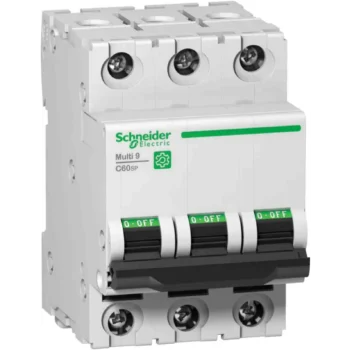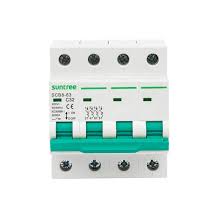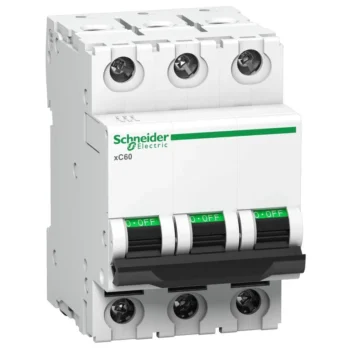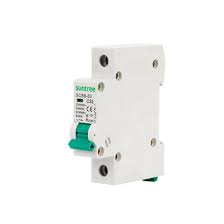
Description
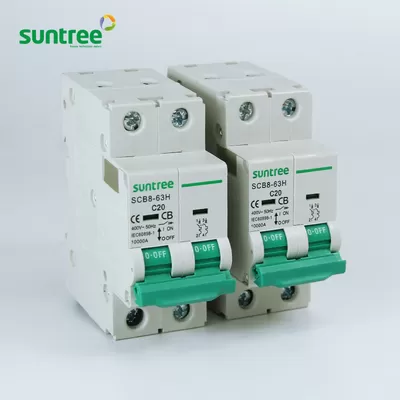
Double Pole MCB 63A — SCB8-63 2P 400VAC Main Switch / AC Circuit Breaker
The Double Pole MCB 63A sits at the top of the SCB8-63 single-phase product range. At sixty-three amps continuous, it is the breaker most often specified as the main switch of a single-phase consumer unit in Kenyan homes, apartments, retail shops, salons, and small offices — the device that disconnects the entire premises from the supply in one mechanical action. It is also the right choice for protecting the AC output of large single-phase hybrid solar inverters above 9 kW, for isolating 11 kW single-phase EV charge points, and for feeding sub-distribution boards that serve outbuildings or rented units from a larger main panel.
This rating is deliberately positioned where the domestic single-phase supply tops out in Kenya: most utility-fed single-phase services are sized at 60A or 80A, so a 63A 2P main switch matches the supply cable while leaving a single-pole margin against the upstream service fuse. The breaker keeps the same SCB8-63 mechanical platform, DIN rail mount, and C-curve trip characteristic as smaller variants in the family, while internally upgraded contacts and arc chamber dimensions handle the higher continuous current and fault energy.
Where this 63A breaker belongs in an installation
- Consumer unit main switch: A single rocker disconnects every downstream branch breaker at once, used for isolation during maintenance or emergencies.
- Tenant sub-main feeder: Single-phase tap-off from a three-phase main board feeding an apartment, shop, or kiosk inside a larger building.
- Outbuilding incoming protection: Workshop, garage, or guest cottage fed from a buried sub-main run.
- Large single-phase hybrid inverters: AC output protection for 9 kW to 12 kW domestic solar systems.
- 11 kW EV charging point: Higher-current single-phase Type 2 chargers used at upmarket residences.
- Heavy welder benches: Industrial stick and TIG welders with sustained 40–50 amp draw on the supply side.
- 3-5 HP borehole and irrigation pumps: Large single-phase agricultural motors with starting currents that exceed lower-rated breakers.
- Backup ATS panels: Switching the household supply between solar, generator, and utility on a 60-amp service.
Main switch versus branch protection
The 63A 2P breaker is fundamentally different in purpose from the smaller variants you have seen in this family. A 20A 2P protects a specific branch circuit. A 32A 2P protects a single high-load appliance like a geyser or EV charger. The 63A 2P most often functions as the master isolator at the top of the consumer unit, ahead of every other breaker. That role demands two specific properties: it must reset reliably after thousands of routine ON-OFF cycles (homeowners flip the main switch repeatedly over the life of an installation), and it must coordinate correctly with downstream protection so that a branch fault never trips the main first. The SCB8-63 main switch meets both requirements through its 20,000-cycle mechanical endurance rating and its standard C-curve thermal-magnetic profile.
Technical Specifications
| Attribute | Detail |
|---|---|
| Reference Model | SCB8-63 (63A variant) |
| Current Rating (continuous) | 63 amperes |
| Poles Switched | Two (live + neutral, common trip) |
| Voltage Rating | Single phase 230V / split-phase 400V AC |
| Frequency Compatibility | 50/60 Hertz |
| Tripping Curve | Type C, magnetic instantaneous at 5×–10× rated |
| Short-Circuit Withstand | 6 kA at 230/400V AC (IEC 60898-1) |
| Insulation Withstand (Ui) | 500 volts |
| Impulse Withstand | 6 kV typical |
| Pollution Class | 2 (indoor distribution panel) |
| Operating Lever Life | Twenty thousand mechanical actions |
| Switching Cycles Under Load | Four thousand minimum |
| Cable Aperture per Terminal | Solid or stranded copper to 25mm² |
| Recommended Conductor | 16mm² copper as a starting point |
| Ambient Operating Window | −5°C through +40°C |
| Mounting System | Snap-fit onto 35mm symmetrical DIN rail |
| Footprint on Rail | 2 standard 18mm modules |
| Front Lever | Single rocker, common trip linkage |
| Compliance Standard | IEC 60898-1 household-and-similar circuits |
Headline Features
- Built for repeated daily operation — the rocker mechanism is tested to twenty thousand mechanical operations, making it the right choice for a master switch that householders flip routinely.
- Linked-trip both poles — an overload or short circuit detected on either conductor mechanically operates both poles together; no half-disconnection possible.
- Generous 25mm² terminal opening — comfortably accepts the 16mm² and 25mm² conductors typically used at main switch positions.
- Universal DIN rail fitment — drops into the master position of any consumer unit, replacing an undersized 40A or 50A main switch without panel modification.
- Visible position window — colour-coded mechanical flag shows ON, OFF, or tripped status without opening the panel cover.
- Reset behaves predictably — push the lever fully OFF, then firmly back to ON; never reset under suspected fault until the cause is investigated.
- Heat-rated polymer enclosure — V0 flame-retardant casing tolerates fault clearance without softening, and resists tracking under sustained load.
- Coordinates with downstream MCBs — standard C-curve allows good selectivity with downstream 16A, 20A, 32A, and 40A branch breakers under most fault conditions.
Typical Roles in Kenyan Installations
- Consumer unit main switch for medium-and-large family homes drawing up to about 14 kW peak
- Apartment tap-off breakers at the floor distribution board of multi-storey residential blocks
- Single-phase sub-main feeding a barn, dairy parlour, or agricultural processing shed
- AC isolator for 10 kW and 12 kW hybrid solar inverters used in larger off-grid-leaning homes
- 11 kW Type 2 EV charging points at higher-end residences and small fleet sites
- Heavy welding workshops and small fabrication units running multiple machines
- Salon and barbershop main switches where heating and styling equipment combine to high demand
- Pump house feeders for boreholes serving multi-family compounds in Kajiado, Kiambu, and Machakos
Installation Notes
At the 63A position the rules tighten further. The supply cable feeding this breaker is almost always 16mm² copper as a minimum, increasing to 25mm² where the run is long or routed through warm building voids. The downstream tails to the busbar of the consumer unit follow the same conductor sizing. Terminal torque at sixty-three amps is critical — a loose connection here can run hot enough to discolour the breaker housing within weeks, and is the single most common reason a main switch needs early replacement. Use a calibrated torque screwdriver to the value stamped on the breaker body, document the installation date, and schedule a torque recheck within the first six months of service while warranty cover applies.
This device should never be confused with an isolator switch (which has no protective tripping function) or with a residual current device (RCD/RCBO) that adds earth-leakage protection. For installations requiring shock protection — every Kenyan domestic main switch position from 2024 onward, under updated EPRA guidance — the 63A MCB should sit downstream of a 63A 100mA Type AC RCD, or be replaced entirely by a 63A 2P RCBO if combined overcurrent and earth-leakage protection in a single module is preferred.
Upgrading your consumer unit, planning a large solar system, or wiring an 11 kW EV charge point?
Get a fully specified single-line diagram — every breaker, cable size, and RCD — through our Solar Calculator for system-level sizing, or send your load schedule via My Quote for a complete panel design.