Description
Renergy iPower 5.12-RM Lithium Battery — 51.2V Rack-Mount LiFePO4 for Telecom and Indoor Solar Backup
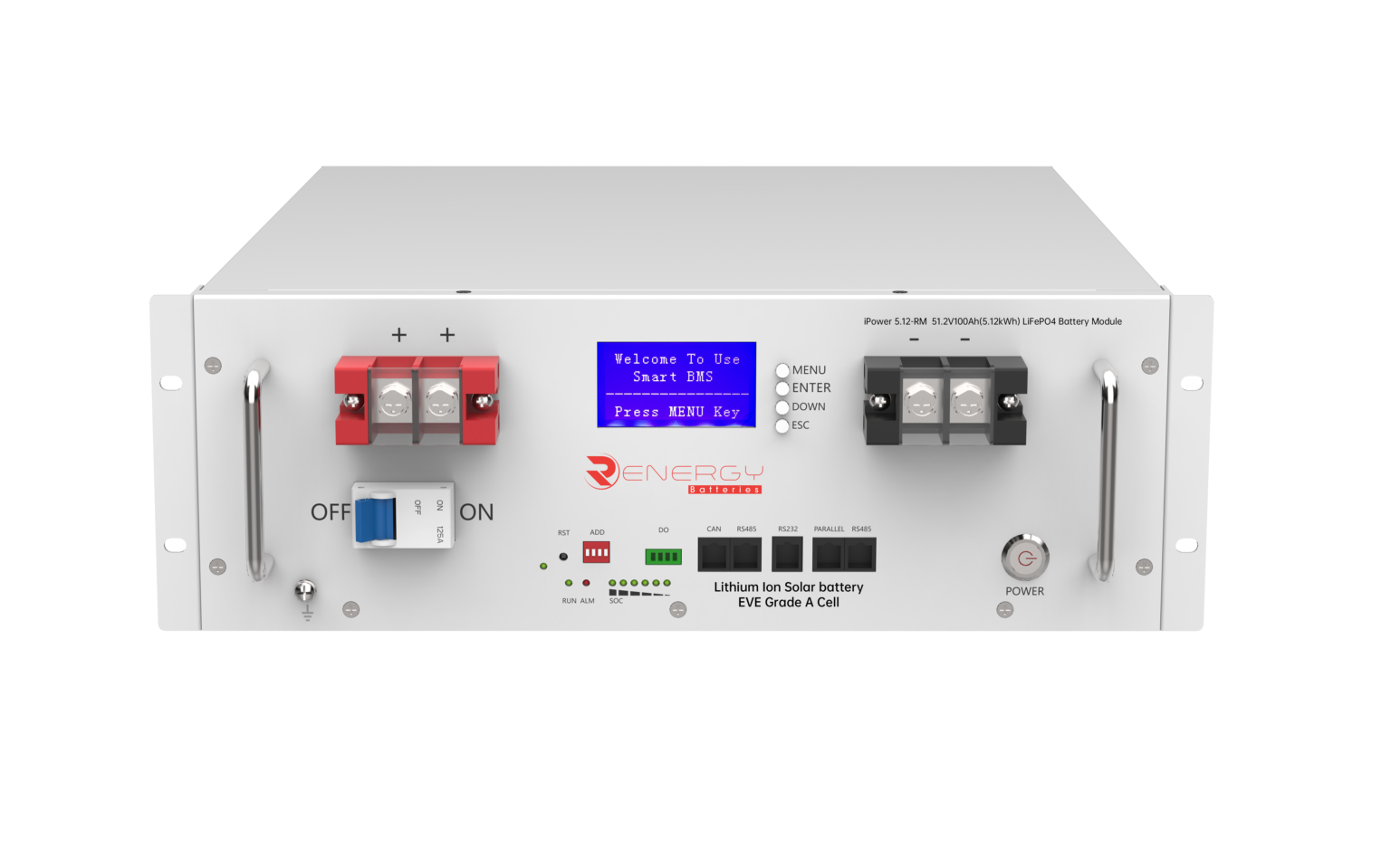
Some battery deployments don’t need a colour touch LCD screen mounted on the front face. Some installation contexts have no use for Bluetooth pairing with a smartphone or WiFi connection to a cloud monitoring platform. The Renergy iPower 5.12-RM rack-mount lithium battery serves exactly these deployment contexts — 19-inch equipment rack environments in telecom shelters, indoor solar backup at commercial equipment rooms, server room critical-load backup, and industrial sites where the centralised monitoring infrastructure already handles battery oversight through the inverter or supervisory control system. The rack-mount variant strips the standard wall-mount iPower 5.12’s residential-style features (LCD, Bluetooth, WiFi) from the configuration and presents the battery as professional infrastructure suited to the operational context. Common references include Renergy iPower 5.12-RM, the iPower 5.12-RM, the Renergy rack-mount 5.12, the Renergy 51.2V telecom battery, and the Renergy 5.12 kWh rack unit.
The product sits alongside the standard wall-mount iPower 5.12 in the Renergy residential range, sharing the same electrical architecture but targeting a fundamentally different deployment audience. Same 51.2V system voltage, same 100Ah cell capacity, same 5.12 kWh stored energy, same Grade A LFP cells, same Renergy three-tier cycle life rating, same 10-year design life, same Renergy Power Limited UK corporate brand backing. What changes is the physical form factor (480 × 442 × 155 mm rack-mount versus the wall-mount enclosure shape) and the deliberate streamlining of features inappropriate to professional rack deployment. The streamlined configuration isn’t a downgrade — it’s appropriate engineering for the deployment context where consumer-style local interfaces simply aren’t useful.
Renergy markets the iPower 5.12-RM specifically for indoor solar backup and telecom energy storage applications, which captures the deployment-context distinction clearly. Telecom shelters at cellular towers and ISP infrastructure sites operate with centralised monitoring through Network Operations Centres — the local battery doesn’t need its own LCD because operators are watching battery status remotely through the supervisory control system. Indoor solar backup installations at commercial equipment rooms typically integrate the battery monitoring with the inverter and the building management system — again, no need for local LCDs because the data is presented through the building control interface. The rack-mount form factor fits cleanly into existing 19-inch equipment rack infrastructure that telecom and commercial premises already use for switchgear, network equipment, and inverter installations.
The professional rack-mount design philosophy
Standard 19-inch equipment racks have been the industry convention for telecom, server room, and industrial electrical infrastructure for decades. Rack dimensions are standardised at 19 inches wide externally, with internal mounting hole spacing matched to the EIA-310 specification that all rack-compatible equipment follows. The iPower 5.12-RM’s 480 × 442 × 155 mm dimensions fit cleanly into this rack convention — the 442 mm width matches the standard rack opening, the 480 mm length corresponds to typical rack equipment depth, and the 155 mm height corresponds to approximately 3.5 standard rack units (3.5U) of vertical space.
Practical implications of the rack-mount form factor compared to wall-mount alternatives. The battery sits horizontally inside the rack rather than vertically against a wall, distributing the 47 kg weight across the rack’s structural rails. Multi-unit installations stack vertically inside the same rack rather than spreading across multiple wall positions — three iPower 5.12-RM units occupy approximately 10.5U of rack space (about 460 mm of vertical space), substantially more compact than three wall-mount batteries spread across multiple wall sections. Service access happens by sliding the battery forward on the rack rails rather than dismounting from a wall — cleaner workflow during maintenance or component replacement.
The rack-mount approach also aligns with how telecom and commercial premises organise their electrical infrastructure operationally. Telecom shelters house batteries, rectifiers, distribution panels, and monitoring infrastructure inside racks for environmental control (temperature-managed cabinets), security (locked rack doors), and operational efficiency (standardised cable routing). Server rooms house battery backup alongside servers, networking equipment, and power distribution units inside racks for the same reasons. Commercial equipment rooms organising solar-plus-storage with hybrid inverters and distribution panels often follow the rack convention to integrate cleanly with existing electrical room layouts.
Where the streamlined feature set is the right choice
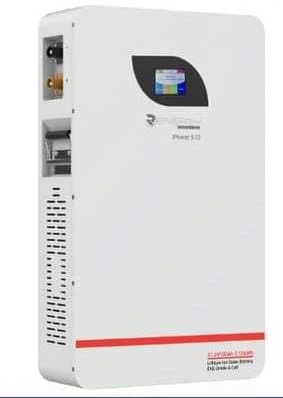
The wall-mount iPower 5.12 includes a colour touch LCD screen on the front face, Bluetooth connectivity for smartphone pairing, and WiFi connectivity for home network or cloud platform integration. These features make sense for residential buyers monitoring their solar storage system directly — checking State of Charge from the phone, viewing cycle count history on the LCD during regular household movement past the battery, configuring operational modes through the touch interface during initial setup.
None of these features serve the telecom and industrial deployment context. Telecom site operators don’t pair their phones with each battery in their fleet — that workflow doesn’t scale across 50+ tower sites. Server room operators don’t walk up to each battery to check the LCD — they monitor through the data centre management system. Industrial site operators don’t configure operating modes through touch interfaces — the modes are set during commissioning and don’t change during operational life.
For these deployment contexts, the LCD and wireless features represent capability the buyer pays for but doesn’t use — and worse, the LCD touchscreen introduces a failure mode (display damage, touch screen wear) that adds maintenance overhead without delivering operational value. Streamlining the feature set removes these unnecessary elements from the product, reducing complexity, reducing failure modes, and reducing acquisition cost. The streamlined design is a deliberate engineering choice rather than an economy compromise.
Bicity catalog position for rack-mount installations
| Form factor | Available product | Capacity | Brand positioning |
|---|---|---|---|
| Standard 12V/24V/48V wall-mount | Vestwood family | 1.28-9.6 kWh range | Value-tier Vestwood ecosystem |
| Small 12V drop-in | Suness EV-2.56N | 2.56 kWh | Lead-acid replacement positioning |
| Wall-mount residential 51.2V | Renergy iPower 5.12 | 5.12 kWh | Premium British wall-mount with LCD and wireless |
| Rack-mount Tier 1 PV brand | Jinko JKS-B48100-HI | 4.8 kWh | Tier 1 brand alignment for Jinko PV installations |
| Rack-mount British brand — this product | Renergy iPower 5.12-RM | 5.12 kWh | Streamlined British rack-mount for telecom and indoor solar backup |
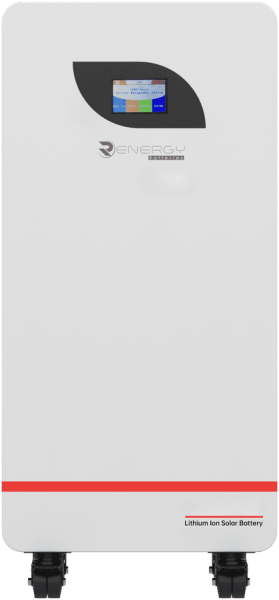
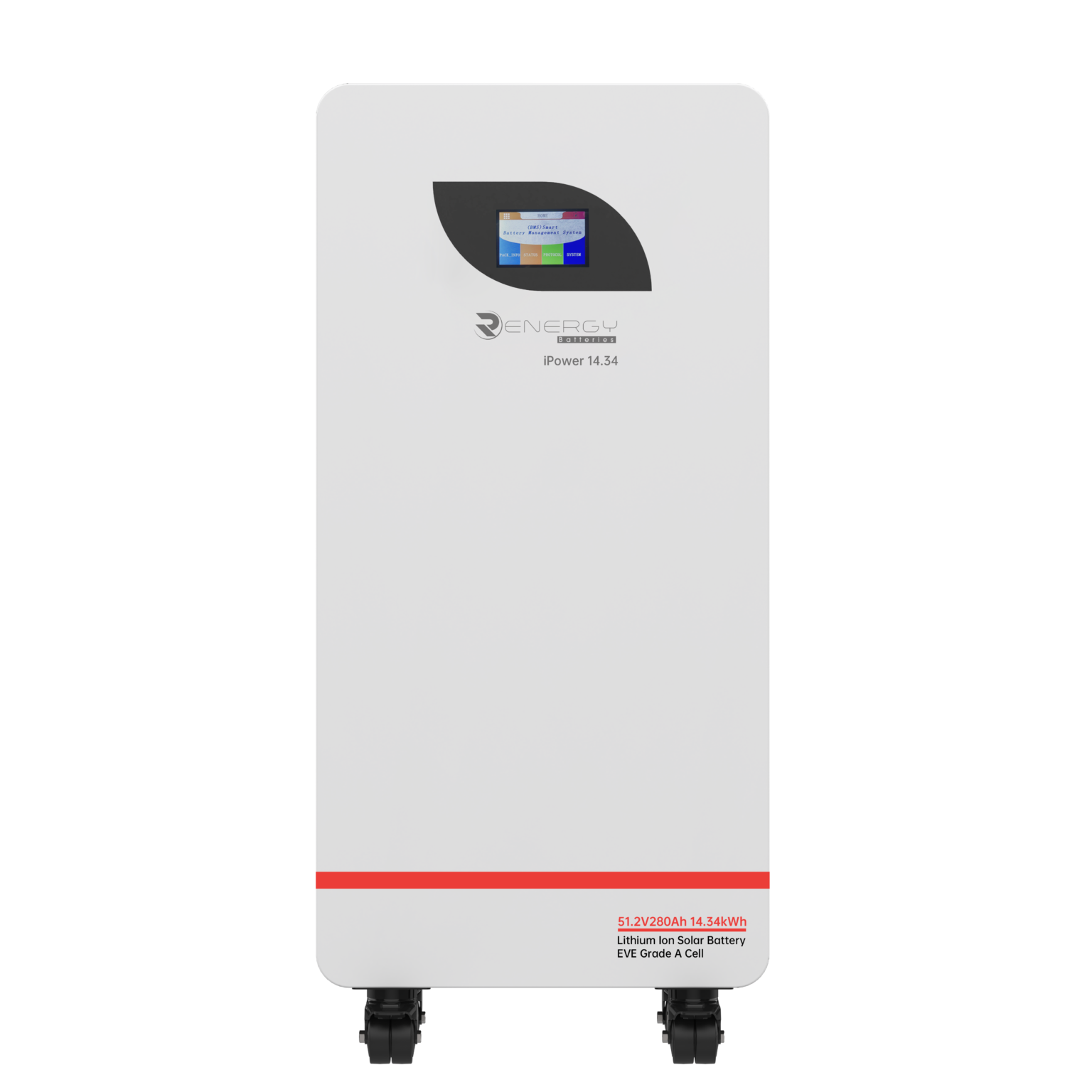
| Larger residential single-unit | iPower 10.24, 14.34, 16.07 | 10-16 kWh | Wall-mount or wheeled residential flagship |
| Commercial single-unit | Suness EV-15.36N | 15.36 kWh | Commercial wall-mount |
Within the rack-mount form factor specifically, two options exist in the Bicity catalog at residential capacity tiers: the Jinko JKS-B48100-HI at 4.8 kWh and the iPower 5.12-RM at 5.12 kWh. Both are LFP rack-mount batteries with similar electrical architecture. The Jinko option carries Tier 1 PV brand alignment most useful when paired with Jinko solar panels for matched-brand installations. The iPower 5.12-RM carries British brand backing under Renergy Power Limited’s UK Companies House registration plus alignment with the wider Renergy iPower family — useful for installations spanning multiple capacity tiers under one brand. The choice between them depends on the buyer’s broader installation context and brand priorities.
Three deployment scenarios where the 5.12-RM fits cleanly
Telecom shelter battery banks at cellular towers and microwave repeater sites. Kenyan mobile network operators run extensive infrastructure across the country — cellular tower sites, microwave repeater installations, fibre node points-of-presence, rural ISP infrastructure. These sites typically have telecom shelters housing batteries, rectifiers, network equipment, and monitoring infrastructure inside 19-inch racks for environmental control and operational efficiency. The iPower 5.12-RM drops into the rack alongside the existing equipment, providing LFP chemistry advantages over the lead-acid banks that many telecom sites historically used while maintaining the rack-mount deployment convention that telecom operations require.
Indoor solar backup at commercial equipment rooms with rack infrastructure. Smaller offices, retail premises, professional services firms, and similar commercial installations frequently organise their electrical equipment inside dedicated equipment rooms with 19-inch rack infrastructure for switchgear, networking, and inverter installation. Solar-plus-storage retrofits to these commercial premises benefit from rack-mount battery integration that fits the existing room layout rather than requiring separate wall-mount infrastructure that disrupts the established convention. Single-unit installations cover 4-6 kWh of evening backup demand; parallel installations of 2-3 units extend capacity to 10-15 kWh for larger commercial premises.
Smaller server rooms and IT facility critical-load backup. Small businesses, professional services firms, and smaller IT-dependent operations operate server rooms housing computing infrastructure, networking gear, and power distribution. Critical-load backup for these rooms covers the IT infrastructure plus the cooling that the equipment requires through grid outages. Rack-mount battery integration alongside the existing UPS and inverter infrastructure delivers the backup function without requiring separate battery room infrastructure. The streamlined feature set suits the data-centre operational model where monitoring happens through the management system rather than local LCD displays.
Where the iPower 5.12-RM is the wrong specification
For residential buyers building hybrid solar installations in their home utility room or garage, the rack-mount form factor and streamlined feature set are wrong matches. Residential buyers typically value the local LCD display and smartphone connectivity that the wall-mount iPower 5.12 includes — these features deliver real operational value in the residential context where the owner directly monitors and manages the system. The iPower 5.12 wall-mount variant provides this residential-appropriate feature set; the 5.12-RM removes features that residential buyers actually want.
For installations without existing 19-inch rack infrastructure, the rack-mount form factor introduces complications. Mounting the unit requires either purchasing a 19-inch rack to house it (adding cost and floor space requirement) or fabricating custom mounting infrastructure (adding installation complexity). The wall-mount iPower 5.12 mounts directly to a structural wall with appropriate brackets, avoiding the rack infrastructure requirement entirely.
For installations where the buyer specifically wants Bluetooth or WiFi connectivity for system monitoring without paying for optional accessory upgrades, the wall-mount iPower 5.12 provides these features as standard while the rack-mount variant requires optional configuration. Specifying optional CAN bus or dry port communication on the 5.12-RM may also add cost depending on the specific configuration — pricing should be verified at the time of order.
What “Customizable Capacity” actually offers
The Renergy datasheet identifies “Customizable Capacity” as a key feature of the iPower 5.12-RM that distinguishes it from the fixed-capacity standard residential models. The feature targets buyers with specific telecom or industrial capacity targets that don’t match the standard 5.12 kWh point — telecom site engineering specifications often call for specific battery bank capacities matched to site load characteristics, and the customisation option lets Renergy configure the rack unit to meet those specific targets.
For most Bicity buyers, the standard 5.12 kWh configuration covers the typical telecom and indoor solar backup capacity requirements at the single-unit level. The customisation option becomes relevant for larger projects with specific engineering requirements where standard product capacities don’t fit — typically buyers operating at the project scale where direct engagement with Renergy’s technical sales team makes sense for custom configuration discussion. For these projects, Bicity Solar facilitates the engagement between buyer and manufacturer rather than handling custom configuration directly.
Inverter pairing through RS485 with optional CAN
The standard communication interface on the iPower 5.12-RM is RS485 — the workhorse protocol of industrial battery installation. RS485 supports long cable runs (up to 1200 metres at lower baud rates), multi-drop addressing (multiple devices on the same bus), and noise immunity appropriate for industrial environments. Most professional-grade hybrid inverters and battery management systems support RS485 as a primary or secondary protocol, making the iPower 5.12-RM compatible with the major brands available in the Kenyan telecom and commercial inverter market.
CAN bus and dry port communication are available as optional configurations rather than standard fit. CAN bus suits installations using hybrid inverter brands that specifically require this protocol; dry port (relay output) suits installations integrating the battery with building management systems or supervisory control systems that monitor through contact closures rather than digital communication. Specifying these options at order time adds the relevant interface hardware to the unit; verifying which protocols the connected inverter or monitoring system requires before ordering avoids retrofit costs.
For matched-brand operation across the Renergy ecosystem, the RPI-LV hybrid inverter series supports RS485 communication natively with the iPower battery family. Mixed-brand installations should reference the connected inverter manufacturer’s documented battery compatibility list to confirm protocol requirements before commissioning. The 16-unit parallel scaling architecture also operates over the chosen communication protocol — parallel-stacked deployment using all units on the same RS485 bus is the typical approach for larger telecom and commercial installations.
Specifications confirmed from the Renergy iPower 5.12-RM datasheet
| Specification | Value |
|---|---|
| Brand | Renergy Power Limited (UK) |
| UK Companies House registration | Number 10115425 (England and Wales) |
| Product family | iPower Rack-Mount — Telecom and Indoor Solar |
| Model | iPower 5.12-RM |
| Form factor | 19-inch rack-mount enclosure |
| Cell chemistry | LFP (Lithium iron phosphate) — Grade A cells |
| Cell configuration | 16 cells in series at 100Ah per cell |
| Rated voltage | 51.2V |
| Rated capacity | 100Ah |
| Rated energy | 5.12 kWh |
| Output voltage range | 43.2V – 58.4V |
| Charging voltage | 57.6V – 58.4V |
| Cut-off voltage | 43.2V |
| Max charge current | 100A |
| Recommended charge current | ≥50A |
| Max discharge current | 100A |
| Continuous power output (51.2V × 100A) | Approximately 5.12 kW |
| Round-trip efficiency | 98% |
| Cycle life at 50% DOD (0.2C, 25°C) | 8,000 cycles |
| Cycle life at 80% DOD (0.2C, 25°C) | 6,000 cycles |
| Cycle life at 100% DOD (0.2C, 25°C) | 4,000 cycles |
| Manufacturer design life | Greater than 10 years |
| Enclosure dimensions (L × W × H) | 480 × 442 × 155 mm |
| Rack space occupied | Approximately 3.5U |
| Approximate weight | 47 kg |
| Charging temperature range | 0°C to 55°C |
| Discharging temperature range | -20°C to 60°C |
| Long-term storage temperature | -10°C to 30°C |
| Operating humidity | 5% – 95% relative humidity |
| Standard communication | RS485 |
| Optional communication | CAN bus and dry port available as configuration options |
| Local interface | Not standard — telecom and industrial deployment context typically uses centralised monitoring through inverter or supervisory control |
| Wireless connectivity | Not standard — appropriate to the rack deployment context |
| Customisable capacity | Configuration options available for larger projects with specific capacity targets |
| Maximum parallel configuration | Up to 16 units (approximately 82 kWh aggregate) |
| BMS scope | Cell temperature, current, voltage, State of Charge, State of Health |
| Inverter compatibility | Wide range of inverter brands supporting RS485 at 48V/51.2V architecture |
Rack installation considerations
The iPower 5.12-RM installation workflow follows standard 19-inch rack equipment installation conventions. An EPRA-registered electrician with experience in telecom or commercial rack equipment installation handles the work effectively. Six considerations drive the deployment approach:
Rack capacity and structural verification. The host 19-inch rack must support the 47 kg unit weight plus any other equipment installed above the battery position. Standard equipment racks rated for typical IT or telecom equipment loads usually handle this comfortably, but verifying the rack rating against total loaded weight matters for installations stacking multiple iPower 5.12-RM units or combining the battery with other heavy equipment. The battery should be mounted on properly fastened rack rails rather than relying on the front rack-mount ears alone for vertical support.
Vertical positioning within the rack. The battery weight benefits from positioning toward the bottom of the rack rather than the top — lowering the overall centre of gravity for stability and easing future maintenance access. For multi-unit installations, parallel-stacking the batteries together at the bottom of the rack creates a clean battery bank section that’s easy to identify visually. The inverter and switchgear can sit above the battery section in standard telecom and commercial rack organisation.
Cable routing through rack cable management infrastructure. 19-inch racks include cable management features (vertical cable managers, horizontal cable runs, lacing bars) that organise the DC and communication cables cleanly. The DC cables between battery and inverter run through dedicated DC cable channels; the RS485 communication cable routes separately through low-voltage signal channels. Cable separation between DC power and signal is standard rack practice that prevents electrical noise from affecting communication reliability.
DC cable sizing for the 100A continuous envelope. The DC cables between battery and hybrid inverter must handle 100A maximum continuous current at 51.2V system voltage. For typical rack-internal cable runs of 0.5-2 metres, solar PV stranded copper at 16-25 mm² cross-section handles the load with comfortable derating margin. Longer cable runs between separate rack cabinets require larger cross-sections to manage voltage drop within acceptable limits.
Communication interface configuration at commissioning. Standard RS485 communication establishes during commissioning by connecting the battery RS485 port to the inverter RS485 input and verifying communication through the inverter’s battery monitoring interface. For installations using optional CAN bus or dry port communication, the configuration depends on which protocol was specified at order time — verify the protocol availability on the delivered unit matches the inverter pairing requirement.
Environmental control in the equipment room. Telecom shelters and commercial equipment rooms benefit from environmental control that maintains the 15-30°C target range protecting battery cycle life. Cooling infrastructure (HVAC, mechanical ventilation, or evaporative cooling in some Kenyan installations) keeps the rack environment within the rated operating envelope. Humidity control prevents condensation issues at the higher humidity limits of the rated envelope.
Deploying lithium battery backup into existing 19-inch rack infrastructure at a telecom shelter, server room, or commercial equipment room? Replacing aged lead-acid bank with LFP chemistry while keeping the rack-mount deployment convention? Spec’ing indoor solar backup at a commercial premises where the residential-style LCD and wireless features simply don’t fit the operational model?
The Renergy iPower 5.12-RM brings the British iPower brand engineering to the rack-mount form factor with deliberately streamlined features appropriate to professional deployment contexts. Run the load profile through the Solar Calculator to size the installation, then drop the design into My Quote for a costed package covering the iPower 5.12-RM quantity, rack mounting hardware specification, compatible RS485 hybrid inverter pairing, optional CAN bus or dry port communication configuration where required, and the rack integration workflow for the existing equipment infrastructure.