Description
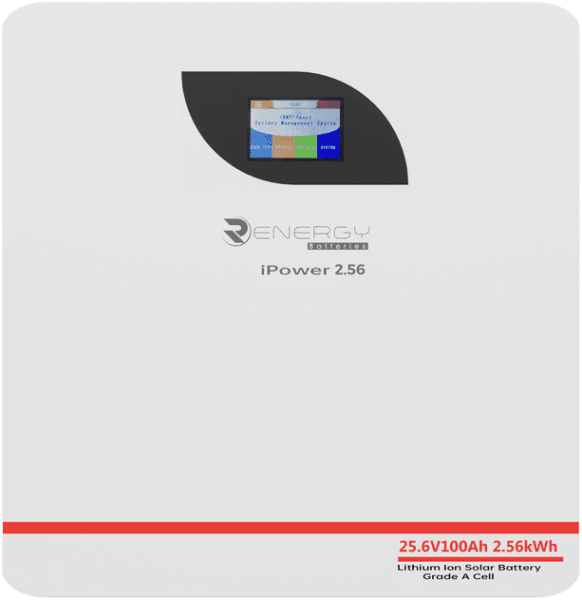
Renergy iPower 2.56 kWh Lithium Battery — 24V LiFePO4 Wall-Mount Solar Storage from a British Battery Brand
Renergy Power Limited has built its product range around premium Lithium-ion battery storage manufactured under British corporate ownership — registered in England and Wales under company number 10115425, established in 2016 to address the growing UK and global demand for efficient sustainable energy storage. Within the residential iPower wall-mount family, the Renergy iPower 2.56 kWh Lithium Battery occupies the smallest capacity position — a 24V architecture designed for installations where the dominant 48V residential hybrid voltage does not apply. The product fits a specific architectural niche in the Kenyan solar storage market: solar systems running on 24V system voltage where the buyer wants Renergy brand backing at a more modest capacity tier than the popular iPower 5.12. Local references to the product include Renergy iPower 2.56, the Renergy 24V lithium battery, the iPower 2.56, and the Renergy 100Ah 24V wall-mount battery.
Understanding the iPower 2.56’s place in the broader Kenyan solar landscape requires acknowledging that 24V system architecture is a minority voltage tier. Most Kenyan residential hybrid solar runs on 48V (or 51.2V nominal) — the voltage that the dominant hybrid inverter brands target as their primary architecture. 24V system voltage remains relevant for three specific scenarios: small off-grid installations where 48V infrastructure would be over-specified, mid-size 12V system upgrades stepping up to handle larger inverters and longer cable runs, and specialised applications where the inverter or load profile specifically requires 24V input. The iPower 2.56 is built for these specific scenarios rather than competing with the 48V residential mainstream.
For buyers committed to the 24V architecture, the Renergy brand association adds something the other 24V alternatives in the Kenyan market typically lack. Renergy Power Limited operates under UK corporate registration with the transparency and accountability that comes with British company law — separate from the offshore brand structures common to many lower-tier Chinese-manufactured battery brands. The brand backing routes warranty fulfilment, technical support escalation, and product roadmap continuity through a single accountable UK entity, providing a consistency that buyers facing 10-year residential project horizons typically value.
Where the iPower 2.56 fits in the Renergy iPower wall-mount family
The full Renergy iPower wall-mount range spans from the 2.56 kWh entry point through to 32.15 kWh commercial-scale capacities. Within that hierarchy:
| Renergy model | System voltage | Energy | Family position |
|---|---|---|---|
| iPower 2.56 — this product | 24V (25.6V) | 2.56 kWh | 24V entry point — smallest in the family |
| iPower 4.8-RM | 48V | 4.8 kWh | Mid-residential rack-mount form factor |
| iPower 5.12-RM | 51.2V | 5.12 kWh | Rack-mount variant of the 5.12 |
| iPower 5.12 | 48V / 51.2V | 5.12 kWh | Mainstream residential wall-mount workhorse |
| iPower 10.24 | 51.2V | 10.24 kWh | Larger residential single-unit |
| iPower 14.34 | 51.2V | 14.34 kWh | Large residential to small commercial bridge |
| iPower 16.07 | 51.2V | 16.07 kWh | Top-tier residential single-unit |
| iPower 28.67 | High voltage | 28.67 kWh | Commercial-tier storage |
| iPower 32.15 | High voltage | 32.15 kWh | Largest in the residential/commercial range |
The 24V system voltage of the iPower 2.56 makes it architecturally distinct from the rest of the iPower family — the 4.8-RM through 32.15 models run at 48V or higher. A buyer choosing the iPower 2.56 is committing to a 24V solar installation, which means specifying matched 24V solar charge controllers and 24V inverters across the rest of the system. Mixing the iPower 2.56 with the 48V iPower models in the same installation is not technically feasible without intermediate DC-DC conversion that’s rarely cost-justified.
One workaround pattern that does see use: stacking two iPower 2.56 units in series produces a 48V system voltage at 2.56 kWh combined capacity. This is technically possible but produces a different operational profile than dedicated 48V batteries — the BMS units in each unit operate independently rather than coordinating across the series stack, and warranty terms for series-stacked operation should be verified with Renergy before commissioning. Buyers wanting 48V architecture in a Renergy battery are typically better served by the iPower 4.8-RM or iPower 5.12 directly.
Three buyer profiles that consistently reach the iPower 2.56
The first profile is the rural Kenyan off-grid homeowner with modest electrical demand running a 24V system architecture. These installations typically pair 600W-1.5kW solar arrays with a 24V charge controller (PWM or MPPT) and a 1.5-2.5kW 24V inverter — supporting LED lighting throughout, refrigeration, fans, phone charging, basic entertainment, and modest appliance use. Daily energy consumption sits at 1-2 kWh, which the iPower 2.56 covers at moderate Depth of Discharge (40-80%) — operating comfortably within the rated cycle life envelope. The 24V architecture step up from common 12V off-grid systems handles slightly larger inverters and longer cable runs more efficiently than the 12V alternative.
The second profile is the country property or weekender installation — holiday homes at Naivasha, Magadi, Maasai Mara fringe, coastal cottages, highland country retreats — where the property is used intermittently and the storage system sits at partial state of charge between visits. The Grade A LFP cells inside the iPower 2.56 hold storage capacity much better than lead-acid alternatives that sulfate at partial state of charge. Combined with the 5%~95% humidity tolerance, the product suits the intermittent-use property pattern that Kenyan country properties typically follow. The 25 kg lightweight design also matters here — single-person handling at remote installations is easier than the 45-50 kg larger batteries require.
The third profile is the telecom site operator, security system installer, or specialised commercial backup buyer running 24V system architecture for technical reasons. Some legacy telecom and security infrastructure was designed around 24V DC bus voltage rather than the dominant 48V hybrid solar voltage — for these sites, the iPower 2.56 provides modern LFP chemistry in the matched system voltage without forcing an architectural transition to 48V. The 16-unit parallel scaling supports growing site backup capacity from 2.56 kWh up to approximately 41 kWh at the same 24V voltage, covering most specialised backup scenarios.
Where the iPower 2.56 is the wrong specification
Three scenarios where this product is not the right choice. The first is mainstream Kenyan residential hybrid solar installations. These typically run at 48V/51.2V system voltage paired with the dominant hybrid inverter brands. For these installations, the iPower 5.12 (the 48V/51.2V cousin of the 2.56) is the correct Renergy choice — the architectural compatibility with 48V hybrid inverters and matched-voltage solar charge controllers makes the 5.12 the mainstream Renergy residential option. Buyers wanting Renergy brand backing at a 48V architecture should look at the 5.12 or the rack-mount iPower 5.12-RM variant.
The second is very small off-grid installations where 12V architecture remains adequate. Households running just 200-500W of solar with a 1kW inverter, supporting basic lighting and phone charging only, are well served by 12V architecture — and the iPower 2.56 at 24V requires stepping up the entire system. The Suness EV-2.56N at 12V provides the same 2.56 kWh capacity with the simpler 12V system voltage that smaller installations typically prefer. The decision criterion is the inverter and PV array sizing — if the buyer needs more than about 1.5kW inverter capacity, 24V starts to make sense; below that, 12V is usually adequate.
The third is buyers needing significant storage capacity (5+ kWh of usable energy daily). The iPower 2.56’s 2.56 kWh nominal capacity is fundamentally limited at the single-unit level — parallel-stacking to reach 5+ kWh requires 2-3 units of complexity where one larger single-unit battery would be simpler. For these capacity requirements, stepping up to a 48V architecture with the iPower 5.12 or larger gives more practical economics.
Six engineering features that distinguish the iPower 2.56
- Grade A LFP cells across the 8-cell series stack: The eight cells in series inside the iPower 2.56 are all Grade A LiFePO4 cells per the Renergy specification — passing all manufacturer specifications on first factory inspection. The cell-level quality consistency matters at the 24V architecture because four cells in series carry less voltage redundancy than the 16-cell 48V stacks; weak cells affect pack capacity more visibly. Grade A cell sorting protects the 8,000-cycle rating across the operational life of the pack.
- Three-tier cycle life rating (8,000 / 6,000 / 4,000): Renergy publishes cycle life at three Depth of Discharge points: 8,000 cycles at 50% DOD, 6,000 cycles at 80% DOD, and 4,000 cycles at 100% DOD — all tested at 0.2C rate and 25°C reference temperature. The three-point disclosure lets buyers match the rating against their actual operational profile. Conservative-cycling installations (40-60% DOD daily) get the 8,000-cycle envelope; aggressive-cycling installations (90-100% DOD daily) get 4,000 cycles. Single-figure cycle ratings from competing brands typically pick the most favourable DOD point and hide the operational sensitivity.
- Greater than 98% round-trip efficiency: The Renergy datasheet specifies >98% efficiency — among the highest in the residential LFP category. Round-trip efficiency is the ratio of energy delivered out of the battery to energy stored into it; a >98% rating means a 2.56 kWh charge delivers approximately 2.51 kWh back to loads. The 2-3% efficiency advantage over standard residential LFP batteries (typically 90-95%) compounds substantially over the cycle life of the unit — recovering more of the daily solar generation through the storage stage.
- Colour touch LCD with Bluetooth and WiFi connectivity: The local user interface uses a colour touch LCD on the battery enclosure showing real-time SoC, voltage, current, cell temperatures, cycle count, and alarm status. The touch interface allows menu navigation directly at the battery without requiring laptop or smartphone connection. Bluetooth and WiFi connectivity add wireless monitoring through smartphone apps or cloud platforms — operating without the optional accessory module purchase that some competing brands require for connectivity.
- RS485 and CAN bus inverter communication: Both communication protocols available on the same unit cover all major hybrid inverter brands available in the Kenyan 24V system market. Buyers choosing the iPower 2.56 don’t face the protocol-compatibility lottery that some battery brands create — the inverter installer selects whichever protocol the connected inverter supports.
- 16-unit parallel scaling at 24V system voltage: Up to 16 units in parallel takes total system capacity to approximately 41 kWh at 24V — comfortably covering most 24V system scaling scenarios without changing the fundamental product family. The parallel architecture coordinates the BMS units through the CAN bus link, ensuring balanced cell management across the parallel stack.
The British brand consideration at the 24V capacity tier
Most 24V lithium batteries available in the Kenyan market are unbranded or carry obscure Chinese manufacturer brands — the 24V tier sits below the threshold where major battery brands typically invest in product development and brand-building. The iPower 2.56 stands out at the 24V tier specifically because Renergy as a British-registered company applies the same brand standards and warranty backing across the full iPower family rather than relegating the smaller capacities to budget product lines.
For buyers, the implication is access to British corporate brand backing at a capacity tier where it’s normally unavailable. Renergy Power Limited under UK Companies House registration 10115425 carries the same accountability for the iPower 2.56 as for the larger iPower models — same warranty channel, same product engineering standards, same brand reputation at stake. The buyer gets the brand association of Renergy’s premium positioning at a substantially lower acquisition cost than the larger family members require.
This matters operationally for buyers planning long-horizon installations (10-15 years) where brand continuity and warranty channel accessibility affect total cost of ownership. Unbranded 24V batteries from generic suppliers may deliver acceptable initial performance, but warranty fulfilment, replacement-part logistics, and technical-support escalation become problematic when issues arise 5+ years into the installation life. Renergy’s structured brand approach addresses this consistency-of-support concern at the 24V tier specifically.
Practical engineering envelope for Kenyan installations
- Charging temperature 0°C to 55°C / discharging -20°C to 60°C: The discharging envelope is wider than the charging envelope — typical for LFP cells where cold-charging risks lithium plating damage. Kenyan installation environments comfortably sit inside the charging range (ambient rarely drops to 0°C even at highland altitudes like Eldoret, Nyandarua, Mount Kenya foothills). The discharging envelope covers coastal commercial heat extremes at Mombasa and Diani as well as overnight highland cool conditions.
- Storage temperature -10°C to 30°C with 5-95% humidity range: Long-term storage requires the narrower temperature envelope — relevant for distributors holding stock or for buyers shelving batteries between intermittent installation phases. The wide humidity tolerance covers everything from arid Northern Kenya through to coastal Indian Ocean humidity at Mombasa, Diani, Watamu, and Kilifi.
- Recommended 50A versus maximum 100A charge current: The Renergy datasheet distinguishes recommended charge current (50A for optimal cycle life) from maximum charge current (100A). Solar PV charging at 25-50A from a typical 1-2kW PV array stays within the recommended envelope; faster-charging scenarios pushing toward the 100A maximum should be limited to periodic use rather than daily operation to protect the rated cycle life.
- Output voltage range 21.6V to 29.2V (cut-off at 21.6V): The battery operates across this voltage envelope as State of Charge changes from full to fully discharged. Connected 24V inverters and 24V loads should tolerate the full voltage range; most modern 24V inverters operate comfortably across 20-32V input. Loads designed for nominal 24V should accept the LFP voltage curve which holds higher voltage through most of the discharge cycle compared to lead-acid alternatives.
- Wall-mount form factor at 480 × 370 × 165 mm and 25 kg: The compact wall-mount enclosure fits cleanly in domestic utility spaces, garages, and small equipment rooms. The 25 kg weight allows single-person installation handling — substantially easier than the 45-50 kg weights of the larger iPower units. Mounting requires solid wall construction (masonry, concrete, or reinforced framing); standard plasterboard partitions need backing reinforcement to support the load and any installation-related impact.
- Touch screen LCD operation mode selection: Multiple operating modes are selectable through the LCD interface — accommodating different inverter pairing scenarios, monitoring depth preferences, and parallel-configuration setups without requiring laptop tools or external configuration software.
- Built-in BMS with cell-level intelligent monitoring: The integrated Battery Management System monitors and manages cell temperature, current, voltage, State of Charge, and State of Health continuously. Protection actions across overcharge, over-discharge, short-circuit, over-temperature, and under-temperature conditions trigger automatically without external control intervention.
Compatible 24V solar charge controllers and inverters
The iPower 2.56 pairs with 24V solar charge controllers (both PWM and MPPT variants) widely available in the Kenyan market. Charge controllers should support LiFePO4 battery type selection — most modern MPPT controllers include this as a configuration option that adjusts absorption voltage (typically 28.4-28.8V for LFP at 24V) and float voltage (typically 27.2V for LFP at 24V) to the LFP chemistry profile. Older PWM controllers without lithium battery type selection may require manual parameter adjustment per the controller manufacturer’s documentation.
For 24V inverter pairing, the dominant 24V inverter brands available in Kenya typically support communication protocols compatible with the RS485 or CAN bus interfaces on the iPower 2.56. The protocol-level configuration depends on the specific inverter manufacturer’s documented battery compatibility list; the installer should verify pairing through the inverter manufacturer’s compatible battery section before commissioning. The Vestwood 24V inverter range provides matched-brand operation for 24V system architecture where complete single-brand ecosystem alignment matters operationally.
Where the iPower 2.56 deploys across Kenyan installations
- Rural off-grid homesteads at 24V system architecture: Households running 600W-1.5kW solar arrays with 1.5-2.5kW 24V inverters supporting LED lighting throughout, refrigeration, fans, phone charging, basic entertainment, and modest appliance use. Single or paired iPower 2.56 units cover 1-2 kWh daily energy consumption at moderate DOD.
- Country property and weekender installations across upmarket holiday locations: Holiday homes at Naivasha, Magadi, the Maasai Mara fringe, Tigoni country properties, coastal cottages at Diani and Watamu, highland retreats — the LFP chemistry’s storage tolerance suits the intermittent property usage pattern where the system sits at partial state of charge between visits.
- Specialised 24V telecom site backup at remote tower and repeater locations: Legacy telecom infrastructure designed around 24V DC bus voltage — cellular tower auxiliary backup, microwave repeater sites, rural ISP point-of-presence sites — where the LFP chemistry replaces tired lead-acid banks while maintaining the existing 24V system architecture.
- Security system backup with 24V DC bus equipment: CCTV systems using 24V DC distribution, electric fence energiser backup, gate motor backup at 24V architecture, alarm system standby — security installations where the matched system voltage avoids the DC-DC conversion overhead of stepping between battery voltage and equipment voltage.
- Marine and RV installations stepping up from 12V to 24V: Boat house battery applications and RV conversions transitioning from 12V to 24V architecture for larger inverter sizing or longer cable run efficiency — the iPower 2.56 provides Renergy brand backing in the matched 24V system voltage.
- Small light commercial standby applications at 24V: Smaller commercial premises with specialised equipment requiring 24V DC backup — typically smaller offices, dental practices, optometry clinics, small retail establishments with 24V DC critical loads.
- Renergy brand entry-point installations: Buyers wanting Renergy brand backing at a more modest capacity tier than the iPower 5.12 — possibly as a satellite installation paired with a primary Renergy installation elsewhere, or as a first Renergy purchase establishing brand familiarity before committing to larger family members.
- Lead-acid retirement scenarios at 24V architecture: Existing 24V solar installations with aged lead-acid or AGM battery banks reaching end-of-life — the iPower 2.56 drops into the existing 24V system after a LiFePO4 chemistry reconfiguration on the charge controller, delivering modern cycle life and depth-of-discharge advantages while preserving the existing 24V inverter and load infrastructure.
Specifications — from the official Renergy iPower 2.56 datasheet
| Specification | Value |
|---|---|
| Bicity SKU | BC-BAT-RENERGY-2.56 |
| Brand | Renergy Power Limited (UK) |
| UK corporate registration | Company number 10115425, registered in England and Wales |
| Brand established | 2016 in the United Kingdom |
| Product family | iPower Residential wall-mount |
| Model | iPower 2.56 |
| Cell chemistry | LFP (Lithium iron phosphate) — Grade A cells |
| Cell configuration | 8 cells in series (8S) |
| Rated voltage | 25.6V (24V nominal system voltage) |
| Rated capacity | 100Ah |
| Rated energy | 2.56 kWh |
| Output voltage range | 21.6V – 29.2V |
| Charging voltage | 28.8V – 29.1V |
| Cut-off voltage | 21.6V |
| Maximum charging current | 100A |
| Recommended charging current | 50A |
| Maximum discharging current | 100A |
| Round-trip efficiency | Greater than 98% |
| Cycle life at 50% DOD | 8,000 cycles (0.2C, 25°C) |
| Cycle life at 80% DOD | 6,000 cycles (0.2C, 25°C) |
| Cycle life at 100% DOD | 4,000 cycles (0.2C, 25°C) |
| Design life | Greater than 10 years |
| Dimensions (L × W × H) | 480 × 370 × 165 mm |
| Weight | 25 kg |
| Charging temperature range | 0°C to 55°C |
| Discharging temperature range | -20°C to 60°C |
| Storage temperature range | -10°C to 30°C |
| Operating humidity | 5% to 95% relative humidity |
| Local user interface | Colour touch LCD screen |
| Wireless connectivity | Bluetooth and WiFi |
| Inverter communication | RS485 and CAN bus |
| Parallel scaling | Up to 16 units (~41 kWh total at 24V) |
| Form factor | Wall-mount enclosure |
| Operating mode selection | Touch screen menu interface |
| BMS monitoring scope | Cell temperature, current, voltage, State of Charge, State of Health |
| Inverter compatibility | Wide range of inverter brands supporting RS485 or CAN bus protocols at 24V architecture |
Installation considerations for the iPower 2.56
The iPower 2.56 installation workflow sits between the small-format 12V drop-in replacement complexity and the larger 48V wall-mount commissioning requirements. An EPRA-registered electrician familiar with both 24V solar architecture and wall-mount lithium battery installation handles the work scope effectively. Six considerations drive the practical installation approach:
Wall structural verification. The 25 kg unit weight requires solid wall construction at the mounting position. Standard masonry, concrete, or reinforced framing supports the load comfortably; plasterboard partitions, hollow stud walls, or lightweight construction require backing reinforcement before installation. The wall-mount approach saves floor space compared to free-standing alternatives but transfers the structural load to the wall, so verifying the wall capacity matters operationally.
24V architecture coherence across the system. The iPower 2.56’s 24V system voltage must match the rest of the installation — the solar charge controller, the inverter, and any DC loads should all operate at 24V nominal. Mixing the iPower 2.56 with 48V components (a common error when buyers transitioning from existing 48V systems acquire the iPower 2.56 thinking it will work) creates an architectural incompatibility that requires DC-DC conversion infrastructure to bridge.
Charge controller LiFePO4 configuration. The connected solar charge controller needs configuration for LiFePO4 chemistry — most modern MPPT controllers include “Lithium” or “LiFePO4” as a battery type selection that adjusts absorption voltage (28.4-28.8V for 24V LFP) and float voltage (27.2V for 24V LFP) to the chemistry profile. Skipping this configuration step (leaving the controller set for lead-acid defaults) reduces cycle life materially by holding the battery at sub-optimal charging voltages.
Cable sizing for 100A maximum current envelope. The 100A maximum charge and discharge current at 24V system voltage requires appropriate stranded copper cable sizing between battery, charge controller, and inverter. For typical residential cable run lengths of 2-3 metres, 16-25 mm² stranded copper handles the load adequately once ambient temperature derating is factored in. Where conductors run further or where the equipment room sits at higher ambient temperatures, step up to a larger cross-section to keep voltage drop within acceptable limits.
Communication protocol selection at commissioning. The dual RS485 and CAN bus availability gives flexibility, but the installer needs to verify which protocol the connected 24V inverter supports and configure the matching channel on the iPower 2.56 through the touch LCD menu. Verifying communication establishment before final commissioning prevents non-obvious operational issues that present as unrelated faults later.
Bluetooth and WiFi pairing for mobile monitoring. The wireless connectivity features require initial pairing with the buyer’s smartphone (Bluetooth) and home network (WiFi) — typically a 5-10 minute commissioning task per the Renergy app documentation. Skipping this commissioning step leaves the wireless features inactive; the local touch LCD continues to provide status visibility but the mobile monitoring advantages are not realised.
Building a 24V off-grid solar installation and want Renergy brand backing at the residential entry tier? Replacing tired 24V lead-acid batteries in an existing small off-grid system? Pairing a Renergy iPower 2.56 with a 24V inverter at a country property or weekender installation?
The Renergy iPower 2.56 kWh Lithium Battery brings the British brand’s iPower family quality standards to the 24V architecture in a compact 25 kg wall-mount form factor with greater than 98% round-trip efficiency, the three-tier cycle life rating across 50/80/100% DOD operational profiles, and colour touch LCD with built-in Bluetooth plus WiFi connectivity. Size your 24V installation through the Solar Calculator against your daily kWh load, then submit your specification through My Quote for a complete 24V bill of materials including iPower 2.56 quantity, matched 24V solar charge controller, 24V inverter sizing, and DC protection components matched to the 100A current envelope of the installation.