Description
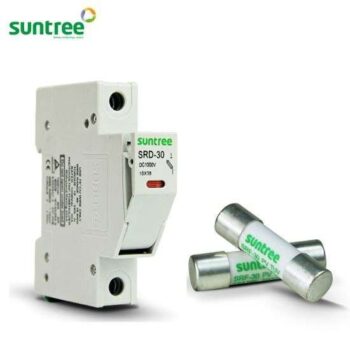
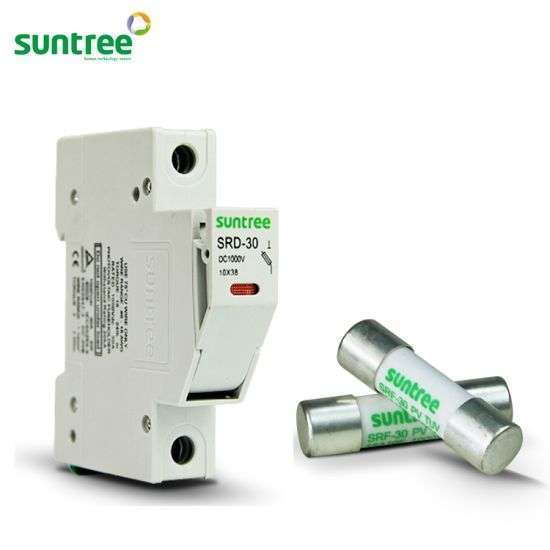
Solar DC Fuse Holder 20A Kenya — Suntree SRF-30 PV Fuse with Holder 1000VDC for Standard Residential Solar
The Solar DC Fuse Holder 20A from Suntree — sold across the Kenyan standard residential solar market under several names including Suntree SRF-30 PV Fuse Holder 20A, the 10x38mm gPV Solar Fuse 20A, the DC Fuse Link with Holder 20A, the PV String Fuse 20A 1000VDC, and the Standard Residential PV Fuse 20A — is the everyday workhorse of Kenyan residential solar overcurrent protection. Most installations in the residential 5-8 kW capacity band that dominates the Kenyan home solar market use this variant for string-level protection because the typical residential panel string current matches the 20A fuse rating with appropriate engineering margin.
The 20A variant sits at the centre of the practical residential PV fuse range. It pairs naturally with the 5-8 kW residential installations that have become standard across the Kenyan home solar market — 6-8 modern higher-output panels (450W to 500W class, the dominant residential module size) producing string short-circuit currents in the 11-13A range. Applying the IEC 60364-7-712 sizing margin of 1.56× to typical residential Isc values produces fuse sizing requirements that the 20A rating handles precisely — comfortably above the legitimate operating current while providing the rapid-response fault protection that the gPV class characteristic delivers.
Many Kenyan installers default to the 20A variant as the residential standard because most home installations fall within its design envelope. This is correct engineering practice rather than lazy specification — the residential market has standardised around panel current ratings that the 20A fuse correctly serves. Smaller installations using older or smaller-output panels may genuinely need the 16A variant; larger installations using higher-output panels or parallel-string commercial configurations may genuinely need the 32A variant. But the 20A variant covers the broad middle of the residential market where most Kenyan home solar deployments sit.
What makes the 20A variant the residential standard
The Kenyan residential solar market has standardised around specific panel and inverter combinations that drive the 20A fuse selection as the most common residential variant. Five factors converge on the 20A as the workhorse:
- Modern residential panel current characteristics: Higher-output residential panels in the 450W to 500W class — the dominant module size in Kenyan residential installations — typically carry short-circuit current (Isc) in the 11-13A range under standard test conditions. Applying the standard 1.56× IEC sizing margin produces fuse sizing requirements of approximately 17-20A, with the 20A rating providing the appropriate next-standard rating above this calculated value.
- Vestwood residential inverter design point: The Vestwood 5kW Hybrid Inverter and Vestwood 6kW Hybrid Inverter — the dominant residential inverter pairings in the Kenyan market — accept string current up to approximately 18-22A continuous through their MPPT inputs. The 20A fuse rating matches this inverter input envelope with appropriate string-level protection that operates before the inverter input protection circuits engage.
- Typical residential string length and current: Most Kenyan residential installations use single strings of 6-8 panels in series. Series panel configurations produce voltage proportional to the number of panels but maintain string current at the single-panel level. The 20A fuse handles the single-panel current envelope of modern residential modules with appropriate margin.
- Residential combiner box current density: Standard residential combiner boxes integrate 2-4 string positions, each with its own SRF-30 PV fuse. The 20A current per string position keeps total combiner box current density at sustainable levels for residential enclosure cooling without specialty heat-management provisions.
- Cost-to-protection ratio at the residential price point: The 20A fuse occupies the standard residential price tier — modestly higher than the 16A entry variant, substantially lower than the 32A larger-residential variant. The pricing aligns with the equipment value of standard residential installations, keeping protection cost proportional to the panel and inverter investment being protected.
How the 20A fits within the SRF-30 PV fuse family
The Suntree SRF-30 holder hosts standard 10x38mm cylindrical PV fuse cartridges across three current ratings in the Bicity Solar range. The 20A variant sits at the workhorse position between the smaller 16A entry rating and the larger 32A commercial-residential rating:
| Fuse Holder Assembly | Current Rating | Typical Application Tier |
|---|---|---|
| Solar DC Fuse Holder 16A | 16A continuous | Smaller residential (3-5 kW), entry installations, smaller off-grid |
| Solar DC Fuse Holder 20A — this product | 20A continuous | Standard Kenyan residential (5-8 kW) — the dominant residential workhorse variant |
| Solar DC Fuse Holder 32A | 32A rating | Larger residential 8-12 kW plus small commercial 8-15 kW, including parallel-string scenarios |
The 20A variant covers the largest segment of the Kenyan residential solar market — installations where homeowners invest in mainstream solar capacity to offset domestic electricity bills, provide reliable backup during national grid outages, and reduce ongoing dependence on rising grid electricity costs. Most Kenyan residential solar installations completed in the past several years use this 20A variant; the smaller 16A and larger 32A variants serve their respective niches at the edges of the residential market.
When the 20A is correctly sized for an installation
The 20A variant is appropriately sized for installations meeting three engineering criteria. Verify each criterion before defaulting to the 20A simply because it is the most common variant:
- Panel string short-circuit current (Isc) in the 11-13A range: Modern residential higher-output panels typically carry Isc in this range under standard test conditions. The panel datasheet specifies the exact Isc value — verify before specifying the fuse rating. Panels with Isc below 11A drive sizing toward the 16A variant; panels with Isc above 13A drive sizing toward the 32A variant or parallel-string protection arrangements.
- Standard residential single-string or independent parallel-string protection: The 20A protects one string. Single-string standard residential installations install one 20A SRF-30 per pole at the combiner string entry. Parallel-string installations install one 20A SRF-30 per string position inside the residential combiner — each string has its own fuse providing independent string-level protection while the strings combine at the busbar downstream of the fuses.
- Residential 550V architecture or smaller off-grid voltage classes: The 1000VDC holder and cartridge ratings sit well above the residential 550V envelope, leaving plenty of voltage margin for cold-morning string peaks. The same 1000V coverage also extends to entry commercial 1000V configurations where the 20A current rating remains appropriate — though commercial 1000V installations more typically use the larger 32A variant due to higher per-string current at the commercial scale.
When the 20A is the wrong choice — step up or step down
Three scenarios where the 20A is incorrectly sized and you should select a different variant from the same SRF-30 family. First, smaller residential installations using older or smaller-output panels (300-400W class) with Isc in the 9-11A range produce fuse sizing requirements below the 20A rating. Use the 16A variant for these smaller installations; the 20A would technically work but provides less optimal protection margin than the correctly-sized 16A variant.
Second, larger residential installations using high-output panels (550W+ modern modules) or commercial installations with parallel-string combining where the combined post-combiner current exceeds 25A need the 32A variant. The 20A would nuisance-trip under legitimate high-irradiance operation in these higher-current installations.
Third, very small specialty installations (solar pumps, streetlight DC bus circuits, telecom backup systems) using small panel configurations with very low string current may need different fuse arrangements rather than the standard residential 20A. Specialty applications often use specialty fuse configurations matched to their specific current profile.
How the 20A SRF-30 integrates into the standard residential protection scheme
The 20A PV fuse holder sits inside the residential combiner box at the string entry position, working alongside the other DC protection categories in the complete residential scheme. The standard residential installation typically includes:
| Protection Layer | Function | Position in Residential Installation |
|---|---|---|
| 20A SRF-30 PV Fuse Holder — this product | String-level overcurrent and reverse-current protection | At each string entry inside the residential combiner |
| SISO-40 DC Isolator Switch | Manual array-side disconnection | Rooftop near the panel array |
| 2P 550VDC DC MCB | Combiner output overcurrent and manual switching | At combiner box output and at inverter DC input |
| 2P 600VDC DC SPD | Transient voltage surge diversion to earth | Inside combiner box and at inverter DC input |
| Vestwood 5kW or 6kW Hybrid Inverter | DC-to-AC conversion plus battery management | Indoor or weather-protected outdoor location |
The 20A PV fuse handles string-level fault protection that no other device in the residential scheme provides. The DC MCB protects combined-output overcurrent but cannot interrupt selectively for string-specific faults. The DC SPD protects against transient surge voltage events but does not interrupt fault current. The DC isolator provides manual switching but no automatic protection. Only the PV fuse provides the string-level automatic overcurrent protection — making it an essential layer in any properly engineered residential scheme.
Why most Kenyan residential installations need string-level fuse protection
The case for string-level PV fuse protection in standard residential installations rests on five practical scenarios that residential systems actually experience over their 20-25 year operating lifetime. Indirect lightning events affecting nearby panels can damage individual modules; damaged modules can create internal short circuits driving fault current through the string. Animal damage to panel cables (rats, cats, monkeys, birds in coastal and highland Kenya regions) can short-circuit individual conductors within the string. Water ingress into module junction boxes during the long rains can cause progressive electrical degradation that culminates in string-level faults. Cable insulation aging over the 20+ year project life eventually leads to insulation failure events — slow-developing rather than catastrophic, but eventually requiring fuse interruption. Manufacturing defects in panels, junction boxes, or string-side connectors occasionally produce fault conditions that the string-level fuse must clear before the fault damage propagates to adjacent strings or downstream equipment.
Without string-level PV fuse protection, these fault scenarios propagate through to downstream equipment — damaging the residential inverter, affecting parallel strings through reverse current, potentially creating fire risk in cable runs. The 20A SRF-30 PV fuse handles all five fault scenarios within milliseconds of the fault current exceeding the fuse rating, isolating the faulted string before the damage spreads. The protection investment is modest compared to the residential equipment it protects.
Technical Specifications
| Specification | Value |
|---|---|
| Bicity SKU | BC-PVF-1000V-20A |
| Manufacturer | Suntree / XinChi Electric Group — SRF-30 holder line equipped with the 10x38mm gPV cartridge at the 20A current rating |
| Device category | PV Fuse + Holder Assembly — standard residential string-level overcurrent protection |
| Fuse class | gPV photovoltaic full-range under IEC 60269-6 |
| Holder standard | IEC 60947-3 covering switches, disconnectors, and fuse-combination units |
| Rated voltage (Ue) | 1000V DC under continuous service |
| Rated current (In) | 20A continuous rating |
| Breaking capacity (Icn) | 33 kA short-circuit at 1000VDC |
| Minimum interrupting current | 1.3× In (approximately 26A) per the gPV characteristic |
| Time constant under test | Sub-millisecond DC circuit time constant |
| Pole configuration | 1-pole holder accepting one 10x38mm cylindrical fuse cartridge |
| Fuse dimensions | 10mm diameter × 38mm length (standard 10x38mm) |
| Holder DIN rail width | 18mm single standard module |
| Operating temperature range | -30°C through +70°C in service |
| Storage temperature range | -40°C through +85°C de-energised |
| Mounting | Standard 35mm DIN rail snap attachment for combiner boxes |
| Terminal capacity | Solar PV stranded copper 2.5mm² through 10mm² per terminal |
| Holder body material | Polycarbonate with elevated heat-deflection rating and UV resistance |
| Fuse cartridge body | Ceramic with sand-filled arc-quench chamber |
| Power dissipation | Approximately 4W at full rated load |
| Withdrawal safety | Lid-locked mechanism prevents removal of energised fuse under load |
| Compliance | Certified to IEC 60269-6 for the fuse cartridge and IEC 60947-3 for the holder, with CE marking and TUV third-party verification |
| Service life (no fault events) | Open-ended under normal use — cartridge replacement only after fault events |
| Net weight | Approximately 0.09 kg complete assembly |
Engineering Features Specific to the 20A Standard Residential Variant
- 20A continuous rating sized for modern residential strings: Matches the 11-13A Isc range of modern higher-output 450-500W residential panels with the standard 1.56× sizing margin per IEC 60364-7-712 OCPD recommendations. Provides comfortable fault protection while remaining well above legitimate high-irradiance operating current.
- 1000VDC voltage envelope with broad architectural coverage: Rated voltage that handles residential 550V architecture with substantial margin and extends through entry commercial 1000V deployments. Same holder hosts different cartridge ratings for different installation tiers.
- 33 kA breaking capacity for full residential short-circuit interruption: Substantial interrupting capability handles the short-circuit fault currents that develop in faulted residential strings, including reverse-current scenarios where parallel healthy strings drive fault energy into a faulted string through the residential combiner busbar.
- gPV class for residential-appropriate fault behaviour: Full-range interrupting characteristic per IEC 60269-6 ensures the fuse operates dependably right across the fault spectrum that residential systems actually see — from outright short-circuit currents all the way down to slow sustained overloads where general-purpose AC fuse classes commonly fail to interrupt.
- Sub-millisecond DC time constant testing: Tested under DC circuit conditions that mirror real residential installation behaviour rather than AC laboratory conditions. Confirmed to clear DC fault currents cleanly without lingering arc events that could otherwise compromise adjacent residential combiner devices.
- Lid-locked safety withdrawal mechanism: The SRF-30 holder lid release is interlocked with the cartridge contact path so that opening the lid breaks the load circuit before the cartridge separates from the terminals. Residential service personnel must safely de-energise the string through the upstream SISO isolator before working on the holder — closing off the safety-critical possibility of pulling an arcing cartridge under live load.
- Standard 10x38mm cylindrical cartridge form factor: Industry-standard cartridge dimensions ensure replacement availability across the Kenyan solar market without manufacturer lock-in. Service replacement uses any IEC 60269-6 gPV-class 20A 10x38mm cartridge from certified Suntree or comparable suppliers.
- 18mm DIN rail footprint for residential combiner integration: Single-module width that fits cleanly inside residential combiner boxes alongside the per-string fuses for adjacent strings, plus the downstream DC MCBs, DC SPDs, and busbar arrangements. Standard residential combiner box layouts accommodate the 20A SRF-30 without modification.
- Approximately 4W power dissipation at full residential load: Modest heat generation under continuous residential operation. Standard combiner box ventilation handles the per-fuse dissipation without specialty heat-management arrangements; verify the combiner enclosure rating supports the total combined dissipation of all installed fuses and adjacent devices.
- IEC 60269-6 PV-specific certification for residential compliance: The PV-specific fuse standard that EPRA residential inspectors verify on solar installation documentation — distinguishing the gPV class from general-purpose IEC 60269-1 fuses inappropriate for solar DC service.
Typical Kenyan Standard Residential Installation Scenarios for the 20A Variant
- Standard residential solar across Karen, Runda, Muthaiga, Lavington, Kilimani, Westlands, Spring Valley, Lower Kabete, Kileleshwa, Loresho, Ridgeways — Nairobi premium residential areas where 5-8 kW solar with Vestwood 6kW Hybrid Inverter pairing is the typical installation pattern
- Mid-range residential solar across Kiambu, Limuru, Tigoni, Ruiru, Thika, Athi River, Machakos suburbs where 5-7 kW installations with higher-output modern panels need the 20A string protection
- Coastal premium residential homes in Mombasa Nyali, Bamburi, Shanzu, Diani, Watamu, Malindi, Kilifi where 5-8 kW residential systems require string-level protection alongside surge protection due to coastal lightning and salt-air conditions
- Highland standard residential solar in Murang’a, Nyeri, Embu, Meru, Nyahururu, Karatina, Kerugoya where afternoon thunderstorm activity drives complete DC protection scheme requirements at the residential scale
- Lake Victoria basin standard residential solar in Kisumu, Kakamega, Bungoma, Siaya, Migori, Busia where lightning frequency makes the complete DC protection scheme (PV fuses + SPDs + MCBs + isolators) economically essential for residential project life
- Rift Valley standard residential solar in Nakuru, Naivasha, Eldoret, Kericho, Bomet residential estates where 5-8 kW systems support household electrical needs through national grid instability
- Standard hybrid residential installations with battery storage where 5-15 kWh lithium battery banks pair with 5-8 kW solar generation, requiring the complete protection scheme including 20A string-level PV fuses
- Premium home office and home business solar where workspace electrical demand justifies 5-8 kW capacity with proper string-level protection matched to the modern higher-output panels typically specified for these installations
- Religious institution solar at neighbourhood churches and smaller mosques operating at the 5-8 kW capacity range where the 20A fuse rating provides the appropriate string-level protection scale
- Smaller clinic, dental practice, and optician solar at neighbourhood medical facilities where the equipment value justifies proper string-level protection while the system capacity sits in the standard residential band
- Boutique hotel and small B&B solar at coastal hospitality properties and upcountry tourism establishments operating at 5-8 kW residential-scale capacity
- Smaller agricultural homestead solar at farms with substantial domestic electrical needs alongside productive operations — typically 5-8 kW installations using modern panels matched to the 20A string protection
Pairing the 20A SRF-30 with Bicity Solar ecosystem components
The 20A PV fuse holder integrates with several Bicity Solar residential products to build the complete standard residential protection scheme. Four common integration patterns appear across Kenyan standard residential installations:
- Standard residential 5-8 kW single-string: One 20A SRF-30 in the residential combiner: A standard residential single-string installation routes 6-8 modern higher-output panels via the rooftop SISO-40 array disconnector down to the residential combiner enclosure. Inside the combiner, the 20A SRF-30 PV fuse delivers string-level overcurrent protection at the string entry. The downstream sequence inside the combiner passes through a 2P 550VDC DC MCB on the combined output, then runs to the Vestwood 6kW Hybrid Inverter DC input. This is the dominant residential installation pattern in the Kenyan home solar market.
- Standard residential 5-8 kW parallel-string: Multiple 20A SRF-30 positions in the combiner: Residential installations running two or three strings in parallel install one 20A SRF-30 per string slot inside the residential combiner. Each string gets independent string-level protection upstream of the busbar combining, while the combined output is handled by a single downstream DC MCB rated for the cumulative current. This pattern suits larger residential installations spanning multiple roof faces or split-array architectures.
- Standard residential with comprehensive surge protection: Complete DC protection scheme: Combining the 20A SRF-30 with a 2P 600V DC SPD, a 2P 550VDC DC MCB, and the SISO-40 array-side isolator builds the protection package that EPRA-registered installers typically specify for standard residential systems across Kenyan lightning-active regions. The four devices each cover a distinct protection function within the integrated scheme — overcurrent at the string, surge events at the device, combined-output overcurrent, and manual disconnection at the array.
- Standard hybrid residential with battery: Protection across PV and battery sides: Hybrid residential installations carrying 5-15 kWh battery storage use the 20A SRF-30 PV fuse on the PV side for string-level protection. Some installations layer in separate battery-side fuse arrangements on the battery DC bus between the lithium bank and the inverter battery input — a different fuse rating and form factor sized for the battery DC current rather than the PV string current.
Installation Notes for the 20A SRF-30 in Standard Residential Systems
Installation must be performed by an EPRA-registered solar electrician experienced in standard residential solar installations. The 20A SRF-30 assembly mounts inside the residential combiner box as part of the broader installation workflow. Seven practical considerations apply to 20A installations:
First, fuse sizing verification matched to the specific panels. Even though the 20A is the residential standard, verify the calculation for the specific installation. Open the panel datasheet, identify the Isc value, multiply by 1.56 for the standard sizing margin, round up to the next standard rating. If the calculation produces 20A, install the 20A variant. If the calculation produces 16A or 32A, install the appropriate alternative from the same SRF-30 family. The engineering calculation should drive the specification rather than default residential conventions.
Second, residential combiner box space planning. The 20A SRF-30 occupies one DIN rail module per string position. Plan the residential combiner layout to accommodate one 20A SRF-30 per string plus the downstream DC MCB plus DC SPD plus busbar arrangements. Standard residential combiner enclosures accommodate this layout for 1-3 strings; larger string counts may require larger combiner enclosures.
Third, conductor sizing matched to the 20A current. The 20A string current uses 4mm² solar PV cable as the minimum residential conductor size — sized for both ampacity (with adequate derating margin) and voltage drop over the typical residential cable run length. Larger 6mm² conductors may be appropriate for longer cable runs or higher-temperature installation environments.
Fourth, terminal torque verification at residential commissioning. The 20A SRF-30 terminal screws require torque to the manufacturer-specified value using a calibrated torque wrench. Under-torqued terminals create high-resistance connections that heat under continuous residential operation, eventually causing thermal failure of the connection. Over-torqued terminals can damage the conductor strands or the holder terminal threads. Use the calibrated torque value during commissioning.
Fifth, polarity convention across the residential installation. Although the fuse cartridge is polarity-tolerant in its interrupting function, the rest of the residential installation depends on consistent polarity. Mark positive and negative consistently across all conductors entering and leaving the 20A SRF-30, supporting future residential maintenance work.
Sixth, lid-locked safety mechanism verification during commissioning. Test the holder lid mechanism with the residential array safely de-energised through the upstream SISO-40 isolator. Verify the lid opens cleanly, the cartridge can be withdrawn and reinserted, and the lid closes positively. The lid-lock prevents future residential service personnel from accidentally pulling a live cartridge under residential string load.
Seventh, replacement cartridge stock for residential maintenance. Each cartridge interrupts only once; after a fault event a fresh cartridge replaces the spent one. Bicity Solar suggests holding at least two spare 20A 10x38mm gPV cartridges on site for any standard residential installation, supporting same-visit fault clearance for the EPRA-registered installer without separate procurement trips.
Building a standard residential solar installation in Kenya (5-8 kW Vestwood 5kW or 6kW Hybrid pairing) with modern higher-output panels?
Specify the Solar DC Fuse Holder 20A (Suntree SRF-30 PV Fuse with Holder 1000VDC) as the string-level overcurrent protection inside your residential combiner box — the standard residential workhorse matched to typical Kenyan residential panel current. Pair with the SISO-40 rooftop DC isolator, a 2P 550VDC DC MCB downstream of the combiner output, a 2P 600V DC SPD for residential surge coverage, and a Vestwood hybrid inverter to complete the residential package — open the Solar Calculator to size your residential requirements, or share your project specifications through My Quote for a tailored residential bill of materials covering the fuse sizing verification step for your specific panel configuration.