Description
Solar DC Fuse Holder 32A Kenya — Suntree SRF-30 PV Fuse with Holder 1000VDC for Larger Residential and Small Commercial Solar
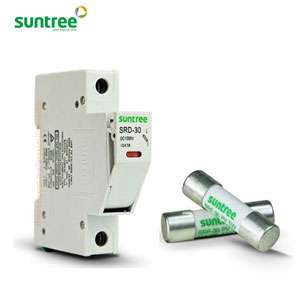
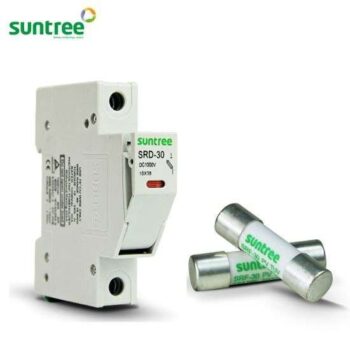
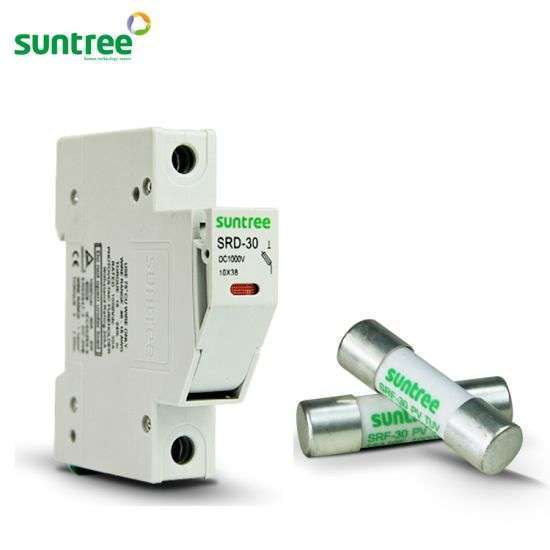
The Solar DC Fuse Holder 32A from Suntree — appearing across the Kenyan larger-residential and small-commercial solar market under several names including Suntree SRF-30 PV Fuse Holder 32A, the 10x38mm gPV Solar Fuse 32A, the DC Fuse Link with Holder 32A, the PV String Fuse 32A 1000VDC, and the Commercial Solar Fuse Holder 32A — is the larger-current protection variant within the SRF-30 family for solar installations operating above the standard residential current band. It serves the specific market segment between standard residential solar and the larger commercial deployments that move toward different fuse arrangements at the utility scale.
Three buyer scenarios drive 32A demand in Kenyan solar. Larger residential installations of 8-12 kW capacity using high-output panels in the 550W+ class generate per-string short-circuit currents in the 14-17A range — applying the standard 1.56× IEC sizing margin produces fuse sizing requirements that move beyond the 20A standard residential workhorse toward the 32A rating. Parallel-string residential combiners where multiple strings combine at the busbar create combined-output currents in the 25-30A range that the 32A fuse handles correctly at the combined position. Small commercial installations at the 8-15 kW capacity tier using commercial-grade panels and commercial-style combiner architectures size string protection at the 32A rating to match the commercial string current envelope.
Buyers reaching the 32A variant typically arrive after specific calculation rather than as a default specification. The 32A is rarely a casual purchase — it reflects either a larger residential installation with high-output panels, a parallel-string combining requirement at the residential or small-commercial scale, or a small commercial single-string protection scheme where the commercial-tier current envelope drives the rating upward. Verify your specific application against the engineering criteria below before defaulting to the 32A based on the “biggest available” impulse — undersizing the protection on a true commercial installation creates real safety gaps, but oversizing on a standard residential installation creates legitimate operating-current threshold issues.
When the 32A rating is genuinely appropriate
The 32A variant is correctly sized for installations meeting at least one of three engineering criteria. Each criterion identifies a specific installation pattern where the 32A rating is the right answer and the lower 20A workhorse is under-sized:
- Larger residential single-string with high-output 550W+ panels: Larger residential installations of 8-12 kW capacity sometimes use higher-output panels (550W, 580W, 600W modern modules) in single-string configurations. These higher-output panels carry short-circuit current (Isc) in the 14-17A range. Applying the standard 1.56× IEC sizing margin produces fuse sizing requirements of approximately 22-27A, with the next-standard rating above this calculation being the 32A variant. The 20A workhorse would nuisance-trip under legitimate high-irradiance operation at this current level.
- Parallel-string residential combiners with combined output above 25A: Residential installations where two or three strings combine at a busbar inside the combiner box produce combined currents that add up significantly. Two 14A strings combine to 28A continuous; three 11A strings combine to 33A continuous. The 32A fuse at the combined-output position protects the combined cable run from the combiner to the inverter where the standard residential 20A would under-size for the combined current. Note: each individual string still typically uses per-string 20A fuses at the string entry positions in addition to the 32A at the combined output.
- Small commercial single-string at 8-15 kW capacity: Small commercial installations at the lower end of the commercial market use single-string configurations with commercial-grade panels generating string currents in the 15-22A range. The 32A fuse correctly sizes the string protection for these small commercial installations. Larger commercial deployments (15-30 kW+) typically move to higher-capacity fuse arrangements beyond the 10x38mm form factor that the SRF-30 holder accommodates.
When the 32A is wrong — step down to the 20A standard residential
Three scenarios where the 32A is over-specified and the 20A workhorse is the correct answer. First, standard residential installations at the 5-8 kW capacity tier using current-generation 450-500W panels (the dominant residential module size) with Isc in the 11-13A range produce fuse sizing requirements in the 17-20A band — well within the 20A workhorse rating. The 32A on these standard residential installations is over-specified rather than safer; the fuse rating should match the calculated requirement rather than defaulting to larger.
Second, smaller residential installations at the 3-5 kW capacity tier using older or smaller-output panels with Isc in the 9-11A range produce fuse sizing requirements that the smaller 16A variant handles correctly. The 32A on these smaller installations is dramatic over-specification — neither safer nor more reliable, just larger and more expensive than the installation needs.
Third, single-string installations without parallel-string combining produce only the single-string current — no current combination drives the rating upward. Single-string installations match the fuse rating to the single-string Isc rather than to hypothetical combined currents that the installation does not actually produce.
How the 32A fits within the SRF-30 PV fuse family
The Suntree SRF-30 fuse holder accepts standard 10x38mm cylindrical cartridges across three current ratings in the Bicity range. The 32A variant occupies the larger-current position above the 20A residential workhorse, serving the upper-residential and small-commercial market segments:
| Fuse Holder Assembly | Rated Current | Typical Use Tier |
|---|---|---|
| Solar DC Fuse Holder 16A | 16A rating | Smaller residential 3-5 kW, entry installations, smaller off-grid scenarios |
| Solar DC Fuse Holder 20A | 20A rating | Standard residential 5-8 kW — the dominant residential workhorse band |
| Solar DC Fuse Holder 32A — this product | 32A rating | Larger residential 8-12 kW, small commercial 8-15 kW, parallel-string combined outputs above 25A |
The 32A variant covers a smaller market segment than the 20A workhorse but a larger market segment than the entry 16A. Larger residential is a growing band in Kenya — homeowners installing solar today often specify higher capacity than buyers from earlier years did, driven by higher household electrical loads, electric mobility considerations, and the broader pattern of residential systems expanding to support whole-home backup rather than just essential-load backup. Small commercial is also growing as offices, clinics, schools, and small hospitality businesses move from grid-only to grid-plus-solar electrical architecture.
The parallel-string combiner application — where the 32A pays for itself
The most common 32A application in Kenyan residential solar is the parallel-string combiner output position. Standard residential installations with two or three strings combining at a residential combiner busbar produce combined currents that exceed the 20A rating but stay within the 32A envelope. The 32A at the combined-output position protects the cable run from the residential combiner box to the residential inverter — protecting against faults in this cable run, against combined-output overcurrent that exceeds the inverter input rating, and providing the coordination point between per-string 20A protection upstream and inverter-level protection downstream.
The combiner architecture pattern for parallel-string residential typically uses one 20A SRF-30 per individual string at the string entry position, combined by a busbar, with the combined output passing through the 32A SRF-30 (or alternatively through a 32A DC MCB depending on the specific protection scheme). The per-string 20A fuses provide string-specific fault isolation including reverse current protection between healthy and faulted strings. The combined 32A fuse provides protection for the cable run from the combiner to the inverter plus combined-output overcurrent if the combined current somehow exceeds the inverter input capacity. The two fuse positions handle different fault scenarios at different points in the residential combiner architecture.
Where the 32A SRF-30 fits in the larger-residential and small-commercial protection scheme
| Protection Function | 32A SRF-30 Position | Other Devices in the Scheme |
|---|---|---|
| Larger residential single-string (8-12 kW, high-output panels) | One 32A SRF-30 per pole at the string entry inside the residential combiner box | SISO-40 rooftop isolator, 4P 1000V DC MCB at combiner output, 2P 600V DC SPD, hybrid inverter pairing |
| Parallel-string residential combiner (combined output) | One 32A SRF-30 at the combined-output position inside the residential combiner | Per-string 20A SRF-30 at each string entry, busbar combining, DC MCB downstream |
| Small commercial single-string (8-15 kW) | One 32A SRF-30 per pole at the string entry inside the commercial combiner | Commercial isolator at array, 4P 1000V DC MCB at combiner output, 4P 1000V DC SPD, commercial inverter pairing |
Each of these three patterns puts the 32A SRF-30 in a different position within the overall protection scheme. The single-string larger-residential pattern uses the 32A at the string entry. The parallel-string residential combiner uses the 32A at the combined-output position with smaller per-string fuses upstream. The small commercial pattern uses the 32A at the string entry but pairs with commercial-tier devices (4P 1000V DC MCBs, 4P 1000V DC SPDs) on the rest of the scheme rather than residential 2P 550V devices.
Technical Specifications
| Specification | Value |
|---|---|
| Bicity SKU | BC-PVF-1000V-32A |
| Manufacturer | Suntree (XinChi Electric Group) — SRF-30 holder line equipped with the 32A 10x38mm gPV cartridge |
| Device category | PV Fuse + Holder Assembly — larger-residential and small-commercial string-level overcurrent protection |
| Fuse class | gPV per IEC 60269-6 photovoltaic full-range standard |
| Holder standard | IEC 60947-3 for switching, disconnecting, and fuse-combination unit classification |
| Rated voltage (Ue) | 1000VDC continuous service rating |
| Rated current (In) | 32A continuous rating |
| Breaking capacity (Icn) | 33 kA short-circuit interrupting at 1000VDC |
| Minimum interrupting current | 1.3× In (approximately 42A) per the gPV class characteristic curve |
| Time constant during DC testing | Less than 1 ms DC time constant under fault test conditions |
| Pole configuration | Single-pole holder taking one 10x38mm cylindrical fuse cartridge |
| Fuse cartridge dimensions | 10mm diameter, 38mm length (industry-standard 10x38mm) |
| Holder width on DIN rail | 18mm — one standard module width |
| Operating temperature | -30°C up to +70°C in service |
| Storage temperature | -40°C up to +85°C without energisation |
| Mounting | 35mm DIN rail snap-fit click-on |
| Terminal capacity | Solar PV stranded copper from 2.5mm² up to 16mm² (larger conductor capacity than 16A/20A variants to support the higher current envelope) |
| Holder material | Polycarbonate with high heat-deflection performance and UV-stabilised resin |
| Cartridge body | Ceramic with sand-filled arc-extinction chamber |
| Power dissipation | Approximately 5-6W at the rated 32A continuous load |
| Withdrawal interlock | Lid-coupled mechanism breaking the contact path before cartridge separates from terminals |
| Compliance | IEC 60269-6 plus IEC 60947-3, with CE mark and TUV verification |
| Service life pre-fault | Indefinite under normal continuous operation — cartridge does not age during normal service |
| Net weight | Roughly 0.10 kg complete assembly |
Engineering Features Specific to the 32A Variant
- 32A continuous rating for the upper-residential and small-commercial current band: Sized to match string-level currents in the 14-17A Isc range produced by high-output 550W+ residential panels, plus combined parallel-string currents in the 25-30A range at residential combiner busbars, plus single-string commercial currents in the 15-22A range. Provides appropriate engineering margin without nuisance-tripping under legitimate operating peaks.
- 1000VDC voltage envelope spanning residential and commercial architectures: Rated voltage that handles residential 550V architecture with comfortable margin and extends fully through commercial 1000V deployments. The 32A current rating remains appropriate across both voltage classes for the applications it serves.
- 33 kA breaking capacity for combined fault current interruption: Substantial interrupting capability handles the larger short-circuit currents that develop in faulted larger-residential and small-commercial installations, including parallel-string combined-fault scenarios where multiple healthy strings drive fault current into a faulted string through the combiner busbar at the higher current density.
- gPV full-range characteristic for the larger-current envelope: The IEC 60269-6 full-range interrupting characteristic ensures the 32A cartridge clears faults across the entire spectrum it might encounter — from outright short circuits at hundreds of amps prospective fault current, through intermediate fault levels, down to sustained overload conditions just above the 32A continuous rating where general-purpose fuse classes routinely fail to interrupt.
- Sub-1 ms DC time constant in fault testing: Tested under DC fault conditions appropriate for the larger-current envelope rather than scaled-down AC test methodology. Confirmed to clear DC faults cleanly across the 32A rated current envelope without sustained arcing that could damage adjacent combiner devices at the higher dissipated energy.
- Lid-interlocked safety withdrawal at the higher current rating: The same SRF-30 holder safety mechanism applies at the 32A rating — the lid release breaks the cartridge contact path before the cartridge separates from the terminals. Particularly valuable at the higher current rating where the energy of arcing-under-load incidents would be substantially greater than at the lower 16A or 20A ratings.
- Larger terminal capacity supporting the 32A current envelope: Terminal acceptance up to 16mm² stranded copper provides the conductor capacity that the 32A continuous current requires with appropriate derating margin. Smaller-rated holders (16A and 20A) accept up to 10mm² conductors which would under-size for 32A continuous operation.
- Standard 10x38mm cartridge form factor at the larger rating: Industry-standard cartridge dimensions ensure replacement availability across the Kenyan solar market without manufacturer lock-in even at the larger 32A rating. Service replacement uses any IEC 60269-6 gPV-class 32A 10x38mm cartridge from certified Suntree or comparable suppliers.
- 5-6W power dissipation at full 32A load: Heat generation at full continuous load that the standard residential combiner enclosure ventilation handles adequately. Verify the combiner enclosure rating supports the total combined dissipation when multiple 32A fuses install side-by-side in parallel-string applications — the per-fuse dissipation scales with installed count.
- IEC 60269-6 PV-specific certification at the larger-current band: Same gPV class certification across the SRF-30 family — the standard EPRA inspectors verify on residential and small-commercial solar installation documentation regardless of the specific current rating.
- Cost-to-protection ratio at the larger-residential and small-commercial tier: The 32A variant carries modestly higher pricing than the 20A workhorse, matched appropriately to the higher-value installations it protects. The protection cost stays proportional to the larger panel arrays and larger inverter investments being protected — sustainable margin for the supplier without over-burdening the buyer.
Typical Kenyan Larger-Residential and Small-Commercial Scenarios for the 32A Variant
- Larger residential solar installations of 8-12 kW capacity in premium Nairobi areas (Karen large-plot residential, Runda extended residences, Muthaiga premium homes, Spring Valley larger properties, Tigoni country homes, Limuru residential estates, Kiambu larger residential plots) using high-output 550-600W modern panels
- Larger coastal residential properties in Mombasa Nyali large beach homes, Diani extended beach properties, Watamu premium villas, Malindi larger residential plots, Kilifi seafront homes where 8-12 kW solar generation supports larger household electrical loads plus battery backup
- Larger highland residential solar at Murang’a country estates, Nyeri extended residences, Embu premium homes, Meru larger residential, Nanyuki country estates where 8-12 kW installations support full-home backup including electric heating and water pumping
- Parallel-string residential combiners across mid-range and premium Nairobi residential where two or three strings combine at the combiner box producing combined currents in the 25-30A range
- Boutique hotel and lodge solar at coastal hospitality properties, upcountry tourism establishments, and conservancy lodges operating at 8-15 kW commercial-scale capacity with single-string or small parallel-string configurations
- Office and professional services solar at smaller commercial premises, accounting firms, legal practices, IT consultancies, architecture studios using 8-15 kW commercial-tier solar for workspace electrical loads
- Larger medical facility solar at private clinics, dental specialty practices, larger optician operations, larger medical labs operating at 8-15 kW commercial capacity where the equipment value justifies appropriate string-level protection
- Smaller manufacturing and processing solar at workshops, light manufacturing operations, agricultural processing centres, small bakeries, food processing operations at 8-15 kW commercial scale
- Religious institution larger solar at larger churches, mosques with significant electrical demand, religious training centres operating at 8-15 kW commercial-scale solar capacity
- Education facility solar at private schools, tutoring centres, vocational training establishments, professional training centres operating at 8-15 kW solar capacity
- Larger agricultural operation solar at substantial farms with both domestic and productive electrical demand, dairy operations with substantial milking and cooling loads, poultry operations with cooling and processing requirements, horticultural operations with greenhouse ventilation and irrigation
- Restaurant and hospitality smaller commercial solar at standalone restaurants, café operations, smaller event venues, smaller catering operations at 8-15 kW commercial scale
- Co-working and shared workspace solar at smaller co-working facilities, business incubator spaces, shared office facilities operating at 8-15 kW commercial capacity
Pairing the 32A SRF-30 with Bicity Solar ecosystem components
The 32A variant integrates differently across larger-residential, parallel-string-residential, and small-commercial installations. Three integration patterns dominate Kenyan deployments at the 32A scale:
- Larger residential 8-12 kW single-string with high-output panels: 32A SRF-30 at the string entry: A larger residential installation routes 8-10 high-output 550W+ panels via the rooftop SISO-40 array isolator down to the residential combiner enclosure. Inside the combiner, one 32A SRF-30 per pole provides string-level overcurrent protection at the entry. The combined output passes through a 4P 1000V DC MCB (BC-DCB-1000V-32A-4P or larger as appropriate) and runs to the larger hybrid inverter input. The 2P 600V DC SPD provides surge protection alongside the 32A fuse inside the residential combiner.
- Parallel-string residential combiner: One 32A SRF-30 at combined output position with per-string 20A protection upstream: Two or three strings each carrying their own 20A SRF-30 at the string entry combine through the residential busbar to the combined-output position. At the combined output, one 32A SRF-30 protects the cable run from the residential combiner to the inverter. The 32A combined-output fuse provides combined overcurrent and cable protection that the per-string 20A fuses cannot deliver at the combined point.
- Small commercial 8-15 kW with commercial protection scheme: 32A SRF-30 at string entry plus commercial-tier downstream devices: Small commercial installations using commercial-grade panels in the 350-450W class produce string currents in the 15-22A range that the 32A SRF-30 protects at the string entry. The downstream commercial protection scheme uses 4P 1000V DC MCBs (typical 32A-63A ratings), 4P 1000V DC SPDs for commercial surge protection, and commercial isolator switches at the array side. The protection scheme differs from residential at the downstream device class while the per-string 32A SRF-30 remains common across the larger-residential and small-commercial applications.
Installation Notes for the 32A SRF-30 in Larger-Residential and Small-Commercial Systems
Installation requires an EPRA-registered solar electrician with documented experience at the larger-residential or commercial scale appropriate to the specific installation. Seven practical considerations apply to 32A installations:
First, application verification before specifying the 32A. Confirm through engineering calculation that the installation genuinely needs the 32A rating rather than the smaller 20A workhorse. Compute the panel string Isc × 1.56 sizing margin, round up to the next standard rating. If the calculation produces a value above 20A, the 32A variant is appropriate. If the calculation produces a value at or below 20A, install the 20A variant from the same SRF-30 family rather than over-specifying with the 32A.
Second, combiner box selection at the 32A current scale. Larger-residential and small-commercial installations use larger combiner enclosures than standard residential — IP65 weatherproofing, larger interior volume for the additional DIN rail devices, larger terminal blocks for the higher-current cable terminations. Verify the combiner enclosure suits the 32A current scale rather than reusing a standard residential combiner that may be undersized for the heavier installation.
Third, conductor sizing matched to the 32A current envelope. The 32A continuous current requires 6mm² minimum solar PV cable for most installation contexts, with 10mm² appropriate for longer cable runs or higher-temperature installation environments. Smaller 4mm² cable common in standard residential 20A installations under-sizes for the 32A current and creates voltage drop plus thermal issues at sustained full load.
Fourth, terminal torque specification at the larger current. The 32A SRF-30 terminal screws require torque to the manufacturer-specified value using a calibrated torque wrench. The torque value typically differs from the smaller 20A holder due to the heavier terminal construction. Under-torqued terminals create high-resistance connections that heat under the heavier 32A continuous load, eventually causing terminal failure. Use the calibrated torque value documented in the installation guide.
Fifth, heat dissipation planning at the 32A current. The 32A holder dissipates 5-6W at full continuous load — substantially more than the 20A workhorse. Plan adequate clearance from adjacent DIN rail devices in the combiner enclosure to support heat dissipation. Multiple 32A fuses installed side-by-side in parallel-string applications create higher local heat density that may require active ventilation or larger enclosure volume.
Sixth, lid-locked safety verification at commissioning. Test the 32A SRF-30 lid mechanism with the installation safely de-energised through the upstream array isolator. Verify clean lid opening, smooth cartridge withdrawal, smooth cartridge reinsertion, positive lid closing. The lid-lock safety is particularly important at the 32A rating because the energy of arcing-under-load incidents would be substantially higher than at smaller ratings.
Seventh, replacement cartridge provisioning at the larger scale. The 32A 10x38mm gPV cartridges should be stocked on site for larger-residential and small-commercial installations — at least three to four spare cartridges for parallel-string installations with multiple 32A fuses, supporting prompt fault clearance without procurement delays at the commercial scale where downtime carries higher operational cost than residential downtime.
Specifying a larger residential 8-12 kW solar installation with high-output panels, a parallel-string residential combiner architecture, or a small commercial 8-15 kW solar deployment?
Add the Solar DC Fuse Holder 32A (Suntree SRF-30 PV Fuse with Holder 1000VDC) where the engineering calculation drives the rating above the standard residential 20A workhorse. Pair with appropriate combiner boxes, downstream DC MCBs (4P 1000V variants at the commercial scale), DC SPDs, and the inverter pairing your design specifies — open the Solar Calculator to size your larger-residential or small-commercial requirements, or send your project details via My Quote for a comprehensive bill of materials confirming the 32A specification matches your specific calculated requirement before commitment.