Description
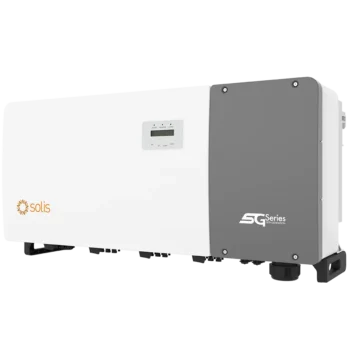
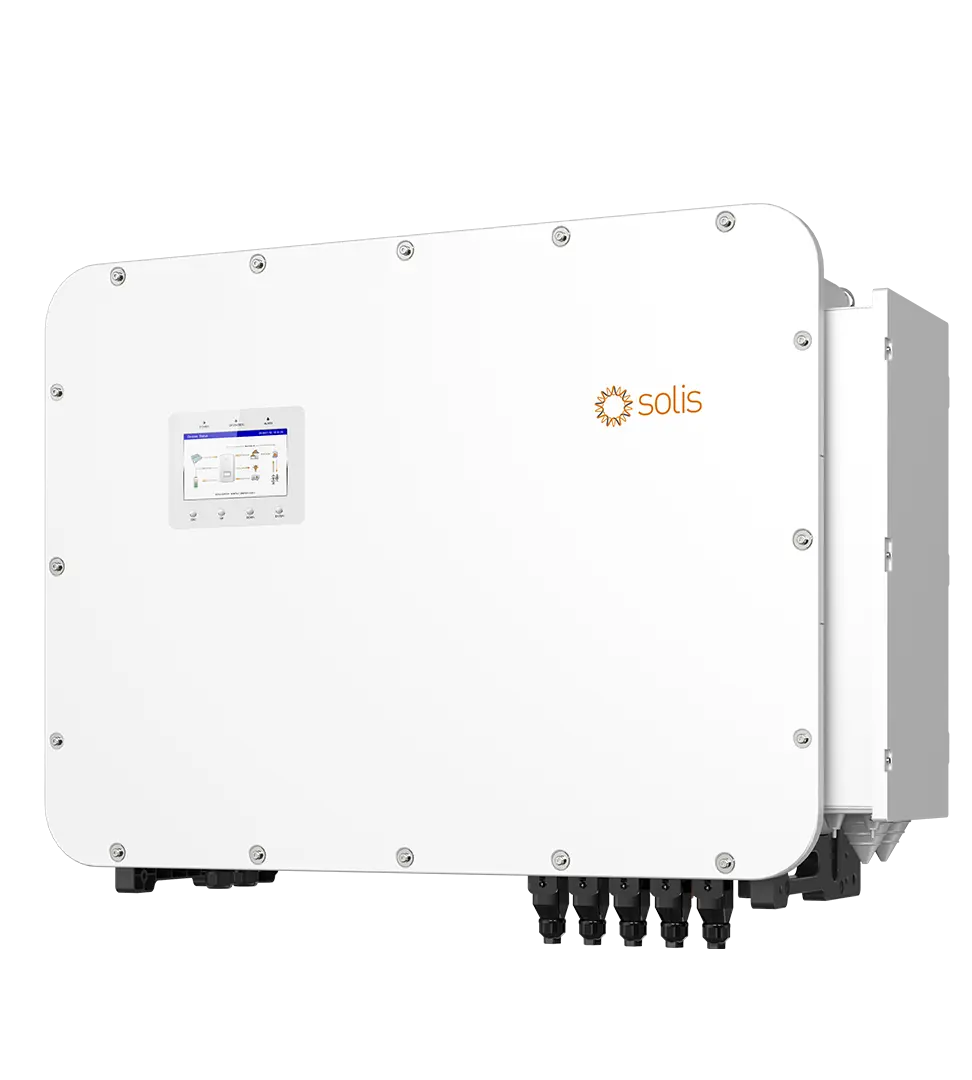
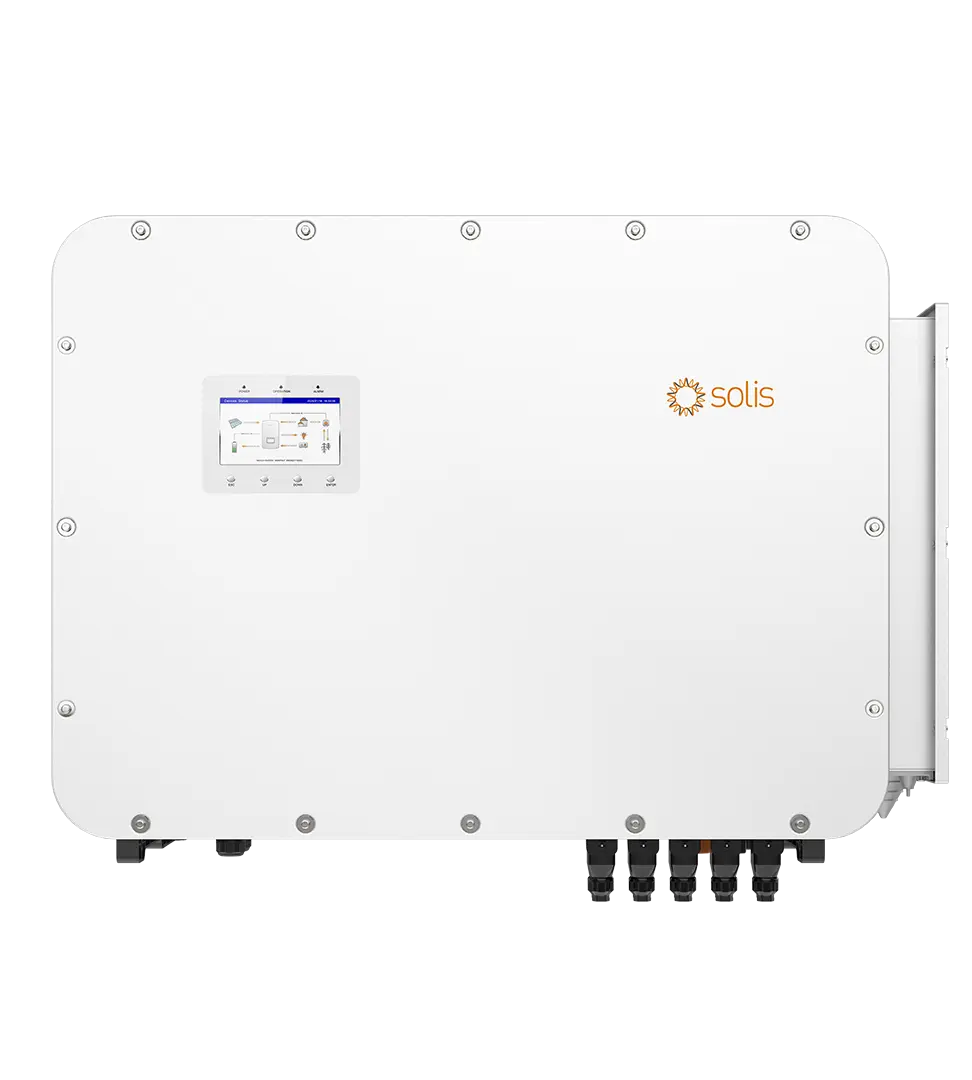
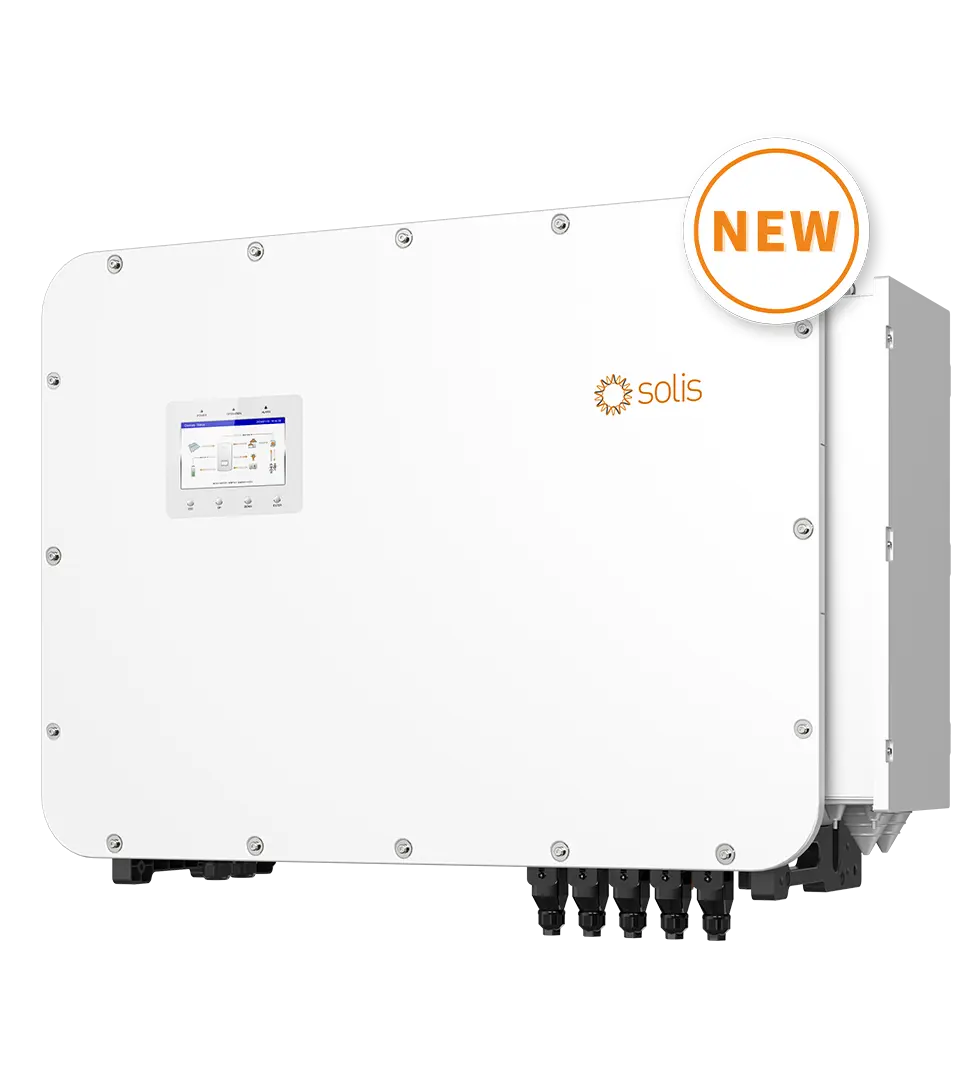
The Solis S6-EH3P125K10-NV-YD-H produces 125kW across three phases and will accept 250kW of solar array behind it. This is utility scale equipment for industry: factories, processing plants, tea and coffee works, large cold stores, hospitals, campuses and irrigation schemes with their own substation.
Its specification promises twice the rating in array, and that promise comes with a condition nobody mentions. It is worth understanding before a single panel is ordered, because it changes the procurement.
You cannot fill a 250kW allowance with ordinary modules. Strings are limited to 1000V, and what matters is the open circuit voltage on a cold morning, which runs roughly a tenth above the figure on the label. With a 620W panel that caps a string at seventeen modules if you want sensible margin. Twenty strings of seventeen 620W modules comes to about 211kW, which leaves nearly 40kW of the allowance unreachable.
Move to a 750W module and seventeen in a string still clears the ceiling, but twenty strings now reach about 255kW and the allowance is genuinely usable. The 250kW figure assumes high wattage panels, and with 620W panels the project lands at roughly 84% of it. That is why the specification advertises a 21 ampere string current and compatibility with high power modules: the machine was designed around them.
Two further figures deserve settling early.
The battery gives 120kW at its rated voltage, not 125kW. Producing 125000W at 200 amperes calls for 625V, and the bank’s rated point is 600V. So full nameplate from storage needs the bank working above 625V, and at the rated point you have 120kW. During a long outage that difference is small but real, and it belongs in the design rather than in a surprise.
Its overload multiple is the lowest in its own series. This model holds 1.4 times rating for ten seconds where the 75kW to 100kW models hold 1.6 times. In absolute terms 175kW still beats 160kW, so stepping up gains you power. What it does not gain you is headroom against the multiple, and a motor starting cares about the multiple on its own feeder.
Solis 125kW Three Phase Hybrid Inverter Specifications and Module Choice
1. System Architecture and Configuration
Three Phase Output
- 125kW rated and 125kVA apparent, three phase with neutral and earth
- Running on the 380V system or the 400V one, with neutral and earth
- 189.9 amperes per phase at 380V, 180.4 at 400V
- Up to 41.25kW on any one phase, a third of the rating
- Above 0.99 on power factor, adjustable 0.8 to lead or lag
- Dynamic reactive power compensation, which trims reactive charges
- Under 3% distortion on the grid current, and the same on the backup voltage
- Anti reverse flow control, so nothing is pushed back up the feeder
Solar Charging System
- Ten trackers between them taking twenty strings
- 42 amperes on each tracker, 21 amperes on each string
- 60 amperes of fault current permitted per tracker
- 250kW of array accepted, matched by 250kW of conversion
- A 1000V string limit, 600V nominal, with tracking between 150V and 950V
- The full 250kW only arithmetically available once a string passes about 595V
- Generation beginning from 180V
- An isolating switch for the array built into the unit
Battery Integration
- High voltage lithium only, 300V through 950V
- Modules from 100 through 314 ampere hours accepted
- Each of the two ports handling 100 amperes, in both directions
- Two hundred amperes in total, which is fast charging at this scale
- Around 120kW from storage at the rated bank voltage
- The full 125kW available once the bank works above 625V
- Two independent ports, so capacity can be added later
- Pack data over CAN, on two dedicated management ports
- A reserve level held back deliberately for outages
Grid, Generator and Backup
- Grid input to 250 amperes, which is 164.5kW at 380V
- Incoming supply accepted from 304V upward
- A generator port of its own, rated at the full 125kW
- One combined interface for grid tied solar, wind and a generator
- Controls aimed at weak grids and generator hybrid sites
- Utility bypass, feeding backup loads straight from the grid
- Backup handover under 10 milliseconds on a single unit
- Under 20 milliseconds where up to six run in parallel
- Load prioritising, extending the run time of what matters
Protection and Cooling
- Cooling fans fitted with spare capacity, so losing one does not halt the plant
- Type II surge devices on DC and on AC, both included
- Insulation resistance watched without interruption
- Residual current detection in service
- Reverse polarity covered on the DC side
- Both output overcurrent and short circuit faults protected against
- Islanding protection, which opens the connection on supply loss
- Arc fault detection specifiable as an extra, which twenty strings justify
- IP66, rated for an exposed position, and under 45 watts at rest
2. Technical Specifications
| Parameter | Value |
|---|---|
| Rated output power | 125kW |
| Maximum apparent output power | 125kVA |
| Maximum power on one phase | 33% of rating, around 41.25kW |
| Operation phase | Three phases, neutral and earth |
| Rated output voltage | 220V and 380V, or 230V and 400V |
| Rated frequency | 50Hz or 60Hz |
| Rated output current | 189.9A at 380V, 180.4A at 400V |
| Power factor | Above 0.99, adjustable 0.8 leading to 0.8 lagging |
| Current distortion | Under 3% |
| Maximum AC input power | 164.5kW at 380V, 173.2kW at 400V |
| AC input voltage range | 304V to 437V on the 380V system, 304V to 460V on the 400V system |
| Maximum AC input current | 250A |
| Backup rated output power | 125kW |
| Backup overload, 1.4 times rating | 175kW for 10 seconds |
| Backup overload, 1.6 times rating | 200kW for 200 milliseconds |
| Backup switch time | Under 10ms single, under 20ms in a parallel set of up to 6 |
| Backup rated output current | 189.9A at 380V, 180.4A at 400V |
| Maximum AC passthrough current | 189.9A at 380V, 180.4A at 400V |
| Backup voltage distortion at linear load | Under 3% |
| Generator maximum input | 125kW, 189.9A at 380V, on a dedicated port |
| Recommended maximum array | 250kW |
| Maximum usable PV input power | 250kW |
| Maximum PV voltage | 1000V |
| Rated PV voltage | 600V |
| Start-up voltage | 180V |
| MPPT voltage range | 150V to 950V |
| Voltage needed for full conversion | Around 595V |
| Maximum input current | 42A on each of ten trackers |
| Maximum current per string | 21A |
| Maximum short circuit current | 60A on each of ten trackers |
| Trackers and strings | 10 trackers, 20 strings |
| Integrated PV switch | Yes |
| Battery type | Lithium ion only |
| Battery voltage range | 300V to 950V |
| Battery module capacity | 100Ah to 314Ah |
| Maximum charge and discharge current | 100A on each of two ports, 200A in total |
| Battery ports | 2, with 2 management ports |
| Battery communication | CAN |
| Available from the battery at rated voltage | Around 120kW |
| Bank voltage needed for full output | Above 625V |
| Maximum efficiency | 97.5% |
| European weighted efficiency | 97.2% |
| Battery charged from solar, and from AC | 98.2% and 97.0% |
| Battery discharged | 97.0% |
| Surge protection | Type II on DC and Type II on AC |
| Output overcurrent protection | Yes |
| Insulation resistance monitoring | Yes |
| Residual current detection | Yes |
| DC reverse polarity protection | Yes |
| Anti islanding protection | Yes |
| Integrated arc fault detection | Optional |
| Protection class and category | Class I, category II on DC and category III on AC |
| Protection rating | IP66 |
| Topology | Non isolated |
| Self consumption | Under 45W |
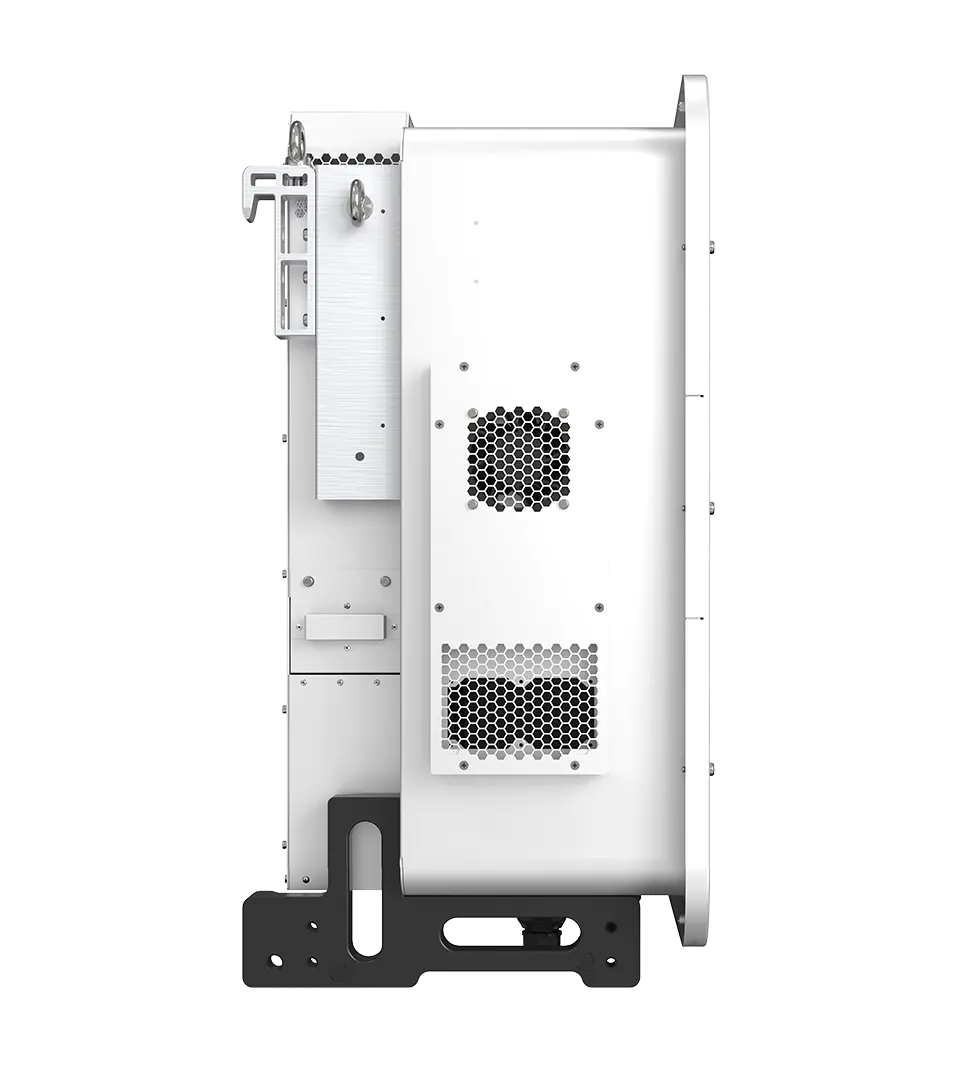
| Cooling | Intelligent redundant fan cooling |
| Operating temperature | -25C to +60C, 0 to 100% humidity |
| Maximum altitude | 3000m |
| Dimensions and weight | 1174 x 814 x 400mm, 170kg |
| Parallel operation | Up to 1.25MW, with a switching cabinet advised beyond six units |
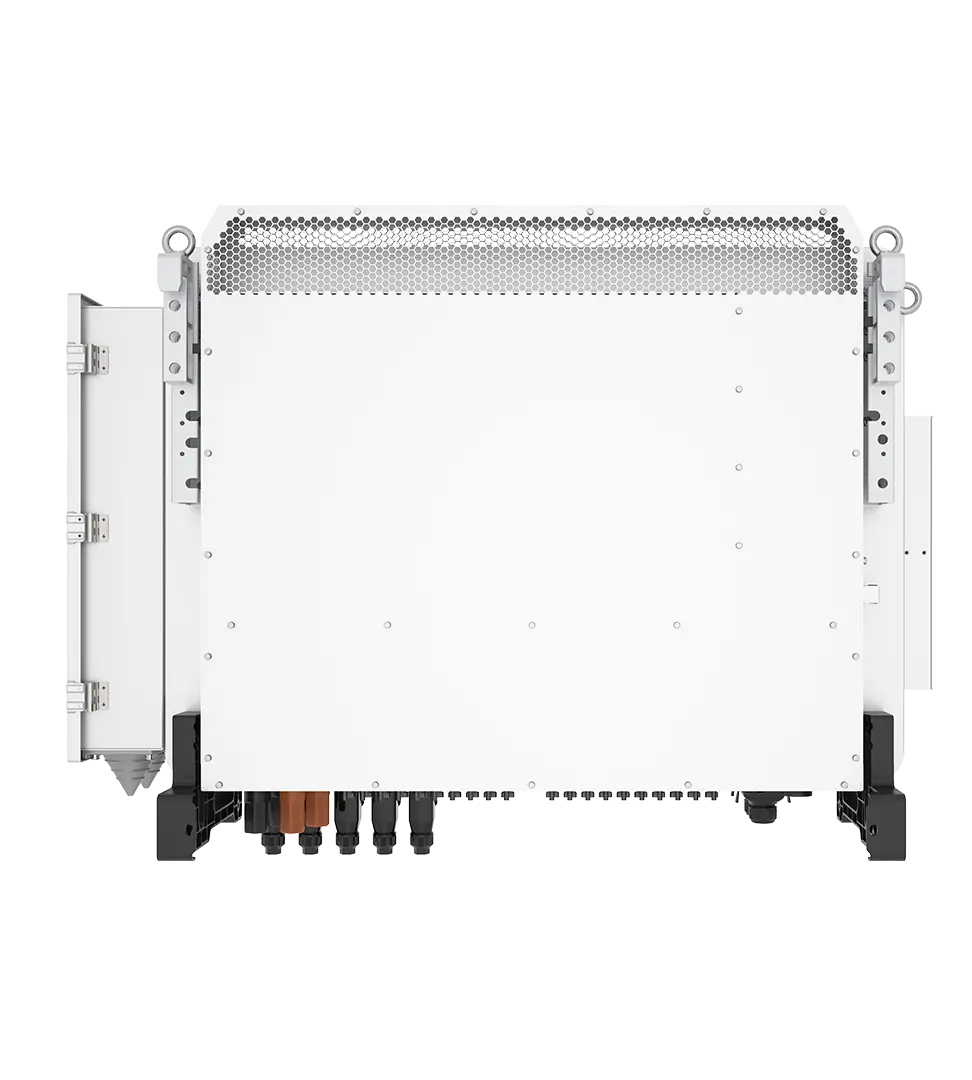
| Solar and battery connection | MC4 plugs on solar, terminal connector on battery |
| Display | 7 inch LCD with Bluetooth and app |
| Communication | WiFi, LAN and Bluetooth as standard, with two CAN battery ports, two CAN parallel ports, RS485, a meter link, five inputs and four outputs. Cellular available |
| Standards | NRS 097-2-1, G99, VDE-AR-N 4105, EN 50549, CEI 0-21, IEC 62116, IEC 61727, IEC and EN 62109, IEC and EN 61000, EN 55011 |
3. Key Features
- Twice the rating in array, which high wattage modules make reachable
- Twenty one amperes per string, sized for modern high power panels
- Ten trackers, enough for a roof divided into many planes
- The highest weighted efficiency in its series at 97.2%
- Redundant cooling fans, so one failure does not take the plant down
- A generator input of its own, carrying the whole 125kW
- One interface accepting grid tied solar, wind and a generator together
- Utility bypass, feeding backup circuits directly from the grid
- Two hundred amperes of charge current for fast battery filling
- Battery modules from 100 to 314 ampere hours, which widens sourcing
- Two independent battery ports for staged expansion
- Demand management and anti reverse flow built in
- Reactive power compensation, which reduces reactive charges
- Parallel operation to 1.25 megawatts as a site grows
- Module choice and bank voltage worked out by Bicity Solar before quotation
4. Applications and Use Cases
- Tea and coffee factories: large roofs, heavy daytime processing load
- Manufacturing and assembly plants: machinery carried while the roof earns
- Large cold stores: compressors running through the working day
- Hospitals and referral facilities: handover faster than equipment can register
- University and college campuses: consumption lining up with generation
- Flower farms and packhouses: cooling, grading and pumping in daylight
- Irrigation schemes: pumping scheduled into the solar window
- Sites on a weak or unreliable supply: the generator hybrid controls are built for it
- Plants paying reactive power charges: compensation is included rather than extra
- Projects intended to reach megawatt scale: paralleling goes to 1.25MW
5. Installation and Engineering Notes
Module choice decides how much of the allowance you get
This is the calculation to run before ordering panels, and it is the one most often skipped at this scale. Strings cannot exceed 1000V, and the figure that counts is open circuit voltage on a cold morning, roughly a tenth above the label.
| Module | Cold open circuit, per module | Modules per string | Twenty strings total | Against the 250kW allowance |
|---|---|---|---|---|
| 620W | Around 55V | 17 | About 211kW | 84%, nearly 40kW unreachable |
| 700W | Around 56V | 17 | About 238kW | 95%, close |
| 750W | Around 57V | 17 | About 255kW | Fully used |
Eighteen 620W modules would reach about 990V on a cold dawn, which is technically inside the ceiling and only ten volts clear of it. We do not design to that margin, because a colder than usual morning or a module batch at the top of its tolerance band removes it entirely.
The practical conclusion is that panel wattage is a system design decision here, not just a price comparison. Check each candidate module’s open circuit voltage, add roughly ten percent, and divide into 1000 before comparing anything else. Current is rarely the constraint, since 21 amperes per string accommodates essentially any module now on the market.
The battery sets the real ceiling on backup output
Producing 125kW from storage calls for 625V at 200 amperes, and the bank’s rated point sits at 600V.
| Bank voltage | Power at 200A | Against the 125kW rating |
|---|---|---|
| 950V, top of range | Around 190kW | No constraint at all |
| 700V | 140kW | Comfortably above |
| 625V | 125kW | Exactly at the rating |
| 600V, rated | 120kW | About 4% short |
| 300V, bottom of range | 60kW | Less than half |
Specify the bank so its working window sits above 625V through the periods when full output matters. Note too that each of the two ports carries 100 amperes, so both must be wired and healthy for 200 amperes to be available at all. Running one port leaves half the current on the table.
Lifting, access and mounting
At 170kg in a 1174 by 814 by 400mm body, this needs mechanical lifting, a mounting structure engineered for the load, and the access route planned before delivery. None of that is a surprise at this scale, but it belongs in the budget at design stage.
- Confirm the structure carries 170kg with a working factor above it
- Survey the delivery path, counting doorway widths and corners
- Arrange lifting equipment rather than extra hands
- Leave clearance for airflow and for cable entry on a body this size
- Place it clear of workspaces, given that it is fan cooled
Circuit sizing
Each device is chosen a quarter above its circuit’s continuous current and taken to the next manufactured size. Three phase circuits take four poles. At this scale the design should be calculated for the installation rather than lifted from a table.
| Circuit | Design current | Device | Cable, short run |
|---|---|---|---|
| Solar, each string | Up to 26A | 32A DC, rated beyond 1000V | 6mm² solar cable |
| Battery, each of two ports | 125A | 160A DC, rated beyond 950V | 35mm² |
| AC output | 237A | 250A, 4 pole | 120mm² |
| Grid input | 313A | 315A, 4 pole | 150mm², or paired runs |
| Generator input | 237A | 250A, 4 pole | 120mm² |
- High voltage storage keeps battery cable modest even at 125kW, which is one of its real advantages
- Array protection needs a rating past 1000V and battery protection past 950V
- With the PV switch integrated, no additional array isolator is called for
- Drawing 250 amperes means the supply and its transformer must match
- Across twenty strings, arc fault detection earns its cost
- Commissioned by licensed engineers working to a site specific calculation
6. Care, Maintenance and Operations
- Keep cooling intakes clear, and confirm every fan in the redundant set still turns
- Treat a fan fault as a scheduled repair rather than an emergency, which is what redundancy buys
- Retighten both battery port terminations on an annual cycle
- Watch for the two port currents drifting apart, which signals an uneven path
- Review the tariff schedule whenever the tariff structure changes
- Schedule array cleaning, since dirt on this much panel costs real money
- Watch generation per string, as one failure among twenty hides in the total
- Revisit the held back reserve against the site’s real outage behaviour
- Keep records, which commercial insurers increasingly expect
7. Do’s and Don’ts
Do
- Choose module wattage against the 1000V ceiling before comparing panel prices
- Add about ten percent to a module’s open circuit figure before dividing into 1000
- Specify the bank to work above 625V where full output matters
- Wire both battery ports, because each carries only half the current
- Distribute the twenty strings over ten trackers according to roof orientation
- Build strings long enough to clear 595V under load
- Use the generator port rather than an external changeover arrangement
- Arrange lifting equipment and an engineered mount before delivery
Don’t
- Assume 620W panels will fill the 250kW allowance, because they stop near 211kW
- Design an eighteen module string on a 620W panel, which leaves ten volts of margin
- Expect the full 125kW from storage at the rated bank voltage
- Load the whole bank onto one port while the second sits idle
- Assume this model matches the 100kW on overload multiple, since it does not
- Exceed about 41kW on any single phase
- Specify 550V class DC gear for a 1000V array
- Handle 170kg as though it were an ordinary wall fixing
8. Compatibility
- Lithium banks on the high voltage platform, 300V through 950V
- Battery modules from 100 to 314 ampere hours, which broadens sourcing
- Packs reporting over CAN, across two management ports
- Arrays to 250kW on twenty strings over ten trackers, with high wattage modules
- Incoming three phase at either nominal system, accepted from 304V
- Generators on a dedicated port at the full rating
- Existing grid tied solar, and wind, through the combined interface
- DC coupling and AC coupling both, which suits a retrofit
- Further units in parallel, to 1.25 megawatts
- WiFi, LAN, Bluetooth, CAN and RS485 as standard, with cellular available
- Every Kenyan location, since the rating extends to 3000m
Lead acid is not supported on this platform. Every model up to 18kW in the catalogue accepts it; the high voltage machines do not, and a 300V to 950V lithium bank is a separate procurement exercise with its own lead time.
9. Performance Table
The overload curve, and how it compares inside its own series.
| Model | Sustained overload, 10 seconds | Instantaneous, 200 milliseconds |
|---|---|---|
| 75kW | 1.6 times, 120kW | 2 times, 150kW |
| 80kW | 1.6 times, 128kW | 2 times, 160kW |
| 99.9kW and 100kW | 1.6 times, around 160kW | 2 times, around 200kW |
| 125kW, this model | 1.4 times, 175kW | 1.6 times, 200kW |
In absolute terms this model still delivers the most overload power in the series, at 175kW for ten seconds. What it gives up is the multiple: 1.4 times rather than 1.6. That matters when a single large motor sits on one feeder, because the inrush is a multiple of that motor’s rating rather than a share of the inverter’s. Where one very large direct on line start dominates the site, the 100kW model’s 1.6 times is worth comparing against this model’s 1.4, alongside whether a soft starter removes the question entirely.
10. How It Compares With the 80kW
Both sit on the same platform, in the same chassis, at the same weight. The differences are not all in the direction the nameplate suggests.
| Consideration | This 125kW | The 80kW |
|---|---|---|
| Rated output | 125kW | 80kW |
| Array accepted | 250kW | 160kW |
| Module wattage needed to fill it | Around 735W and up | Ordinary modules suffice |
| Full conversion threshold | Around 595V | Around 381V |
| Bank voltage for full output | Above 625V | Above 400V |
| From storage at rated 600V | 120kW, slightly short | 80kW, the full rating |
| Overload at 10 seconds | 1.4 times | 1.6 times |
| Weighted efficiency | 97.2% | 96.9% |
| Per phase | About 41.25kW | About 26.4kW |
| Chassis and weight | Identical | Identical |
Choose this one where the load genuinely reaches toward 125kW, where the roof is large enough to justify a 250kW array, where high wattage modules are the plan anyway, and where a bank can be specified to work above 625V.
Choose the 80kW where the load sits nearer 80kW, where ordinary modules are already specified, where the overload multiple matters more than absolute power, or where a shorter string is forced by the roof. It makes its full rating from storage at the rated bank voltage, which this model does not quite do.
Both run to 1.25 megawatts in parallel, so starting at 80kW does not cap the site.
11. Mini FAQ
Can it really take a 250kW array?
Yes, with high wattage modules. With 620W panels the 1000V string ceiling caps the array near 211kW.
Does it give 125kW from the battery?
Above 625V, yes. At the rated 600V you get around 120kW, because 125kW needs 625V at 200 amperes.
Does it have a generator input?
Yes, a dedicated port at the full 125kW, plus a combined interface for grid tied solar and wind.
Is its overload better than the 100kW?
In power yes, in multiple no. This model holds 1.4 times for ten seconds where the 100kW holds 1.6.
Will it take lead acid?
No. High voltage lithium only, between 300V and 950V.
What does redundant cooling mean in practice?
A single fan failure degrades cooling rather than stopping the machine, so a repair can be scheduled.
How far can it scale?
To 1.25 megawatts in parallel, with a switching cabinet advised beyond six units.
How much can one phase carry?
About 41.25kW, a third of the rating.
12. Why Buy From Bicity Solar
- Module wattage checked against the 1000V ceiling before panels are ordered
- The gap between the array allowance and what your chosen panel can reach stated up front
- Bank specified to work above 625V where full output is needed
- Each of the two ports connected, because one alone carries half the amperes
- Twenty strings spread across ten trackers by roof face
- Honest comparison with the 80kW, including where it is the better machine
- Generator integration through the dedicated port rather than bolted on outside
- Lifting and mounting arranged ahead of a 170kg delivery
- Array and battery protection rated for their own voltages, 1000V and 950V
- Paperwork supplied matches the serial stamped on the unit
- Work completed and certified on a current EPRA licence
- Warranty matters pursued at the distributor by us
- Shipped to every county, with spares and support following
Before you order panels, tell us which module you intend to use. On a 250kW allowance with a 1000V string ceiling, panel wattage decides how much of that allowance you can actually reach, and the difference between a 620W and a 750W module is around 40kW of array.
Give us the panel’s datasheet along with the roof area and its faces, your supply and transformer rating, and the way load divides between phases. From there we set string length by the cold morning figure, tell you outright what share of the allowance your chosen panel reaches, size the bank against the 625V threshold, and flag it if the 80kW is the better fit. Try the numbers yourself in the Solar Calculator, or hand us the site through My Quote.