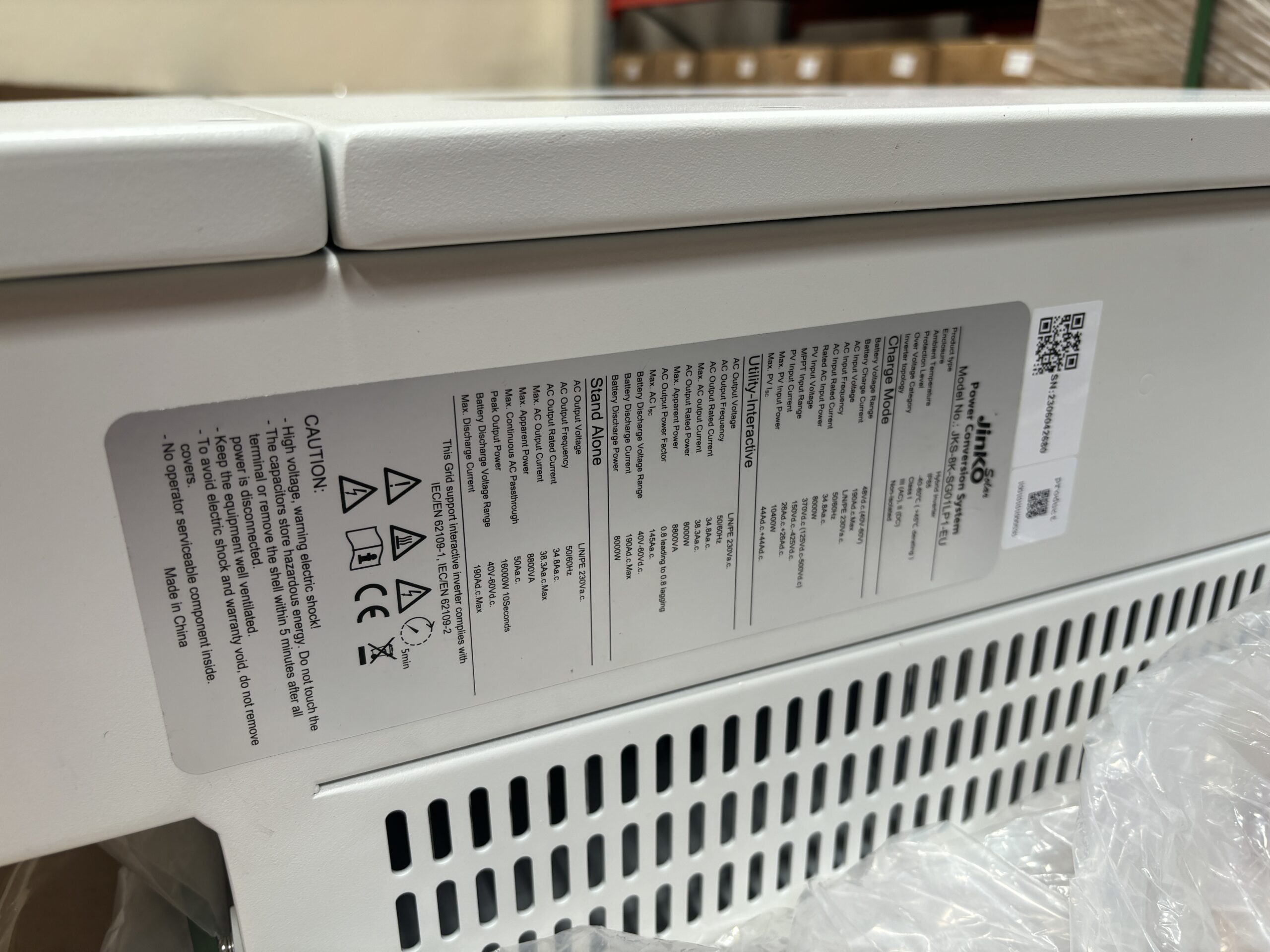
Description
The Entry Point Into Commercial Three-Phase Solar
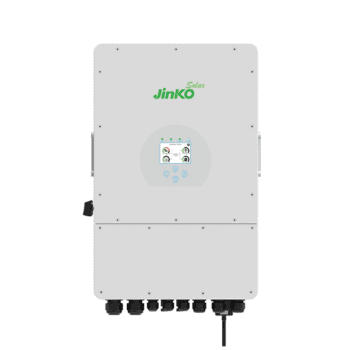
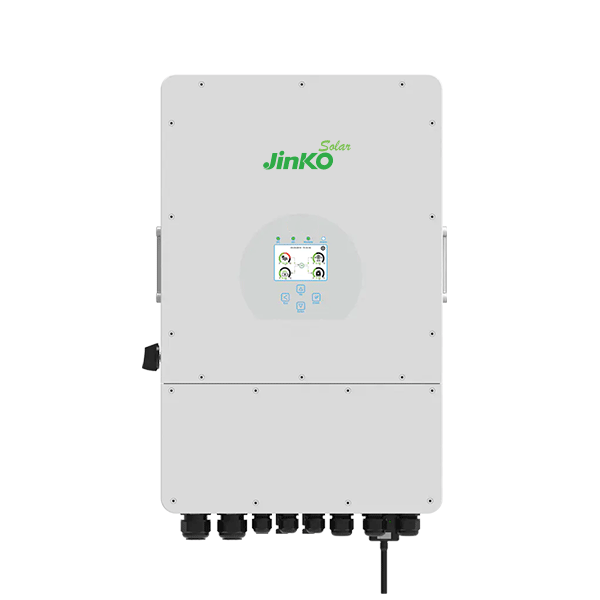
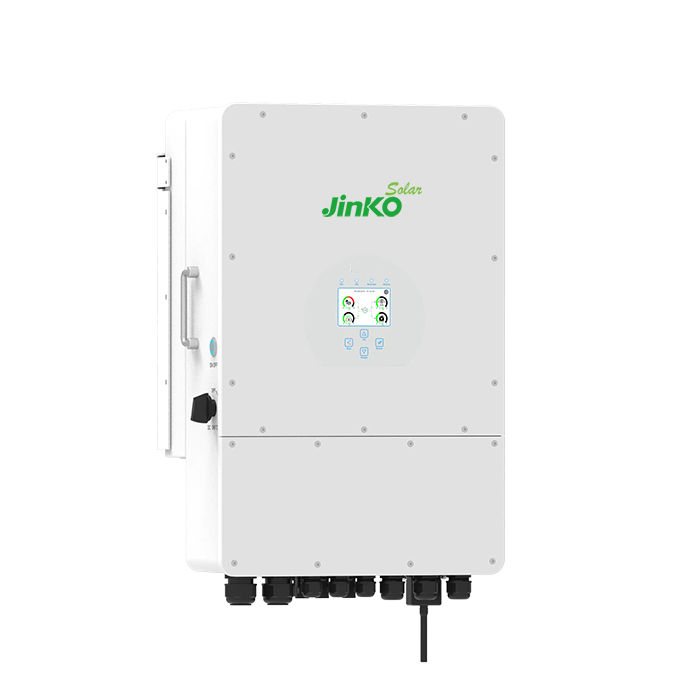
The Jinko JKS-10K-SG04LP3-EU is the inverter where Kenyan buyers cross the line from residential to commercial solar. It’s the first model in the Jinko hybrid range built for three-phase power — the electrical standard that virtually every medium-sized business, shop, office, workshop, and large estate in Kenya operates on.
If you’ve been looking at single-phase inverters and wondering whether they’ll work with your building’s electrical supply, this is almost certainly the one you actually need. Most Kenyan commercial buildings and many larger rural homes with heavy loads are wired three-phase because three-phase distributes power more efficiently across high-load circuits and runs motors smoothly without the balance problems that plague single-phase systems.
Why Three-Phase Matters for Your Building
Before anything else, it’s worth explaining what makes three-phase different — because this is the single feature that separates the JKS-10K-SG04LP3-EU from everything smaller in the Jinko range. In a single-phase system, all your electricity flows through one live wire and one neutral. In a three-phase system, power flows through three separate live wires (typically called L1, L2, and L3) with a shared neutral, and the three phases are offset by 120 degrees from each other.
This architecture matters for three practical reasons:
- Motor loads run smoother. Any equipment with a motor — water pumps, refrigeration compressors, industrial machinery, lifts, workshop tools — runs more efficiently on three-phase. The three offset phases produce a rotating magnetic field that makes three-phase motors start easier, run cooler, and last longer than their single-phase equivalents.
- Load balancing is automatic. On a three-phase system, your building’s circuits are distributed across the three phases so that no single phase is overloaded. A shop with refrigeration on phase 1, lighting on phase 2, and checkout equipment on phase 3 doesn’t suffer voltage drops the way a single-phase shop with the same total load would.
- Higher power in smaller cables. Three-phase delivers more kilowatts through the same copper cross-section than single-phase, which reduces cable cost and voltage drop on long runs — important for installations where the distribution board is far from the main load.
Who Actually Needs a Three-Phase Inverter
The JKS-10K-SG04LP3-EU is the correct choice if any of the following apply to your building:
- Your utility connection is three-phase. Check your distribution board — if you see three live wires entering (typically red, yellow, blue + neutral), you have a three-phase supply and you need a three-phase inverter to grid-tie correctly.
- You run any three-phase equipment. Three-phase water pumps, commercial air conditioning, industrial motors, compressors, or workshop machinery all require three-phase input. A single-phase inverter cannot supply them.
- Your total connected load exceeds 8kW. Beyond this point, single-phase systems struggle with voltage stability, and three-phase becomes the practical choice regardless of equipment type.
- You operate a shop, office, workshop, or small factory. Almost all commercial premises in Kenyan towns are wired three-phase as standard.
- You have a large rural estate or farm. Borehole pumps, irrigation systems, and livestock equipment typically run three-phase for efficiency.
13kW PV Input Capacity: Oversized by Design
The JKS-10K-SG04LP3-EU accepts up to 13,000W of solar panel DC input against its 10kW rated AC output — a 1.3× DC-to-AC ratio. This is a deliberate engineering choice, not a manufacturing limitation. In real-world Kenyan conditions, solar panels rarely produce their full STC-rated output because of cell temperature rise, soiling, morning/evening sun angles, and partial shading. Oversizing the DC input ensures the inverter reaches its full 10kW output during more hours of the day, not just during the brief peak-noon window.
In practical terms, you can install up to 22 × 580W panels, 23 × 550W panels, or 19 × 670W panels on this inverter with confidence. The dual MPPT tracker design allows asymmetric string configurations — particularly useful for commercial rooftops where available mounting space is often irregular.
Heavy-Duty Battery Integration
With a 210A maximum charge and discharge current at 48V, the JKS-10K-SG04LP3-EU is built to work with serious battery banks. This matters for commercial users who need full daytime solar capture plus overnight backup:
- 15kWh lithium bank: Minimum recommended size for small commercial premises running essential loads overnight
- 20kWh lithium bank: The commercial sweet spot — enough to run a shop’s refrigeration, security system, and basic operations through a full overnight cycle
- 30kWh+ parallel bank: For larger operations needing 24-hour continuity during extended grid outages
Our Jinko, Renergy, and Vestwood lithium battery ranges all pair correctly with this inverter. The inverter communicates with the battery BMS via CAN or RS485 protocols for lithium systems, and uses voltage-based charging for lead-acid alternatives.
Time-of-Use: Programmable Energy Management
One of the more sophisticated features of the JKS-10K-SG04LP3-EU is its 6-period time-of-use scheduling. This lets you program the inverter to behave differently at different times of the day:
- Morning (07:00–10:00): Prioritise solar for immediate loads, minimal battery charging
- Midday (10:00–15:00): Full solar generation, aggressive battery charging
- Afternoon (15:00–17:00): Continue battery charging, supply loads from solar
- Evening peak (17:00–21:00): Discharge battery to cover peak loads, minimise grid draw
- Overnight (21:00–05:00): Battery supplies essential loads, grid reserves for emergencies
- Pre-dawn (05:00–07:00): Top up battery from grid if depleted, prepare for morning solar
For businesses on commercial tariffs with peak-rate periods, this programmability directly translates to reduced grid costs by ensuring battery capacity is used during the most expensive hours rather than discharged randomly.
System Configurations for Kenyan Commercial Properties
Here are three realistic builds around the JKS-10K-SG04LP3-EU:
Configuration 1: Medium Shop or Supermarket
18 × Canadian Solar 550W HiKu6 panels (9.9kW DC) + JKS-10K-SG04LP3-EU inverter + 20kWh lithium battery from our Jinko, Renergy, or Vestwood range. Powers shop lighting, 4–6 refrigeration units, POS systems, CCTV, Wi-Fi, and back-office equipment. Suitable for daily consumption of 45–70 kWh across three phases.
Configuration 2: Small Office Building
16 × Jinko Tiger Neo 580W panels (9.28kW DC) + JKS-10K-SG04LP3-EU inverter + 15kWh lithium battery (Jinko, Renergy, or Vestwood). Supports office lighting, multiple computers, printers, small commercial AC, server equipment, and kitchen facilities. Suitable for offices with 15–30 staff operating standard business hours.
Configuration 3: Workshop or Small Factory
15 × Canadian Solar 670W HiKu7 panels (10.05kW DC) + JKS-10K-SG04LP3-EU inverter + 20kWh lithium battery. Powers workshop machinery (welders, grinders, drills), compressors, workshop lighting, and office facilities. The three-phase output is essential for motor loads. Suitable for small manufacturing operations and trade workshops.
Scalability: Up to 10 Units in Parallel
For businesses planning phased commercial growth, the JKS-10K-SG04LP3-EU supports parallel operation of up to 10 units. This means you can deploy a single 10kW inverter today and progressively expand to 20kW, 30kW, 50kW, or 100kW of combined three-phase capacity over time — without replacing the original inverter. Each new unit synchronises automatically with the existing system and shares load proportionally across the combined capacity.
This is particularly valuable for growing businesses: you pay only for the capacity you need now, knowing that future expansion is a straightforward hardware addition rather than a system redesign.
Full Technical Specifications
PV Input Data:
- Max DC Input Power: 13,000W
- Max PV Input Voltage: 800V
- Rated PV Input Voltage: 370V
- MPPT Voltage Range: 150V – 550V
- Full Load DC Voltage Range: 200V – 650V
- Start-up Voltage: 160V
- Max PV Input Current: 26A (MPPT 1) + 13A (MPPT 2)
- Max PV Short-Circuit Current: 34A + 17A
- Number of MPPT Trackers: 2
- Strings per MPPT Tracker: 2 + 1
AC Output Data:
- Rated AC Output Power: 10,000W
- Max AC Output Power: 11,000W
- Peak Power (Off-Grid): 20,000W for 10 seconds
- AC Output Type: Three-phase + neutral (3L+N+PE)
- Rated AC Voltage: 220V/380V or 230V/400V (three-phase)
- Rated Output Current: 21.7A per phase
- Max AC Current: 22.7A per phase
- Max Continuous AC Pass-Through: 50A per phase
- Output Frequency: 50Hz / 60Hz
- Unbalanced Output: Supported (any phase can carry different load)
- Total Harmonic Distortion: <3% (linear load <1.5%)
Battery Input Data:
- Battery Type: Lithium-ion (LiFePO4) or Lead-Acid
- Battery Voltage Range: 40V – 60V
- Max Charging Current: 210A
- Max Discharging Current: 210A
- BMS Communication: CAN and RS485
- Time-of-Use Charging: 6 programmable periods
- Transformer Isolation: Integrated
Efficiency and Grid Features:
- Max Inverter Efficiency: 97.6%
- European Efficiency: 97.2%
- MPPT Efficiency: 99.9%
- Grid-to-Off-Grid Switchover: <10 milliseconds
- Zero Export Capability: Supported
- Grid Peak Shaving: Supported
- Generator Start/Stop Control: Supported
Communication Interfaces:
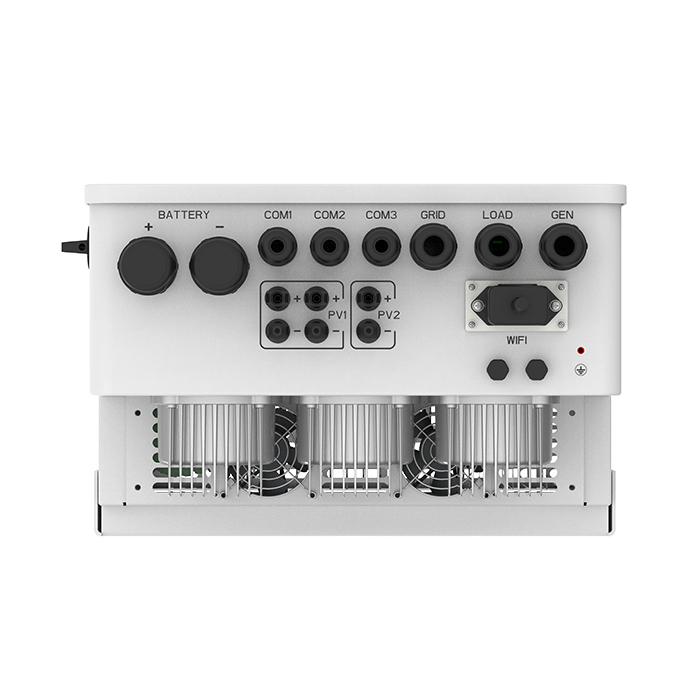
- CAN: 2 × (BMS + parallel)
- RS485: 1 × (BMS)
- RS232: 1 × (remote control)
- DRM: 1 × (demand response)
- Wi-Fi / LAN / 4G: Optional data logger
Protection Features:
- PV Input Lightning Protection: Integrated
- Anti-islanding Protection: Integrated
- PV Reverse Polarity Protection: Integrated
- Insulation Resistor Detection: Integrated
- Residual Current Monitoring (RCD): Integrated
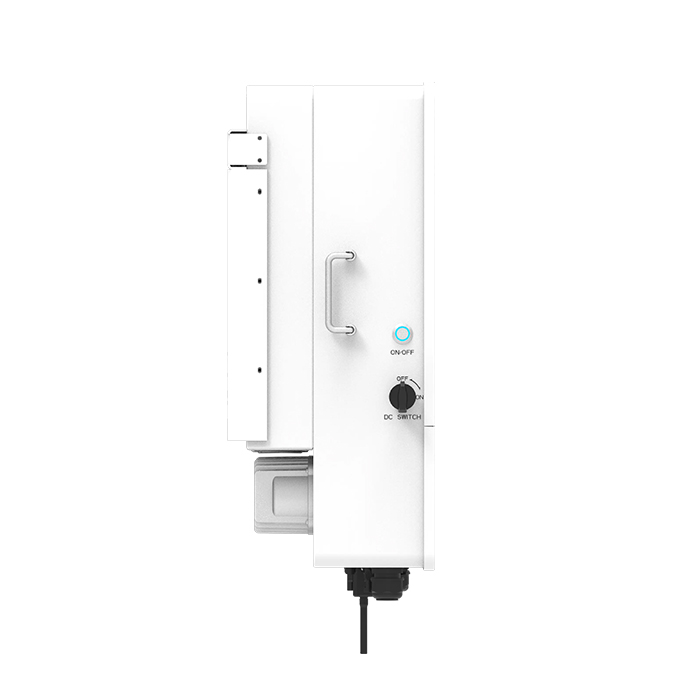
- DC Input Switch: Integrated
- Surge Protection: Integrated
- Over-current / Over-voltage / Short-Circuit Protection: Integrated
- Over-temperature Protection: Integrated
- Ground Fault Detection: Integrated
Physical and Environmental:
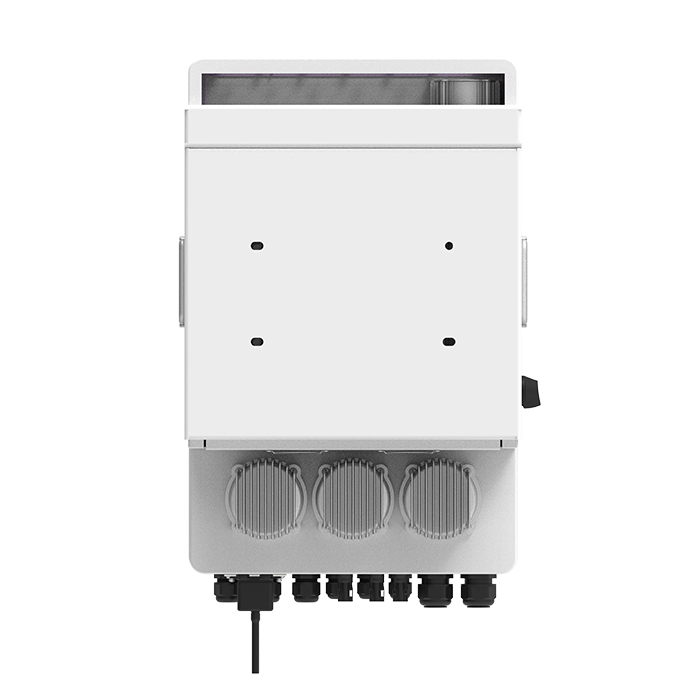
- Dimensions: 540 × 670 × 220 mm
- Weight: ~38 kg
- Protection Rating: IP65 (indoor and outdoor)
- Operating Temperature: -25°C to +60°C (derating above 45°C)
- Cooling: Smart fan cooling
- Mounting: Wall-mounted
- Display: Colour LCD touch screen
Complete Your Commercial System
A commercial solar installation requires more than just the inverter. To build a complete working system around the JKS-10K-SG04LP3-EU, you’ll need:
- Solar panels — typically 16–22 modules of the 550W–670W class for this inverter’s 13kW DC capacity
- Lithium battery bank — choose from our Jinko, Renergy, or Vestwood ranges (15kWh to 30kWh for commercial applications)
- DC circuit breakers and string combiner box (required for 3-string commercial installations)
- Three-phase AC circuit breakers and distribution hardware
- Earthing system (essential for commercial installations and required by EPRA regulations)
- Solar cable, MC4 connectors, and commercial-grade mounting hardware
- Professional installation by an EPRA-certified commercial solar technician
- Net metering application (if exporting surplus solar back to the grid)
Commercial solar installations in Kenya require proper load analysis and system design before procurement. Use our Solar Calculator for an initial estimate, or request a detailed commercial quote from our team. For direct consultation, message us on WhatsApp at 0794 917 789.
Frequently Asked Questions
How do I know if I need a three-phase inverter?
Check your utility meter and distribution board. If you see three live conductors entering your building (typically red, yellow, and blue wires plus a neutral), you have a three-phase supply and you need a three-phase inverter like the JKS-10K-SG04LP3-EU. Most Kenyan shops, offices, workshops, and commercial buildings are three-phase as standard. If you’re unsure, ask an EPRA-certified electrician to inspect your distribution board before ordering.
Can I use a three-phase inverter on a single-phase supply?
No. A three-phase hybrid inverter must be connected to a matching three-phase grid supply to function correctly. If your building has single-phase utility power, you need the Jinko 5kW or 8kW single-phase hybrid inverter instead. Attempting to wire a three-phase inverter to a single-phase supply will cause the inverter to fault on startup.
How many solar panels does the Jinko 10kW three-phase inverter support?
The JKS-10K-SG04LP3-EU accepts up to 13,000W of DC input. This translates to approximately 22 panels of 580W, 23 panels of 550W, or 19 panels of 670W class. The dual MPPT tracker design with 2+1 string configuration allows flexible layouts across different roof orientations.
Is this inverter suitable for my shop or small business?
Yes, if your shop is on a three-phase utility supply (which is standard for Kenyan commercial premises). The JKS-10K-SG04LP3-EU is specifically sized for medium shops, supermarkets, small offices, workshops, and medium-sized commercial buildings with daily consumption of 40–70 kWh. The three-phase output distributes load cleanly across your shop’s existing electrical circuits.
Can the inverter run three-phase motors and commercial equipment?
Yes. The JKS-10K-SG04LP3-EU produces true three-phase output with proper 120-degree phase separation, which is exactly what three-phase motors and commercial equipment require. This includes three-phase water pumps, commercial air conditioning, industrial compressors, workshop machinery, and production equipment.
What batteries work with the Jinko 10kW three-phase inverter?
The inverter supports both lithium iron phosphate (LiFePO4) and deep-cycle lead-acid batteries at 48V nominal voltage. The 210A maximum charge/discharge current accommodates battery banks from 15kWh up to 30kWh or larger. Jinko, Renergy, and Vestwood lithium battery ranges all pair correctly with this inverter via CAN or RS485 BMS communication.
Does the inverter support time-of-use scheduling for commercial tariffs?
Yes. The JKS-10K-SG04LP3-EU supports 6 programmable time periods for battery charging and discharging. This lets businesses on commercial tariffs optimise battery usage across peak, off-peak, and standard rate periods — discharging the battery during expensive peak hours and charging it during cheaper off-peak windows.
What is the grid-to-backup switchover time?
Less than 10 milliseconds. This is fast enough that sensitive three-phase commercial equipment — computers, servers, refrigeration, POS systems, network hardware — continues operating without interruption during grid outages. Only very specialised precision equipment requires faster switchover than this.
Can I connect multiple Jinko 10kW inverters in parallel for a bigger system?
Yes. The JKS-10K-SG04LP3-EU supports parallel operation of up to 10 units, giving a combined capacity of 100kW three-phase. This makes it well-suited to phased commercial expansion where you start with 10kW today and add more capacity as your business grows.
Does the inverter support unbalanced loads across the three phases?
Yes. Unlike some three-phase inverters that require perfectly balanced loads across L1, L2, and L3, the JKS-10K-SG04LP3-EU supports unbalanced three-phase output. This means your shop can have a heavy refrigerator load on phase 1, lighter lighting load on phase 2, and POS systems on phase 3 without causing the inverter to fault or underperform.
What is the warranty on the Jinko 10kW three-phase hybrid inverter in Kenya?
Jinko provides a 5-year standard manufacturer warranty on the JKS-10K-SG04LP3-EU. Bicity Solar Energy Suppliers handles warranty registration at the time of purchase and supports warranty claims during the coverage period. Extended warranty options may be available for commercial installations — contact us for details.
Where can I buy the Jinko 10kW three-phase hybrid inverter in Kenya?
Bicity Solar Energy Suppliers stocks the Jinko 10kW 48V Three Phase Hybrid Solar Inverter (JKS-10K-SG04LP3-EU) with manufacturer warranty and delivery to all 47 counties. Contact us via WhatsApp on 0794 917 789 or request a quote through our website for current pricing and commercial delivery to Nairobi, Mombasa, Kisumu, Nakuru, Eldoret, Thika, Machakos, and other commercial hubs across Kenya.