Description
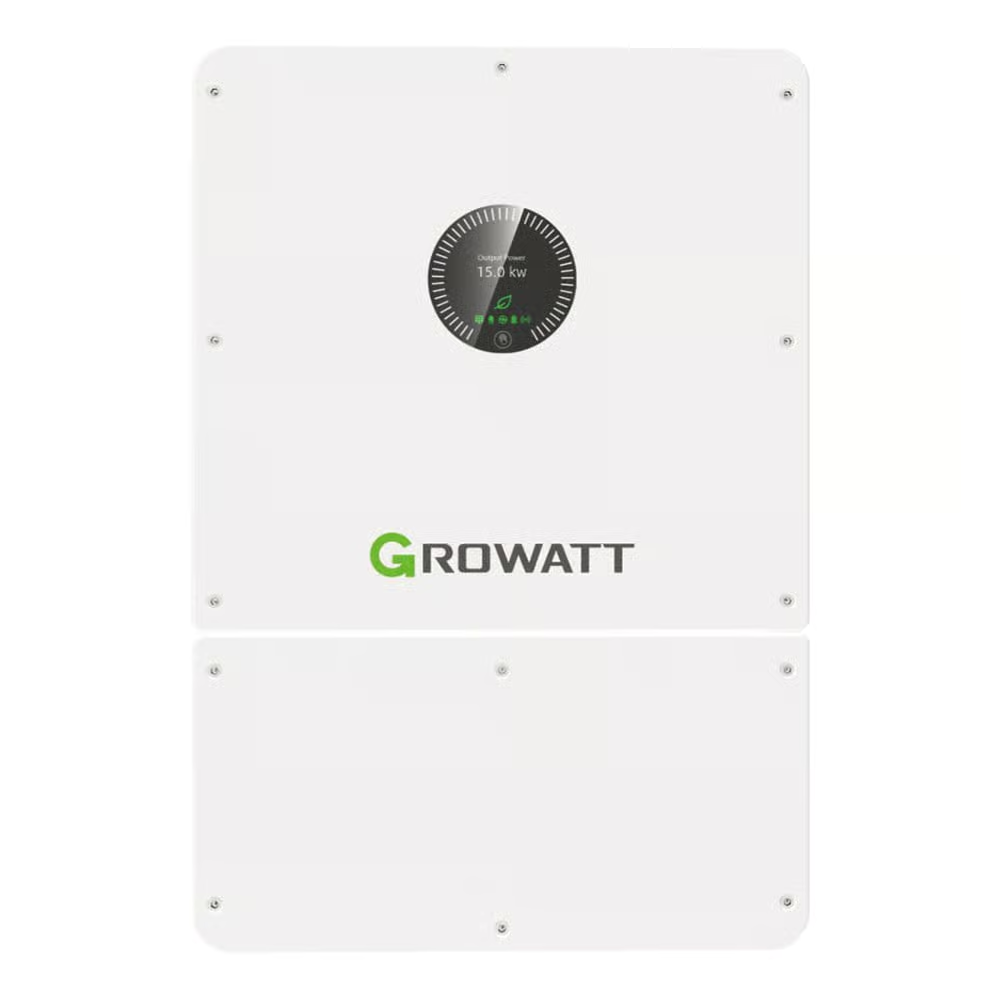
Growatt WIT 15K-HU: Three Phase That Does Not Ask Your Loads to Behave
Three phase inverters usually come with an unspoken condition: your loads should be reasonably balanced across the three phases. Kenyan commercial premises are frequently nothing of the sort. A workshop with a large motor on one phase, offices and lighting on another, and a cold room on the third is normal rather than exceptional, and it is exactly the situation that causes a three phase inverter to trip or derate.
The Growatt WIT 15K-HU permits 100% three phase unbalanced output. Put the entire load on one phase and it keeps working. That single line in the datasheet is worth more on a real Kenyan commercial site than most of the headline figures above it.
Two other specifications make this the most site tolerant inverter we have reviewed. It is rated IP66, so it mounts outdoors with no equipment room required. And it is rated to 3000m altitude, which covers every town in Kenya including the highland sites where other inverters are derated or excluded.
This review covers all three, the battery current question that governs the installation, how to string 24kW of panels to it, and where it is the wrong choice.
What 100% unbalanced actually means
In a balanced three phase system each phase carries roughly a third of the total load. Many three phase inverters assume this, and when the assumption fails they either limit output, trip, or produce a voltage imbalance that upsets sensitive equipment.
Real buildings rarely cooperate. A single large motor sits on one phase. A welding bay loads another. Air conditioning is added to whichever phase had room at the time. Over years of incremental additions, the imbalance grows rather than corrects.
The WIT 15K-HU handles this by permitting the full rated output on any distribution across the phases, including all of it on one. In backup operation that means the inverter continues supplying an unbalanced building exactly as the grid did, without anyone having to rewire the distribution board first.
The practical consequence is that an installation on this inverter does not require a load balancing exercise before commissioning. On an existing commercial premises, that alone can be the difference between a straightforward retrofit and a project that stalls while an electrician redistributes circuits.
IP66, which changes where it can go
Every other inverter and power station in this catalogue is rated IP20, meaning strictly indoors with no water protection at all. The WIT 15K-HU is IP66.
The 6 for dust means fully dust tight, nothing enters at all. The second 6 for water means protected against powerful water jets from any direction. Together that is a genuinely outdoor rating, not a splash resistant compromise.
For Kenyan sites this matters more than it would elsewhere. Many farms, workshops, water points and rural institutions have no suitable indoor space for a 43kg wall mounted inverter, and building one adds cost and delay to a project. An IP66 unit mounts on an external wall and is finished.
Two sensible cautions remain. Direct sun on the enclosure raises its internal temperature, and this unit derates above 45C, so a shaded wall or a simple sun hood protects output on hot afternoons. And IP66 describes water and dust, not security, so an accessible outdoor position still wants a cage or a sensible mounting height.
Rated to 3000m, which covers all of Kenya
Altitude derating catches out imported electronics in Kenya more than in most markets, because so much of the country sits high. Thinner air removes heat less effectively, so manufacturers specify a ceiling above which performance is reduced or the warranty qualified.
The WIT 15K-HU is rated to 3000m. Eldoret at around 2,085m, Kericho at 2,100m, Limuru at 2,200m, Nyahururu at 2,360m, Timau at 2,400m and Molo at 2,500m all sit comfortably inside it, as does everywhere lower.
This is worth stating plainly because other inverters in the same brand’s range are limited to 2000m, which excludes those towns entirely. If the site is in the highlands, that limit is the first specification to check on any inverter, and this one passes it.
The battery question, and a limit worth understanding
This is a low voltage inverter, which means a 48V nominal battery bank rather than a high voltage stack. The battery voltage range is 40V to 60V with 51.2V recommended, and the maximum charge and discharge current is 290A.
Run the arithmetic and something becomes clear. At 51.2V, 290A delivers about 14.8kW, which is almost exactly the inverter’s rated output. In other words, the 290A figure is matched to full output at nominal battery voltage.
Below nominal it does not keep up. A battery at 48V would need 312A to deliver 15kW, and at 44V it would need 341A, both above the 290A ceiling. The practical effect is that full rated output depends on the battery holding voltage, and a deeply discharged or heavily sagging bank will not support 15kW no matter what the inverter is rated for.
Three things follow. Choose batteries with a solid discharge rating rather than only large capacity, because voltage sag under load is what costs you output. Keep the battery cable short and generously sized, since at 290A every milliohm of resistance becomes voltage lost before it reaches the inverter. And expect that a bank capable of 290A will be substantial in its own right, typically two or three large lithium units in parallel rather than one.
Stringing 24kW of panels
The DC side is far more generous than anything else in this review series, because this is a genuine high voltage string inverter rather than a low voltage power station input.
Limits are a 150V to 850V MPPT window, 1000V absolute maximum, 180V to start, 40A per tracker, 50A short circuit per tracker, 20A per string, and 24000W recommended across two trackers with three string inputs between them.
| Panels in series | Operating voltage | Open circuit | Likely on a cold dawn | String power | Verdict |
|---|---|---|---|---|---|
| 12 x 620W | Around 504V | Around 600V | Around 660V | 7,440W | Comfortable |
| 14 x 620W | Around 588V | Around 700V | Around 770V | 8,680W | Comfortable |
| 16 x 620W | Around 672V | Around 800V | Around 880V | 9,920W | Good use of the window |
| 18 x 620W | Around 756V | Around 900V | Around 990V | 11,160W | At the limit, verify panel figures first |
| 20 x 620W | Around 840V | Around 1000V | Over 1000V | 12,400W | Exceeds the ceiling when cold |
The DC to AC ratio is 1.6 at the recommended 24kW against 15kW of output, which is deliberate and healthy oversizing. An array larger than the inverter output spends more of the day at full production, particularly in the early morning, the late afternoon and under cloud. The inverter simply limits when the array would exceed it.
One practical note on the string inputs. Two trackers with three string inputs between them means the strings are not evenly divided, so one tracker carries two strings and the other carries one. Confirm the exact arrangement against the unit in front of you before finalising the array layout, since this is the kind of detail that differs between production runs.
UPS, black start and the generator input
Switchover to backup takes 10ms, which is fast enough that computers, tills, cold rooms and network equipment do not notice the grid failing. That is considerably quicker than the 20 to 30ms typical of lower tier equipment.
Black start deserves more attention than it usually gets. It means the inverter can bring the system up from a completely dead state using only the battery, with no grid and no solar present. Without it, a system that has fully discharged during an extended outage can be left waiting for sunrise before it will do anything at all. On a site where that matters, this is a genuine reliability feature rather than a specification line.
The dedicated generator input with smart load control means a generator wires in permanently rather than through a manual changeover. The inverter starts and uses it according to the rules you set, and can shed non essential loads to keep the generator inside its own rating. On a farm or institution that already runs a generator, this converts it from a thing someone operates into part of an automated system.
Where it falls short
Three phase only. Obvious but worth stating: a single phase property cannot use this. Confirm your supply type before anything else, since three phase is common in Kenyan commercial premises but far from universal.
Full output depends on battery voltage. Covered above. The 290A ceiling means 15kW is available at nominal battery voltage and progressively less as the bank sags.
43kg on a wall. A two person lift onto a structurally adequate wall, and the mounting surface needs to be genuinely sound rather than merely vertical.
Derating above 45C. The outdoor rating invites exposed mounting, and exposed mounting in Kenyan sun can push the enclosure past that. Shade the position.
Source figures for weight and dimensions vary widely. Published weights across suppliers range from 38kg to 51kg, and two sets of dimensions circulate. We publish the manufacturer datasheet figures and measure stock on arrival.
Published warranty is five years with ten available. Which applies depends on registration and region, so we confirm the specific terms in writing at the point of sale rather than quoting a number from a reseller listing.
Where it is the right choice
- Commercial premises already on three phase. Workshops, light manufacturing, cold storage, print shops, anywhere with motor loads.
- Buildings with badly unbalanced loads. The feature that distinguishes it, and the reason a retrofit does not need a rewiring exercise first.
- Sites with no equipment room. IP66 means an external wall is a valid mounting position.
- Highland installations. Rated to 3000m where other models stop at 2000m.
- Farms and institutions running a generator. The dedicated generator input with load control automates what is usually manual.
- Sites needing genuine UPS behaviour. 10ms switchover plus black start.
- Installations expected to grow. Six units in parallel reaches 90kW.
Full specifications
| Specification | Value |
|---|---|
| Brand | Growatt, Shenzhen Growatt New Energy Technology |
| Model | WIT 15K-HU, from the WIT 4 to 15K-HU series |
| Type | Three phase hybrid, transformerless |
| Rated AC output power | 15000W |
| Maximum AC apparent power | 110% continuous, 200% of rated for 10 seconds |
| Rated AC output voltage | 220V/380V or 230V/400V, -15% to +10% |
| Maximum output current | 25A at 220V, 23.9A at 230V |
| AC grid connection type | 3P3W+PE or 3P4W+PE |
| Nominal frequency | 50Hz or 60Hz |
| Load unbalance permitted | 100% three phase unbalanced |
| Adjustable power factor | -1 to +1 |
| Total harmonic distortion | Under 3% |
| Maximum efficiency | 97.6% |
| European efficiency | 97.0% |
| MPPT efficiency | 99.9% |
| Maximum recommended PV power | 24000W |
| Maximum DC voltage | 1000V |
| Start voltage | 180V |
| Nominal DC voltage | 600V |
| MPPT voltage range | 150V to 850V |
| MPP trackers | 2 |
| PV string inputs | 3 |
| Maximum input current per tracker | 40A |
| Maximum short circuit current per tracker | 50A |
| Maximum string current | 20A |
| Battery voltage range | 40V to 60V, 51.2V recommended |
| Battery types | Lithium or lead acid |
| Maximum charge and discharge current | 290A |
| BMS communication | RS485 or CAN |
| On and off grid transfer time | 10ms |
| Black start | Supported |
| Generator input | Yes, with smart load control |
| Parallel capability | Up to 6 units, 90kW |
| DC switch | Yes |
| Surge protection | Type II and Type III |
| Residual current monitoring | Yes |
| PV reverse polarity protection | Yes |
| Interfaces | RS485, USB, WiFi, LAN |
| Display | OLED or LED, plus app |
| Cooling | Smart air cooling |
| Protection degree | IP66, indoor or outdoor |
| Operating temperature | -30C to +60C, derating above 45C |
| Relative humidity | 0 to 100% |
| Noise | Under 50dB(A) |
| Maximum altitude | 3000m |
| Dimensions | 475 x 698 x 240mm |
| Weight | 43kg, see note on varying published figures |
Installation notes
Confirm the supply is genuinely three phase. Three phase at the meter, not a three phase cable serving a single phase connection, which is a distinction that catches people out on older commercial premises.
Shade an outdoor mounting position. IP66 permits exposure, but derating above 45C means direct afternoon sun costs output. A north facing wall or a simple hood solves it.
Size battery cable for 290A and keep it short. At that current, voltage lost in the cable directly reduces available output, so this is a performance question as well as a safety one.
Confirm the string input arrangement on the unit. Two trackers with three inputs means an uneven split, and the array layout should be designed around the actual arrangement.
Wire the generator input if a generator exists. Leaving it unused discards the automation that makes a generator worth having on a hybrid system.
Connect the BMS over RS485 or CAN. At 290A, inferring state of charge from voltage is unreliable, and the inverter manages the bank far better with real data.
Three phase premises with loads that were never balanced, and no equipment room to put an inverter in? That combination is common and it narrows the field considerably.
Send us your supply type, how the loads sit across the phases, and the site altitude, and we will confirm whether this is the right machine or whether a different configuration suits better. To size the whole installation from the ground up, start with the Solar Calculator. Pricing, a battery bank sized to the 290A requirement, mounting hardware and installation anywhere in Kenya all come back through My Quote.