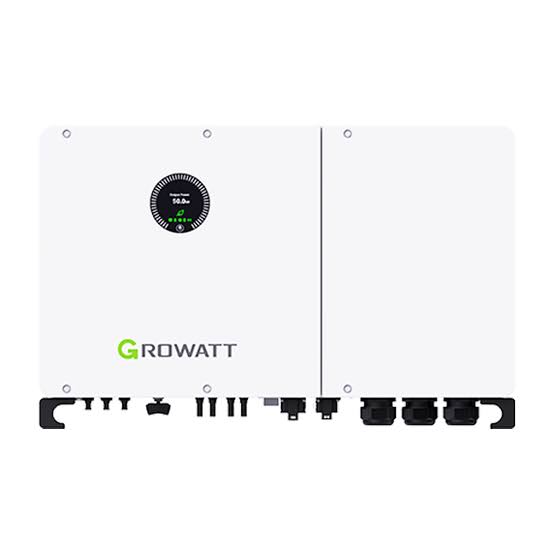
Description
Growatt WIT 50K-XHU: Two Specifications Nobody Quotes, and Both Matter Here
The Growatt WIT 50K-XHU carries 50kW of three phase output, accepts 100kW of solar across four MPP trackers, runs three independent high voltage battery channels, and converts at 98.1%. Those are the headline figures, and they are strong.
Two quieter lines further down the datasheet are what make it suit a Kenyan commercial site in particular.
No derating at 50C ambient. Most inverters reduce output as they heat, typically starting somewhere around 45C. This one holds full output to 50C. On a Kenyan commercial roof or an external plant room wall in the afternoon, that is the difference between the rated output and something less than it, every hot day, for the life of the installation.
Weak grid tolerance down to a short circuit ratio below 1.2. This is a measure of how stiff the grid connection is. At the end of a long rural feeder, or on an industrial park where the supply is already heavily loaded, a weak grid can cause inverters to trip or refuse to synchronise. Equipment specified for strong grids misbehaves in exactly the places that most need solar.
Both are easy to overlook because neither appears in a headline. Both decide how much energy the system actually delivers on the days it matters most.
100kW of panels on a 50kW inverter
The maximum recommended PV power is 100kW against 50kW of output, a two to one ratio. That is an unusually generous allowance at this size, and it is the specification with the largest effect on what the system produces across a year.
Once an inverter is big enough to carry the building’s load, further output capacity does nothing. Array capacity is what adds energy. An inverter that permits 100kW of panels will out produce one permitting 65kW on the same roof, every day, regardless of how closely matched the two look on their output ratings.
Oversizing works because an inverter only reaches its rating when the array is near peak production, which is a few hours around midday on a clear day. A larger array lifts the whole production curve, so full output arrives earlier, holds later, and survives cloud. Midday excess is simply limited, which costs little.
On a commercial roof with the space available, the ability to fit 100kW rather than 65kW is the single biggest determinant of what the system actually produces across a year.
Four trackers, eight strings, and a wide window
Four MPP trackers with two string inputs each gives eight strings in total, with 40A permitted per tracker and 50A short circuit.
The voltage window is 180V to 1000V with a 1100V absolute maximum, which is wide at both ends. A low floor means the inverter starts working earlier in weak morning light, and a high ceiling means longer strings, fewer of them, and less DC cabling across a large roof.
The full load range of 620V to 850V is worth noting separately. The inverter accepts panels from 180V, but reaching full rated output requires the array to be operating in that upper band, so strings should be designed to sit there during normal production rather than merely to stay inside the outer limits.
| Panels in series | Operating voltage | Open circuit | In the full load band | Verdict |
|---|---|---|---|---|
| 14 x 620W | Around 588V | Around 700V | Just below 620V | Works, but below the full load band |
| 16 x 620W | Around 672V | Around 800V | Yes | Good |
| 18 x 620W | Around 756V | Around 900V | Yes | Best use of the band |
| 20 x 620W | Around 840V | Around 1000V | At the top | Only after verifying panel figures |
Eighteen panels per string across eight strings reaches around 89kW, comfortably inside the 100kW ceiling and sitting squarely in the full load voltage band. Figures assume 620W panels at roughly 42V operating and 50V open circuit, and your own panel datasheet should always be checked, since voltage rises as temperature falls.
Three battery channels, which is unusual
The battery side takes high voltage, 200V to 900V with 512V recommended, across three independent channels at 55A each. Three is more than this class usually provides.
Three channels matter for two practical reasons. Battery banks can be expanded in stages without disturbing what is already installed and commissioned, which suits a commercial site that grows its storage as budget allows. And the channels can be used independently, so a fault or maintenance on one bank does not take the whole storage system out of service.
High voltage also means modest current. Where the low voltage models in this family draw hundreds of amps from a 48V bank, this one moves the same power at a fraction of that, which makes the DC cabling straightforward rather than specialist. The trade is that high voltage battery stacks are a narrower market than the 51.2V batteries widely sold in Kenya, so battery sourcing deserves attention before committing.
Backup behaviour
In backup mode the inverter delivers 50kW rated and 75kVA apparent, at up to 113.6A, with 150% overload for ten seconds. Switching between grid and backup takes 10ms or less, and black start means the system can be brought up from completely flat using only the battery, with no grid and no sun.
It permits 100% three phase unbalanced output, so the full rating can sit on any distribution across the phases including all on one. On commercial premises where loads were never balanced, that removes a rewiring exercise before commissioning.
Continuous AC passthrough is rated at 200A, which matters when the grid is healthy and the building is simply drawing through the inverter rather than from it.
Where it falls short
High voltage batteries are a narrower market in Kenya. The low voltage 51.2V batteries sold everywhere here do not apply. Confirm battery availability and support before specifying.
90kg. This is a mechanical handling and structural question, not a two person wall mount in a corridor.
Full output needs the array in the upper voltage band. Strings designed only to stay within the outer limits may never reach the full load range.
Three phase only, and genuinely commercial. The specification is wasted on anything smaller than a serious commercial or institutional load.
Published efficiency figures vary. Sources give 97.4%, 98.1% and 98.2%. We publish 98.1% from the series datasheet. The spread is narrow enough not to change a buying decision but wide enough to be worth noting.
Published weight figures vary. 90kg, 100kg and 160kg appear across listings. The 160kg figure belongs to the larger WIT 50-100K series rather than this model. We publish 90kg and weigh stock on arrival.
Warranty terms differ by source and region. Confirmed in writing at the point of sale rather than quoted from a reseller page.
Where it is the right choice
- Factories and processing plants. Heavy motor loads, unbalanced phases, and roof area to fill.
- Sites with weak or distant grid supply. The short circuit ratio tolerance is the specification that matters and nobody else publishes it.
- Hot locations and exposed plant rooms. No derating at 50C holds output through the afternoon.
- Large roofs. 100kW of array capacity is the segment advantage.
- Institutions and hotels. Hospitals, schools, lodges, anywhere outages are commercially serious.
- Phased storage investment. Three battery channels allow banks to be added without disturbing existing ones.
- Estates and agricultural processing. Irrigation, cold chain, milling.
Full specifications
| Specification | Value |
|---|---|
| Brand | Growatt, Shenzhen Growatt New Energy Technology |
| Model | WIT 50K-XHU, from the WIT 29.9 to 50K-XHU series |
| Type | Three phase hybrid, high voltage battery, transformerless |
| AC nominal output power | 50000W |
| Maximum AC apparent power, backup | 75kVA |
| Maximum output current, grid | 83.3A |
| Maximum output current, backup | 113.6A |
| Maximum input current, grid | 166.7A |
| Maximum continuous AC passthrough | 200A |
| Overload capacity | 110% continuous, 150% off grid for 10 seconds |
| Nominal AC voltage | 220/230V line to neutral, 380/400V line to line |
| AC grid connection type | 3P3W+PE or 3P4W+PE |
| Frequency | 50Hz or 60Hz, range 45Hz to 65Hz |
| Load unbalance permitted | 100% three phase unbalanced |
| Weak grid capability | Short circuit ratio below 1.2 |
| Maximum efficiency | 98.1% |
| Maximum recommended PV power | 100000W |
| DC to AC ratio | 2 to 1 |
| Maximum DC voltage | 1100V |
| Start voltage | 195V |
| Nominal DC voltage | 620V |
| MPPT voltage range | 180V to 1000V |
| Full load DC voltage range | 620V to 850V |
| MPP trackers | 4 |
| PV strings per tracker | 2, eight inputs in total |
| Maximum input current per tracker | 40A |
| Maximum short circuit current per tracker | 50A |
| Battery voltage range | 200V to 900V, 512V recommended |
| Battery channels | 3 independent |
| Maximum charge and discharge current | 55A per channel |
| BMS communication | RS485 or CAN |
| Grid to off grid switching | 10ms or less |
| Black start | Supported |
| Generator input | Yes, with smart load function |
| Surge protection | Type II, DC and AC |
| Interfaces | RS485, USB, WiFi, GPRS, RF, LAN |
| Cooling | Smart air cooling, no derating at 50C ambient |
| Protection degree | IP66, indoor or outdoor |
| Operating temperature | -30C to +60C |
| Noise | Under 55dB(A) |
| Dimensions | 920 x 585 x 320mm |
| Weight | 90kg |
Installation notes
Design strings into the 620V to 850V full load band. Staying inside the outer MPPT limits is not the same as reaching full output.
Confirm high voltage battery availability first. This is the specification most likely to constrain a Kenyan project, and it should be settled before the inverter is ordered.
Plan the three battery channels around phasing of investment. Using one channel now and leaving two for later is a legitimate and tidy strategy.
Mechanical handling needs planning. 90kg onto a wall at a commercial site means lifting equipment and a structural check.
Confirm the grid connection type. 3P3W+PE and 3P4W+PE are different and the installation must match the supply.
Raise the weak grid capability with the client if supply is poor. On a site that has had trouble with previous equipment synchronising, this is the specification that explains why and the reason to choose this machine.
At 50kW the inverters all look similar on paper. The questions that separate them are how much array you can actually fit, whether the unit holds output when it is hot, and whether it will synchronise with your supply.
Tell us the available roof area, the supply conditions at the site, and whether the plant room is air conditioned or an external wall, and we will tell you whether this specification is being used or wasted. Begin a full assessment with the Solar Calculator, or send the site details through My Quote for a costed commercial proposal.