Description
Solar DC Fuse Holder 16A Kenya — Suntree SRF-30 PV Fuse with Holder 1000VDC for Smaller Residential and Off-Grid Solar
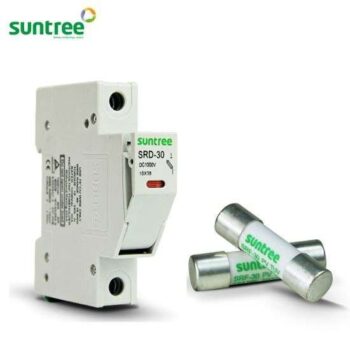
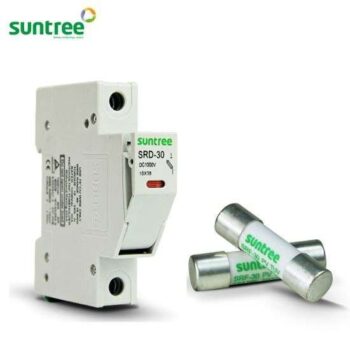
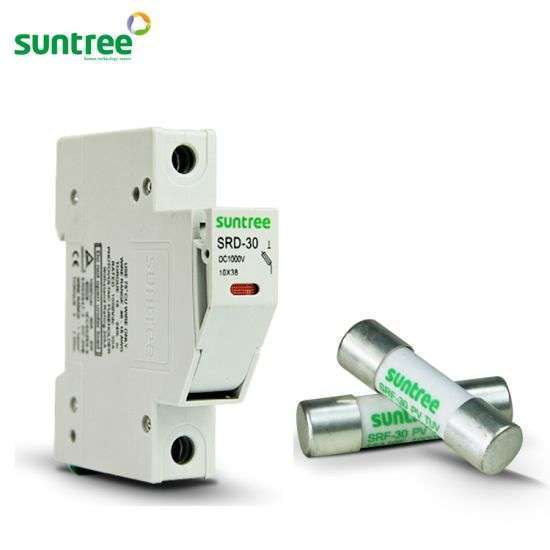
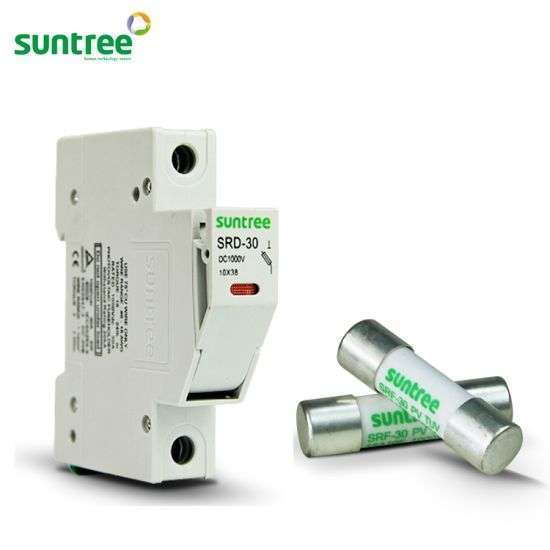
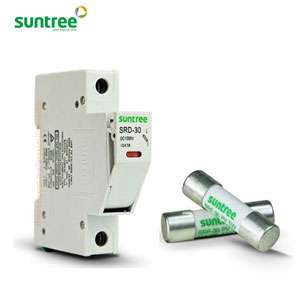
The Solar DC Fuse Holder 16A from Suntree — referenced throughout the Kenyan smaller residential solar market under several product names including Suntree SRF-30 PV Fuse Holder 16A, the 10x38mm gPV Solar Fuse 16A, the DC Fuse Link with Holder 16A, the PV String Fuse 16A 1000VDC, and the Solar Combiner Box Fuse 16A — is the entry-tier overcurrent protection device for smaller residential and off-grid solar installations. It is the small ceramic-and-polycarbonate assembly that sits inside the combiner box (or directly inline on the DC string cable) and quietly performs the single most important function in solar overcurrent protection: cutting the fault current cleanly when a downstream short circuit or sustained overload would otherwise damage the panels, cables, or downstream electronics.
This 16A variant sits at the smaller end of the practical PV fuse current range. It pairs naturally with smaller residential installations of 3-5 kW capacity using 6-8 modern panel modules where each string carries 8-12A continuous current under normal operation. The 16A rating provides the conservative overcurrent margin (typically 1.25× to 1.56× the string short-circuit current per IEC 60364-7-712 sizing recommendations) that protects against sustained fault currents without nuisance-tripping under legitimate high-irradiance operation. Larger residential and commercial installations step up to the 20A or 32A variants in the same SRF-30 holder family — same physical assembly, different cartridge ratings.
Most Kenyan homeowners do not specifically search for “16A solar fuse” by current rating — they search for “solar DC fuse holder Kenya” and let their installer specify the current rating that matches their panel string configuration. This page covers the 16A variant in detail; if your panel string carries higher continuous current you may need the 20A or 32A variant instead. The decision is engineering rather than budgetary — undersizing the fuse risks nuisance tripping during legitimate high-output midday operation; oversizing the fuse risks failing to protect against fault currents that would damage the panel string. Match the fuse rating to your specific installation.
What the 16A SRF-30 assembly actually does in a solar installation
The PV fuse + holder assembly performs overcurrent protection at the string level — distinct from the system-level protection that DC MCBs provide at the combiner output or inverter input. Five specific protection scenarios make the 16A SRF-30 valuable in smaller residential installations:
- String-level short-circuit fault interruption: If a fault develops within a panel string (damaged module, water ingress causing internal short, animal damage to cable insulation), the fault current can reach several times the normal operating current. The 16A fuse interrupts this fault current within milliseconds, isolating the faulted string before damage propagates to adjacent strings, the combiner busbars, or downstream MPPT input electronics.
- Reverse current protection in parallel-string installations: When multiple strings combine in parallel at a combiner box, a fault in one string can cause reverse current to flow from the healthy strings into the faulted string through the common busbar. The 16A fuse interrupts this reverse current, preventing the healthy strings from feeding fault energy into the damaged string and creating cascading damage across the array.
- Cable insulation thermal protection: The cables connecting panel strings to the combiner box are sized for the normal continuous current. Sustained overload would heat the cable insulation toward its rated temperature limit, eventually causing insulation failure and potential fire. The 16A fuse cuts sustained overload current before cable insulation reaches damaging temperature.
- MPPT input protection from string faults: Inverter and charge controller MPPT inputs are designed for the rated string current; sustained overcurrent damages the input MOSFETs and the surrounding switching electronics. The 16A fuse interrupts string-level faults before they reach the MPPT input, protecting the most expensive component in many smaller solar installations.
- EPRA compliance and insurance documentation: Kenyan electrical regulations for solar PV installations include overcurrent protection at appropriate points in the DC architecture. The 16A SRF-30 assembly with IEC 60269-6 gPV certification provides the documentation evidence that EPRA inspectors verify in residential installation paperwork, and that some insurance providers verify when assessing solar coverage.
Why IEC 60269-6 gPV class specifically matters for solar applications
Many buyers — and some installers — conflate solar fuses with general-purpose electrical fuses, leading to misapplications that compromise actual protection. Three engineering distinctions make the gPV class specifically suitable for solar PV applications:
- Full-range interrupting capability vs. partial-range: General-purpose AC fuses (IEC 60269-1) interrupt currents from short-circuit levels down to several times the rated current. Below that threshold they may not reliably interrupt — the fault could persist as a sustained overload. The gPV class (IEC 60269-6) provides full-range interrupting capability, reliably interrupting fault currents from short-circuit levels all the way down to currents just above the rated value. Solar PV strings experience exactly the lower-end fault scenarios (partial shading combined with reverse current, gradual cell degradation) that general-purpose fuses cannot reliably interrupt.
- DC interrupting capability at high voltage: General-purpose AC fuses are tested at AC voltage waveforms with natural current zero crossings every half-cycle that assist arc extinction. DC has no current zero crossings — the fuse must extinguish the arc through pure thermal and mechanical action. The gPV class is specifically tested for DC interruption at 1000VDC with the substantial arc energy that develops at this voltage class. General-purpose fuses installed on solar DC may simply fail to interrupt during fault events.
- Photovoltaic-specific I²t characteristics: The gPV class uses I²t (let-through energy) characteristics matched to the typical fault current waveforms in PV systems — slower-rising prospective fault currents from solar array characteristics rather than the rapid-rising currents of utility-supplied AC circuits. The gPV characteristic ensures the fuse operates at the correct point in the fault progression to protect downstream equipment without nuisance-tripping under legitimate transient currents during solar startup and irradiance changes.
Selecting solar fuses by gPV class rather than current rating alone is the engineering discipline that distinguishes reliable installations from those that experience either nuisance tripping or unprotected fault events. The Suntree SRF-30 + 10x38mm 16A gPV fuse assembly meets the gPV class specifically; this is verified by the IEC 60269-6 certification reference in the device documentation.
How the 16A fits within the SRF-30 PV fuse family
The Suntree SRF-30 holder accepts 10x38mm cylindrical PV fuse cartridges across the standard current ratings. The same physical holder hosts different current ratings — buyers select the fuse rating matching their specific string current, with the holder providing the same DIN rail mounting, the same safety-withdrawal mechanism, and the same IEC 60947-3 holder certification across the range:
| Fuse Holder Assembly | Current Rating | Typical Application Tier |
|---|---|---|
| Solar DC Fuse Holder 16A — this product | 16A continuous | Smaller residential (3-5 kW), single-string protection, smaller off-grid systems |
| Solar DC Fuse Holder 20A | 20A continuous | Standard Kenyan residential (5-8 kW), the most common residential variant |
| Solar DC Fuse Holder 32A | 32A continuous | Larger residential (8-12 kW), small commercial (8-15 kW), parallel-string protection |
The 16A variant suits the smaller end of the residential market — installations where each string carries a modest 8-12A continuous and where the 16A fuse rating provides appropriate overcurrent margin. Standard residential installations using 6-8 modern higher-output panels typically need the 20A variant because the higher panel output drives continuous string current toward 12-15A. Larger residential and small commercial installations need the 32A variant. Verify your panel string short-circuit current and the EPRA-registered installer’s fuse sizing calculation before defaulting to the 16A simply for the lower price.
When the 16A is correctly sized — and when it isn’t
Fuse sizing follows engineering rather than guesswork. The 16A variant is appropriately sized for installations meeting three specific criteria, and inappropriately sized for installations exceeding any of them:
- Panel string short-circuit current (Isc) at or below 10-11A: Typical smaller residential panels (300-400W modern modules) carry Isc in the 9-11A range under standard test conditions. With the standard 1.56× sizing margin (1.25× for OCPD margin × 1.25× for Isc continuous current margin), the appropriate fuse rating is 1.56 × 10A = 15.6A, rounded up to the next standard 16A rating. Higher-output panels (450W+ modern modules with Isc above 11A) drive fuse sizing toward 20A.
- Single-string installation or independent string protection in parallel-string combiners: The 16A protects one string. If the installation has multiple parallel strings combining at a combiner box, each string typically needs its own fuse holder at the string entry — multiple 16A SRF-30 assemblies installed in parallel positions inside the combiner. Single-string off-grid installations need just one 16A assembly per pole.
- Residential 550V architecture or smaller off-grid voltage classes: The 1000VDC rating of the holder and fuse comfortably handles residential 550V architectures, smaller off-grid 48V/96V systems, and entry commercial 1000V configurations. Higher voltage classes (1500VDC utility-scale) need fuses rated for those higher voltages.
Three scenarios where the 16A is the wrong choice and you should step up to the 20A or 32A variant: panel strings using larger 500W+ modules with Isc above 13A typically need the 20A variant for proper margin. Parallel-string installations where multiple strings combine and the consolidated current after combining sits in the 18-28A range need the 32A variant at the combined point. Installations on commercial 1000V architecture with 12-15 panel strings carrying continuous current above 15A need the 20A or 32A variants from the same family.
How the 16A SRF-30 fits in the complete Bicity Solar DC protection scheme
The 16A PV fuse assembly is one layer in the complete DC protection architecture, sitting between the panel strings and the downstream protection devices. The scheme covers four distinct protection functions, each with its own device category:
| Protection Layer | Function | Position | Bicity Range |
|---|---|---|---|
| String-level PV fuse — this product | String overcurrent and reverse-current protection | At each string entry into the combiner box (or inline on string cable) | SRF-30 PV Fuse Holder 16A/20A/32A |
| DC Isolator Switch | Manual disconnection at the array side | On the roof near the panel array | SISO-40 4P 1000VDC 32A |
| DC Circuit Breaker (DC MCB) | Automatic overcurrent protection plus manual switching at distribution | Inside combiner box output and at inverter DC input | SL7N-63 family (2P 550V and 4P 1000V from 10A to 63A) |
| DC Surge Protector (DC SPD) | Transient voltage surge diversion to earth | Inside combiner box and at inverter DC input | SUP1-PV40 family (1P/2P/3P/4P variants) |
A complete smaller residential installation typically uses one 16A SRF-30 PV fuse per string at the combiner box entry, one SISO-40 DC isolator at the roof, one DC MCB at the inverter DC input, one DC SPD at the inverter, and a combiner box that houses several of these protection devices in a single weatherproof enclosure. The PV fuses serve a different function from the DC MCBs — the fuses protect against string-level faults; the MCBs protect against combined-output overcurrent and provide manual switching. Both are required in a properly engineered protection scheme.
Technical Specifications
| Specification | Value |
|---|---|
| Bicity SKU | BC-PVF-1000V-16A |
| Manufacturer | Suntree (XinChi Electric Group) — SRF-30 holder series with 10x38mm gPV fuse cartridge |
| Device category | PV Fuse + Holder Assembly — string-level overcurrent protection for solar DC circuits |
| Fuse class | gPV — photovoltaic full-range per IEC 60269-6 |
| Holder standard | IEC 60947-3 — switches, disconnectors, switch-disconnectors and fuse-combination units |
| Rated voltage (Ue) | 1000V DC continuous |
| Rated current (In) | 16A continuous |
| Breaking capacity (Icn) | 33 kA at 1000VDC |
| Minimum interrupting current | 1.3× In (approximately 21A) per IEC 60269-6 gPV characteristic |
| Time constant | Less than 1 millisecond (DC circuit time constant under which the fuse is tested) |
| Pole configuration | 1-pole holder accepting single 10x38mm cylindrical fuse |
| Fuse dimensions | 10mm diameter × 38mm length (standard 10x38mm cylindrical PV fuse) |
| Holder DIN rail width | 18mm (1 standard module) |
| Operating temperature | -30°C to +70°C ambient under service |
| Storage temperature | -40°C to +85°C de-energised |
| Mounting | 35mm DIN rail snap-fit attachment in standard combiner boxes and distribution panels |
| Terminal capacity | Solar PV stranded copper conductor 2.5mm² up to 10mm² per terminal |
| Holder body material | Polycarbonate with high heat-deflection temperature and UV resistance |
| Fuse cartridge body | Ceramic with sand-filled arc-quench chamber |
| Power dissipation | Approximately 3 W at full rated current |
| Withdrawal safety | Lid-locked withdrawal mechanism prevents removal of energised fuse under load |
| Compliance | IEC 60269-6 (fuse), IEC 60947-3 (holder), CE marked, TUV certified |
| Service life (no fault events) | Indefinite — fuse cartridge service life is determined by fault events rather than calendar time |
| Net weight | Approximately 0.08 kg complete assembly |
Engineering Features Specific to the 16A SRF-30 Assembly
- 16A continuous rating sized for smaller residential strings: Matches the typical 9-11A short-circuit current of smaller residential panel strings (300-400W modules) with the standard 1.56× sizing margin per IEC 60364-7-712 OCPD recommendations. Provides appropriate fault protection without nuisance-tripping under legitimate high-irradiance midday operation.
- 1000VDC voltage rating with substantial residential margin: Operating voltage rating that comfortably covers residential 550V architecture with substantial margin for cold-morning string voltage peaks. Same 1000V rating also covers entry commercial 1000V architecture where the 16A current rating remains appropriate.
- 33 kA breaking capacity for full short-circuit interruption: Interrupting capability handles the substantial short-circuit currents that can develop in faulted solar PV strings, including parallel-string fault scenarios where multiple healthy strings drive fault current into a faulted string. The 33 kA rating provides margin above the typical Kenyan residential installation requirement.
- gPV class for solar-specific fault behaviour: Full-range interrupting characteristic per IEC 60269-6 ensures the fuse operates correctly across the full fault current range that solar systems experience — from short-circuit levels down to sustained overload currents that general-purpose AC fuses cannot reliably interrupt.
- Sub-1-millisecond time constant for DC circuit testing: Tested under DC circuit conditions matching the actual installation behaviour rather than the AC test conditions used for general-purpose fuses. Verified to interrupt DC fault currents reliably without prolonged arc events that could damage adjacent equipment.
- Lid-locked safety withdrawal mechanism: The holder lid mechanism prevents withdrawal of the fuse cartridge while the circuit is energised under load. Service personnel must physically open the holder lid before the cartridge can be removed; the lid release mechanism interrupts the circuit before the cartridge separates from the terminals. Prevents the safety-critical scenario of pulling an arcing cartridge under load.
- 10x38mm standard cylindrical form factor: Standard PV fuse cartridge dimensions ensure that replacement cartridges remain available across the Kenyan solar market — no manufacturer lock-in for service replacement. Use only gPV-class cartridges from Suntree or comparable certified manufacturers carrying the IEC 60269-6 mark for any future replacement service.
- 18mm DIN rail footprint for residential combiner box integration: Single-module width that fits cleanly in residential combiner boxes, dedicated PV distribution panels, and small distribution enclosures without requiring oversized cabinets. Multiple holders mount side-by-side for multi-string installations.
- Approximately 3W power dissipation at full current: Modest heat generation under continuous full-load operation. Combiner box layout should provide adequate ventilation around the fuse holder positions, but no special heat-dissipation provisions are typically required at the 16A current level.
- IEC 60269-6 PV-specific certification: The PV-specific fuse standard that EPRA residential inspectors look for in solar installation documentation, distinguishing the gPV class from general-purpose IEC 60269-1 fuses that are inappropriate for solar DC service.
Typical Kenyan Residential Installation Scenarios for the 16A Variant
- Smaller residential solar installations across Kiambu, Limuru, Ruiru, Thika, Athi River, Machakos, and outer Nairobi metropolitan suburbs — typical 3-5 kW systems using 6-8 panels in single-string configuration with Vestwood 5kW Hybrid Inverter pairing
- Coastal residential homes in Mombasa, Diani, Watamu, Malindi, Kilifi where smaller 3-4 kW residential solar provides backup during national grid outages and reduces daytime electricity costs
- Highland smaller residential solar in Murang’a, Nyeri, Embu, Meru, Kerugoya, Nyahururu where afternoon thunderstorm activity makes proper string-level overcurrent protection particularly important alongside surge protection
- Lake Victoria basin smaller residential solar in Kisumu, Kakamega, Bungoma, Siaya, Migori, Busia where lightning frequency makes complete DC protection schemes (PV fuses + SPDs + DC MCBs) economically essential
- Rift Valley smaller residential solar in Nakuru, Naivasha, Eldoret, Kericho, Bomet residential estates where 3-5 kW installations support household electrical loads during regular national grid instability
- Off-grid weekend home solar at Naivasha lakeside properties, Mount Kenya area cabins, Aberdares foothill weekend homes, coastal holiday cottages — where smaller 3-4 kW off-grid systems with single-string PV configurations use the 16A fuse for string protection
- Off-grid remote facility small solar at conservation ranger stations, smaller mission outposts, isolated research stations — where smaller PV strings feeding 48V battery banks need string-level overcurrent protection sized appropriately for the modest current
- Small home office and small home business solar where the workspace electrical needs justify a 3-5 kW solar installation with proper protection but where the larger fuse ratings would be over-specified
- Entry-tier residential solar in growing Kenyan towns — Nyeri, Embu, Meru, Garissa, Lodwar, Bungoma, Kakamega, Kisumu, Nakuru, Eldoret — where 3-5 kW first-installation solar systems serve households moving from grid-only to grid-plus-backup electrical architecture
- Smaller rural mission school and rural clinic solar at facilities operating below the residential capacity threshold where the protection scheme matches the system scale rather than over-specifying for unnecessary commercial capacity
- Charge controller input protection in smaller off-grid systems where the 16A fuse protects the MPPT input from string-level faults that would otherwise damage the charge controller electronics
- DIY-friendly residential solar where homeowners can specify the 16A fuse for an installer to fit, knowing the rating matches their smaller panel configuration without needing to size larger commercial-tier components
Pairing the 16A SRF-30 with Bicity Solar ecosystem components
The 16A PV fuse holder integrates with several Bicity Solar residential products to build the complete smaller-residential protection scheme. Four common integration patterns appear across Kenyan smaller-residential installations:
- Smaller residential 3-5 kW single-string: One 16A SRF-30 in the residential combiner: A residential single-string installation with 6-8 modern panels routes from the rooftop SISO-40 DC isolator, then carries the string current along solar PV cable down to the residential combiner enclosure where the 16A SRF-30 PV fuse delivers string overcurrent protection. From the combiner output, the line passes through a 2P 550VDC DC MCB and finally lands at the Vestwood 5kW Hybrid Inverter DC input. The 16A fuse handles the string-level fault protection that the larger DC MCB cannot provide.
- Smaller residential 3-5 kW with array-side isolation: 16A SRF-30 in combiner + SISO-40 at roof: The double-isolation residential pattern adds the SISO-40 DC isolator at the array side providing EPRA-required array-side disconnection plus the 16A SRF-30 PV fuse at the combiner side for string overcurrent protection. The two devices serve different protection functions and both are appropriate for the residential installation.
- Off-grid 2-4 kW with charge controller: 16A SRF-30 between panels and MPPT controller: Off-grid installations using a MPPT charge controller feed through the 16A SRF-30 PV fuse positioned between the panel array (or rooftop combiner) and the charge controller MPPT input. The fuse protects the charge controller from string-level faults that would otherwise damage the MPPT electronics.
- Smaller hybrid residential with battery: Complete protection scheme: The 16A SRF-30 PV fuse plus 2P 600V DC SPD (BC-SPD-600V-40KA-2P) plus 2P 550VDC DC MCB plus SISO-40 array-side isolator together form the complete protection scheme for smaller residential hybrid installations with 5-15 kWh battery storage. Each device handles a distinct protection function within the integrated residential protection architecture.
Installation Notes for the 16A SRF-30 in Smaller Residential Systems
Installation must be performed by an EPRA-registered solar electrician with documented residential solar installation experience. The 16A SRF-30 assembly mounts inside the residential combiner box or distribution enclosure as part of the broader solar installation workflow. Seven practical considerations apply to 16A SRF-30 installations:
First, fuse sizing verification before installation. The 16A rating must match the calculated fuse size for the specific panel string in the installation. The EPRA-registered installer calculates the appropriate fuse rating based on panel short-circuit current (Isc) × 1.56 sizing margin × rounded up to the next standard rating. Verify that this calculation supports the 16A rating before installing; if the calculation drives the rating toward 20A or higher, install the appropriate larger variant from the same SRF-30 family instead.
Second, mounting position within the residential combiner box. The 16A SRF-30 mounts on standard 35mm DIN rail inside the combiner box, typically at the string entry position before the busbar combining or downstream MCB. The mounting position should allow heat dissipation around the holder during continuous operation, with at least the standard module-width clearance from adjacent DIN rail devices.
Third, conductor termination at the holder terminals. The 16A SRF-30 accepts solar PV stranded copper conductor from 2.5mm² up to 10mm². Use solar PV cable rated for the operating voltage class (typically 4mm² for residential 16A applications, sized for both ampacity and acceptable voltage drop over the cable run length). Strip the cable insulation to the manufacturer-specified length and torque the terminal screws to the documented value using a calibrated torque wrench.
Fourth, polarity convention even though the fuse is polarity-tolerant. The fuse cartridge interrupts current regardless of direction, but the rest of the installation depends on consistent polarity convention. Mark positive and negative consistently across all conductors entering and leaving the holder for the benefit of future maintenance work.
Fifth, lid-locked withdrawal mechanism verification. Test the holder lid mechanism during commissioning by opening the lid (with the circuit safely de-energised through the upstream SISO isolator) and verifying the cartridge can be cleanly withdrawn and reinserted. The lid mechanism prevents future service personnel from accidentally pulling a live cartridge under load.
Sixth, replacement cartridge stock provisioning. The fuse cartridge is sacrificial — after a fault event the cartridge requires replacement. Bicity Solar recommends keeping at least one spare 16A 10x38mm gPV cartridge on site for residential installations, ensuring that fault clearance does not leave the system unprotected during the replacement procurement period.
Seventh, commissioning documentation. Record the SRF-30 installation date, fuse current rating, gPV class, and IEC 60269-6 certification reference in the residential solar commissioning documentation. EPRA inspectors and insurance assessors verify this documentation as part of installation compliance and coverage assessment.
Building a smaller residential solar installation in Kenya (3-5 kW Vestwood 5kW Hybrid pairing) or an entry-level off-grid system?
Specify the Solar DC Fuse Holder 16A (Suntree SRF-30 PV Fuse with Holder 1000VDC) for string-level overcurrent protection inside the residential combiner box. Combine with the SISO-40 DC isolator at the roof, 2P 550VDC DC MCB at the combiner output, 2P 600V DC SPD for surge protection, and Vestwood 5kW Hybrid Inverter for the complete smaller residential scheme — open the Solar Calculator to scope your residential protection requirements, or send your project through My Quote for a complete residential bill of materials with fuse sizing verification for your specific panel string configuration.