Description
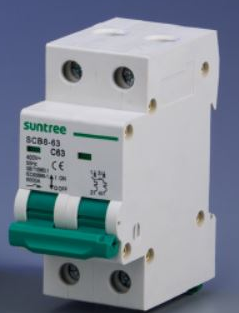
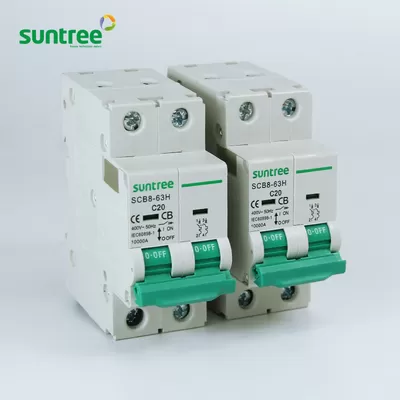
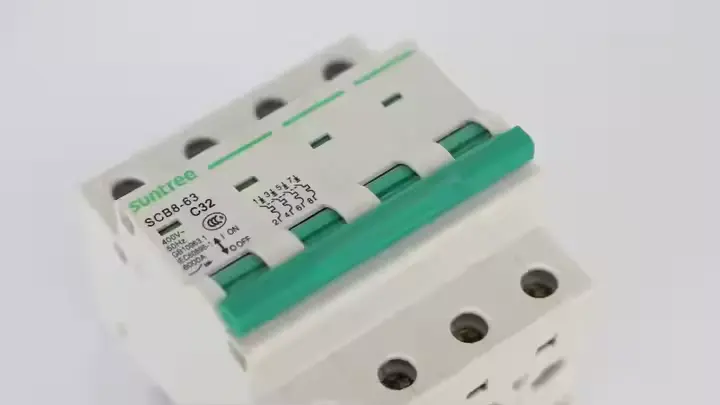
Four Pole MCB 63A — SCB8-63 4P 400VAC Three Phase Main Switch / Circuit Breaker
The Four Pole MCB 63A is the natural master device for any three-phase Kenyan installation drawing up to about 43 kVA total — three-phase residences in upmarket Nairobi suburbs, small offices and salons fed from a three-phase service tap, dairy parlours and irrigation pump houses on agricultural smallholdings, and the AC output side of three-phase hybrid solar inverters in the 10 kW to 20 kW range. At 63 amperes per pole across all three lines and the neutral, it provides single-action isolation of the entire premises while keeping the same compact SCB8-63 platform used throughout the rest of the family.
Where the 4P 80A from the SCB8-125 family targets medium commercial premises with prospective fault currents demanding 10 kA breaking, the 4P 63A in the SCB8-63 family covers the next tier down — smaller installations where the utility supply is sized at 60 amps per phase and the fault current available at the incomer position remains within the 6 kA family rating. That places the 63A 4P right at the meeting point between single-phase residential (where the 63A 2P main switch dominates) and full commercial three-phase (where the 80A 4P or higher takes over).
Recognising when a three-phase 63A breaker is the right call
- Three-phase residential supplies: A growing number of larger Kenyan homes — particularly those above 250 square metres in Karen, Runda, Muthaiga, Loresho, Spring Valley, and Kitisuru — sit on three-phase service connections rather than single-phase. The 4P 63A becomes the master switch of the household consumer unit in these cases.
- Small office and serviced workspace incomers: Three-phase shared-workspace premises, small estate agency offices, accounting practices, and other modest professional setups typically draw 30 to 45 kVA across three phases.
- Salon and barbershop three-phase services: Multi-chair beauty salons with several hooded dryers, steam wands, and water heaters often choose three-phase to balance the heating load across the supply.
- Three-phase irrigation and farm pump installations: Submersible borehole pumps in the 3 kW to 11 kW three-phase range, common across dairy farms in Limuru, Nyeri, Kiambu, and Nakuru.
- Three-phase 11 kW EV chargers: The newer wave of imported Type 2 three-phase EV chargers drawing 16 amperes per phase.
- 10 kW to 20 kW three-phase hybrid inverters: AC output isolation for residential-scale and small-commercial three-phase solar systems.
- ATS panel input and output protection: Automatic transfer switches selecting between mains, generator, and solar on a three-phase service.
- Three-phase sub-mains: Tap-off feeders from a larger commercial main panel to smaller tenants, outbuildings, or workshop wings.
4P versus 3P: a deliberate choice for the master position
The decision between a 4-pole and a 3-pole breaker at the master position of a three-phase installation comes down to whether the neutral conductor needs to be switched. In most Kenyan three-phase residential and small-commercial premises, the answer is yes — and the reason is the mix of loads behind the panel. A home with three-phase incoming supply still has many single-phase outgoing circuits (lighting on one phase, kitchen on another, sockets distributed across all three), all sharing a common neutral back to the supply transformer. Under fault conditions on an unbalanced three-phase system, the neutral can carry significant return current; switching it along with the three lines is the safer practice and is increasingly required at master switch positions by updated regulatory guidance. The 4P 63A handles this requirement cleanly; the matching 3P 63A on the related products page is the right choice only where the downstream load is genuinely a balanced three-phase device with no neutral routing.
Technical Specifications
| Property | Value |
|---|---|
| Reference Family | SCB8-63 (4P 63A variant) |
| Continuous Current per Pole | 63 amperes |
| Switched Poles | Four (R, Y, B, plus Neutral) |
| Trip Linkage | Common bar — any pole fault drops all four |
| Working Voltage | 400V phase-to-phase, 230V phase-to-neutral |
| Frequency Window | 50 / 60 Hertz dual rating |
| Curve Type | C — magnetic trip at five-to-ten times nominal |
| Trip Mechanism | Thermal (slow) plus magnetic (instantaneous) |
| Fault Interrupt Rating | 6 kA at 400V per IEC 60898-1 |
| Insulation Withstand Voltage | 500V (Ui) |
| Pollution Degree Allowance | 2 — sealed indoor distribution panel |
| Mechanical Operating Life | Twenty thousand handle operations |
| Electrical Switching Life | Four thousand under rated load |
| Rail Mounting | Snap-on, 35mm symmetrical DIN profile |
| Module Occupancy | Four standard 18mm modules |
| Per-Terminal Cable Range | Solid or stranded copper to 25mm² |
| Recommended Supply Conductor | 16mm² copper minimum per phase, 25mm² for long runs |
| Ambient Working Range | From minus five up to plus forty Celsius |
| Status Window per Pole | Colour-coded mechanical indicator |
| Standard of Reference | IEC 60898-1 / IEC 60947-2 |
Highlight Features
- Common-trip integrity — a fault detected on any single pole mechanically drops all four together, never leaving partial energisation that could damage three-phase motors or feed unbalanced voltage to inverters.
- Single rocker actuation — one handle disconnects every phase plus neutral, ideal for a master isolator where speed of isolation matters during emergency situations.
- Compact four-module width — half the rail space of a moulded-case device of equivalent rating, fitting comfortably in standard residential and small-commercial panel enclosures.
- Generous 25mm² terminal opening — accepts the typical 16mm² and 25mm² conductors used at the master switch position of a three-phase service.
- Per-pole status indicators — independent windows on each pole confirm every conductor is mechanically open before any downstream service work commences.
- C-curve characteristic for mixed loads — handles the mix of single-phase resistive, single-phase inductive, and balanced three-phase motor loads typical of a residential or small-commercial premises without false tripping.
- Same depth as smaller family members — sits flush in panels populated by other SCB8-63 breakers for a clean, uniform installation appearance.
- Reliable mechanism for daily operation — twenty thousand operations of guaranteed life cover the routine ON-OFF cycling that a master switch sees over decades of household use.
Typical Kenyan Installation Contexts
- Three-phase consumer unit master switch in larger detached residences across Karen, Lavington, Kileleshwa, and Westlands
- Small office incomer protection for accounting practices, law firms, and consultancies in mid-rise commercial buildings
- Multi-chair salon and spa main switches where heating equipment is balanced across three phases
- Dairy parlour incomers feeding milking equipment, refrigeration, and lighting in agricultural operations
- Borehole pump house main switches for medium-output irrigation and water-supply installations
- Three-phase EV charging point isolators at residential properties with three-phase service
- AC output protection for hybrid solar inverters in the 10 kW to 20 kW three-phase range
- Generator and ATS panel input/output isolation for three-phase backup installations
Installation Notes
At the master switch position of a three-phase Kenyan installation, four practical points govern correct setup. First, the supply conductors must be sized to the breaker — typically 16mm² copper per phase plus matching neutral on short runs, stepping to 25mm² where the cable passes through warm voids or runs more than five metres from the meter position. Second, phase rotation must be confirmed with a phase rotation indicator before energising any downstream three-phase motor or inverter; reverse rotation can damage motors and prevent grid-tie inverters from synchronising. Third, the neutral conductor connects to the fourth pole, never bypassed straight through to the busbar; a 4P breaker that has its neutral pole left unwired is functionally a 3P breaker with one wasted module. Fourth, the load-side connections feed the busbars of the consumer unit, with each phase landing on its own busbar and the neutral connecting to the panel’s separate neutral bar.
Routine torque verification on terminations at six and twelve months after commissioning catches the early signs of loose connections before they progress to heat damage. The 4P 63A handles up to about 43 kVA total across all three phases simultaneously; sustained loading above that figure on any phase requires either rebalancing the outgoing distribution or stepping up to the SCB8-125 4P family.
Designing or upgrading a three-phase installation?
Get a complete three-phase load schedule with main switch, breakers, RCDs, and cable sizes — start with our Solar Calculator for system-wide capacity sizing, or share your appliance list through My Quote for a turnkey panel design.