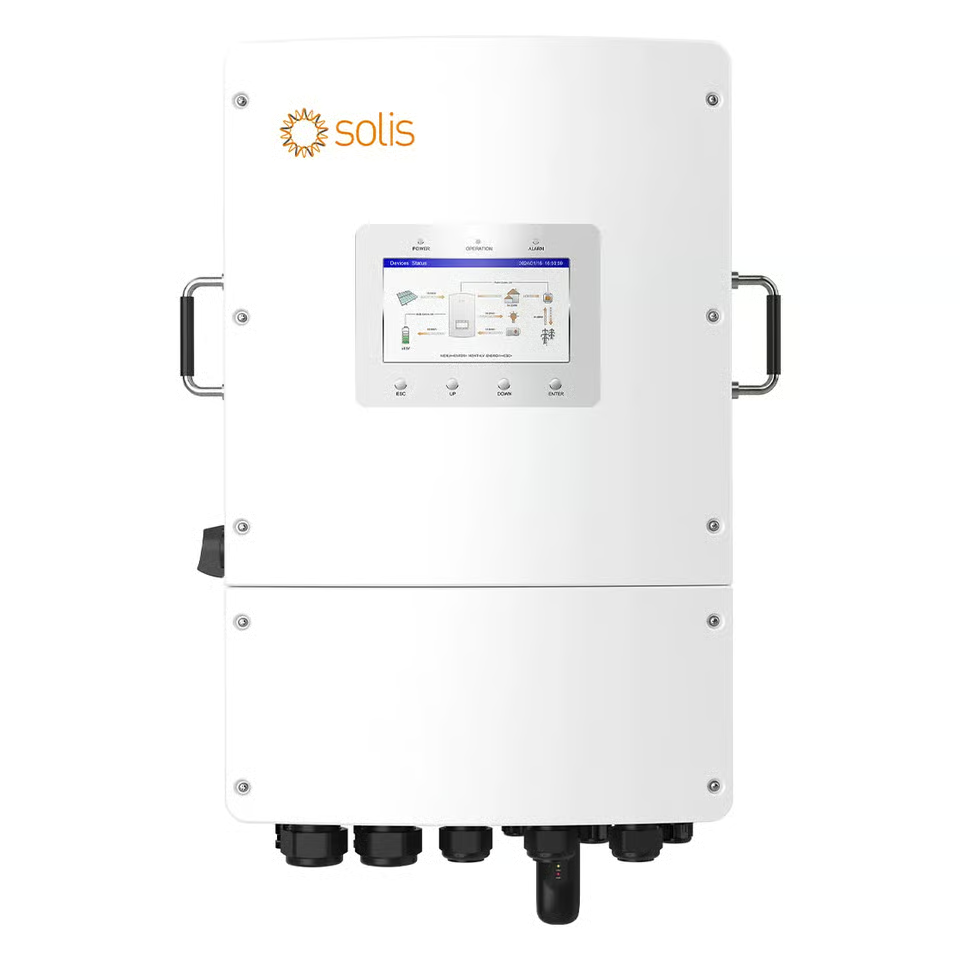
Description
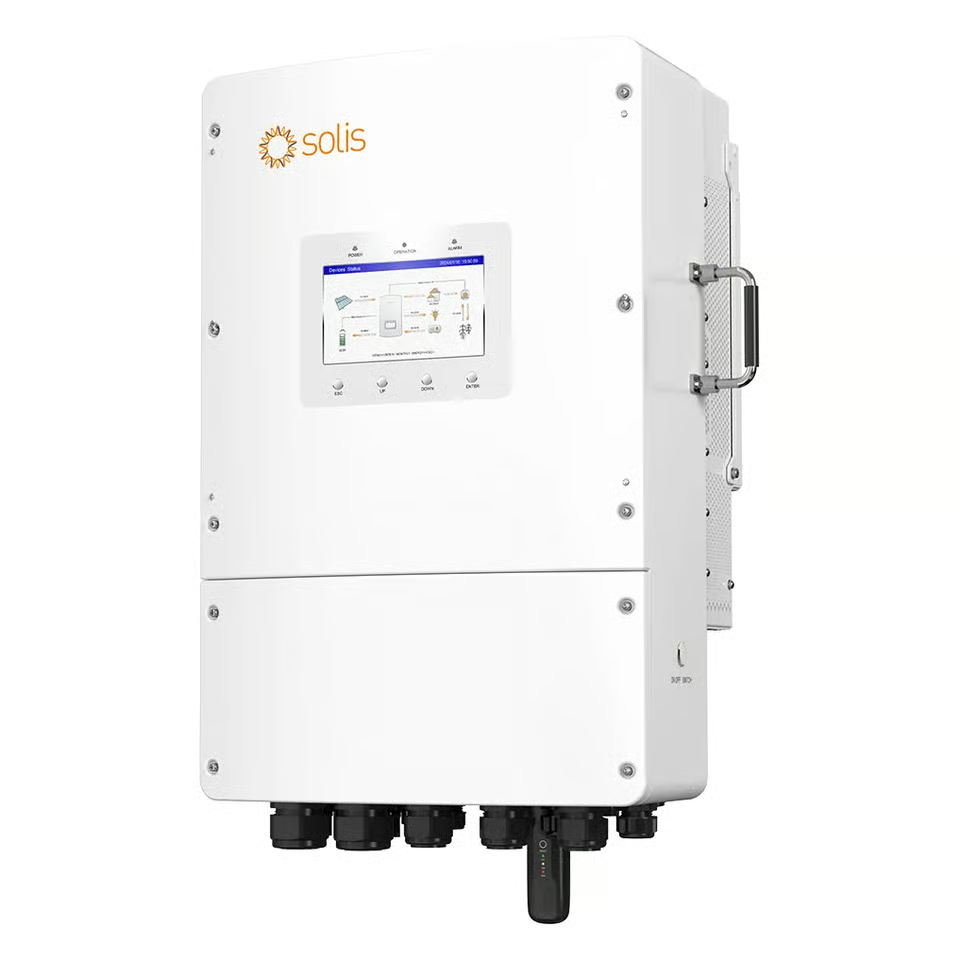
The Solis S6-EH3P18K02-NV-YD-L 18kW Three Phase Hybrid Inverter is the largest unit in the low voltage Solarator range, producing 18000W across three phases from a 48V battery and an array of up to 36kW. It suits factories, farms, schools, lodges and estates whose three phase demand has outgrown the smaller models.
It is designed around sites where the grid is unreliable and a generator is already part of the arrangement. The generator input accepts the full 18kW with automatic control, so the inverter, the array and the set work as one system rather than three that interfere with each other.
One characteristic needs stating before anything else, because it decides whether this is the right unit for a given site.
The full 18kW is not available from the battery alone. Drawing 18kW from a 48V bank calls for roughly 352A, and the inverter accepts 320A. On storage by itself it delivers around 16.4kW with the bank at rest and close to 17.3kW on a freshly charged one. The remaining capacity is there whenever solar or the grid is contributing, which covers most of the day. This is the ceiling of a 48V platform at this power rather than a fault, but a site that must have a true 18kW through a long outage should know it in advance.
1. System Architecture and Configuration
Hybrid Energy Core
- 18kW rated output, 18kVA apparent, across three phases
- Wired as three lines plus neutral and earth, 380V or 400V between phases
- 27.3A per phase at 380V, 26.1A per phase at 400V
- Unbalanced output supported, with up to 7.2kW on any one phase
- Double rated power for ten seconds, enough for heavy motor starting
- Displacement factor better than 0.99, harmonic current under 3%
Solar Charging System
- Four strings divided evenly between two independent trackers
- 36kW recommended array against a 28.8kW conversion ceiling
- Tracking spans 200V to 850V on a 1000V rated input, with 550V the design point
- Each tracker takes 42A, with 50A of short circuit headroom, giving 21A to a string
- Generation begins at 160V
- Long strings keep the number of roof runs down on a large array
Battery Integration
- Ordinary 48V architecture, accepting 40V to 60V
- 320A combined, delivered through two ports of 175A each
- Works with lithium chemistries and with flooded or sealed lead acid
- Charge state and cell temperature reported directly by the pack over CAN or RS485
- A reserve level you set yourself, held back for outages
- Screw terminals rather than plug connectors, sized for the current
Protection and Cooling
- Sealed to IP66, so a wall outside is as valid as one inside
- Forced air cooling, running at or below 65 dB(A)
- DC isolation built into the housing, removing one enclosure from the wall
- Anti islanding, short circuit and output overcurrent protection
- Reverse polarity blocking plus Type II surge arrest on the array input
- Protection class I, with overvoltage category III on the mains, backup and generator terminals
- Arc fault detection and AC surge protection both offered as options
2. Technical Specifications
| Parameter | Specification |
|---|---|
| Rated output power | 18kW |
| Maximum apparent power | 18kVA |
| Overload capability | Twice rated power for 10 seconds |
| Operation phase | Three phase with neutral and earth |
| Rated grid voltage | 220V/380V or 230V/400V |
| Rated grid frequency | 50Hz or 60Hz |
| Rated output current | 27.3A per phase at 380V, 26.1A at 400V |
| Maximum power per phase | 40% of rated power, so 7.2kW |
| Power factor | Above 0.99, adjustable 0.8 leading to 0.8 lagging |
| Current distortion | Under 3% |
| Grid input range | 323V to 437V on a 380V system, 340V to 460V on a 400V system |
| Maximum grid input power | 27kW |
| Maximum grid input current | 41A at 380V, 39.2A at 400V |
| Maximum AC passthrough | 50A |
| Backup output | 18kW, twice rated for 10 seconds |
| Backup switch time | Under 10ms single unit, under 20ms in parallel |
| Backup voltage distortion | Under 3% at linear load |
| Generator maximum input | 18kW, 27.3A per phase |
| Battery voltage | 40V to 60V, 48V nominal |
| Battery type | Lithium ion or lead acid |
| Maximum charge and discharge | 320A combined |
| Battery ports | 2 ports, 175A each |
| Battery communication | CAN or RS485 |
| MPPT quantity | 2 trackers, 4 strings |
| Recommended maximum array | 36kW |
| Maximum usable PV input power | 28.8kW |
| Maximum PV voltage | 1000V DC |
| Rated PV voltage | 550V |
| Start-up voltage | 160V |
| MPPT voltage range | 200V to 850V |
| Maximum input current | 42A per tracker |
| Maximum short circuit current | 50A per tracker |
| Maximum efficiency | 97.5% |
| European weighted efficiency | 96.4% |
| Battery charged from solar | Up to 95.0% |
| Battery charged from AC | Up to 94.4% |
| Battery discharged to AC | Up to 94.5% |
| Night self consumption | Under 30W |
| Topology | Non isolated |
| Cooling and noise | Intelligent fan cooling, under 65 dB(A) |
| Protection rating | IP66, indoor or outdoor |
| Operating temperature | -25C to +60C, 0 to 100% relative humidity |
| Maximum altitude | 4000m |
| Dimensions and weight | 430 x 660 x 305mm, 42kg |
| Connections | MC4 on the solar input, screw terminals for battery and AC |
| Communication | CAN, RS485 and Ethernet, with WiFi, cellular and LAN available |
| Display | 7 inch touchscreen with Bluetooth and app |
| Parallel operation | Up to 6 units |
| Warranty | 5 years standard, extendable to 20 |
3. Key Features
- The largest low voltage three phase unit in the range, running on ordinary 48V lithium
- 320A of battery current spread across two independent ports
- Generator input rated to the full 18kW, with several connection methods and automatic control
- 36kW of array against an 18kW nameplate, double the inverter rating
- High voltage strings mean fewer cable runs crossing the roof
- 97.5% peak efficiency and under 30W drawn overnight
- Unbalanced three phase output, tolerating up to 7.2kW on one phase
- Smart load management, shedding lower priority circuits to extend backup on the rest
- A battery reserve level you choose, kept back for interruptions
- Solar only off grid operation, so storage can be added in stages
- Both DC and AC coupling, so an existing array can stay in service
- Integrated DC switch and a 7 inch touchscreen for local control
- Built to suit the board you already have, and looked after locally
4. Applications and Use Cases
- Factories and processing plants: three phase machinery running without a converter
- Farms: irrigation, milking parlours, cold rooms, grain dryers and feed mills
- Schools and colleges: kitchens, laboratories, boarding houses and offices together
- Hospitals and larger clinics: imaging, sterilisers, theatres and cold chain
- Lodges and hotels: laundry, kitchens and guest wings on separate phases
- Estates and apartment blocks: lifts, boreholes, pumps and common services
- Sites already running a generator: fuel displaced rather than the set replaced
5. Installation and Engineering Notes
Protective devices below are set 25% clear of the steady load and then taken up to a manufactured size. What goes in on the day answers to the real route length, how tightly the cables sit together and the temperature around them.
| Circuit | Design current | Device | Cable, short run |
|---|---|---|---|
| PV, per string | 21A | 32A DC, rated beyond 1000V | 4mm² solar cable |
| Battery, per port | 175A | 250A DC on each port | 95mm² per port |
| AC output | 27.3A per phase | 40A, 4 pole, Type C | 10mm² |
| Grid input | 41A per phase | 63A, 4 pole | 16mm² |
| Backup passthrough | 50A | 63A, 4 pole | 16mm² |
Both battery ports have to be wired. Each one carries 175A, so a single port leaves the inverter at roughly half its battery capability however large the bank behind it. Run the two circuits separately, protect each at its own rating, and keep the pair equal in length so current divides as intended.
- Spread single phase loads across all three phases, since no phase may exceed 7.2kW
- Fourteen panels per string across four strings fills the 36kW allowance at about 34.7kW
- Keep cold open circuit voltage well under 1000V, measured at dawn rather than at midday
- Every solar side isolator, breaker and surge device needs a rating beyond 1000V
- Battery terminations are screw type and carry heavy current: crimp with the correct die and torque to specification
- Keep both battery circuits short, ideally inside two metres
- Combine at the array when strings come off separate roof faces
- Where storms are frequent, add external arrestors and a purpose built earth
- Hanging 42kg needs two pairs of hands and a wall that will hold it
- Fans mean this belongs in a plant room, not next to a desk
- Where a generator is present, size it for the load plus whatever charging you intend to run alongside
- Commissioning carried out by our own licensed engineers
6. Care, Maintenance and Operations
- Check the load on each phase annually, because a working building changes what it runs
- Confirm both battery circuits are sharing current rather than one carrying the work
- Retighten battery terminals to torque, since current of this order finds every weak joint
- Keep fan intakes free of dust, chaff and insect nests, which matters most on farms and in mills
- Measure today’s yield against the baseline taken on day one
- Pull cell balance and temperature data from the pack itself
- Inspect string connectors on the roof after each long rains
- Update firmware when a release is published
- Review the generator charge window if fuel use looks higher than expected
7. Do’s and Don’ts
Do
- Connect both ports whenever the bank can supply more than 175A
- Size storage on sustained current, not on stored energy
- Keep the heaviest single phase appliance below 7.2kW on its phase
- Check the inverter is reading the battery, not inferring from terminal volts
- Specify DC protection to the 1000V class throughout
- Establish that the incoming supply really is three phase, before committing
- Align generator running hours with a scheduled charge window
- Record the backup circuit schedule before the installer departs
Don’t
- Expect a full 18kW from the battery by itself, because the current ceiling prevents it
- Run a single battery port and assume the full 320A is available
- Design a string that nears 1000V on the coldest morning
- Reach for 500V components on a string that runs to 850V
- Run this alongside a different rating in a parallel group
- Put mismatched packs, old beside new, on a shared busbar
- Place it where people are trying to concentrate or sleep
8. Compatibility
- LiFePO4 storage at 48V nominal, talking CAN or RS485
- Lead acid, operating with no communication at all
- Solar arrays up to 36kW, with 28.8kW converted at any instant
- Generator sets up to 18kW, with several connection methods and auto control
- Grid tied arrays already installed, brought in by AC coupling
- A meter or CT set, without which demand reduction is guesswork
- SolisCloud over Ethernet, with WiFi, cellular and LAN available
- Locally held approved batteries run to Pylontech, Hubble, Dyness, Vestwoods and Felicitysolar, stacked until 320A is on tap
Listing is granted model by model and firmware build by firmware build, so a familiar brand name is not itself an approval. Connector pinouts are not standardised either. We confirm both and make up the lead before anything ships.
9. Performance Table
| Load | Estimated backup runtime on a 40kWh lithium bank |
|---|---|
| 3kW | Around 11 hours |
| 6kW | Around 5.5 hours |
| 10kW | Around 3.5 hours |
| 14kW | Around 2.5 hours |
| 16.4kW, the battery ceiling | Around 2 hours |
Based on 36kWh available from a 40kWh bank at 90% depth, after conversion losses. Any daylight at all lengthens these times. A bank assembled to supply 320A tends to land around this size regardless.
10. What It Runs, and the Two Ceilings
Two limits apply at once on this machine, and neither is the headline figure.
No single phase may exceed 7.2kW. The unit supports unbalanced output, which is more forgiving than three phase inverters that insist on even loading, but 40% of the rating is where each phase stops. A single phase appliance, meaning almost every heavy appliance in a Kenyan building, draws entirely from the phase it is wired to.
The battery supplies about 16.4kW. The full 18kW arrives only when solar or the grid is adding to it.
| Situation | What governs it | Outcome |
|---|---|---|
| Three phase machinery, 12kW, grid present | Total rating | Comfortable, 6kW still free |
| Three phase machinery, 12kW, on battery | Battery current | Fits inside the 16.4kW ceiling |
| One instant shower, 4.5kW | Phase ceiling | Well inside 7.2kW |
| A shower and a cooker on one phase | Phase ceiling | Around 7.5kW, just over the limit |
| Two showers split across two phases | Phase ceiling | Comfortable on both |
| Whole site balanced, grid present | Total rating | Up to 6kW on each phase, 18kW in all |
| Whole site balanced, long outage | Battery current | Around 5.4kW per phase, 16.4kW in all |
In daily use neither ceiling is noticed, because the array is contributing for most of the working day and the loads are spread. Both matter when a site runs flat out through a long interruption, which is exactly the condition this class of inverter is bought for.
11. Mini FAQ
Does it really deliver 18kW?
From the grid or the array, yes. From the battery by itself it gives around 16.4kW at rest and close to 17.3kW on a freshly charged bank, because 18kW would call for more current than the 48V platform allows.
Why two battery ports?
Each carries 175A, and the combined 320A rating needs both. Wiring only one leaves roughly half the battery capability unused.
How much can one phase take?
7.2kW, which is 40% of the rating. Unbalanced loading is supported, so a single heavy appliance on one phase is not a problem until it passes that figure.
Will it work with my generator?
Yes, and it is built for it. The generator input accepts the full 18kW with automatic control, and a charge window aligned to the running hours turns fuel into stored energy.
How many panels does it take?
Up to 36kW across four strings, with 28.8kW converted at any instant. Fourteen 620W panels on each of four strings comes to about 34.7kW.
Is a 1000V array different to wire?
Yes. Every isolator, breaker and surge device on the solar side needs a rating beyond 1000V, and parts from a 500V system will not transfer.
How quickly does it switch?
Under 10 milliseconds on its own, and under 20 milliseconds where several units run in parallel.
Can it run without a battery at first?
Yes. It will operate off grid from solar alone, so storage can be added later as budget allows.
12. Why Buy From Bicity Solar
- Real Solis stock, delivered with the paperwork bearing its own serial
- Honest figures, including the ones that qualify the headline rating
- Phase loading counted before the inverter is proposed, not after
- Both battery circuits specified and installed so the full 320A is actually available
- DC hardware chosen for 1000V duty rather than carried over from a smaller system
- Generator integration set up so the set and the inverter cooperate
- Installed and signed off under regulator licence
- Cover registered inside the deadline that unlocks the extended term
- Any claim pursued from here, with the distributor, on your behalf
- Delivered nationwide, then supported and kept in spares
At 18kW the question is rarely whether the inverter is big enough. It is whether the battery, the phases and the generator are arranged so you can actually reach it.
Tell us what each phase is carrying, what generator is on site, and how much roof you have. We will work out what the installation actually produces when the grid is down, arrange four strings within the 1000V ceiling, and build a bank that fills both ports. Work the numbers yourself in our Solar Calculator, or hand the site over through My Quote and we will cost it out.