Description
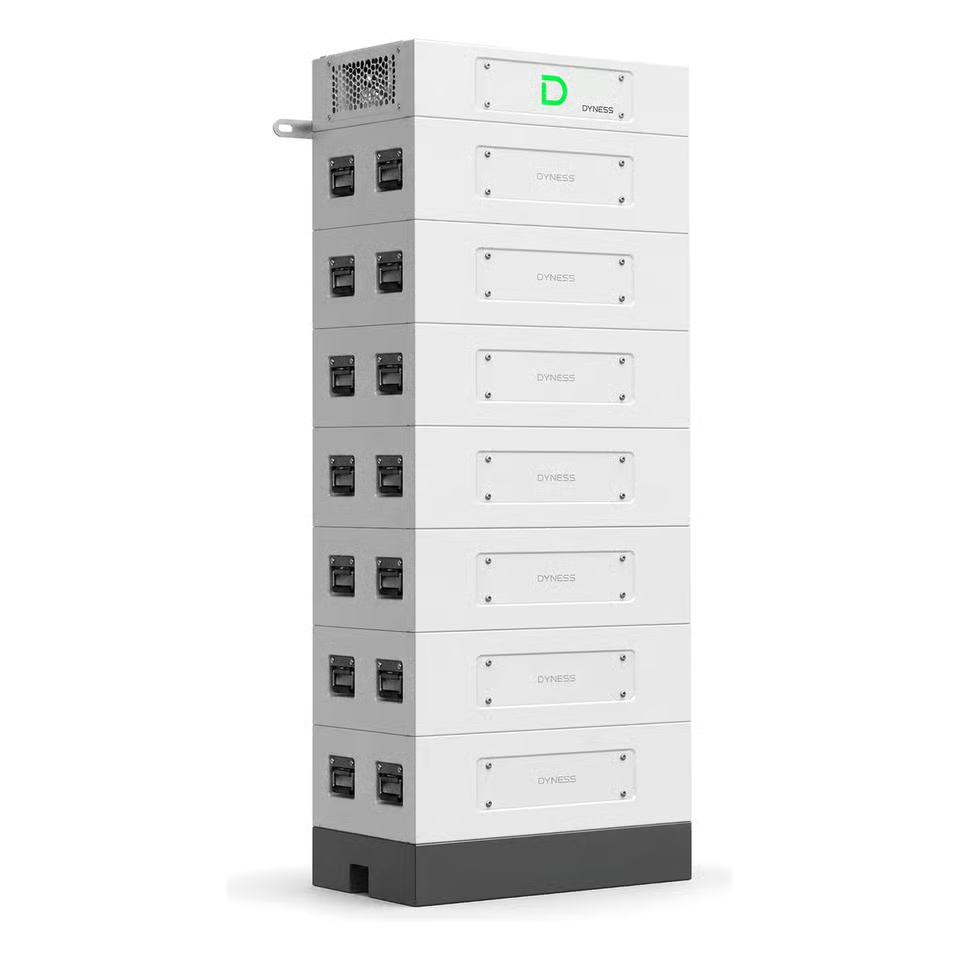
The Dyness Stack314 stores energy for commercial sites in S51314 modules of 16.076 kilowatt hours apiece, each one sixteen lithium iron phosphate cells wired to 51.2 volts and 314 ampere hours. They seat on one another with no cable to run in between, and a controller at the summit takes care of switching and of talking to the inverter.
It is the Stack280 with larger cells, and almost nothing else has changed. The footprint, the module height, the base, the control unit, the clearance requirement, the column height and the current limits are all identical. What rises is the energy: about twelve percent more per module, for four and a half percent more weight.
That makes it an unusually clean upgrade. The same floor position, in the same room, with the same cabling and the same inverter arrangement, holds more energy.
- A full column of eight modules holds 128.6 kilowatt hours
- A full cluster of fifteen reaches 241.1 kilowatt hours
- The floor area per stack is unchanged at 770 by 425 millimetres
- Twelve clusters in parallel reach 2.89 megawatt hours
- The smallest system is three modules, already 48.2 kilowatt hours
There is a quieter benefit in that arithmetic. Because the current limits did not rise alongside the capacity, the same amperes now represent a gentler rate of work for the cells. Section seven explains why that changes which inverter a single cluster will comfortably serve.
Dyness Stack314 16kWh Module: Column Planning, Ceiling Height and Inverter Pairing
1. Technical Specifications
| Parameter | Value |
|---|---|
| Module name | S51314 |
| Battery type | Lithium iron phosphate |
| Module voltage and capacity | 51.2V, 314Ah |
| Module energy | 16.076kWh |
| Usable energy per module | About 15.3kWh at 95 percent depth of discharge |
| Cells per module | 16, each 3.2V and about 1,005Wh |
| Modules in series | 3 to 15 per cluster |
| Modules per column | Two columns advised above 8 |
| Energy per cluster | 48.23kWh to 241.14kWh |
| Nominal cluster voltage | 153.6V to 768V |
| Operating voltage | 134V at three modules up to 876V at fifteen |
| Recommended current | 140A, about 0.45C |
| Maximum continuous current | 200A, about 0.64C |
| Peak discharge current | 290A for 2 minutes at 25C |
| Depth of discharge | 95 percent |
| Cycle life | 8,000 cycles or 10 years |
| Cycle life test conditions | 0.2C charge and discharge, 25C, 95 percent depth |
| Communication | CAN and RS485 |
| Module dimensions | 770 wide, 425 deep, 230.5 tall |
| Single module weight | 115kg |
| Full column height | About 2,208mm at eight modules |
| Clearance above the system | 450mm minimum |
| Floor to ceiling required | Greater than 2,658mm at eight modules |
| Charging temperature | 0C to 55C |
| Discharging temperature | minus 20C to 55C |
| Protection level | IP20, indoor positions only |
| Fire protection | Aerosol extinguisher built into each module |
| Installation method | Stack type, rackless, no cabling between modules |
| Cooling | Forced air |
| Monitoring | Built in wireless with app updates |
| Clusters in parallel | Up to 12, reaching 2.89MWh |
| Warranty | 10 years |
| Certification | CE-EMC, CE-RED, UN38.3 |
Two notes on that table. The cycle figure is quoted against gentle test conditions, a 0.2C rate at 25 degrees, and no remaining capacity percentage is published alongside it, so it describes endurance rather than what the cells will still hold at the end. And the certifications listed are those the manufacturer states for this model; if a tender or an institutional specification names a particular cell safety standard, confirm it against current certificates before bidding.
2. Key Points
- Each module holds 16.076 kilowatt hours from sixteen large format cells
- Twelve percent more energy than the previous range, in the same box
- Footprint, height, clearance and current limits are all unchanged
- The same currents now represent a lower rate of work for the cells
- A full column of eight gives 128.6 kilowatt hours
- A module weighs 115 kilograms, which rules out manual placement
- A 95 percent discharge depth leaves barely any capacity stranded
- Charging stops at zero degrees while discharging continues far below
- Each module has an aerosol suppression device sealed inside it
- Twelve clusters in parallel reach 2.89 megawatt hours
3. Ceiling Height And Column Planning
Headroom is the constraint that decides most layouts on this range, and the figure catches people out. Dyness ask for 450 millimetres to stay empty above the finished stack. Below that the arithmetic is simple: a 133 millimetre base, then one 230.5 millimetre layer for each module and one more for the controller sitting above them.
| Modules | Energy | Column height | Floor to ceiling needed | Under a 2.4m ceiling |
|---|---|---|---|---|
| 3 | 48.2kWh | 1,055mm | 1,505mm | Fits |
| 4 | 64.3kWh | 1,286mm | 1,736mm | Fits |
| 5 | 80.4kWh | 1,516mm | 1,966mm | Fits |
| 6 | 96.5kWh | 1,747mm | 2,197mm | Fits |
| 7 | 112.5kWh | 1,977mm | 2,427mm | Does not fit |
| 8 | 128.6kWh | 2,208mm | 2,658mm | Does not fit |
Under a standard 2.4 metre ceiling the practical limit is six modules, which is 96.5 kilowatt hours. Seven needs 2,427 millimetres and a 2.4 metre room does not have it. Eight needs 2,658 millimetres and calls for a 2.7 metre room or a taller service area.
Above eight modules the manufacturer advises splitting into two columns in any case. In practice the ceiling settles that question before the module count does, and a design that assumed one tall column frequently becomes two shorter ones once the room is measured. Each additional column needs its own floor position and its own expansion package, so this is worth establishing before the layout is drawn rather than after.
4. Floor Loading
| Modules in column | Energy | Module mass | Load per square metre |
|---|---|---|---|
| 3 | 48.2kWh | 345kg | About 1,055kg |
| 4 | 64.3kWh | 460kg | About 1,405kg |
| 5 | 80.4kWh | 575kg | About 1,755kg |
| 6 | 96.5kWh | 690kg | About 2,110kg |
| 7 | 112.5kWh | 805kg | About 2,460kg |
| 8 | 128.6kWh | 920kg | About 2,810kg |
Only the modules are counted there; hardware above and below adds a little more. Set against an office floor built for perhaps 250 to 300 kilograms in each square metre, a loaded stack asks for roughly ten times as much, which is why slabs and ground level positions are the usual choice. Anything suspended, or anything above the ground floor, wants an engineer’s opinion while the module count can still change.
5. Handling 115 Kilogram Modules
- Each module is 115 kilograms, beyond what a team should lift unaided
- The uppermost module on a full column goes above 1.7 metres
- Lifting equipment belongs in the plan from the beginning
- Doorways, corners, thresholds and lift capacity all need measuring first
- Stairs are rarely a realistic route for a module of this mass
- Easiest of all is a ground level room a lorry can pull up to
None of that appears as a line on an equipment quotation, which is exactly why it causes trouble. A battery can be entirely right for the application and still be undeliverable to the room chosen for it.
6. Charging In Cold Places
The two temperature windows are not symmetrical and the difference matters on highland sites.
- Discharging runs from minus 20 degrees up to 55
- Replenishing is allowed between zero and 55 degrees and nowhere else
- Dyness publish no sub zero charging option against these modules
Supplying through a freezing night costs nothing at all. Replenishing is the half that waits, and it waits until the air around the cells has recovered past zero. High ground in Kenya does reach that mark after dark, and a store room with no insulation around it tracks the outside air almost exactly. Putting the stack within the heated shell of a building settles the matter, provided somebody raises it while the drawings are still open.
7. Which Inverter One Cluster Will Serve
Battery power is voltage times current. Current is capped per cluster while voltage climbs with the module count, so the module count effectively decides how large an inverter the storage can feed.
| Modules | Nominal voltage | Energy | At 140A recommended | At 200A maximum |
|---|---|---|---|---|
| 8 | 409.6V | 128.6kWh | 57.3kW | 81.9kW |
| 10 | 512.0V | 160.8kWh | 71.7kW | 102.4kW |
| 12 | 614.4V | 192.9kWh | 86.0kW | 122.9kW |
| 15 | 768.0V | 241.1kWh | 107.5kW | 153.6kW |
The larger inverters, where this range differs
A 110 kilowatt three phase machine drawing from a full fifteen module cluster asks for about 143 amperes. On this range that is roughly 0.46C and only a couple of percent above the recommended current, which is a reasonable place to run. On the previous 280 ampere hour range the identical inverter at the identical current worked the cells at about 0.51C, noticeably harder, which is why a second cluster was the better answer there.
So the larger cell quietly changes the recommendation. A 110 kilowatt inverter on a single full cluster is sound here. A 125 kilowatt machine asks for about 163 amperes, which is sixteen percent above the recommended rate on either range, so that one still wants two clusters and gains the extra stored energy in the bargain.
Smaller machines
- A 30 kilowatt hybrid is served comfortably by a short cluster
- A 50 kilowatt machine wants around seven modules at the recommended rate
- An 80 kilowatt machine sits comfortably on eleven or twelve
- Matching at the recommended current rather than the maximum lengthens cell life
8. Installation And Commissioning
Before anything is ordered
- Measure the ceiling, then decide the module count
- Establish whether the room forces a second column
- Satisfy yourself the slab takes the loading set out earlier
- Pin down how it reaches the room and what lifts it there
- Confirm the room stays above freezing all year
- Check your machine accepts the voltage span your chosen count produces
Building the column
- The base is anchored before any module is lifted onto it
- Modules go on singly, each located and then locked down
- Nothing is wired module to module; the seating faces pass the current
- The control unit finishes the column once the modules are seated
- Two column arrangements are joined by the expansion package cabling
- Wall fixings and earthing are completed before the system is woken
Before leaving site
- See per module readings appear on the inverter screen and read sensibly
- Programme the current ceilings down to the advised rate rather than the maximum
- Check the extinguisher indication on each module
- Verify zero volts at the posts first; this level of direct current kills
- Demonstrate isolation to whoever holds responsibility for the room
- Record how many modules, arranged how, across what voltage span
9. Care And Operations
- Dryness year round, since no part of this carries a moisture rating
- Never let the space fall to zero, or replenishment simply halts
- Preserve the clear space above the column, since cooling depends on it
- Keep ambient temperature moderate, because heat shortens cell life
- Favour the recommended rate over the maximum wherever the design allows
- Watch cell voltage spread in the monitoring at service visits
- Keep the isolation point labelled and reachable
- Time any later additions to fall within the mixed age allowance
10. Stack314 Or Stack280
These two ranges share a chassis. Choosing between them is almost entirely a question of energy per position rather than of layout, because the layout does not change at all.
| Measure | Stack280 | Stack314 |
|---|---|---|
| Module energy | 14.336kWh | 16.076kWh |
| Module weight | 110kg | 115kg |
| Energy per kilogram | 0.130kWh | 0.140kWh |
| Footprint | 770 by 425mm | 770 by 425mm |
| Module height | 230.5mm | 230.5mm |
| Full column height | About 2,208mm | About 2,208mm |
| Clearance required | 450mm | 450mm |
| Energy per full column | 114.7kWh | 128.6kWh |
| Energy under a 2.4m ceiling | 86.0kWh | 96.5kWh |
| Recommended current | 140A, which is 0.50C | 140A, which is 0.45C |
| Maximum current | 200A, which is 0.71C | 200A, which is 0.64C |
| Peak current | 280A | 290A |
| Maximum cluster | 215.0kWh | 241.1kWh |
| Maximum system | 2.58MWh | 2.89MWh |
| Load per square metre, full column | About 2,690kg | About 2,810kg |
Reading that table
- Twelve percent more energy for four and a half percent more mass
- Not one millimetre of extra floor space or room height
- The same control unit, base and expansion parts serve both
- The cells work at a lower rate for the same delivered power
- A single cluster becomes a reasonable match for a 110 kilowatt inverter
- The floor carries about four percent more at a full column
Where a site is tight on space or headroom, the newer range gives more for the same room. Where an existing installation is being extended, the older range remains the match for what is already standing, since mixing capacities within a series string is not how these are designed to run. And where a specification names particular standards, check the certification listed for the model being quoted rather than assuming the ranges are identical on paper as well as in the flesh.
11. Suitable Applications
- Manufacturing carrying production through grid interruptions
- Hotels and lodges away from the dependable parts of the network
- Hospitals and clinics with storage behind the critical supply
- Schools and colleges with heavy daytime demand and roof area
- Chillers and produce handling, where an outage ruins what is stored
- Supermarkets and retail carrying substantial refrigeration
- Telecommunications and data sites needing long autonomy
- Peak shaving against demand charges on commercial tariffs
- Large arrays generating well beyond daytime consumption
12. Why Buy From Bicity Solar
- A tape run up the wall before anyone commits to a capacity
- A clear answer on whether it is the building splitting your stack, not the kilowatt hours
- Loading checked for the count you are actually buying, on the floor you actually have
- Access and hoisting agreed while the order can still be changed
- Highland temperature limits put on the table during design
- Inverter matched at the recommended current, not the ceiling
- Advised honestly when the older range is the better fit for an extension
- Certification listings checked against what a tender actually requires
- The cycle number put in context of how it was measured
- Figures we cannot stand behind simply omitted from your paperwork
- A handover where each module is shown reporting to the machine
- Genuine product, with paperwork matching the delivery
- EPRA licensed crews who spend their weeks on systems this size
- Delivered countrywide, with service and expansion support afterwards
This range gives you twelve percent more energy in exactly the same floor space and room height as the one before it. The question is rarely whether it fits the budget and almost always whether it fits the room, because a full column needs 2,658mm from floor to ceiling and a standard 2.4 metre room allows six modules rather than eight.
Give us four things: your target capacity, the machine it has to feed, which floor it stands on and how high the room is. Back comes the module count, how many stacks that becomes, what the slab will carry and whether your inverter is happier on one cluster or two. Work the wider system through the Solar Calculator, or pass the site details to us via My Quote.