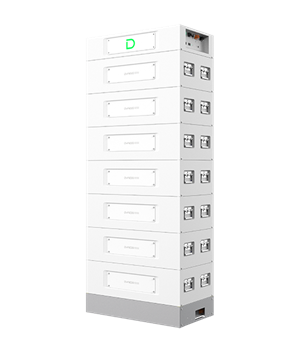
Description
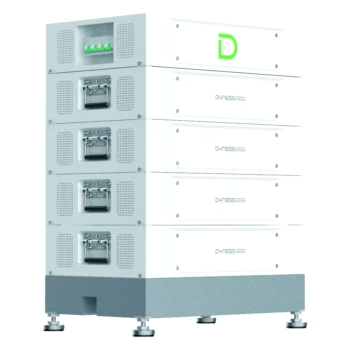
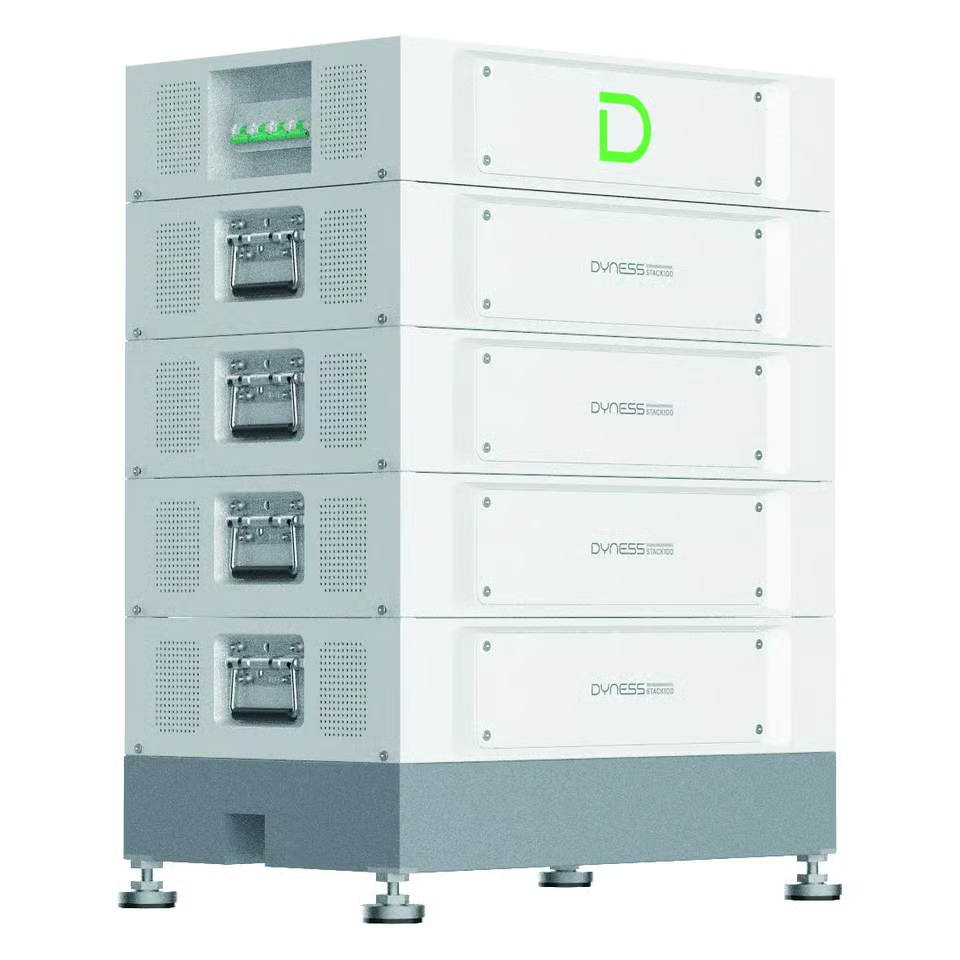
The Dyness Stack280 is a commercial scale high voltage battery built from S51280 modules, each holding 14.336 kilowatt hours at 51.2 volts and 280 ampere hours. Modules stack on one another without cabling between them, and a control unit on top handles the switching and the link to the inverter.
Where the smaller Stack100 suits a large home or a shop, this one starts where that range ends. The minimum configuration is three modules, which is already 43 kilowatt hours, and a single cluster reaches 215 kilowatt hours. Twelve clusters in parallel bring the ceiling to 2.58 megawatt hours.
One number on this product is routinely misread, and it decides your floor plan. A cluster can hold up to fifteen modules electrically, but a single column is physically limited to eight. Everything above eight modules is therefore built as two columns standing side by side. The headline 215 kilowatt hour figure is never one stack in a corner. It is two.
That distinction changes the room, the delivery and the installation method, so it belongs at the front of a specification rather than in a footnote.
- Eight modules per column, which is 114.688 kilowatt hours
- A full fifteen module cluster splits as seven and eight
- Each column occupies 770 by 425 millimetres of floor
- A full column stands 2,203 millimetres tall
- Each module weighs 110 kilograms, so a full column is 880 kilograms of modules
Dyness Stack280 14.3kWh Module: Column Limits, Loading and Inverter Pairing
1. Column Limit And What It Means For Your Floor
The physical limit and the electrical limit on this product are different numbers, and planning off the wrong one is the most common mistake made with it.
Two limits, both real
- A cluster is an electrical group of three to fifteen modules wired in series
- A column is a physical stack, and it stops at eight modules
- Below nine modules, a cluster and a column are the same thing
- At nine modules and above, one cluster becomes two columns
- The two columns are still one cluster, sharing one control unit
How clusters divide
| Modules | Energy | Columns | Split | Floor area |
|---|---|---|---|---|
| 3 | 43.0kWh | 1 | Single stack | 0.33 square metres |
| 5 | 71.7kWh | 1 | Single stack | 0.33 square metres |
| 8 | 114.7kWh | 1 | Single stack, at the limit | 0.33 square metres |
| 10 | 143.4kWh | 2 | Five and five | 0.65 square metres |
| 12 | 172.0kWh | 2 | Six and six | 0.65 square metres |
| 15 | 215.0kWh | 2 | Seven and eight | 0.65 square metres |
Note what happens between eight and ten modules. Capacity rises by a quarter, and the floor space needed doubles, because a second column has to start. If your room is tight, eight modules is a natural stopping point and nine is an expensive one.
2. Technical Specifications
| Parameter | Value |
|---|---|
| Module name | S51280 |
| Battery type | Lithium iron phosphate |
| Module voltage and capacity | 51.2V, 280Ah |
| Module energy | 14.336kWh |
| Usable energy per module | About 13.6kWh at 95 percent depth of discharge |
| Modules in series | 3 to 15 per cluster |
| Modules per column | 8 maximum |
| System energy range | 43kWh to 215.04kWh per cluster |
| Operating voltage | 134.4V to 864V |
| Recommended charge and discharge current | 140A, which is 0.5C |
| Maximum charge and discharge current | 200A, which is 0.7C |
| Peak discharge current | 280A for 2 minutes at 25C |
| Depth of discharge | 95 percent |
| Cycle life | 8,000 cycles or 10 years |
| Cycle life test conditions | 0.2C charge and discharge, 25C, 95 percent depth |
| Communication | CAN and RS485 |
| Column dimensions | 770 wide, 425 deep, 363 plus 230 per module tall |
| Single module weight | 110kg |
| Charging temperature | 0C to 55C |
| Discharging temperature | minus 20C to 55C |
| Protection level | IP20, indoor positions only |
| Fire protection | Aerosol extinguisher, acting within 5 seconds |
| Installation method | Stack type, rackless, no cabling between modules |
| Cooling | Forced air |
| Monitoring | Built in wireless module with app updates |
| Module mixing | Permitted within three years |
| Clusters in parallel | Up to 12, reaching 2.58MWh |
| Warranty | 10 years |
| Certification | UN38.3, CE-EMC, IEC 62619 |
On cycle life: the 8,000 cycle figure is quoted against gentle test conditions, being a 0.2C rate at 25C. No remaining capacity percentage is published alongside it, so the figure describes how long the cells last rather than what they will still hold at the end. Heavier daily cycling and warmer rooms both shorten it.
3. Key Points
- Each module carries 14.336 kilowatt hours, close to three times a Stack100 module
- Eight modules is the physical limit on one column
- Anything above 114.7 kilowatt hours occupies two floor positions
- A module weighs 110 kilograms, which rules out manual placement
- Recommended current is 140A and the ceiling is 200A
- Depth of discharge is 95 percent, so very little capacity is held back
- Every module carries its own aerosol extinguisher
- Charging stops at zero degrees, though discharging continues far below
- Older and newer modules may run together if bought under three years apart
- Twelve clusters in parallel reach 2.58 megawatt hours
4. Floor Loading, Which Dyness Themselves Flag
The datasheet carries an explicit instruction that upper floor installations need the floor assessed before the number of stacks is fixed. That is unusual for a specification sheet, and it reflects how concentrated the mass is.
| Modules in column | Height | Module mass | Load per square metre |
|---|---|---|---|
| 3 | 1,053mm | 330kg | About 1,010kg |
| 4 | 1,283mm | 440kg | About 1,345kg |
| 5 | 1,513mm | 550kg | About 1,680kg |
| 6 | 1,743mm | 660kg | About 2,015kg |
| 7 | 1,973mm | 770kg | About 2,355kg |
| 8 | 2,203mm | 880kg | About 2,690kg |
Those figures count the modules only, and the control unit and base add more. For comparison, a typical office floor is designed around 250 to 300 kilograms per square metre, and a warehouse ground slab a good deal more. A full column sits an order of magnitude above the office figure, which is why ground floors and slabs are the normal answer and suspended floors need checking by someone qualified to judge them.
There is a quiet advantage here that is easy to miss. Because the column stops at eight modules and the footprint is wider than the smaller range, a full Stack280 column actually presses less heavily on the floor than a full Stack100 column does, despite the modules being more than twice the weight. Section ten sets the two side by side.
5. Getting 110 Kilograms Into Position
A single module weighs 110 kilograms. That is beyond what a team should lift by hand, and the difficulty compounds as the column grows, because each module has to go higher than the last.
- The final module on a full column is raised more than 1.7 metres
- Lifting equipment belongs in the installation plan from the start
- Doorways, corridors and lift capacity all need checking before delivery
- The route to the room matters as much as the room itself
- Stairs are rarely viable for a module of this mass
- A ground floor position with vehicle access is the straightforward case
This is worth settling early, because it is not a cost that appears on an equipment quotation. The battery can be entirely correct for the application and still be undeliverable to the room someone has in mind for it.
6. Charging In Cold Places
The charging and discharging windows on this battery are not symmetrical, and on Kenyan highland sites that asymmetry has practical consequences.
- Discharging is permitted from minus 20C up to 55C
- Charging is permitted only from zero to 55C
- No low temperature charging variant is listed for this range
So the battery will keep delivering through a cold night without complaint, but it will not accept charge until the room comes back above freezing. At altitude, in places such as Timau, Molo, Nyahururu or the Mau, overnight temperatures can reach that threshold, and an unheated outbuilding will track them closely.
The fix is ordinary: site it inside the insulated envelope of a building rather than in a detached store, keep the room above freezing, and let the battery’s own heat during operation do the rest. The point is to decide this during design rather than discover it when morning charging is late.
7. Which Inverter A Cluster Will Feed
Battery power is voltage multiplied by current, and because current is capped per cluster while voltage rises with module count, the module count effectively sets how large an inverter the storage can serve.
| Modules | Nominal voltage | At 140A recommended | At 200A maximum |
|---|---|---|---|
| 8 | 409.6V | 57.3kW | 81.9kW |
| 10 | 512.0V | 71.7kW | 102.4kW |
| 12 | 614.4V | 86.0kW | 122.9kW |
| 15 | 768.0V | 107.5kW | 153.6kW |
What that means in practice
- A 30kW three phase hybrid is served comfortably by a small cluster
- A 50kW machine wants around seven modules to stay at the recommended rate
- An 80kW machine wants twelve modules to avoid running the battery hard
- A 110kW or 125kW machine exceeds what one cluster delivers at 140A
- Those larger inverters are therefore paired with two clusters
The last line is the one that catches people. A full fifteen module cluster produces 107.5 kilowatts at the recommended rate, which is short of a 110 kilowatt inverter and well short of a 125 kilowatt one. Reaching those outputs from a single cluster means running continuously above the recommended current, which is permitted up to 200A but is not how you would design a system meant to last. Two clusters is the sound answer, and it also doubles the stored energy, which such an installation usually wants anyway.
8. Installation And Commissioning
Before anything arrives
- Confirm the module count, then confirm whether that is one column or two
- Confirm the floor can carry the load at the figures in section four
- Confirm ceiling height against a 2,203 millimetre column plus working space
- Confirm the delivery route and the lifting arrangements
- Confirm the room stays above freezing year round
- Confirm the inverter battery window covers the voltage your count reaches
Building the column
- The base is positioned and secured before any module arrives on it
- Modules are placed one at a time, locating on the unit below
- No cabling runs between modules, as the stacking interface carries it
- The control unit completes the column once the modules are in place
- Two column systems are linked by the parallel and series cabling
- Earthing is made off before the system is woken
Before leaving site
- Verify the inverter is reading the cluster and reporting cell data
- Verify charge and discharge limits are set to the recommended rate
- Verify the extinguisher indication on every module
- Demonstrate isolation to whoever will be responsible for the room
- Leave the module count, cluster arrangement and voltage range documented
- Work carried out by technicians practised on high voltage storage
9. Care And Operations
- Keep the room dry, because the equipment carries no water protection
- Keep the room above freezing so charging is never blocked
- Keep airflow around the columns clear, as cooling is forced air
- Keep ambient temperature moderate, since heat shortens cell life
- Run at the recommended rate rather than the maximum where the design allows
- Check the monitoring for cell voltage spread at service visits
- Keep the isolation point reachable and labelled
- Plan any expansion inside the period Dyness allows mixed module ages
10. Stack280 Or Stack100
Both ranges stack without cabling and both reach high voltage, but they are aimed at different sizes of job and the comparison is not simply bigger against smaller.
| Measure | Stack100 | Stack280 |
|---|---|---|
| Module energy | 5.12kWh | 14.336kWh |
| Module weight | 47kg | 110kg |
| Modules per column | 15 | 8 |
| Energy per full column | 76.8kWh | 114.7kWh |
| Footprint | 590 by 390mm | 770 by 425mm |
| Full column height | 2,236mm | 2,203mm |
| Load per square metre, full column | About 3,065kg | About 2,690kg |
| Energy per kilogram | 0.109kWh | 0.130kWh |
| Maximum current | 100A | 200A |
| Smallest system | 15.4kWh | 43.0kWh |
Reading that table
- The larger range stores half again as much in one column position
- It carries about a fifth more energy for every kilogram
- It presses less heavily on the floor, not more, at a full column
- Both reach almost the same height, so both suit similar rooms
- Its double current rating is what lets it serve far larger inverters
- Its individual modules need machinery, where the smaller ones do not
In short, the smaller range suits a large home, a shop or a small office, and it can be carried in by hand. This one suits a factory, a hotel, a hospital, a college or a telecoms site, and it arrives on a vehicle that needs somewhere to unload. The dividing line is usually around forty kilowatt hours, which is where the smaller range is working hard and this one is only beginning.
11. Suitable Applications
- Manufacturing sites carrying production through grid interruptions
- Hotels and lodges, especially off the reliable parts of the network
- Hospitals and clinics needing storage behind their critical supply
- Schools and colleges with substantial daytime load and roof area
- Cold rooms and agricultural processing, where downtime spoils stock
- Supermarkets and retail with heavy refrigeration
- Telecommunications and data sites requiring long autonomy
- Peak shaving against demand charges on a commercial tariff
- Large solar arrays where daytime generation exceeds daytime demand
12. Why Buy From Bicity Solar
- Told plainly that eight modules is a column, before the floor plan is drawn
- Floor loading worked at your actual module count and checked for the storey
- Delivery route, doorways and lifting settled before anything is ordered
- Cold site charging limits raised at design stage, not discovered later
- Inverter matched to the cluster at the recommended rate, not the maximum
- Cluster count sized so large inverters are not fed from a single stack
- Two column layouts set out properly with the correct expansion parts
- Cycle life explained against its test conditions rather than quoted bare
- Unverifiable numbers left out rather than repeated to win a comparison
- Commissioning that proves the inverter is reading every module
- Genuine product, with paperwork matching what is delivered
- EPRA licensed installation, by people who work on commercial systems routinely
- We take any warranty claim up with the manufacturer ourselves
- Delivered across Kenya, with service and expansion support afterwards
Before you plan the room, decide whether you are building one column or two. Eight modules is the limit on a single stack, so anything above 114.7 kilowatt hours needs a second floor position. That one fact moves more projects than any other line on this page.
Tell us the storage you are aiming for, the inverter you intend to run it with, the storey it will stand on and how a vehicle reaches the building. We will confirm the module count, the column arrangement, the floor loading and the lifting that delivery actually needs. Size the whole system in the Solar Calculator, or send your site details through My Quote.