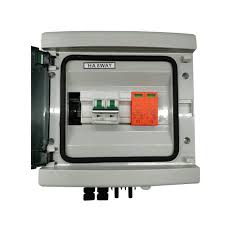
Description
PV Combiner Box 500VDC 1 String — Solar String Combiner with Breaker & Surge Protection
The PV Combiner Box 500VDC 1 String — alternatively known as the Solar String Combiner Box, the DC Combiner Box 1-In 1-Out, or the Single-String PV Combiner — is the protective junction point between your solar panel array and your inverter. While many small residential systems route panel output directly to the inverter without intermediate protection, EPRA installation guidance and modern best practice increasingly require a combiner box on every solar installation regardless of size — the device that brings disconnection, overcurrent protection, and surge protection together in a single weatherproof enclosure mounted at the array side.
This 1-string variant is purpose-built for the most common residential solar configuration in Kenya: a single PV string of 6 to 12 panels feeding a single-MPPT hybrid inverter in the 3 kW to 6 kW range. For larger installations using multiple parallel strings on a single MPPT input, or for systems with two or more separate strings each going to its own inverter input, the 2-string and 12-way variants on related product pages provide additional inputs. For very small installations under 3 kW with no surge protection requirement, the combiner box can be omitted entirely — but adding it is widely recommended for the protection benefits.
What a combiner box actually does in your solar installation
The combiner box performs four essential functions that, without it, must be assembled from individual components scattered across the installation. First, it provides a safe disconnection point on the DC side: a single switch (the DC isolator or DC breaker inside the box) that disconnects the panel array from the inverter for safe maintenance, panel cleaning, or fault investigation. Without this, working on the panels means physically disconnecting the MC4 cables in the open under live DC voltage — a real shock and arc-flash hazard. Second, it provides overcurrent protection through fuses or a DC-rated circuit breaker, clearing any internal panel short circuit before it can damage the inverter or the array wiring. Third, it provides surge protection through a dedicated Class II SPD, absorbing the voltage spikes from nearby lightning strikes that would otherwise propagate down the panel cables and destroy the inverter. Fourth, it provides a single, clean termination point for the panel strings — replacing the otherwise loose, exposed MC4 junctions that accumulate at the panel array with a sealed, weatherproof enclosure.
Where this 1-string combiner box belongs in your installation
- Small residential rooftop solar (3-6 kW): The most common Kenyan application — typically 6 to 12 panels in a single string feeding a hybrid inverter with one MPPT input. The combiner sits at the array side, accepts the single string output from the panel chain, and routes the protected output down to the inverter through a single weatherproof cable.
- Solar water-heating and pumping systems: Where a small panel array drives a DC pump or thermal collector circulation, the combiner provides isolation and surge protection for the pump controller.
- Off-grid cabin and outpost installations: Small remote installations with a single panel array charging a battery bank through an MPPT charge controller.
- School and rural clinic solar installations: Smaller institutional installations under 6 kW where the combiner provides the isolation and surge protection required by inspection.
- Lighting-only solar systems: Small dedicated lighting systems with their own panel array and battery bank, where the combiner provides isolation between the array and the controller.
- Solar boreholes and irrigation pumps: Single-panel-string DC pump installations where the combiner provides safe disconnection for pump maintenance.
Why even small installations benefit from a combiner box
A common cost-cutting decision in Kenyan residential solar installations is to skip the combiner box entirely, routing the panel array output directly into the inverter through a manual MC4 connection. For systems under 3 kW with no surge protection requirement, this can be technically acceptable. For installations above that scale, three things shift the calculation. First, the inverter’s internal DC isolator is usually inadequate for safe maintenance — it interrupts the load but does not allow you to physically isolate the panel array for safe panel cleaning, mounting replacement, or string troubleshooting. Second, the lightning risk in Kenya is real — the highlands, western counties, and Lake Victoria basin all see substantial annual lightning activity, and a nearby strike that induces surge voltage on the panel cables can destroy a hybrid inverter in a single event, with replacement cost running into many tens of thousands of shillings. Third, EPRA inspection increasingly checks for combiner protection on installations above 3 kW. The combiner box turns a one-time installation cost into long-term insurance against single-event inverter destruction.
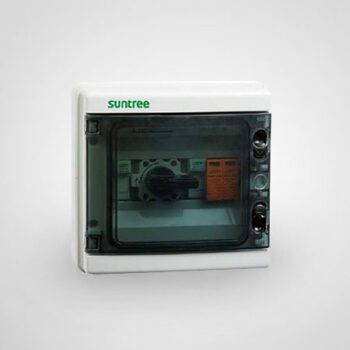
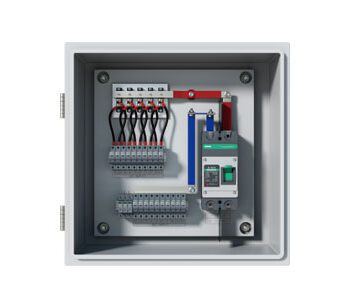
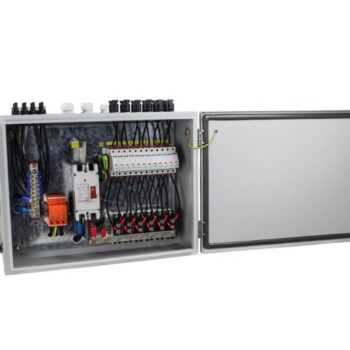
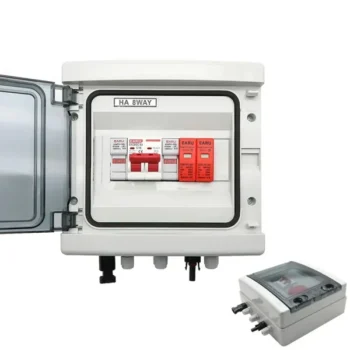
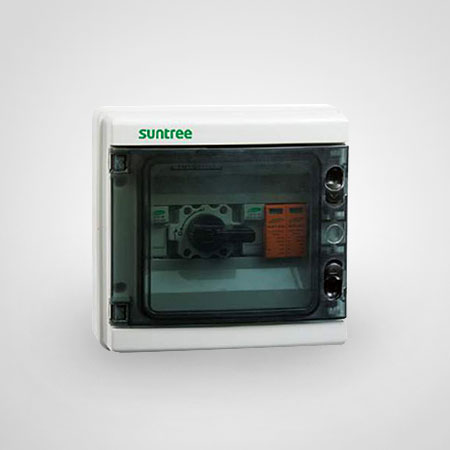
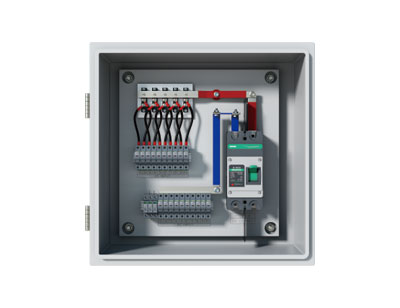
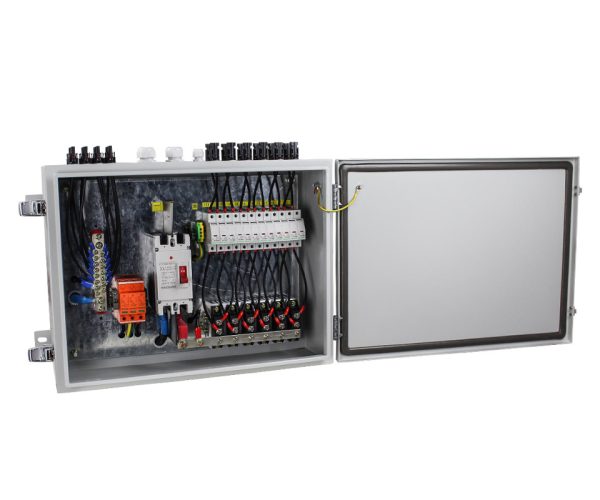
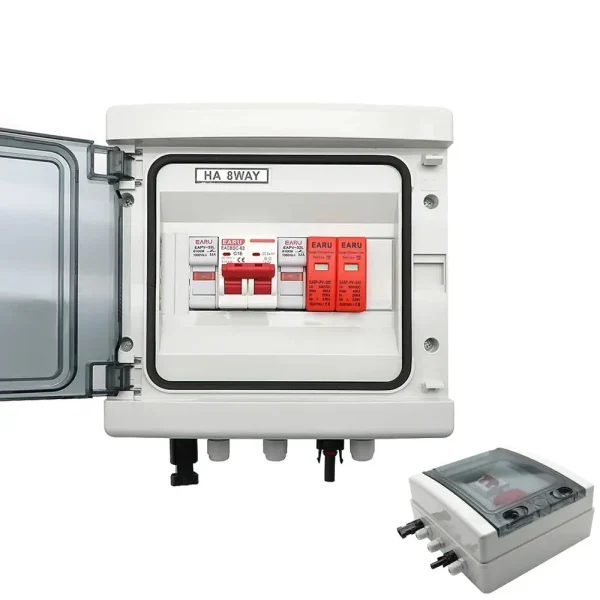
Inside the 500VDC 8W 1-string combiner box
- DC circuit breaker (8A rated): The primary disconnection device, rated to break under DC load up to 500V. Operates manually for routine isolation, automatically on overcurrent fault.
- DC fuse holder with replaceable fuse: Backup overcurrent protection, sized to match the panel string short-circuit current. Replaceable cartridge fuse for easy field service.
- Class II surge protection device (SPD): Absorbs voltage spikes from nearby lightning, clamping the DC bus to safe levels before damage propagates to the inverter. Module-replaceable, with status indicator showing whether the SPD has absorbed a recent surge and needs replacement.
- Input terminal block: Accepts the MC4-terminated cable from the panel string, with proper torque and contact pressure for sustained DC current.
- Output terminal block: Provides the protected DC output that feeds down to the inverter, again with MC4-compatible connectivity.
- Grounding terminal: Dedicated earth-bonding point for the box body and the surge protection device, connecting to the building’s main earth electrode.
- IP65 ABS enclosure: Dust-tight and water-jet protected, suitable for direct outdoor mounting on a wall, post, or panel mounting structure.
- Sealed cable glands: Multiple weatherproof entry points sized for typical solar PV cable (4mm² to 6mm² stranded copper), maintaining the IP65 rating against rain, dust, and pest ingress.
Technical Specifications
| Specification | Value |
|---|---|
| Product Type | PV String Combiner Box / Solar DC Combiner |
| Configuration | 1 string input × 1 string output (1/1) |
| Maximum DC Voltage | 500V DC |
| Rated DC Current | 8A continuous per string |
| Maximum Short-Circuit Current | 15A (configurable via fuse rating) |
| DC Breaker Rating | 500V DC, suitable for solar string disconnection |
| Surge Protection Device (SPD) | Class II, replaceable module with status indicator |
| SPD Maximum Discharge Current (Imax) | 20-40 kA (8/20µs surge waveform) |
| Enclosure Material | ABS polymer, V0 flame-retardant grade |
| Ingress Protection Rating | IP65 (dust-tight, water-jet protected) |
| Operating Temperature Range | -30°C to +60°C |
| Compliance Standards | IEC 61439-2, IEC 60364, IEC 61643-31 |
| Cable Entry | M12 / M16 sealed glands, MC4 connector-compatible |
| Acceptable Cable Size | 4mm² to 6mm² stranded copper solar PV cable |
| Mounting | Wall-mount via four corner brackets, screws included |
| UV Resistance | UV-stabilised ABS body for direct sunlight exposure |
| Status Indicators | SPD status window, breaker position indicator |
Engineering Highlights
- Pre-wired internal circuit: The DC breaker, fuse, SPD, and terminal blocks are factory-wired and tested before shipment, reducing installation time and eliminating wiring errors at site.
- Class II SPD with replaceable module: The surge protection device absorbs lightning-induced voltage spikes; when its absorbing capacity is exhausted (typically after several major surge events), the indicator window shows red and the module pulls out for field replacement without disturbing the rest of the combiner.
- IP65 weatherproof rating: Direct mounting on outdoor walls, panel rails, or roof-mounted structures without additional protective housing. Withstands Kenyan rainy season conditions and tropical UV exposure.
- UV-stabilised ABS body: The enclosure polymer is rated for direct sunlight exposure without yellowing, cracking, or degradation over its service life.
- MC4-compatible connectivity: The cable glands and internal terminals accept standard MC4-terminated solar PV cable directly, with no custom termination work required at installation.
- Dedicated earth-bonding terminal: The combiner provides a clean connection point for the building’s main earth electrode, ensuring the surge protection device has a low-impedance fault path for the surge currents it absorbs.
- Visible status indication: The DC breaker handle and the SPD status window are both visible through the transparent or semi-transparent front cover, allowing visual verification of system status without opening the box.
- Compliance with IEC standards: Designed and tested to international standards for PV combiner equipment, supporting EPRA inspection and any insurance compliance requirements on commercial installations.
Typical Kenyan Installation Scenarios
- 3-5 kW residential rooftop solar installations in Nairobi, Mombasa, Kisumu, and Eldoret family homes
- Single-MPPT hybrid inverter installations (our Vestwood hybrid inverter range pairs cleanly with this combiner)
- Small off-grid cabin and weekend home installations in the Aberdares, Mount Kenya, Naivasha, and coastal regions
- School and rural clinic solar installations under 6 kW total array capacity
- Solar borehole pump installations with single-panel-string DC pump controllers
- Outdoor lighting systems with dedicated solar panel arrays and battery banks
- Small commercial premises with rooftop solar under 6 kW — small shops, salons, kiosks
- Solar carport installations with single-array roofing covering one or two parking bays
- Agricultural water-pumping installations on smallholder farms
- Telecom site backup installations where the panel array charges a battery bank for a remote tower
Installation Notes
Installation of the combiner box must be carried out by an EPRA-registered electrician with solar installation experience. The combiner sits at the array side, as close as practical to the panel string output to minimise the length of unprotected cable runs. Standard installation practice puts the combiner on the panel rail framework or on an adjacent wall, typically less than two metres from the nearest panel. Six practical points govern the installation. First, mounting orientation — the combiner mounts vertically with the cable glands pointing downward; this prevents water collecting around the gland entries during heavy rain. Second, cable routing — incoming cables from the panel string enter the upper or side glands, the protected output cable exits from the lower or opposite-side gland, with all cables strain-relieved at the gland points. Third, terminal torque — every internal terminal must be tightened to the manufacturer’s specified value; loose connections on DC circuits generate measurable heat and progressive damage that can lead to fire under sustained operation. Fourth, polarity verification — the positive and negative terminals must be correctly identified and connected; reverse polarity can damage the SPD and may damage the inverter on first energising. Fifth, earth bonding — the combiner’s dedicated earth terminal must be connected to the building’s main earth electrode through a properly sized earth conductor (minimum 6mm² copper for typical residential installations). Sixth, IP integrity — every cable gland must be tightened to seal around the cable, and any unused gland positions must be closed with the supplied blanking plugs to maintain the IP65 rating.
For installations in lightning-prone areas (highlands and western Kenya particularly), the surge protection device may need replacement more frequently than its design life suggests — every two to three years rather than five or more. The SPD module is the consumable element of the combiner and is normal to replace; check the status indicator at every annual system inspection.
Planning a residential solar installation, off-grid system, or solar pump?
Get a complete system specification including the right combiner box for your array size — start with our Solar Calculator for system sizing and combiner selection, or describe your installation through My Quote for a turnkey design with panels, inverter, combiner, and protection schedule.