Description
SHLX-PV 1/1 1000VDC Combiner Box — Commercial Solar Combiner with 4P MCB & SPD
The SHLX-PV 1/1 1000VDC Combiner Box is the top-tier specification in the SHLX-PV combiner family, designed for commercial and large residential Kenyan solar installations where the panel string voltage and current significantly exceed what smaller residential combiners can safely handle. The “1000VDC” rating gives the installer almost double the voltage envelope of the 500V variants, accommodating the longer panel strings (typically 15 to 20 panels in series) that commercial installations use to reduce DC cable losses across larger arrays.
This is not simply a higher-voltage version of the 550V combiner — it carries a meaningfully different internal protection scheme. Where the 550V variant uses a 2-pole MCB, this 1000V variant uses a 4-pole SL7N-63 DC MCB, switching every conductor in the DC bus simultaneously. And while the 550V combiner relies on its MCB and fuses for protection, this 1000V combiner adds a dedicated SUP2H-PV 3-pole surge protection device with status indication, absorbing lightning-induced voltage transients before they can propagate to the inverter. The combination — 4-pole MCB, dual-pair fuses, and integrated SPD — represents the most comprehensive protective scheme in the residential and small-commercial combiner market.
Why commercial installations need 1000VDC combiners
The economics of commercial solar push installers toward higher-voltage string designs for one simple reason: cable cost. A 15 kW solar array operating at 400V draws 37.5 amperes on the DC cable to the inverter; the same 15 kW array operating at 800V draws only 18.75 amperes. The lower current allows thinner cable, lower copper cost, smaller terminal blocks, and lower I²R cable losses across the typical 30-50 metre cable run common in commercial installations. The 1000VDC combiner is what makes these higher-voltage strings safely possible — its internal components are rated for the full string voltage at the coldest expected operating temperature, with adequate insulation margin to handle the cold-morning voltage peaks that push residential strings beyond 800V open-circuit.
A 15-panel string of typical 550W residential panels with 50V open-circuit voltage produces approximately 750V at standard test conditions, with cold-morning peaks reaching 800-815V. A 20-panel string of the same modules produces approximately 1000V, with cold-morning peaks reaching 1070-1090V — already past the 1000V rating of this combiner, indicating that very long strings need the 1500V commercial variants. The sweet spot for the 1000VDC SHLX is residential strings of 15-18 panels or commercial sub-strings of similar voltage, fitting within the rated envelope with safety margin.
Inside the SHLX-PV 1/1 1000VDC
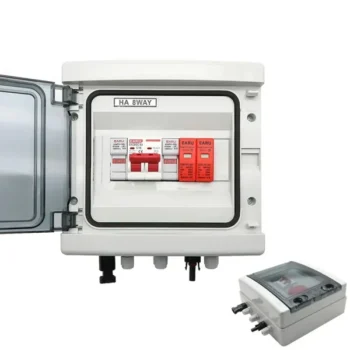
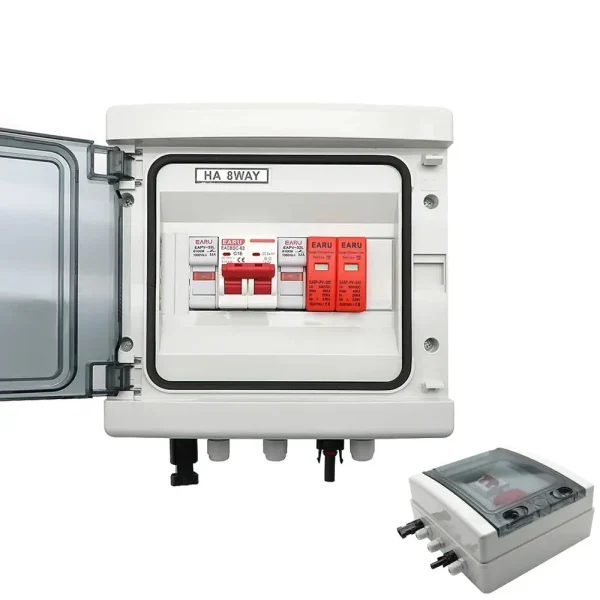
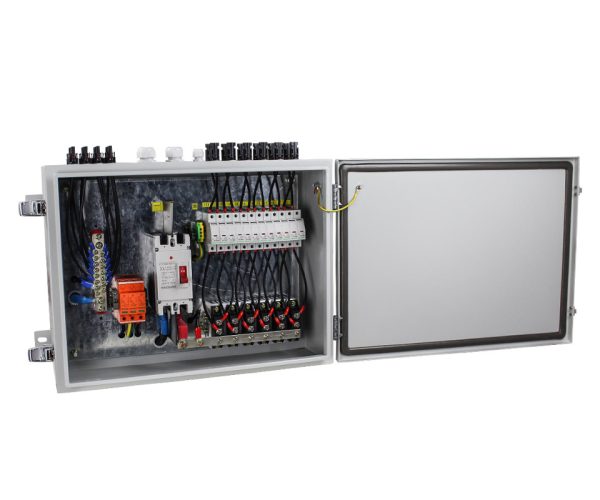
- SL7N-63 4-pole DC MCB: A branded 4-pole circuit breaker rated for 1000V DC operation. The 4-pole design switches all four conductors of the DC bus simultaneously through a common-trip mechanism, providing complete galvanic isolation of the panel string for safe service work.
- SUP2H-PV 3-pole surge protection device: A dedicated Class II SPD rated for 1000V photovoltaic applications, absorbing lightning-induced voltage transients on the DC bus before they propagate to the inverter. Includes a status indicator window showing green (good) or red (replace).
- Two pairs of cartridge fuses: Independent overcurrent protection on positive and negative rails, field-replaceable cartridge format. Sized to match the panel string short-circuit current with 1.25× safety margin.
- Heavy-duty input terminal block: Accepts the MC4-terminated cable from the panel string with secure contact pressure rated for sustained commercial-scale DC current.
- Protected output terminal block: Delivers the combined protected output to the inverter through a single weatherproof DC cable.
- Earth bonding terminal: Dedicated termination for the box body and SPD earth path connection to the building’s main earth electrode.
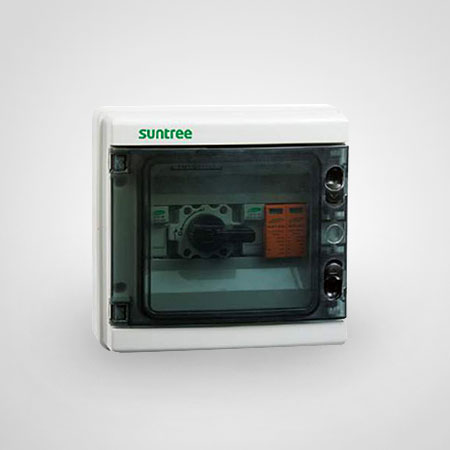
- IP65 enclosure body: PVC engineering material with fire-retardant, anti-impact, and anti-UV testing certification per CGC/GF 037:2014 photovoltaic junction equipment specification.
- Cable entry glands: Multiple sealed weatherproof glands sized for 4mm² to 10mm² solar PV cable, accommodating the heavier cable typical of commercial installations.
Why the 4-pole MCB design matters at 1000V
The 4-pole SL7N-63 MCB inside this combiner is a different beast from the 2-pole device in the 550V variant. At residential 550V levels, the 2-pole switching arrangement adequately protects the DC bus because the per-pole arc length and voltage stress remain manageable. At commercial 1000V levels, the arc that develops when a single pole opens under fault current is substantially more energetic and harder to clear — the DC voltage is twice as high and the arc has twice the energy to dissipate before it can extinguish.
The 4-pole design solves this by splitting the bus voltage across two pairs of contacts in series. Each pair sees half the system voltage during opening, allowing the arc-quench geometry to operate within its rated envelope. Internally the device behaves as two 2-pole MCBs in series, with all four contacts opening simultaneously through the common-trip mechanism. The result is reliable arc clearance even under worst-case 1000V fault conditions where a 2-pole MCB might struggle.
For commercial installations where fault clearance reliability is operationally critical — losing the protective device means losing the entire array until repair, with measurable revenue impact — the 4-pole design represents the appropriate safety margin for the higher-voltage system.
The integrated SUP2H-PV surge protection device
The SUP2H-PV SPD inside the 1000V combiner is the protective component that no smaller combiner in the family includes. It is a Class II surge protection device specifically designed for photovoltaic DC circuits at up to 1000V, with three poles connecting between the positive rail, the negative rail, and earth. The 3-pole configuration creates three discrete surge paths to earth, each rated for 8/20 µs surge waveforms up to typically 40 kA discharge current.
The SPD’s job is fundamentally different from the MCB’s job. The MCB protects against direct fault currents — short circuits between the rails, overcurrents from internal panel string faults, current overloads from damaged equipment. The SPD protects against fast voltage transients from lightning strikes in the vicinity of the installation. Even an indirect strike kilometres away can induce voltage spikes on the panel cables reaching several thousand volts, and these spikes propagate at the speed of electromagnetic wave propagation — far too fast for any mechanical breaker to react. The SPD uses metal-oxide varistors (MOVs) that change resistance in nanoseconds, clamping the bus voltage to safe levels before damage propagates downstream.
The SPD has finite absorption capacity and is a consumable item — replaceable when the status indicator shows red. For commercial installations in lightning-prone Kenyan regions, plan for SPD replacement every 2-3 years. For installations in lower-lightning areas, every 4-5 years is typical.
Where the 1000VDC combiner belongs in Kenyan installations
- 10 kW to 25 kW commercial rooftop solar systems on retail premises, supermarkets, factories, warehouses, hotels, schools, and institutional buildings
- Large residential installations in upmarket properties drawing 10-15 kVA peak load with extensive rooftop array capacity
- Multi-MPPT inverter installations where each MPPT has its own dedicated combiner managing a separate string
- Solar carports and ground-mount commercial installations with structural panel arrangements that suit long single strings
- Institutional installations at schools, hospitals, clinics, and government facilities under 25 kW total capacity
- Three-phase hybrid solar systems using the Vestwood 10kW or 15kW three-phase hybrid inverters with extended string voltages
- Off-grid commercial installations at remote sites — telecom towers, water-treatment facilities, remote lodges — with substantial solar arrays charging large battery banks
- Agricultural processing facilities with significant daytime electrical demand — coffee processing, tea factories, milling, dairy chilling
- Existing systems being upgraded from 500V or 550V architecture to higher-voltage strings for cable cost reduction on extended commercial cable runs
Technical Specifications
| Specification | Value |
|---|---|
| Catalogue Reference | SHLX-PV series, 1/1 configuration |
| Voltage Rating | 1000V DC maximum |
| String Input | Accepts one PV string |
| Protected Output | Single combined feed to inverter |
| Main Disconnection | SL7N-63 series, 4-pole DC variant |
| MCB Rated Current | Up to 63A continuous DC |
| MCB Pole Configuration | 4-pole common-trip (two-pair series arrangement) |
| Fuse Protection | 2 pairs of cartridge fuses (positive + negative) |
| Per-Rail Fuse Rating | 15–20A cartridge (matched to panel Isc) |
| Surge Protection Device | SUP2H-PV 3-pole Class II SPD, replaceable module |
| SPD Discharge Current (Imax) | ~40 kA (8/20 µs surge waveform) |
| SPD Voltage Rating | 1000V DC photovoltaic |
| SPD Status Indication | Green (operational) / Red (replacement required) |
| Enclosure Material | PVC engineering polymer, fire-retardant tested |
| Ingress Protection Rating | IP65 (dust-tight, water-jet protected) |
| UV Resistance | UV-stabilised for direct sunlight exposure |
| Anti-Impact Testing | Per CGC/GF 037:2014 specification |
| Cable Entry | Multiple sealed glands, MC4 connector-compatible |
| Acceptable Cable Size | 4mm² to 10mm² stranded copper solar PV cable |
| Mounting Method | Wall, rail, or post mount with bracket fixings |
| Operating Temperature | -30°C to +60°C ambient |
| Compliance Standards | CGC/GF 037:2014 photovoltaic junction equipment; IEC 61439-2 |
| Earth Bonding Terminal | Dedicated PE termination for SPD return path |
Engineering Features That Matter for Commercial Installations
- 4-pole SL7N-63 DC MCB: Series-arranged contact pairs split the 1000V bus voltage across two opening stages, ensuring reliable arc clearance under worst-case fault conditions where a 2-pole MCB would struggle.
- Integrated SUP2H-PV Class II SPD: Dedicated 3-pole surge protection device specifically rated for 1000V photovoltaic circuits, providing fast lightning surge absorption that no MCB can match in response time.
- Dual-pair fuse architecture: Independent overcurrent protection on positive and negative rails — covers both common short-circuit faults and rarer single-rail earth-fault scenarios.
- SPD status indication: Visible green/red window shows whether the surge protection device has absorbed its rated lifetime surge and needs replacement; supports preventive maintenance scheduling rather than reactive failure response.
- 1000V voltage headroom: Accommodates the longer panel strings (15-18 modules) that commercial installations use for cable cost reduction, with adequate margin for cold-morning voltage peaks.
- CGC/GF 037:2014 compliance: Tested to the photovoltaic junction equipment specification covering fire retardancy, temperature rise, anti-impact resistance, and anti-UV degradation — supporting commercial installation documentation and inspection requirements.
- Larger cable terminal capacity: Accepts up to 10mm² conductor, accommodating the heavier cable specifications typical of commercial installations with longer run lengths.
- Three-tier family positioning: Sits at the top of the SHLX-PV combiner family above the 550V mid-tier and 500V entry-level variants, giving commercial installers a clear specification choice within a single product family.
Typical Kenyan Commercial Installation Scenarios
- 10 kW to 20 kW solar installations on retail premises, supermarkets, and shopping centres across Nairobi, Mombasa, Kisumu, Nakuru, and Eldoret
- Factory and light-manufacturing rooftop solar systems on Mombasa Road, Industrial Area, Athi River, and Ruiru industrial zones
- Hotel and hospitality solar installations on coastal Mombasa, Diani, Watamu, Naivasha, and Maasai Mara properties
- School and university solar installations covering campus rooftops and ground-mount carport arrays
- Hospital and clinic solar installations where backup power reliability is operationally critical
- Tea, coffee, and dairy processing facility solar installations matching the substantial daytime electrical demand of agricultural processing
- Solar carport installations at commercial parking facilities and shopping centre parking areas
- Vestwood 10kW or 15kW three-phase hybrid inverter installations with extended single-string panel arrays
- Multi-MPPT inverter installations where each MPPT input has its own dedicated 1000V combiner
- Telecom backup installations at remote tower sites with substantial solar arrays charging large battery banks
- Water treatment and pumping facility solar installations at municipal water schemes
Installation Notes
Installation of the SHLX-PV 1000VDC combiner is professional commercial-scale electrical work and must be carried out by an EPRA-licensed electrical contractor with documented solar installation experience and commercial PV credentials. Six key considerations apply at this voltage class. First, voltage envelope verification — calculate the panel string’s coldest-morning open-circuit voltage from the panel datasheet’s Voc and temperature coefficient, and confirm it sits below 1000V with adequate safety margin (typically 5-10% headroom). Second, cable specification — at commercial scale the DC cable from the combiner to the inverter often runs 30-50 metres, requiring cable sized for both ampacity and voltage drop at the higher operating voltage; typical sizing is 6mm² to 10mm² stranded copper depending on the specific current and run length. Third, terminal preparation — the higher cable cross-sections used at commercial scale require lug crimping at the cable ends and torque application to the manufacturer’s specified value across all terminations, with documented torque verification for commissioning. Fourth, earth bonding — the SPD’s surge dissipation depends on a low-impedance return path to earth; commercial installations typically require a dedicated copper earth conductor sized to 16mm² minimum, terminated at the combiner’s PE point and bonded to the building’s main earth electrode through a documented path. Fifth, weather protection — the IP65 enclosure handles direct outdoor mounting, but commercial installations benefit from additional protection against direct sun heat buildup (which can derate the internal MCB) and against physical impact in busy operational areas; partial shading or a small protective hood extends the combiner’s reliable service life. Sixth, commissioning documentation — commercial installations typically require formal commissioning documentation including insulation resistance testing, polarity verification, MCB operation testing, SPD status verification, and earth-loop impedance measurement; the combiner should be commissioned and tested as part of the broader PV array commissioning process.
For multi-MPPT inverter installations where each MPPT input has its own dedicated panel string, install one 1000V combiner per MPPT input rather than combining strings before they reach the inverter. This maintains each MPPT’s independent optimisation capability while providing per-string protection and isolation. For installations with three or more parallel strings sharing a single high-current MPPT, the 12-way combiner variants accept multiple inputs into a combined output bus — consult our extended product range for the appropriate specification.
Planning a commercial solar installation, factory rooftop array, or large residential PV system?
Match the 1000V combiner to your specific string design and inverter configuration — start with our Solar Calculator for sizing and combiner selection, or describe your commercial installation through My Quote for a complete commercial system specification including combiner protection, cable schedule, and inspection-ready documentation.