Description
SHLX-PV 1/1 550VDC Combiner Box — DC Combiner with 2P MCB & Dual Fuse Protection
The SHLX-PV 1/1 550VDC Combiner Box is the mid-tier specification in the SHLX-PV combiner family, designed for Kenyan residential solar installations that need slightly higher voltage headroom and branded protective components than the entry-level 500VDC class provides. The “1/1” designation means a single PV string flows into the box and a single protected output flows out to the inverter — the standard architecture for residential systems where one panel chain feeds one MPPT input on the hybrid inverter.
The 550V DC voltage rating gives the installer 10% more voltage margin than equivalent 500V boxes, useful when residential strings run 10 to 12 panels in series at the coldest morning operating temperatures. The internal protective set is built around two named components: a pair of cartridge fuses on each side of the DC bus (so the positive and negative rails are independently protected), and an SL7N-63 series 2-pole DC MCB providing manual disconnection plus overcurrent protection. The combination — branded MCB plus dual fuses — represents a more robust protective scheme than the single-fuse or single-breaker designs found at the budget end of the market.
Where this 550VDC combiner sits in the SHLX-PV family
- Entry tier — PV Combiner Box 500VDC 1-String (sister page): Standard residential combiner for 3–6 kW systems, includes a Class II SPD plus DC breaker and basic fuse. The lower voltage rating suits shorter panel strings (6–10 panels).
- Mid tier — SHLX-PV 1/1 550VDC (this page): Branded SHLX series with SL7N-63 MCB and dual-pair fuse protection. Suits 5–8 kW residential systems with strings of 10–12 panels, particularly in lightning-prone regions where the branded protective set provides extra reassurance.
- Premium tier — SHLX-PV 1/1 1000VDC (sister page): Same SHLX family but rated for 1000V DC strings, suiting larger residential and small commercial installations using high-voltage string designs typical of 10+ kW systems.
The three-tier structure lets you match the combiner to your specific installation rather than over-specifying. A 5 kW residential system with 6 panels (Vestwood 5kW hybrid inverter with single string) fits the entry-level 500VDC. A 6 kW residential system with 10–12 panels (Vestwood 6kW hybrid with longer single string) fits this 550VDC midtier. A 10+ kW commercial installation with 1000V strings fits the premium 1000VDC variant.
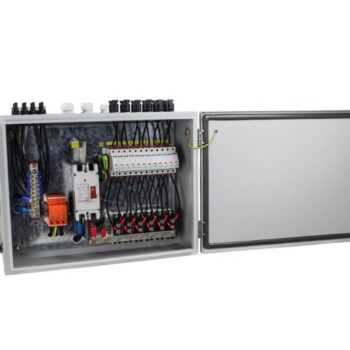
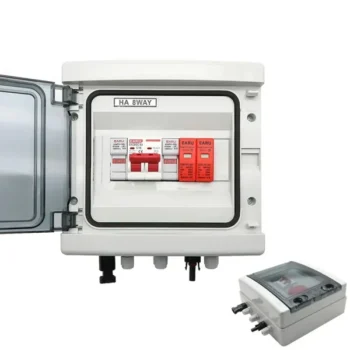
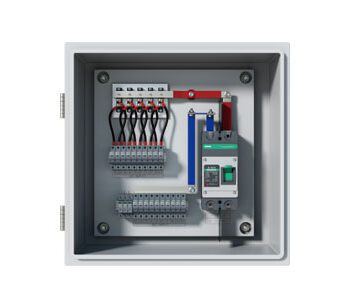
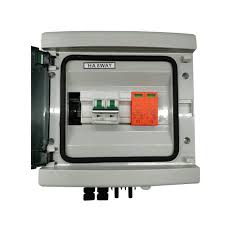
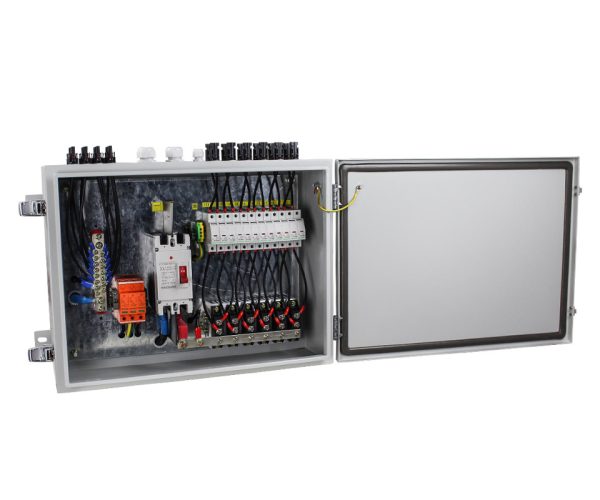
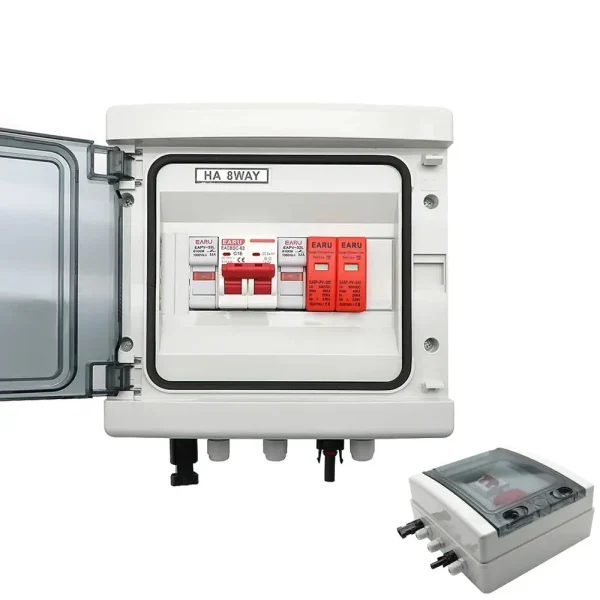
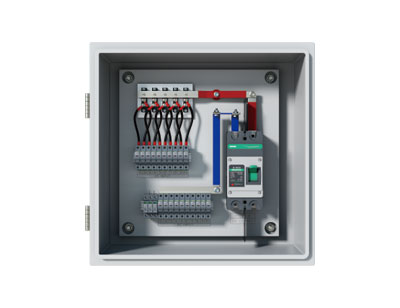
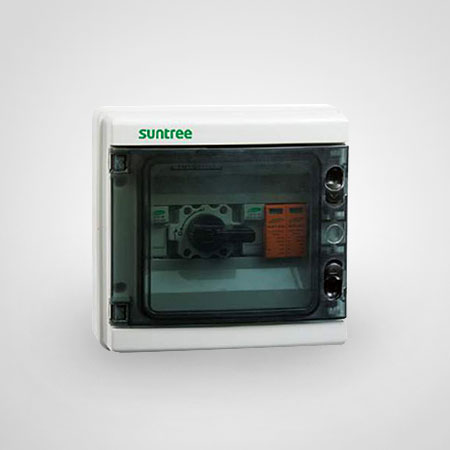
What’s inside the SHLX-PV 1/1 550VDC
- SL7N-63 2-pole DC MCB: A branded 2-pole circuit breaker specifically rated for 550V DC service. The 2-pole design switches both the positive and negative conductors simultaneously, providing complete electrical isolation of the panel string for safe maintenance or fault investigation.
- Two pairs of cartridge fuses: Independent overcurrent protection on the positive and negative rails of the DC bus. Field-replaceable cartridge format means a blown fuse can be swapped without disturbing the wiring.
- Input terminal block: Accepts the MC4-terminated cable from the panel string with proper torque and sustained-current contact pressure.
- Output terminal block: Delivers the protected DC current to the inverter through a single weatherproof output cable.
- Earth bonding terminal: Dedicated termination for the box body’s earth connection to the building’s main earth electrode.
- Cable entry glands: Sealed weatherproof glands sized for 4mm² to 6mm² solar PV cable.
- Weather-resistant enclosure body: Indoor or outdoor mounting; UV-resistant for direct sun exposure under Kenya’s tropical conditions.
- Hinged or screw-fixed front cover: Allows access to fuses and MCB for routine inspection while keeping live terminals enclosed during normal operation.
Why the SL7N-63 MCB matters
The SL7N-63 is a 2-pole DC-rated MCB specifically designed for photovoltaic applications, rated to break the DC arc that develops when the breaker opens under load. Generic AC-rated MCBs are not interchangeable with DC-rated equivalents — when an AC MCB opens an energised DC circuit, the arc does not self-extinguish at the natural zero-crossing (because DC has no zero-crossing), and the breaker can fail to clear the circuit safely. The SL7N-63 uses specific arc-quench geometry plus rated current paths to break DC up to 550V cleanly, which is why DC-rated breakers cost more than their AC equivalents but are essential for solar installation safety.
The 2-pole common-trip design ensures both the positive and negative rails open together. This matters because residential PV strings are bipolar — when one rail develops a fault, isolating only the other rail does not create complete disconnection, and the faulted side can still leak current to earth through the array. The 2-pole MCB removes both rails together, providing complete galvanic isolation of the entire string.
Where the 550VDC combiner fits in Kenyan installations
- 5 kW to 8 kW residential hybrid solar systems with longer single strings — typically 10 to 12 panels in series feeding a single MPPT input on the hybrid inverter
- Vestwood 6kW Hybrid Inverter installations where the inverter’s PV input voltage envelope (typically 70–520V MPPT range) sits well within the combiner’s 550V rating, providing cool-morning headroom
- Highland residential installations in counties such as Murang’a, Kiambu, Nyandarua, Nyeri, Embu, and Meru, where cool morning temperatures push panel string voltages toward the upper end of the operating range
- Lake Victoria basin installations in Kisumu, Siaya, Migori, Busia, and Bungoma counties, where high annual lightning activity warrants branded protective components and dual-fuse redundancy
- Off-grid residential installations with 12-panel arrays charging large battery banks through MPPT charge controllers
- Small school and clinic solar installations in the 5–8 kW range with single-string panel arrays
- Hybrid solar installations with EV charging where the household demand pushes toward the upper end of single-MPPT capability and the longer string design is necessary to capture sufficient energy
- Solar-equipped small commercial premises — shops, salons, retail outlets — with rooftop arrays in the 5–8 kW band
Technical Specifications
| Specification | Value |
|---|---|
| Catalogue Reference | SHLX-PV series, 1/1 configuration |
| Voltage Rating | 550V DC maximum |
| Input Configuration | 1 PV string input |
| Output Configuration | 1 protected output to inverter |
| Disconnection Device | SL7N-63 2-pole DC MCB |
| MCB Rated Current | Up to 63A continuous DC |
| MCB Pole Configuration | 2-pole common-trip (positive + negative) |
| Fuse Protection | 2 pairs of cartridge fuses (positive + negative) |
| Per-Rail Fuse Rating | 10–15A cartridge (matched to panel Isc) |
| Enclosure Material | Weather-resistant polymer body |
| Indoor/Outdoor Use | Both — UV-resistant for direct sunlight exposure |
| Cable Entry | Sealed weatherproof glands sized for solar PV cable, MC4 ready |
| Acceptable Cable Size | Accepts 4mm² through 6mm² copper PV conductor |
| Mounting Method | Wall-mount via four-point bracket fixings |
| Operating Temperature | −25°C to +60°C ambient |
| Compliance Reference | IEC 61439-2 (low-voltage switchgear assemblies) |
| Earth Bonding | Dedicated PE terminal for box body and SPD return |
| Status Indication | MCB position visible through cover window |
Engineering Features That Matter
- Branded SL7N-63 2-pole DC MCB: Solar-rated breaker designed specifically for DC arc-clearance, avoiding the failure mode of generic AC-rated MCBs that cannot safely break DC circuits.
- Dual-pair fuse architecture: Independent overcurrent protection on positive and negative rails — a fault in one rail does not compromise protection on the other.
- 550V voltage headroom: 10% higher voltage rating than equivalent 500V combiners, accommodating cool-morning voltage peaks on residential strings of 10–12 panels.
- Branded SHLX product family: Three-tier voltage progression (500V → 550V → 1000V) provides clear specification choice across the residential and light-commercial market.
- Compact wall-mount design: Single-piece enclosure with integral fixing brackets; mounts on any standard wall, panel mounting structure, or post within reach of the array.
- Field-replaceable consumables: Fuses swap out without disturbing the MCB or wiring; MCB itself replaces as a unit if damaged after a major fault clearance.
- Cool-temperature performance: Operating temperature range covers Kenyan highland mornings (cool conditions occasionally below freezing in Nyandarua, Nyahururu) without performance degradation.
- UV-stabilised body: Direct outdoor mounting without yellowing or polymer cracking over the system’s service life.
Typical Kenyan Installation Scenarios
- Vestwood 6kW Hybrid Inverter installations with 10–12 Jinko 585W panels in a single string (5.85–7.02 kWp arrays)
- Murang’a, Kiambu, Nyeri, and Embu residential installations where highland temperatures push string voltages toward the upper end of the operating range
- Kisumu, Siaya, and Lake Victoria basin homes where annual lightning activity warrants the branded SHLX protective set
- Small dairy farms and agricultural installations with 6 kW residential-tier solar paired with submersible water pumps
- Off-grid and weekend homes in Naivasha, Mount Kenya foothills, and Aberdares where the cooler operating climate makes the 550V rating worthwhile
- Hybrid solar installations with EV charging where the household demand justifies the longer single-string panel design
- Replacement combiner upgrades on existing systems where the original 500V box has experienced repeated nuisance trips on cool mornings
- Small commercial installations on retail premises, salons, and clinics in the 5–8 kW band with branded protective equipment specification
Installation Notes
Only an EPRA-registered electrician with documented solar experience should install this combiner. Position the SHLX-PV 550VDC at the array side so the unprotected DC cable run between the panels and the box is as short as practical. Five practical considerations shape a clean installation. First, mounting position — vertical orientation with cable glands pointing downward, on a stable wall surface within two metres of the nearest panel where possible. Second, polarity verification — the positive and negative panel string conductors must be correctly identified before termination; reverse polarity at the input can damage the SL7N-63 MCB and the fuses, and is not always recoverable. Third, conductor seating — each connection point inside the enclosure should be torqued to the figure specified in the SHLX documentation; DC connections under continuous current generate measurable heat when loose, leading to progressive damage. Fourth, fuse rating verification — the cartridge fuses installed must match the panel string’s short-circuit current (Isc); the standard sizing is 1.25 times Isc, so a panel string with 11A Isc uses 15A fuses, and a string with 14A Isc may need 20A fuses depending on the specific panel datasheet. Fifth, protective earthing — route a properly sized earth conductor from the combiner’s PE point to the building’s primary earth electrode, giving any internal fault a clean low-impedance return path to clear safely.
For lightning-prone installations, the SHLX-PV 550VDC combiner pairs well with a separate surge protection device (SPD) mounted in line with the DC cable between the combiner output and the inverter input. While the combiner itself provides MCB and fuse protection, a dedicated Class II SPD adds the absorbing capacity needed to handle the voltage transients that nearby lightning strikes induce on the panel cables. Consult our DC surge protector product range for compatible options.
Designing a 5–8 kW residential solar system with the Vestwood 6kW Hybrid or similar?
Match the combiner box to your specific panel string design — start with our Solar Calculator for sizing the array and choosing the right combiner voltage rating, or describe your installation through My Quote for a complete system specification including the SHLX combiner box, surge protection, cable schedule, and protection coordination.