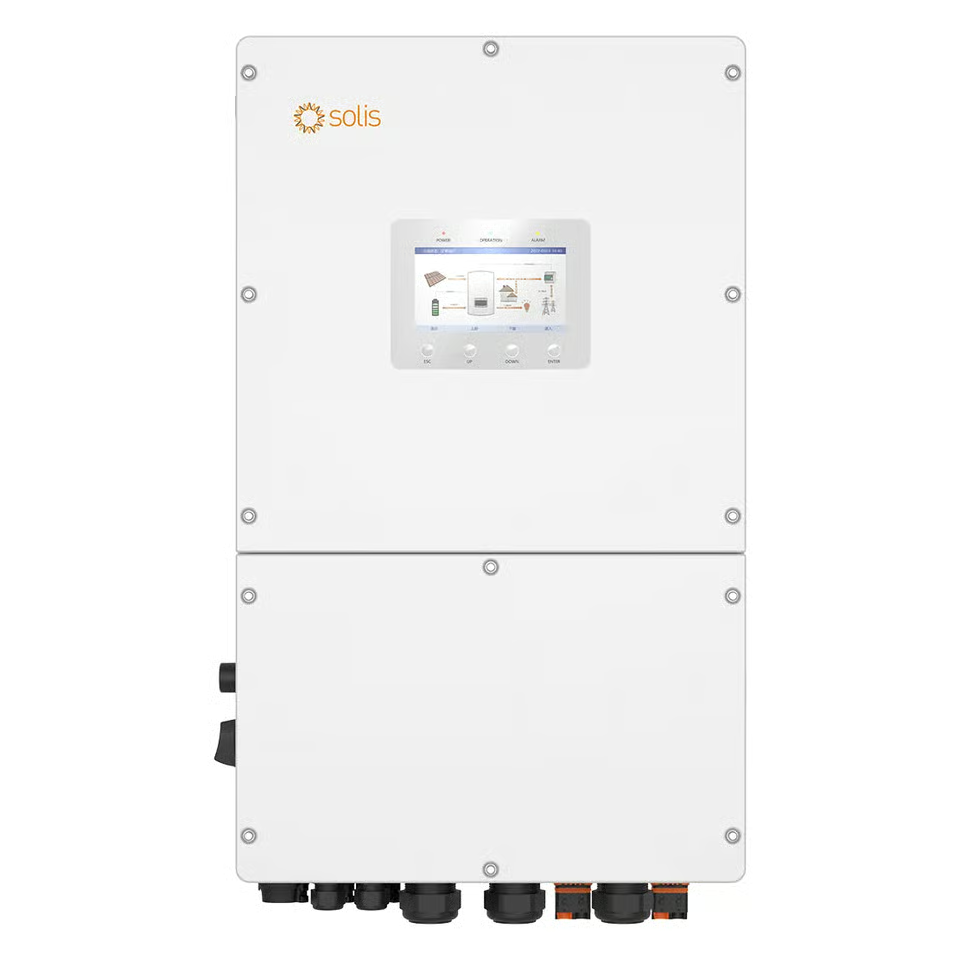
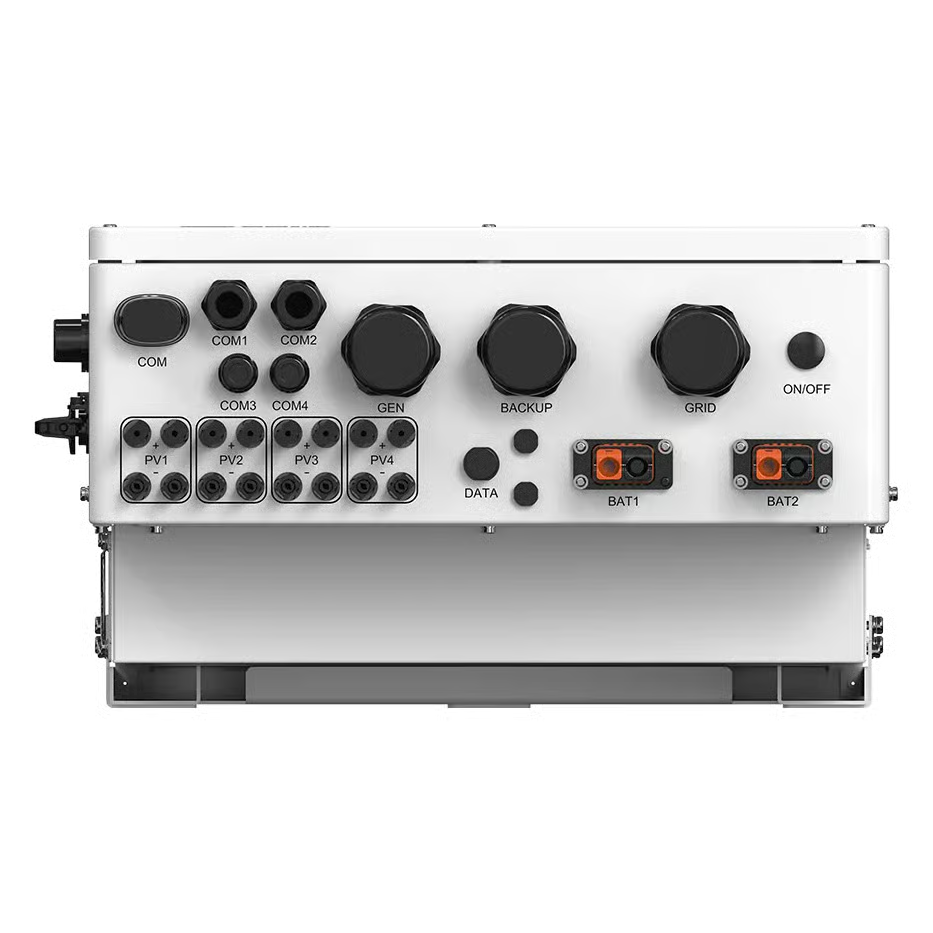
Description
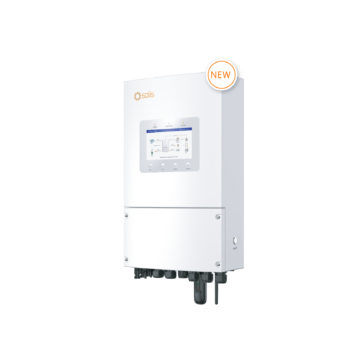
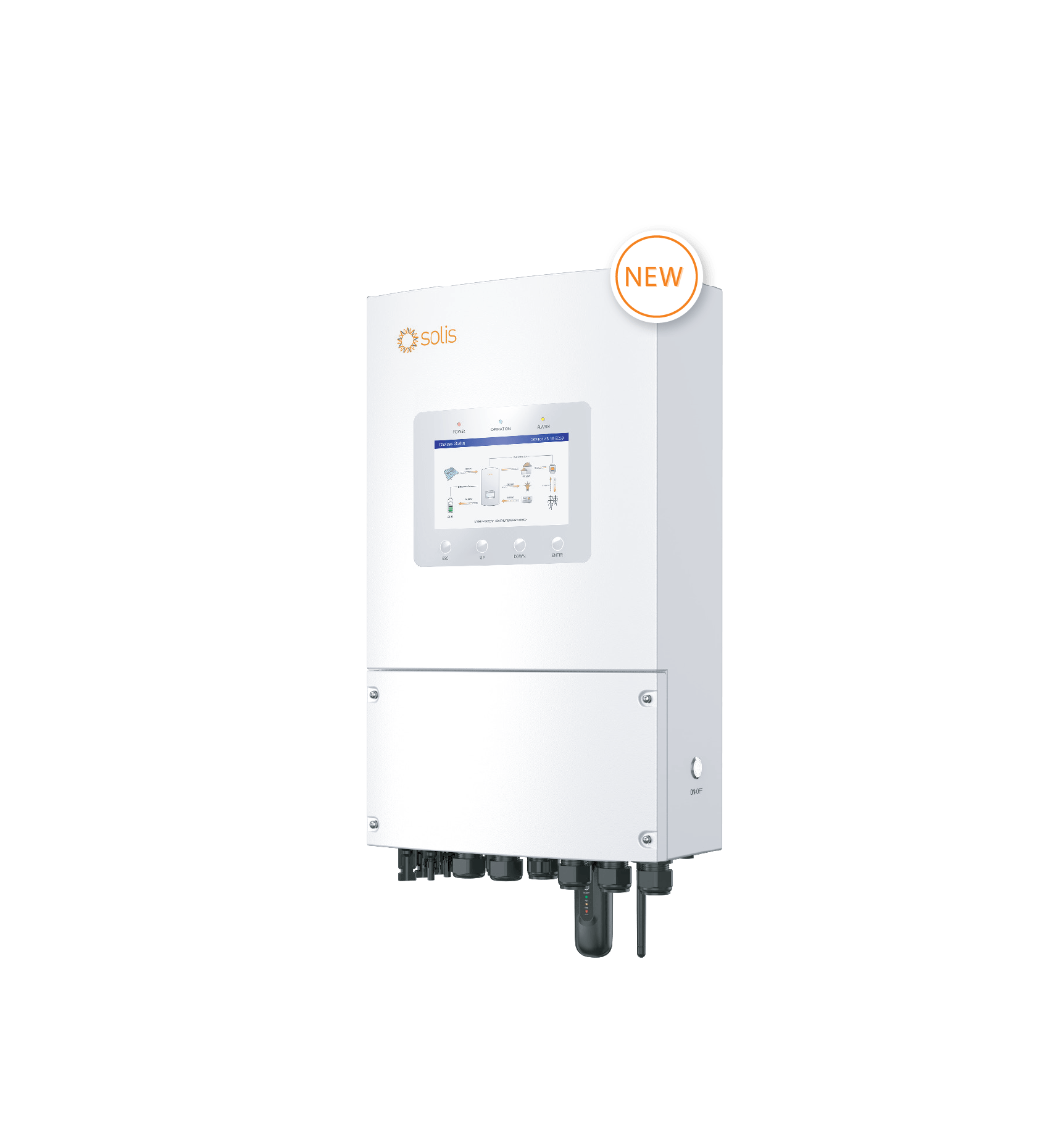
The Solis S6-EH3P30K-H 30kW Three Phase Hybrid Inverter produces 30000W across three phases and carries a solar array of up to 60kW. It is a commercial machine, built for factories, processing plants, hospitals, hotels and large institutions.
It differs from everything below it in the range in one structural way, and that difference is the reason to choose it.
It runs on a high voltage battery, between 150V and 800V, rather than a 48V bank. That is a different storage platform and it has to be planned for. What it buys is the removal of the ceiling that limits every low voltage machine.
On a 48V system the battery current becomes the constraint long before the inverter does. The largest low voltage units in this family cannot quite reach their rated output from storage, because the current required exceeds what the platform will pass. Raise the battery voltage and the same current carries far more power. Here the storage side is rated for 33kW against an inverter rated for 30kW, so the full output is available from the battery with margin left over, through a long outage, at night, with no derating as the bank discharges.
The efficiency follows from the same change. Less current for the same power means lower losses, and this unit converts at 97.8% at its best.
1. System Architecture and Configuration
Hybrid Energy Core
- 30kW rated output and 30kVA apparent, delivered on three phases
- Four wire connection with earth, at 380V or 400V line to line
- 45.6A per phase at 380V, 43.3A per phase at 400V
- Unbalanced loading permitted up to a third of the rating, so 10kW on any one phase
- Sixty percent extra output for two seconds when heavy plant starts
- Power factor held above 0.99 with distortion kept under 3%
Solar Charging System
- Three trackers carrying six strings between them
- A 60kW array allowance, double what the inverter is rated to produce
- Input rated to 1000V, tracking across 150V to 850V, with 600V the design point
- Full output available once string voltage reaches 500V
- Each tracker accepts 40A, 60A of short circuit current and 24kW of power
- Twenty amperes permitted on any single string
- Generation begins at 180V
Battery Integration
- Lithium stack anywhere between 150V and 800V
- Two independently controlled ports, 70A on each
- 33kW of charge and discharge, comfortably above what the inverter produces
- Charge state, cell temperature and limits reported over CAN or RS485
- A reserve level set by you, held back for interruptions rather than cycled daily
- Load prioritising, so the circuits that matter outlast the ones that do not
Protection and Cooling
- Sealed to IP66, suitable for a plant room or an exterior wall
- Intelligent fan cooling, stepping up only as the unit works harder
- Integrated DC switch on the array input
- Insulation resistance detection and anti islanding
- Output overcurrent, short circuit and overvoltage protection
- Reverse polarity blocking, with Type II surge arrest on both DC and AC sides
- Optional arc fault detection on the array input
2. Technical Specifications
| Parameter | Specification |
|---|---|
| Rated output power | 30kW |
| Maximum apparent power | 30kVA |
| Overload capability | 1.6 times rated power for 2 seconds |
| Operation phase | Three phase with neutral and earth |
| Rated grid voltage | 220V/380V or 230V/400V |
| Grid voltage range | 304V to 460V |
| Rated grid frequency | 50Hz or 60Hz, accepted 45Hz to 65Hz |
| Rated output current | 45.6A per phase at 380V, 43.3A at 400V |
| Maximum power per phase | 33% of rated power, so 10kW |
| Power factor | Above 0.99, adjustable 0.8 leading to 0.8 lagging |
| Current distortion | Under 3% |
| Maximum AC passthrough | 91.2A at 380V, 86.6A at 400V |
| Backup output | 30kW |
| Backup switch time | Under 10ms |
| Generator input | 20% to 100% of rated power, so 6kW to 30kW |
| Battery type | Lithium ion, high voltage |
| Battery voltage range | 150V to 800V |
| Maximum charge and discharge current | 70A on each of two ports |
| Maximum charge and discharge power | 33kW |
| Battery communication | CAN or RS485 |
| MPPT quantity | 3 trackers, 6 strings |
| Recommended maximum array | 60kW |
| Maximum usable PV input power | 60kW |
| Maximum PV voltage | 1000V DC |
| Rated PV voltage | 600V |
| Start-up voltage | 180V |
| MPPT voltage range | 150V to 850V |
| Full output voltage range | 500V to 850V |
| Maximum input current | 40A per tracker, 20A per string |
| Maximum short circuit current | 60A per tracker |
| Maximum input power per tracker | 24kW |
| Maximum efficiency | 97.8% |
| European weighted efficiency | 97.4% |
| Battery charged from solar | Up to 98.5% |
| Battery discharged to AC | Up to 97.5% |
| Night self consumption | Under 25W |
| Topology | Transformerless |
| Cooling | Intelligent fan cooling |
| Protection rating | IP66, indoor or outdoor |
| Operating temperature | -25C to +60C, 0 to 95% humidity non condensing |
| Maximum altitude | 4000m |
| Dimensions and weight | 530 x 880 x 290mm, 73kg |
| Display | LED indicators with Bluetooth and app |
| Communication | CAN, RS485 and Ethernet, with WiFi, cellular and LAN available |
| Parallel operation | Up to 6 units directly, further with a switching cabinet |
| Warranty | 5 years standard, extendable to 20 |
3. Key Features
- Full rated output available from storage alone, with the battery side rated above the inverter
- 97.8% peak conversion, which the high voltage architecture makes possible
- Under 25W drawn overnight, the lowest standby figure in the range
- Twice the inverter rating in array allowance, on an input rated to 1000V
- Generator acceptance from a fifth of rating up to the whole of it
- Sixty percent overload for two seconds, covering large motor and compressor starting
- Two independently controlled battery ports, so storage can be staged or split
- Smart load prioritising and a user set battery reserve
- DC and AC coupling both supported, so an existing array stays in service
- Six units in parallel directly, and larger arrangements through a switching cabinet
- Engineered around your switchgear, with support based in Kenya
4. Applications and Use Cases
- Manufacturing: production lines, compressors and extraction running through interruptions
- Food processing and cold storage: refrigeration that cannot be allowed to lapse
- Hospitals: theatres, imaging, sterilisers and laboratory cold chain
- Hotels and conference venues: kitchens, laundries, lifts and guest floors
- Large schools and universities: campus wide supply across several buildings
- Commercial farms: irrigation at scale, packhouses and controlled atmosphere stores
- Data and telecommunications rooms: continuous supply with generator behind it
5. Installation and Engineering Notes
Protective devices below are set a quarter clear of the steady load, then taken up to a size that is actually manufactured. Final values answer to the real route, the grouping and the temperature on site.
| Circuit | Design current | Device | Cable, short run |
|---|---|---|---|
| PV, per string | 20A | 25A DC, rated beyond 1000V | 4mm² solar cable |
| Battery, per port | 70A | 100A DC, rated beyond 800V | 25mm² per port |
| AC output | 45.6A per phase | 63A, 4 pole, Type C | 16mm² |
| Grid input and passthrough | 91.2A per phase | 125A, 4 pole | 35mm² |
The battery circuit is the part that catches people out. A 48V installation needs heavy cable and modest voltage ratings. This one reverses that. Seventy amperes per port is light enough for 25mm squared, but the conductors and every device on them sit at up to 800V, so isolators and breakers must be rated for it. Components carried over from a low voltage system are not suitable, whatever their ampere figure.
- Strings have to be long on this platform: full output needs 500V, and a string that measures 504V in moderate conditions falls below that on a hot roof
- Fourteen to seventeen 620W panels per string works, with fifteen or sixteen the easiest choice
- Six strings of sixteen comes to about 59.5kW and fills the 60kW allowance
- Check the open circuit figure on a cold morning, not a warm afternoon, and leave margin below 1000V
- Every solar side device needs a rating beyond 1000V
- Both battery ports can be used, which also allows storage to be installed in two stages
- Spread single phase loads so none exceeds 10kW
- At 73kg this is a mechanical lift onto a structural wall, not a two person job
- Allow for a 530 by 880 by 290mm body plus clearance for airflow and cable entry
- Fan cooling puts this in a switchroom rather than a workspace
- Lightning prone sites need arrestors outside the inverter and a dedicated earth electrode
- A high voltage battery carries lethal potential with no inverter connected, so isolation procedure matters more here than on a 48V system
- Commissioned by our own licensed engineers
6. Care, Maintenance and Operations
- Verify both battery ports are sharing load rather than one carrying the work
- Check the loading on each phase annually, since a working site changes what it runs
- Confirm the cooling fans run up as load rises
- Keep intakes free of dust, fibre and insect nests, which matters most in mills and packhouses
- Check current output against what the system made when new
- Take balance and thermal readings directly off the stack
- Check rooftop connectors once the wet season has passed
- Keep firmware current as new builds appear
- Follow the documented isolation sequence before any work on the DC side
7. Do’s and Don’ts
Do
- Plan the high voltage battery line at the same time as the inverter, not afterwards
- Specify DC protection rated for 1000V on the array and 800V on the battery
- Build strings long enough to hold 500V when the roof is hot
- Use both battery ports where the stack allows it
- Keep any single phase under 10kW
- Treat the DC side as live and lethal regardless of inverter state
- Size the generator for the site load plus whatever charging runs alongside
- Note down every circuit sitting behind the backup output at handover
Don’t
- Expect it to work with a 48V lithium bank, because the platform starts at 150V
- Carry low voltage DC isolators or breakers across to this installation
- Build short strings that drop under 500V in the heat of the day
- Run a string close to the 1000V limit at dawn
- Attempt the lift without proper handling equipment
- Hang it on the other side of an office or ward wall
- Open the DC side without following the isolation sequence
8. Compatibility
- High voltage lithium stacks between 150V and 800V, communicating over CAN or RS485
- Solar arrays up to 60kW across six strings
- Generator sets from 6kW to 30kW, with automatic control
- Any array already feeding the grid, retained by coupling on the AC side
- Metering, so peak shaving responds to measured demand
- Remote monitoring by Ethernet, or WiFi, LAN and cellular where preferred
- Switching cabinets for arrangements beyond six units
High voltage stacks are matched model by model and firmware build by firmware build, and the approved list differs from the one covering 48V equipment. We confirm the pairing and supply the stack alongside the inverter rather than leaving you to source it.
9. Performance Table
| Load | Estimated backup runtime on a 60kWh high voltage stack |
|---|---|
| 5kW | Around 10 to 11 hours |
| 10kW | Around 5 hours |
| 15kW | Around 3.5 hours |
| 22kW | Around 2.3 hours |
| 30kW | Around 1.7 hours |
Based on 54kWh available from a 60kWh stack at 90% depth, after conversion losses. Any daylight at all lengthens these times. Unlike a 48V installation, the figures hold right down the discharge, because the current the inverter draws stays well inside what the stack delivers.
10. What It Runs, and the One Ceiling That Applies
Most of the limits that shape a smaller installation are absent here. The battery supplies the full rating. The array allowance is double the output. The generator will take anything from a fifth of capacity upward.
One ceiling does apply, and it is the same one that governs any three phase machine: no single phase may carry more than 10kW, a third of the rating.
On a commercial site that is rarely a problem, because the large loads are three phase and draw from all three conductors together. It becomes one where a building has grown by addition, and the single phase circuits have landed wherever was convenient.
| Situation | What governs it | Outcome |
|---|---|---|
| Three phase production line, 22kW | Total rating | Comfortable, 8kW still free |
| The same line during a long outage | Battery capability | Unchanged, storage carries the full rating |
| Cold store compressor starting, 18kW surge | Overload margin | Inside the 1.6 times allowance |
| A single phase water heater bank, 8kW | Phase ceiling | Inside the 10kW limit |
| Two such banks on one phase | Phase ceiling | Exceeds it, though total load is modest |
| Whole site balanced | Total rating | Up to 10kW on each phase, 30kW in all |
Counting the load on each phase before the inverter is chosen is a short exercise that prevents a long argument later.
11. Mini FAQ
Will it work with 48V batteries?
No. The battery platform runs from 150V to 800V, so a high voltage stack is required and must be budgeted alongside the inverter.
Does it give the full 30kW from storage?
Yes, with room in hand. The battery side is rated for 33kW against an inverter rated for 30kW, so output holds through a long outage rather than tapering.
Why is a high voltage battery more efficient?
Because the same power moves at a fraction of the current, and losses rise with the square of current. This unit converts at up to 97.8%.
How long do the strings need to be?
Long. Full output needs 500V, so fourteen to seventeen 620W panels per string, with fifteen or sixteen the easiest choice.
How many panels in total?
Up to 60kW of array, twice the inverter rating. Six strings of sixteen comes to about 96 panels and 59.5kW.
What size generator suits it?
Anything from 6kW to 30kW is accepted with automatic control, so an existing set can usually stay.
Can one person install it?
No. It weighs 73kg and needs handling equipment and a structural wall.
How many can run together?
Six directly, and larger arrangements through a switching cabinet.
12. Why Buy From Bicity Solar
- Genuine units, each arriving with certification matched to its serial
- The high voltage battery specified and supplied with the inverter, not left to you
- Straight answers, including where the headline number needs context
- Phase loading counted before the equipment is proposed
- DC components rated for 1000V on the array and 800V on the battery
- The generator brought into the system rather than left working against it
- Fitted and certified by licensed personnel
- Registration completed in time to qualify for the longer warranty
- Warranty matters taken up with the distributor by us, not by you
- Shipped across the country and backed with parts afterwards
This inverter takes a high voltage battery, not the 48V lithium used on smaller systems. The stack has to be chosen and costed alongside it, and that is the first conversation to have.
Give us a phase by phase load breakdown, your available roof, and details of any generator on site. From that we establish what the plant really produces with the grid down, match a stack to the 33kW the battery stage passes, and set out six strings under the 1000V limit. Run your own numbers in the Solar Calculator, or pass the project to us via My Quote for a full costing.