Description
PV Combiner Box 500VDC 2 String Kenya — Parallel Solar Combiner with Dual DC Breakers & Surge Protection
The PV Combiner Box 500VDC 2 String — also marketed across Kenya as the 2-In 1-Out Solar Combiner Box, the Parallel String Combiner, or the Dual-String DC Combiner — is the right specification for residential and small commercial Kenyan solar systems that use two separate panel strings feeding into a single inverter MPPT input. While the 500VDC 1-string variant on a sister product page serves the simplest residential configuration with a single panel chain, this 500VDC 2-string variant addresses installations where the panel array splits naturally into two physical groups — east-facing and west-facing roof sections, two separate roof areas at different orientations, mounting structures with two rows of panels, or any layout where running a single long string is impractical and two shorter strings make more engineering sense.
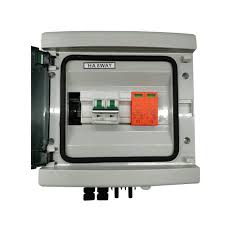
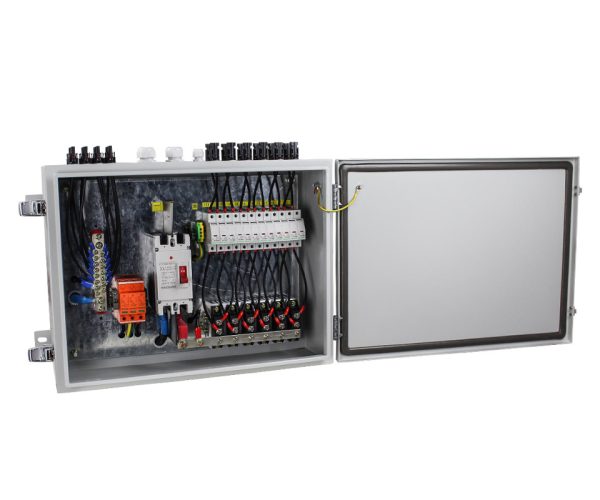
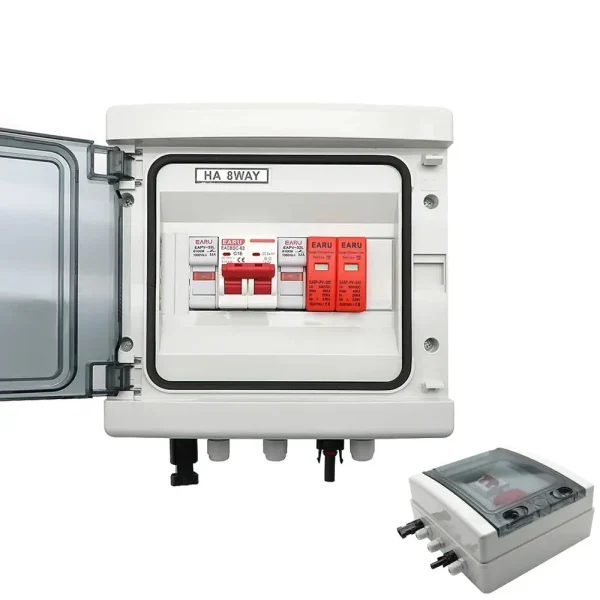
Inside the box, each of the two input strings has its own dedicated fuse and DC disconnection breaker, allowing each string to be isolated and tested independently. The two protected currents then combine onto a common output bus, which feeds the inverter through a single protected output cable. A Class II surge protection device (SPD) on the common bus protects both strings simultaneously against lightning-induced voltage spikes — an essential feature for Kenyan installations in lightning-prone regions like the highlands and Lake Victoria basin.
This 2-in 1-out architecture is significantly more useful for Kenyan installations than two separate 1-string combiners would be — it costs less, takes less roof space, requires fewer cable runs to the inverter, and provides cleaner fault diagnostics when individual strings underperform.
When do you actually need two strings?
The decision to split a solar array into two parallel strings rather than one long single string is driven by physical and electrical considerations that come together in several common Kenyan installation scenarios:
- East-west split arrays (the most popular Kenyan installation pattern): Modern residential roof designs increasingly mount panels on both the east-facing and west-facing roof slopes to capture morning and afternoon sun separately. Wiring a single string across both orientations creates voltage and current mismatches under partial sunlight; running each orientation as its own string solves the mismatch and lets the combiner aggregate the protected outputs cleanly.
- Split-roof Kenyan installations: Many Kenyan homes have separate roof sections (main house plus a garage or annex, common in Karen, Runda, Lavington, and Kileleshwa properties) where panels mount on both. Running a single string between sections requires long cable runs; two strings on separate sections each going through this 2-string combiner is cleaner and uses less DC cable.
- Two-row ground or carport mounts: Ground-mount and carport installations on Kenyan farms and commercial premises sometimes use two parallel rows of panels with the structure between them. Each row becomes its own string.
- Shading mitigation for Kenyan rural installations: When parts of the array experience occasional shading (a chimney shadow at sunset, a neighbouring tree branch in the morning, an adjacent acacia at dawn) and other parts do not, splitting the shaded portion into its own string isolates its underperformance from the unshaded panels.
- Single-MPPT inverter with array larger than one string supports: Most residential hybrid inverters in Kenya — including the Vestwood 6kW Hybrid Inverter — have a single MPPT input. If your panel count exceeds what a single series-connected string can deliver within the inverter’s voltage limits, splitting into two parallel strings doubles the current capacity while staying within the voltage envelope. This is the most common reason to choose 2-in 1-out architecture in Kenyan residential solar installations.
- Future expansion built into installation day: Some Kenyan installers design the first year with one string and a 2-string combiner, leaving the second input unused and ready to accept additional panels in a future phase. The 500VDC 2-string combiner accommodates the expansion without any further hardware change.
Where this 500VDC 2-string combiner fits in the Bicity combiner family
The PV Combiner Box 500VDC 2 String sits in a specific position within our four-tier combiner range. Choosing correctly avoids both undersizing (which forces compromises in your installation) and oversizing (which wastes money on unused capacity):
| Combiner Variant | Voltage Rating | Strings | Best For |
|---|---|---|---|
| PV Combiner Box 500VDC 1 String | 500V DC | 1 in × 1 out | Simple 3-6 kW residential with single panel chain |
| PV Combiner Box 500VDC 2 String (this page) | 500V DC | 2 in × 1 out | 6-10 kW residential with east-west or split-roof arrays |
| SHLX-PV 1/1 550VDC | 550V DC | 1 in × 1 out | 5-8 kW residential with longer strings (10-12 panels) |
| SHLX-PV 1/1 1000VDC | 1000V DC | 1 in × 1 out | 10-25 kW commercial installations |
A buyer with a 6 kW Vestwood Hybrid Inverter, planning to install 12 panels split across an east-facing and west-facing roof, lands squarely on this 500VDC 2-string combiner. A buyer with a 5 kW system on a single roof slope uses the 1-string version. A buyer with a 6 kW system using a single long string of 10-12 panels on one roof uses the SHLX 550V instead. A buyer building a 15 kW commercial system uses the SHLX 1000V.
The architecture inside the 500VDC 2/1 combiner
The internal layout of this 2-in 1-out combiner box is more sophisticated than a simple parallel junction. Each input channel has three protective elements operating independently before the two channels merge:
- Per-string input terminals: Two pairs of input terminals (positive and negative for each string) accept the MC4-terminated cables from each panel chain. The terminals are physically separated and clearly labelled to prevent miswiring.
- Per-string DC fuses: Each string has its own dedicated cartridge fuse, sized to match the panel string’s short-circuit current. A fault on one string blows its own fuse without affecting the other string.
- Per-string DC breakers: Each string has its own manual disconnection breaker, allowing you to isolate one string while leaving the other operational for testing, fault investigation, or panel replacement on a rooftop.
- Common combining bus: Downstream of the per-string protection, the two protected currents combine on a single positive bus and a single negative bus. The combined current equals the sum of the two string currents (typically 14-16A for a 6-10 kW Kenyan residential system).
- Common SPD on the combined bus: A single Class II surge protection device protects both strings simultaneously — efficient because a lightning surge affects all panel cables in the vicinity, not just one string.
- Common output terminals: A single pair of output terminals delivers the combined protected current to the inverter through one DC cable, regardless of how many strings are connected at the input.
Why this beats two separate 1-string combiners for Kenyan installations
An installation with two strings could theoretically use two separate 500VDC 1-string combiner boxes, one per string, with the outputs combined externally before the inverter. This 2-in 1-out architecture is preferred for four reasons that matter to Kenyan buyers:
- Lower total cost: A single 2-string combiner is significantly cheaper than two 1-string combiners plus the external junction needed to combine them. The cost saving on the equipment alone runs into thousands of shillings.
- Less roof clutter and easier installation: One enclosure means fewer cable glands, fewer mounting brackets, and less drilling on your roof. Important for both aesthetics and waterproofing of the roof itself.
- Single SPD efficiency: One Class II SPD on the combined bus provides equivalent surge protection as two SPDs on separate buses — halving the SPD replacement cost over the system life (especially important in lightning-prone Kenyan regions where SPDs need replacement every 2-3 years).
- Cleaner string-level diagnostics: When one string underperforms, you can compare its current to the other string at the same combiner using a single clamp meter reading — without running between two separate boxes during fault investigation.
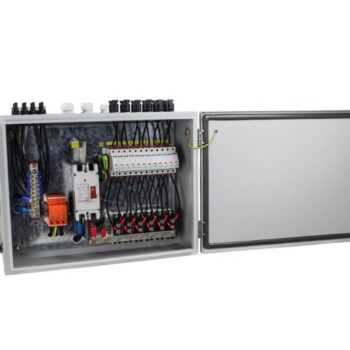
For Kenyan installations with three or more strings sharing one MPPT, our 12-way combiner variants handle the higher input count. For installations with strings going to separate MPPT inputs on dual-MPPT inverters, see the section below on architecture mismatches.
How the combined current shapes the rest of your Kenyan installation
The combined output of the 2-string combiner carries the sum of the two string currents — typically 14-16 amperes for a 6-10 kW Kenyan residential array. This combined current must be handled by everything downstream of the combiner: the output cable from the combiner to the inverter, the inverter’s DC input terminals, and the inverter’s MPPT input itself. Three sizing considerations follow for Kenyan installations:
- Output cable sizing: A 16-ampere DC circuit on a 30-metre run from the combiner to the inverter (typical for Kenyan residential rooftop installations) needs at least 6mm² copper conductor for adequate ampacity and voltage drop; longer runs may require 10mm². This is the same cable as you would use on a high-current single string, sized for the combined current rather than the per-string current.
- Inverter MPPT input current rating: Verify your inverter’s MPPT input can accept the combined current of both strings without exceeding its rated DC input current. The Vestwood 6kW Hybrid Inverter, for example, accepts up to roughly 25A per MPPT input — comfortably handling two combined 8A strings with substantial margin. Most modern 5-10 kW hybrid inverters available in Kenya have similar capacity.
- Inverter MPPT voltage range: Both strings must operate at the same MPPT voltage point — the inverter cannot independently optimise the two strings on a single MPPT input. This is acceptable when both strings have the same number of panels of the same model in similar conditions; it becomes a performance compromise when the strings face strongly different orientations or experience different shading patterns. For severe mismatch cases, a dual-MPPT inverter handling each string on its own MPPT is the better architecture.
Technical Specifications
| Specification | Value |
|---|---|
| Product Type | PV Combiner Box / Parallel String Combiner |
| Configuration | 2 strings in × 1 combined output (2/1) |
| Maximum DC Voltage per String | 500V DC |
| Rated DC Current per String | 8A continuous |
| Combined Output Current | 16A continuous (sum of both strings) |
| Per-String Fuse Rating | 10-15A cartridge (matched to panel Isc) |
| Per-String Breaker | 500V DC manual disconnection breaker |
| Surge Protection | Class II SPD on combined bus, replaceable module |
| SPD Discharge Current (Imax) | 20-40 kA (8/20µs surge waveform) |
| Enclosure Material | UV-stabilised ABS polymer, V0 flame-retardant |
| Ingress Protection Rating | IP65 (dust-tight, water-jet protected — suitable for Kenya rainy season) |
| Operating Temperature | -30°C to +60°C ambient |
| Compliance Standards | IEC 61439-2, IEC 60364, IEC 61643-31 |
| Cable Glands | 4× M12 or M16 sealed glands (2 inputs + 1 output) |
| Acceptable Cable Size | 4-6mm² stranded copper solar PV cable |
| Mounting | Wall, rail, or post mount with included brackets |
| Status Indicators | SPD status window, per-string breaker position |
| Earth Bonding Terminal | Dedicated PE terminal for SPD return path |
Engineering Features That Matter for Kenyan Installations
- Independent per-string protection: Each input string has its own fuse and disconnection breaker, allowing individual string testing, fault investigation, and panel replacement without affecting the other string — critical for Kenyan installations where rooftop access is awkward and you want to minimise time on the roof during maintenance.
- Common SPD on combined bus: A single Class II surge protection device handles surge events for both strings simultaneously, replacing the cost and complexity of two separate SPDs while providing equivalent protection against Kenya’s substantial lightning activity.
- Pre-wired internal circuit: All fuses, breakers, terminal blocks, and the SPD are factory-installed and tested, reducing field installation time and eliminating common wiring errors at site — important when installation labour costs in Kenya are significant.
- Per-string status indication: Each input channel has its own breaker position window, allowing visual verification that a specific string has been isolated during service work — important for safe panel cleaning and fault investigation on Kenyan rooftops.
- Combined-output design: Single output cable run from the combiner to the inverter, simplifying cable routing and reducing the number of DC penetrations through walls and ceilings (and reducing weatherproofing risk on tile roofs typical of Kenyan residential properties).
- IP65 weatherproof enclosure: Direct outdoor mounting in Kenyan rainy season conditions and high-UV coastal exposure without additional protective housing.
- UV-resistant ABS construction: Polymer body rated for direct sunlight exposure across Kenya’s typical solar installation life span (20-25 years) without yellowing, cracking, or material degradation.
- Compliance with IEC 61439-2: Meets the international standard for low-voltage assemblies, supporting EPRA inspection requirements and any insurance documentation for commercial installations in Nairobi, Mombasa, Kisumu, and other regulated markets.
Typical Kenyan Installation Scenarios for This Combiner
- 6 kW to 10 kW residential solar systems with east-facing and west-facing roof arrays — particularly common in Kenyan homes built with traditional symmetric roof pitches in Karen, Runda, Lavington, Muthaiga, Spring Valley, and Loresho neighbourhoods
- Split-roof installations where the main house and a garage, annex, or staff quarters each carry their own panel string, common in larger residential properties across Kiambu, Limuru, and Tigoni
- Two-row ground-mount installations at Kenyan residential properties with adequate land area — common in Athi River, Kitengela, Ngong, and rural settings
- Solar carport structures with panels on both sides of a central ridge, increasingly common at upmarket Kenyan residences
- Vestwood 6kW Hybrid Inverter installations requiring two parallel strings to fit the panel count within MPPT voltage limits
- Small commercial installations on shop, salon, clinic, or retail rooftops with two distinct panel sections — common across Nairobi CBD, Westlands, Mombasa Old Town, and Kisumu commercial districts
- Agricultural installations with one panel string on a borehole shelter and another on the farmhouse roof feeding a common inverter, common on smallholder farms in Murang’a, Kiambu, Nyandarua, and Meru counties
- School and rural clinic solar installations sized between 6 kW and 10 kW with split-roof mounting on Kenyan education and health facility buildings
- Future-proofed Kenyan residential installations starting with one string and ready to add a second on the spare input as the household’s energy needs grow
- Lake Victoria basin installations where lightning frequency makes the integrated SPD particularly valuable for protecting the inverter investment
Installation Notes for Kenyan Conditions
Installation of the 500VDC 2-string combiner must be carried out by an EPRA-registered electrician with solar experience. The combiner mounts at the array side, positioned to minimise the cable runs from both panel strings. For east-west split arrays on Kenyan residential roofs, the combiner often sits at the roof ridge or on a wall directly below the centre of the array; for split-roof installations, it may mount on whichever roof has the longer-running string. Seven practical points govern correct installation under Kenyan conditions:
First, polarity verification — each input string must have its positive and negative correctly identified before connection; the per-string fuses and SPD are polarity-sensitive and reverse connection can damage the components irreversibly. Second, string matching — both strings should ideally consist of the same number of panels of the same model to avoid current mismatch losses on the combined bus; modest mismatches are tolerated by the combiner but reduce overall system efficiency by a few percent. Third, per-string fuse rating — each fuse should be sized to roughly 1.25 times the panel string’s short-circuit current, providing margin for normal Kenyan high-irradiance operating peaks (which can exceed nameplate on bright dry-season afternoons) while still clearing on a true fault.
Fourth, cable gland integrity — each of the four cable glands must be tightened to seal around the cable; unused glands (during single-string operation pending future expansion) must be closed with the supplied blanking plugs to maintain IP65 sealing against Kenyan rainy-season conditions. Fifth, output cable sizing — the combined output current to the inverter is the sum of both string currents, requiring larger cable than either string individually; size for the combined current with appropriate voltage-drop margin given the typical 20-30 metre cable runs in Kenyan residential installations.
Sixth, earth bonding — the combiner’s PE terminal must be connected to the building’s main earth electrode with a low-impedance path; this is critical for the SPD’s surge dissipation function, particularly in lightning-prone Kenyan regions. Seventh, clear string labelling — clearly label which input is which physical string (typically “String 1: East roof” and “String 2: West roof”) to support future fault diagnostics and maintenance by electricians who weren’t part of the original installation.
For Kenyan installations using a dual-MPPT inverter where each MPPT input has its own panel string, this 2-in 1-out combiner is the wrong architecture — you want two separate 1-string combiners (one per MPPT) instead of combining the strings at the combiner. The 2-in 1-out architecture specifically targets single-MPPT hybrid inverters with parallel strings sharing the input, such as the Vestwood 6kW Hybrid range.
Designing an east-west solar array, split-roof installation, or 6-10 kW Kenyan residential system?
Get a complete system specification with the right combiner architecture, string layout, and inverter matching — start with our Solar Calculator for sizing and combiner selection, or describe your Kenyan roof layout through My Quote for a turnkey design with panels, inverter, combiner, and cable schedule.