Description
Combiner Box 1000VDC 12W Kenya — 12-Input Multi-String Solar Combiner with 4P MCB & SPD
The Combiner Box 1000VDC 12W — also called the 12-Input Multi-String Solar Combiner, the 12-Way DC Combiner, or simply the 12 Strings PV Array Combiner Box — is a cost-effective DC combiner specification for Kenyan solar installations that need to collect many short panel strings into a single combined output feeding the inverter. Where the residential 1-string and 2-string combiners suit installations with one or two long strings, this 12W variant handles installations where the panel array splits into many shorter strings — typical of solar systems using older-generation panels with lower wattage, shading-mitigation designs that deliberately keep each string short to limit mismatch losses, or installations spread across multiple roof sections each carrying its own short string.
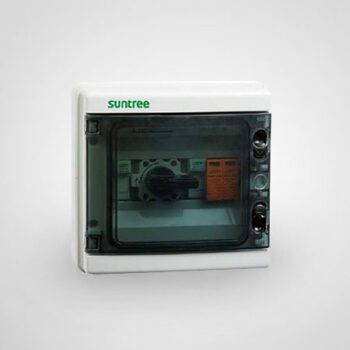
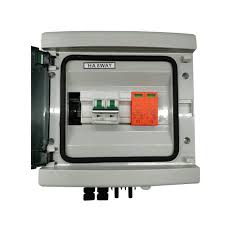
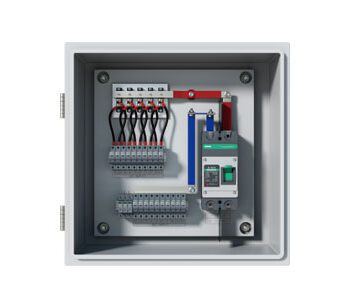
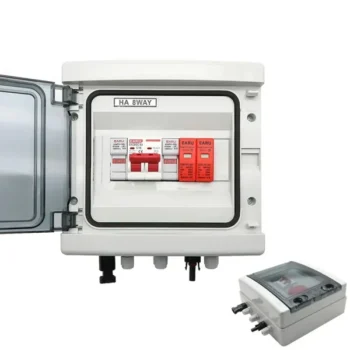
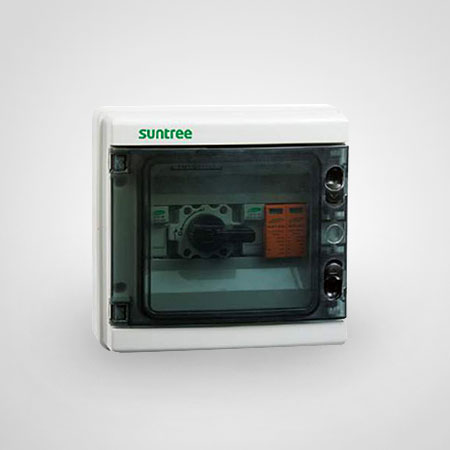
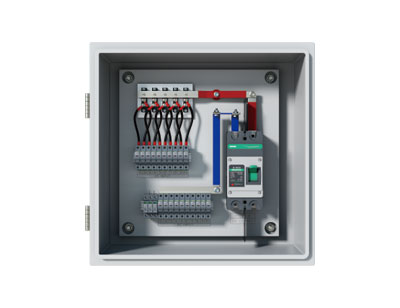
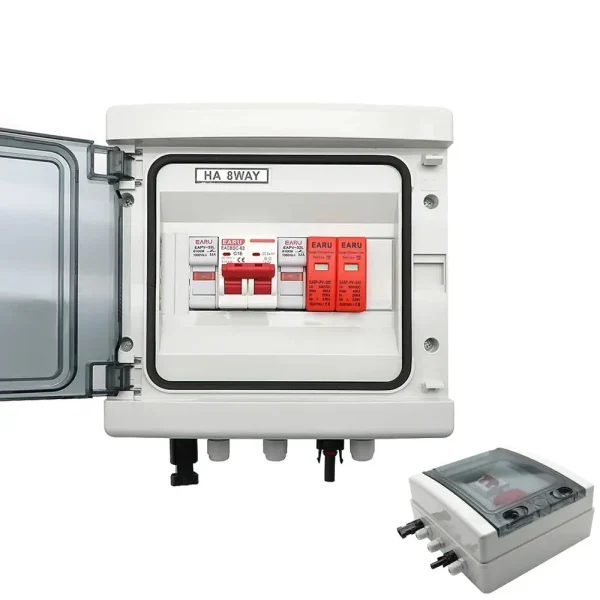
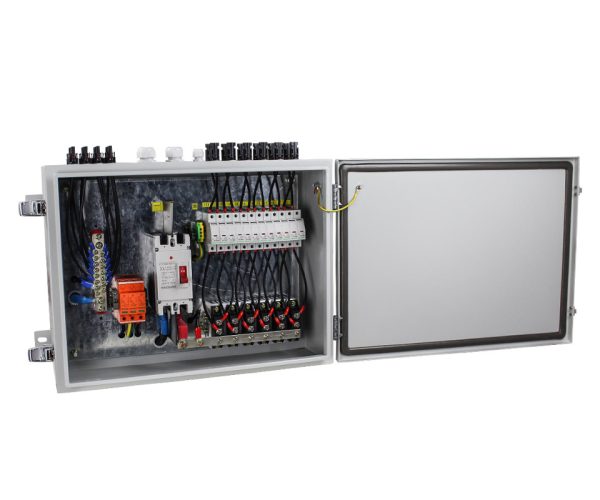
Inside the IP65 enclosure, the 12 string inputs feed onto a common bus protected by 2 pairs of cartridge fuses, with a 4-Pole DC MCB providing main output disconnection and a 3-Pole Class II SPD absorbing lightning-induced voltage transients before they reach the inverter. The protective architecture is shared across the combined bus rather than independent per-string — appropriate for installations where the strings are matched and operating under similar conditions, keeping the unit cost-effective while still delivering proper main disconnection and surge protection.
When do you actually need a 12-input combiner?
The 12-input architecture is genuinely useful for several specific Kenyan installation scenarios that smaller combiners cannot accommodate:
- Older-panel solar systems with many strings: Many existing Kenyan solar installations use 250W, 300W, or 330W panels from earlier generations. A 6-9 kW system using these panels typically arranges into 8-12 parallel strings of relatively few panels each. The 12W combiner accepts the entire array into a single combined output without forcing a panel-array redesign.
- Replacement or expansion of legacy systems: Solar systems built five to ten years ago in Kenya often have wiring topologies that don’t match modern long-string designs. When replacing the inverter or adding capacity, the 12W combiner accepts the existing string topology without rewiring the panels.
- Shading-mitigation designs: When an installation has localised shading sources — chimneys, water tanks, neighbouring buildings, mature trees — splitting the array into many shorter strings limits the mismatch losses from shading. Each shaded panel only drags down the few panels in its specific short string rather than the entire long string.
- Multi-roof Kenyan installations: Properties with several separate roof sections (main house, garage, staff quarters, store room, animal shed) where panels mount on each may have 6-12 separate strings depending on the panel count per roof. The 12W combiner consolidates them centrally.
- Solar carport and ground-mount installations: Large carport canopies and ground-mount arrays with multiple rows of panels naturally form many parallel strings — one per row. The 12W combiner provides centralised collection without requiring multiple smaller combiner boxes.
- Agricultural installations with distributed panels: Kenyan farms with solar covering multiple structures (farmhouse, barn, greenhouse, pump shelter) generate multiple short strings that benefit from centralised combining at the inverter input.
- Small commercial installations with mixed panel configurations: Retail and institutional installations sometimes mix panel ages and types as expansion proceeds; the 12W combiner accepts the heterogeneous strings into a common protected output.
The protective architecture inside the 12W combiner
- 12 string input terminals: Twelve pairs of input terminals (positive and negative per string) accept MC4-terminated cables from each panel string. Terminals are physically separated and labelled to support clean wiring and future fault diagnostics.
- Common combining bus: The 12 input currents combine onto a single positive bus and a single negative bus inside the enclosure. The bus is sized for the total combined current of all 12 strings at full operating current.
- 2 pairs of cartridge fuses on the combined bus: Overcurrent protection on the positive and negative rails of the combined output, providing main fault current clearance for the entire array. Field-replaceable cartridge format for straightforward swap after any fault event.
- 1 × 4-Pole DC MCB on the output: Main disconnection device that switches all four conductors of the combined DC output simultaneously through a common-trip mechanism. Provides reliable arc clearance at 1000V DC through its 4-pole series arrangement.
- 1 × 3-Pole Class II SPD on combined bus: Surge protection device with three poles connecting between positive rail, negative rail, and earth, absorbing lightning-induced voltage transients before they propagate to the inverter. Replaceable module with green/red status indication.
- Common output terminals: One pair of output terminals carries the combined protected current onward to the inverter through a single weatherproof outgoing cable.
- Earth bonding terminal: Dedicated PE termination for the enclosure body, SPD return path, and main earth electrode connection.
- IP65 weatherproof enclosure: Sealed body for direct outdoor mounting in Kenyan rainy season and high-UV coastal exposure conditions.
How the 12W differs from per-string combiners
An important distinction for buyers: the 12W combiner provides shared protection on the combined bus rather than independent per-string protection. The 2 pairs of fuses, the 4-Pole MCB, and the 3-Pole SPD all act on the combined output current, not on individual string currents. This makes the 12W cost-effective and architecturally clean, but it has implications for how the installation behaves under fault conditions and during maintenance:
- String matching becomes important: Because the strings share a single MPPT voltage point on the combined bus, all 12 strings must be reasonably matched in panel count, panel model, and operating conditions. Severe mismatches between strings reduce the combined output efficiency.
- Fault clearance affects the whole array: If a fault on any one string draws excessive current, the shared output fuses or MCB will trip, taking the entire 12-string array offline until the fault is investigated and cleared. There is no per-string isolation — investigating which specific string caused the trip requires testing each string sequentially.
- Maintenance requires complete shutdown: To work on any single panel or string, the entire array must be disconnected via the main 4-Pole MCB. There is no per-string maintenance capability.
- Cost advantage is substantial: By sharing the protective components across all 12 strings rather than duplicating them per string, the 12W combiner costs significantly less than a hypothetical 12-Way combiner with independent per-string breakers and fuses.
For installations that need genuine per-string isolation — typically commercial systems above 25 kW or installations where individual string monitoring matters operationally — a higher-tier industrial combiner is the appropriate choice. For residential and small commercial Kenyan installations where the strings operate under similar conditions and total array shutdown for maintenance is acceptable, the 12W is the cost-optimal choice.
Where the 12W fits in the Bicity combiner family
| Combiner Variant | Voltage | Strings | Protection Architecture | Best For |
|---|---|---|---|---|
| PV Combiner Box 500VDC 1 String | 500V | 1/1 | Per-string fuse + breaker + SPD | 3-6 kW residential with one panel string |
| PV Combiner Box 500VDC 2 String | 500V | 2/1 | Independent per-string protection | 6-10 kW residential east-west arrays |
| SHLX-PV 1/1 550VDC | 550V | 1/1 | 2-Pole MCB + dual fuses | 5-8 kW residential longer strings |
| Combiner Box 1000VDC 12W (this page) | 1000V | 12/1 | Shared output fuses + 4P MCB + 3P SPD | 6-15 kW with many short strings or multi-roof |
| SHLX-PV 1/1 1000VDC | 1000V | 1/1 | 4-Pole MCB + dual fuses + SUP2H-PV SPD | 10-25 kW large residential / light commercial |
The 12W is the right choice for installations that need many string inputs but can accept shared protection. For installations with a single high-current string, the SHLX 1000V provides per-string protection at the same voltage rating. For genuine industrial installations needing per-string isolation across many strings, a higher-tier commercial combiner is required.
Why the 4-Pole MCB matters at 1000V
The 4-Pole MCB inside the 12W combiner is rated specifically for DC service at 1000V — a different beast from generic AC-rated MCBs. The 4-pole design splits the 1000V DC bus voltage across two pairs of contacts in series, with each pair seeing half the system voltage during opening. This arrangement provides reliable arc clearance under the full bus voltage where a 2-pole or single-pole MCB would struggle with the DC arc energy.
The 4-Pole common-trip mechanism ensures all four contacts open together when the device is operated manually or trips automatically on fault current. The result is complete galvanic isolation of the combined output, allowing safe access to the inverter side of the installation without backfeed from the array.
The 3-Pole SPD on the combined bus
The 3-Pole SPD provides Class II surge protection at the 1000V level, connecting between the positive rail, the negative rail, and earth simultaneously. Each pole contains metal-oxide varistor (MOV) elements that change resistance in nanoseconds, clamping the bus voltage to safe levels during lightning-induced surge events before damage propagates to the inverter.
The SPD has finite absorption capacity and is a consumable item. The status indicator shows green during normal operation and changes to red when the MOV reaches end-of-life. For Kenyan installations in lightning-prone regions — the highlands, the Lake Victoria basin, the western counties, and coastal areas — schedule SPD replacement every 2-3 years even if the indicator still shows green; verify the indicator on every monthly inspection.
Technical Specifications
| Specification | Value |
|---|---|
| Product Type | Multi-String PV Combiner Box (12 inputs to 1 output) |
| Number of Inputs | 12 PV string inputs |
| Number of Outputs | 1 combined protected output |
| Voltage Rating | 1000V DC maximum |
| Main Disconnection | 1 × 4-Pole DC MCB |
| MCB Pole Configuration | 4-pole common-trip (series voltage division) |
| Surge Protection | 1 × 3-Pole Class II SPD |
| SPD Pole Configuration | 3-pole (positive, negative, earth) |
| SPD Voltage Rating | 1000V DC photovoltaic |
| SPD Status Indication | Green / red window |
| Fuse Protection | 2 pairs of cartridge fuses on combined output bus |
| Enclosure | IP65 weatherproof body for outdoor mounting |
| Cable Glands | 12 string input glands + 1 combined output gland |
| Acceptable Cable Size | 4mm² to 6mm² stranded copper solar PV cable |
| Mounting Method | Wall-mount or rail-mount with bracket fixings |
| Operating Temperature | -30°C to +60°C ambient |
| Compliance Standards | IEC 61439-2, IEC 60364, IEC 61643-31 |
| Earth Bonding | Dedicated PE terminal for enclosure body and SPD return path |
Engineering Features
- 12 string inputs: Accommodates installations with many short strings — typical of older-panel systems, shading-mitigation designs, or arrays distributed across multiple roof sections — without requiring multiple smaller combiner boxes.
- 4-Pole DC MCB main disconnection: Reliable arc clearance at 1000V DC through series-arranged contact pairs, providing complete galvanic isolation of the combined output for safe inverter-side service work.
- 3-Pole Class II SPD: Lightning surge protection for the entire 12-string array through a single SPD on the combined bus, with status indication for predictive maintenance.
- Dual-pair output fuses: Overcurrent protection on both rails of the combined output, catching common short-circuit faults and providing belt-and-braces protection alongside the main MCB.
- Cost-effective shared protection: By sharing protective components across all 12 strings rather than duplicating them per string, the 12W delivers proper main disconnection and surge protection at a fraction of the cost of independent-per-string industrial combiners.
- IP65 weatherproof enclosure: Direct outdoor mounting in Kenyan rainy season and high-UV conditions without additional housing.
- 13 sealed cable glands: Twelve for string inputs plus one for the combined output, with blanking plugs for any glands not used during partial deployment.
- Pre-wired internal circuit: Fuses, MCB, SPD, and all terminal blocks factory-installed and tested before shipment, reducing site installation time and eliminating common field wiring errors at the higher input count.
- Standardised 1000V DC components: All internal protective devices rated for the full 1000V DC envelope with appropriate insulation margin.
Typical Kenyan Installation Scenarios
- 6-9 kW residential systems using older 250-330W panels arranged in 8-12 parallel strings — common in legacy Kenyan installations being upgraded with new inverters
- 10-15 kW residential systems using modern panels but with the array deliberately split into many short strings for shading mitigation around chimneys, water tanks, and mature trees
- Multi-roof Kenyan properties with panels distributed across main house, garage, staff quarters, and outbuildings, each carrying a short string consolidated into the 12W combiner
- Solar carport installations with multiple panel rows across the canopy structure, each row forming a separate string
- Ground-mount installations on Kenyan farms with multiple panel rows, each row forming its own string
- Replacement or expansion of legacy 5-10 year old solar systems where the existing panel string topology has many short strings that should not be rewired
- Agricultural installations with panels distributed across multiple farm structures — farmhouse, barn, greenhouse, pump shelter, animal sheds
- Small commercial installations on shops, salons, and clinics in the 8-15 kW range with multiple short strings rather than one long high-voltage string
- Future-expansion residential installations starting with 6-8 strings and growing into the unused inputs over time
- Institutional and educational facility solar installations with mixed roof sections each carrying a separate panel string
Installation Notes for Kenyan Conditions
Installation of the 12W combiner must be carried out by an EPRA-certified solar electrician with experience handling multi-string DC arrays. The combiner mounts at the array side, positioned to minimise the cable runs from the various string locations. Six practical points govern correct installation. First, polarity verification — each of the 12 input strings must have its positive and negative correctly identified before connection; reverse polarity at any input can damage the MCB, SPD, or fuses irreversibly. Second, string labelling — every input must be physically labelled with its string identifier (typically “String 1” through “String 12”) matched to the array position, and the same labelling recorded in the installation documentation for future fault diagnostics.
Third, string matching — because the 12W provides shared protection rather than per-string isolation, the 12 strings must be reasonably matched in panel count, panel model, and orientation; severe mismatches between strings reduce combined output efficiency. Fourth, cable gland integrity — each of the 13 cable glands must be tightened to seal around the cable; unused glands (during partial deployment) must be closed with blanking plugs to maintain IP65 sealing against Kenyan rainy season conditions.
Fifth, output cable sizing — the combined output current depends on the total array size; calculate cable size for the combined ampacity with appropriate voltage drop margin given the typical 20-40 metre cable runs from rooftop combiner to ground-floor inverter. Sixth, earth bonding — tie the combiner’s PE terminal to your installation’s primary earth electrode through a properly sized earthing conductor with minimum impedance, since the SPD’s surge dissipation depends entirely on that return path; this matters especially for installations in Kenya’s lightning belt.
For installations requiring per-string isolation (independent fuses and breakers on each string for individual maintenance access), the 12W is not the right choice — a higher-tier industrial combiner with per-string protection is needed. For installations where the strings operate under similar conditions and total-array shutdown for maintenance is acceptable, the 12W provides the cost-optimal solution.
Planning a multi-string residential or small commercial solar installation in Kenya?
Match the combiner to your specific panel string layout and total array size — start with our Solar Calculator for sizing the array and selecting the right combiner architecture, or describe your panel layout through My Quote for a complete system specification with combiner, cable schedule, and protection coordination.