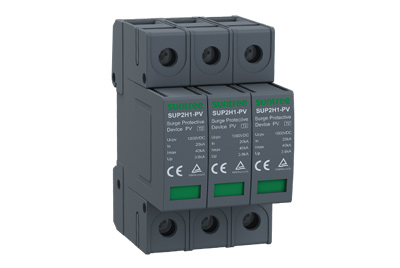
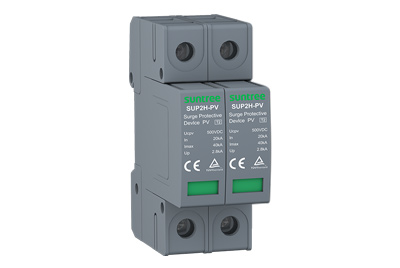
Description
Solar 2P DC Surge Protector Kenya — Suntree SUP1-PV40 2P 600VDC 40kA Type 2 DC SPD for Residential Solar
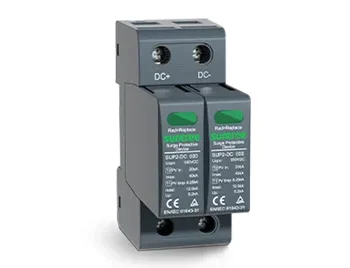
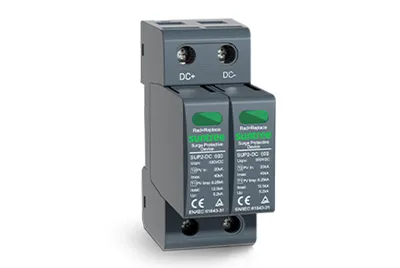
The Solar 2P DC Surge Protector from Suntree — known across the Kenyan residential solar market under several names including Suntree SUP1-PV40 2P 600VDC DC SPD, the 2 Pole DC Surge Protector, the Residential DC Lightning Arrester, the Dual-Pole Solar Surge Protective Device, and the 2P 40kA Residential SPD — is the everyday workhorse of Kenyan home solar lightning protection. It sits inside the residential combiner box or distribution enclosure, quietly waiting for the storm that may not arrive for years, ready to absorb the voltage spike that would otherwise destroy the hybrid inverter, the battery management system, or the home’s solar generation altogether.
This 2-pole variant within the SUP1-PV40 family serves residential solar at the 550V DC architecture that dominates the Kenyan home market. While the 4P 1000V variant in the same family handles commercial systems, the 2-pole 600V variant matches the simpler bipolar topology of residential systems where 6-8 modern panels in series produce string voltages of 300-450V continuous, with cold-morning peaks reaching 500-550V. The 600V rating provides comfortable margin above this residential operating envelope without the cost overhead of the higher-voltage commercial variants.
Most Kenyan homeowners discover the need for a 2P DC SPD the hard way — after a lightning storm damages the inverter, the system goes offline for weeks awaiting replacement, and the warranty claim reveals that surge damage isn’t covered because no SPD was installed. The cost of the SPD plus its EPRA-registered installation runs a small fraction of the inverter replacement cost it prevents, and a smaller fraction still of the lost generation revenue during inverter replacement procurement. The arithmetic is straightforward: install the 2P SPD up front, or pay for inverter damage later.
What makes the 2P 600V variant right for residential solar
The Kenyan residential solar market has standardised around 550V DC architecture for cost and component reasons. Modern hybrid inverters at the residential capacity range (Vestwood 5kW and 6kW Hybrid models, plus equivalent residential offerings from other manufacturers) specify DC input architectures that accommodate 6-8 panel strings producing the 550V envelope. The 2P 600V DC SPD matches this residential architecture for five specific reasons:
- Voltage rating matched to residential operating envelope: The 600V continuous rating sits comfortably above the 550V residential operating voltage with appropriate margin for cold-morning string voltage peaks. Lower-rated SPDs (500V or below) would clamp prematurely on cold mornings when string voltage spikes above the rated value; higher-rated SPDs (1000V) are over-specified for residential use and cost more without adding protection benefit.
- Pole count matched to residential bipolar topology: Residential solar uses a simple two-conductor DC bus — positive line and negative line. The 2P SPD provides one MOV module protecting each conductor to earth, covering both surge propagation modes that affect residential systems. The 4P commercial variant covers four conductors that residential systems don’t have.
- DIN rail footprint that fits residential consumer units: The 36mm width (2 modules) integrates cleanly with the residential consumer units and small combiner boxes typical of Kenyan home installations. The 4P commercial variant’s 72mm footprint may not fit residential enclosures without crowding.
- Cost positioning aligned to residential equipment values: The 2P variant costs roughly half what the 4P commercial variant costs, matching the protective spend to the protected equipment value. The residential inverter and battery being protected are themselves smaller and less expensive than commercial equivalents.
- Terminal capacity suited to residential cable sizes: Residential solar cable runs use 4mm² or 6mm² conductors typical of 6-8 panel string installations. The 2P SPD’s terminal capacity is sized appropriately for these conductor sizes without over-engineering for commercial cable cross-sections that residential installations never use.
When the 2P 600V SPD is not the right choice
Right-sizing applies even to SPDs because mismatching voltage class or pole count either compromises protection or wastes capital. Four scenarios where this 2P 600V variant is the wrong answer from the SUP1-PV40 family:
- Commercial solar on 1000V architecture: Commercial systems using 12-15 panel strings produce 600-800V continuous with cold-morning peaks approaching 1000V. The 2P 600V variant cannot safely operate at these voltages — the varistors would clamp continuously during cold-morning operation, leading to rapid degradation and premature failure. Commercial installations require the 4P 1000V variant from the same family.
- Larger residential systems migrating to 1000V architecture: Some larger residential installations (10-15 kW capacity with elevated rooftop arrays and long cable runs to ground-floor inverters) migrate to 1000V architecture for cable cost reduction. These installations need the 4P 1000V variant rather than the 2P 600V, despite being residential by capacity definition.
- Very small auxiliary DC circuits: 12V, 24V, or 48V battery systems with single earthed conductors, charge controller outputs feeding earthed-neutral DC loads, and similar small auxiliary applications use the 1P 600V variant rather than the 2P. Single-conductor protection suffices for these simpler topologies.
- Grounded mid-point bipolar systems: Specific solar inverter architectures with grounded mid-point bipolar DC systems require the 3P 1000V variant. These architectures are rare in residential Kenyan installations but appear occasionally in specific commercial deployments.
The SUP1-PV40 family — where the 2P sibling fits
The Suntree SUP1-PV40 SPD family covers four pole/voltage variants matching different solar architecture tiers. The 2P 600V variant serves the largest tier (residential) within this family lineup:
| SPD Variant | Voltage Class | Pole Count | Application Tier |
|---|---|---|---|
| Solar 1P DC Surge Protector | 600V DC | 1-pole | Auxiliary DC circuits, smaller off-grid systems with earthed-neutral architecture |
| Solar 2P DC Surge Protector — this product | 600V DC | 2-pole | Residential solar 550V architecture (the largest Kenyan solar market segment) |
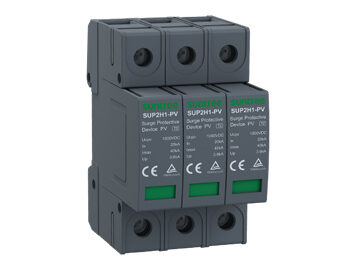
| Solar 3P DC Surge Protector | 1000V DC | 3-pole | Commercial grounded mid-point bipolar systems |
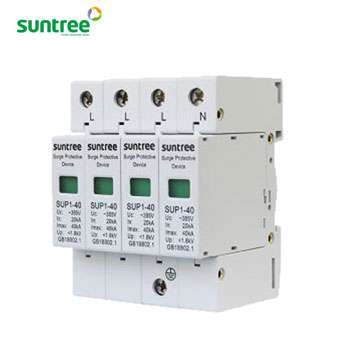
| Solar 4P DC Surge Protector | 1000V DC | 4-pole | Commercial solar 1000V architecture (8-30 kW capacity) |
The 2P 600V variant covers the dominant segment of Kenyan solar — residential systems where homeowners invest in 3-12 kW of generating capacity to offset domestic electricity bills, provide backup during national grid outages, and reduce dependence on rising grid electricity costs. Most Kenyan residential solar installations use this variant; the other three siblings serve smaller niche markets within the broader SPD family.
How residential solar surges actually happen in Kenya
Residential Kenyan solar faces several surge sources that vary by neighbourhood, season, and installation specifics. Understanding the surge environment helps explain why a relatively inexpensive SPD makes such a difference to long-term system reliability:
- Nearby lightning strikes inducing voltage on residential cables: A lightning strike within one or two kilometres of a Kenyan home induces measurable voltage on the residential solar DC cables. The cables — even residential lengths of 15-25 metres — act as antennas picking up the lightning electromagnetic field. The induced voltage travels along the cable and reaches the residential inverter unless an SPD intercepts it. Indirect lightning is by far the most common surge source for residential installations.
- Storms over the residential neighbourhood: Heavy rain and thunderstorm activity that passes over a residential area generates lightning activity affecting all homes in the area. A single storm event can produce multiple surge events affecting unprotected solar installations across an entire neighbourhood. SPD-protected installations survive these events; unprotected installations may experience progressive damage that accumulates over years.
- National grid restoration transients after residential outages: When the national grid restores power to a residential area after an outage, switching transients propagate through the grid and into connected hybrid solar systems. The DC side of the residential hybrid inverter can see these transients through internal electromagnetic coupling. Hybrid systems face this risk; off-grid systems do not.
- Large neighbourhood loads switching: Industrial premises, water pumping stations, or larger commercial loads near a residential area can induce transients on the local electrical infrastructure when they start or stop. These transients can affect residential solar installations through the shared electromagnetic environment of the building.
- Dry-season electrostatic events: Dry-season conditions in arid Kenyan regions can build up electrostatic charge on residential solar arrays. Discharge events through the residential DC system create transient voltages that — while smaller than lightning surges — still exceed component damage thresholds without SPD protection.
Kenyan residential neighbourhoods where the 2P 600V SPD matters most
Residential lightning exposure varies dramatically across Kenya by geographic region. Some areas need SPDs more than others; in lightning-active regions the SPD is not optional even for residential systems:
- Western Kenya residential neighbourhoods: Kisumu suburbs (Milimani, Kondele, Mamboleo, Nyalenda), Kakamega town residential areas, Bungoma residential zones, Siaya and Migori residential areas — these neighbourhoods sit within the most lightning-active region in Kenya. Residential solar in these areas faces frequent surge events; SPD protection is essential rather than optional.
- Central highlands residential areas: Murang’a town residential zones, Nyeri estates, Embu residential areas, Meru town suburbs, Karatina residential zones, Nyandarua small-town residential — afternoon thunderstorm activity in these elevated areas creates regular surge exposure for residential solar.
- Rift Valley residential neighbourhoods: Nakuru residential estates (Section 58, Milimani, Lanet), Naivasha town residential, Eldoret suburbs (Pioneer, Elgon View, Annex), Kericho and Bomet residential areas, Narok town residential — convective thunderstorm activity affects these residential zones regularly.
- Coastal residential areas: Mombasa Nyali Beach residential properties, Bamburi and Shanzu beach homes, Diani and Watamu beach properties, Malindi residential areas, Kilifi seafront homes — marine electrical activity and salt-air conductivity affect coastal residential installations.
- Nairobi metropolitan residential areas: Karen, Runda, Muthaiga, Lavington, Kilimani, Westlands, Spring Valley, Lower Kabete, Kileleshwa, Loresho, Ridgeways, Tigoni, Limuru, Kiambu town, Ruiru, Thika town — combination of moderate thunderstorm activity plus national grid switching transients creates surge exposure throughout the metro region.
Components the 2P 600V SPD protects in residential systems
- Residential hybrid inverters: The most expensive component in most home solar systems. The Vestwood 5kW Hybrid, the Vestwood 6kW Hybrid, and equivalent residential hybrid inverters from other manufacturers all contain MPPT input circuitry sensitive to DC-side surge damage. Inverter replacement costs significant fractions of the original solar investment, with multi-week procurement delays that leave the home without solar generation.
- Residential MPPT charge controllers: Off-grid residential systems and some hybrid systems with separate charge controllers contain similar surge-vulnerable electronics to inverter inputs. Charge controller damage may take the entire battery system offline until replacement.
- Residential battery management systems: Lithium battery banks at 5-15 kWh capacity (the typical residential battery storage range) contain BMS electronics managing cell balancing and protection. BMS failure may render the residential battery bank unusable until specialist replacement — a substantially more expensive failure than simple inverter damage.
- Residential solar panels and bypass diodes: Panel-level surge damage manifests as bypass diode failure within individual modules. The damage reduces panel output progressively; replacing failed panels in residential arrays involves matching production years and electrical characteristics that may no longer be available years after the original installation.
- Home monitoring electronics: Residential solar monitoring (Wi-Fi modules, smartphone app gateways, energy management interfaces) fail under surge events even when main power electronics survive, leaving the homeowner without visibility into system performance.
Technical Specifications
| Specification | Value |
|---|---|
| Bicity SKU | BC-SPD-600V-40KA-2P |
| Manufacturer | Suntree (XinChi Electric Group) — SUP1-PV series, residential 2P variant |
| Device category | DC Surge Protective Device (SPD) — 2-pole residential variant |
| SPD Type | Type 2 (T2) per IEC 61643-31 |
| Maximum continuous operating voltage (Uc) | 600V DC sustained |
| Absolute maximum voltage (Umax) | 750V DC peak |
| Pole configuration | 2-pole — covers positive and negative residential conductors to earth |
| Protection mode | L+/PE, L-/PE (Y-configuration for residential bipolar DC systems) |
| Nominal discharge current (In) | 20 kA per pole at 8/20µs impulse |
| Maximum discharge current (Imax) | 40 kA per pole at 8/20µs impulse |
| Voltage protection level (Up) | Less than 2.5 kV residual voltage after clamping |
| Response time | Less than 25 nanoseconds |
| Status indication | Two visible green windows — Green visible = module functional; Green absent = module replacement required |
| Module design | Two pluggable replaceable modules on common base |
| Internal protection | Encapsulated zinc oxide varistor (MOV) cores with thermal disconnect per module |
| Operating temperature | -40°C to +85°C ambient |
| Storage temperature | -40°C to +85°C de-energised |
| Mounting | 35mm DIN rail snap-fit |
| DIN rail width | 2 modules (36mm footprint — fits cleanly in residential consumer units) |
| Terminal capacity | Solar PV stranded copper conductor 2.5mm² through 10mm² |
| Earth terminal | Dedicated earth terminal for protective bonding conductor up to 10mm² |
| Compliance standards | IEC 61643-31, CE mark, TUV certification |
| Service life (no surge events) | Indefinite — MOV degradation only occurs during actual surge clamping |
| Service life (after surge events) | Up to 40 kA cumulative discharge per pole before module replacement |
| Net weight | Approximately 0.18 kg |
Engineering Features Specific to the Residential 2P 600V Variant
- Two-pole residential protection topology: Direct coverage of positive line to earth and negative line to earth — the two surge propagation modes that affect residential bipolar DC systems. Both pluggable modules work simultaneously to provide complete coverage of residential surge events.
- 600V envelope sized for 550V residential operation: Operating voltage rating that comfortably handles residential 6-8 panel string installations producing 300-450V continuous with cold-morning peaks up to 550V. The 750V absolute maximum allows margin for unusual conditions like single-day high-pressure cold fronts.
- 40 kA Imax per module for residential surge environments: Substantial discharge capacity matched to residential surge events. Lower-rated SPDs (10-20 kA Imax) common in cheap residential SPDs may survive only smaller surge events while leaving the residential system unprotected against larger lightning-induced surges.
- Less than 25 nanosecond response time: Fast enough to intercept residential surge events before they reach the hybrid inverter MPPT inputs. The varistors switch from high to low resistance faster than the rise time of typical lightning-induced surges.
- Sub-2.5kV voltage protection level for residential equipment tolerance: The residual voltage after clamping stays well within the transient tolerance envelope of residential hybrid inverters and residential battery management systems. Residential equipment typically tolerates transients up to 2.5-4 kV; the SPD limits incoming surges to under 2.5 kV.
- Two pluggable modules for simple residential maintenance: Either module can be replaced individually without rewiring the SPD base. Replacement is straightforward enough for any EPRA-registered residential installer to perform during a routine service visit, no specialist commercial-tier equipment required.
- Two independent green status windows for visual inspection: Homeowners or service technicians can verify protection status with a glance — both windows green means full residential protection active; any window without green means immediate professional replacement of that specific module.
- Internal thermal disconnect per module: Each of the two encapsulated MOV cores includes thermal disconnect — preventing the fire risk that could otherwise develop if a degraded MOV becomes a continuous current path. Residential installations particularly benefit from this safety feature.
- Pairs cleanly with Vestwood 5kW and 6kW Hybrid Inverters: Voltage envelope, pole count, and surge protection capability all match the residential hybrid inverter range that dominates Kenyan home solar. The 2P 600V SPD installs at the inverter DC input position protecting these residential inverters from lightning-induced surge damage.
- 36mm DIN rail footprint for residential consumer units: Compact 2-module width that fits cleanly in residential consumer units, small distribution boards, and the smaller combiner boxes typical of residential solar installations without requiring oversized enclosures.
- IEC 61643-31 residential PV certification: The PV-specific SPD standard that EPRA residential inspectors look for in solar inspection documentation. The certification matters for warranty claims, insurance documentation, and EPRA compliance verification.
Typical Kenyan Residential Installation Scenarios for the 2P 600V Variant
- Single-family home solar across Kiambu, Limuru, Tigoni, Ruiru, Thika, and Athi River suburbs — typical 3-6 kW residential systems on 550V architecture with Vestwood 5kW Hybrid pairing
- Premium home solar in upmarket Nairobi residential areas — Karen, Runda, Muthaiga, Spring Valley, Lavington, Kilimani, Westlands, Lower Kabete, Kileleshwa, Loresho, Ridgeways — where 6-12 kW systems with battery storage justify the SPD protection investment
- Coastal residential homes in Mombasa Nyali, Bamburi, Shanzu, Diani, Watamu, Malindi, Kilifi — where salt-air conditions and marine electrical activity create particular surge exposure for residential systems
- Highland residential solar in Murang’a, Nyeri, Embu, Meru, Nanyuki, Karatina, Nyandarua, Mount Kenya area homes where afternoon thunderstorm activity drives surge events
- Lake Victoria basin residential solar in Kisumu, Siaya, Migori, Busia, Bungoma, Kakamega county homes where lightning frequency exceeds the global average
- Rift Valley residential properties in Nakuru, Naivasha, Eldoret, Kericho, Bomet residential estates where convective thunderstorm activity affects home solar systems
- Smaller B&B and guest house solar at smaller hospitality properties — small beach cottages, guesthouses in upcountry tourism areas, small lodges — using residential-scale 3-8 kW solar systems
- Smaller religious institution solar at neighbourhood churches, smaller mosques, community prayer rooms — facilities using residential-scale 3-8 kW solar capacity
- Smaller clinic and dental practice solar at neighbourhood medical facilities — community clinics, dental practices, optician shops, smaller medical labs — using residential-scale solar capacity
- Weekend and holiday home solar at Naivasha lake properties, Mount Kenya area cabins, Aberdares foothill homes, coastal holiday properties, Lake Baringo retreats — where unattended properties benefit from surge protection that prevents undiscovered fault propagation
- Small home office and home business solar where the workspace needs reliable daytime power separate from the rest of the household electrical system
- Smaller agricultural homestead solar at smaller farms, dairy smallholdings, horticultural homes, smaller poultry operations — where residential-scale solar supports both domestic and productive operations
- Off-grid residential properties where solar plus battery is the primary electricity source and surge damage would mean extended periods without any electricity
Pairing the 2P 600V SPD with Bicity Solar ecosystem components
The residential 2P 600V SPD integrates with several Bicity Solar residential products to build the complete home protection scheme. Four common integration patterns appear across Kenyan home installations:
- Standard residential 3-5 kW: Single 2P SPD at the inverter input: A residential string of 6-8 panels feeds through the SISO-40 DC isolator at the roof, then via solar PV cable to the residential combiner box (or directly to the inverter), then through a 2P 550VDC DC MCB at the inverter input alongside this 2P 600V SPD. The SPD intercepts surges before they reach the Vestwood 5kW Hybrid Inverter input terminals.
- Larger residential 5-8 kW: Two 2P SPDs in the double-guard scheme: Larger residential installations benefit from the double-guard architecture — one 2P SPD inside the residential SHLX 550V combiner box at the array side, one 2P SPD at the inverter DC input. The two-position protection covers both the array-end surge induction and any residual surge propagation to the inverter, matching the protection level commercial installations use.
- Residential hybrid with battery storage: SPD on PV side plus consideration for battery DC bus: Hybrid residential installations with 5-15 kWh lithium battery storage use the 2P SPD on the PV side as standard. Some installations add additional SPD protection on the battery DC bus between the lithium bank and the inverter battery input, particularly important in installations with longer battery cable runs from outdoor battery enclosures to indoor inverter rooms.
- Off-grid residential 4-10 kW: SPD before charge controller: Off-grid installations use the 2P SPD between the panel array (or rooftop combiner) and the MPPT charge controller input. The SPD protects the charge controller from lightning-induced surges that would otherwise propagate through to the battery and house loads.
Installation Notes for Residential 2P SPD Deployment
The 2P 600V SPD’s effectiveness in residential installations depends on installation quality as much as on the device specification. Installation must be performed by an EPRA-registered solar electrician — residential SPD work is not appropriate for DIY installation regardless of the homeowner’s general electrical knowledge. Seven practical considerations apply to residential 2P SPD installations:
First, residential earth resistance verification. The SPD requires effective earthing to actually divert surge energy. Residential installations target less than 10 ohms earth resistance between the SPD earth terminal and the building earth electrode. Have the earth resistance measured by an EPRA-registered installer using calibrated test equipment; residential homes with rocky soil, dry sandy soil, or shallow soil over bedrock may need additional earth electrodes or soil enhancement to achieve the target.
Second, connection lead length minimisation. The wires connecting the SPD to the protected conductors and the earth electrode should run as short as the installation geometry allows — keeping each lead within roughly 0.5 metres where possible, certainly avoiding runs over 1.0 metre. Long leads add inductance that delays the SPD’s clamping action; the surge reaches the residential inverter before the SPD has fully responded. Plan the SPD mounting position within the residential consumer unit or combiner box to minimise lead lengths.
Third, double-guard installation where the residential system justifies it. Standard residential installations install one SPD at the inverter input position. Larger residential installations (8-12 kW) or installations in lightning-active Kenyan regions benefit from the double-guard pattern with a second SPD at the array side. Two SPDs cost roughly twice as much; protection improves substantially.
Fourth, connection sequence verification at the residential terminals. Wire the positive DC rail to the SPD’s positive terminal, run the negative rail to the matching negative terminal, and bring the protective earth conductor into the dedicated earth terminal at the bottom of the device. Mistaken cross-connection prevents the SPD from functioning. Residential installations may have less visible labelling than commercial systems, so verify connections by tracing the cable to its source rather than assuming based on terminal position.
Fifth, residential earth conductor sizing. The earth conductor from the SPD to the home’s main earth bar should be 10mm² for residential installations — substantial enough to handle surge current diversion while remaining practical for residential conduit and routing. The earth connection must terminate at the home’s main earth bar (typically inside the meter box or main consumer unit), not at a secondary local earth point that may not be properly bonded to the main electrical earth system.
Sixth, residential consumer unit mounting considerations. Mount the SPD in the residential consumer unit or dedicated solar distribution enclosure with adequate clearance from adjacent DIN rail devices. The 36mm width works in residential consumer units; verify clearance for heat dissipation around the SPD modules during surge events.
Seventh, homeowner education on the green status windows. Brief the homeowner on the visual inspection routine — both green windows visible means residential protection active; any window without green means call an EPRA-registered installer for module replacement. Most residential homeowners can perform this visual check themselves quarterly, with formal annual inspection alongside the broader residential solar service.
Planning a 3-12 kW residential solar installation in Kenya, or retrofitting surge protection to an existing residential system?
Specify the Solar 2P DC Surge Protector (Suntree SUP1-PV40 2P 600VDC 40kA Type 2 SPD) for residential 550V architecture protection. Combine with the SISO-40 DC isolator at the roof, 2P 550VDC DC MCBs at the residential combiner and inverter input, and Vestwood hybrid inverter pairing for the complete residential protection scheme — open the Solar Calculator to scope your residential surge protection requirements, or send your project details through My Quote for a complete residential bill of materials including earth resistance verification guidance.