Description
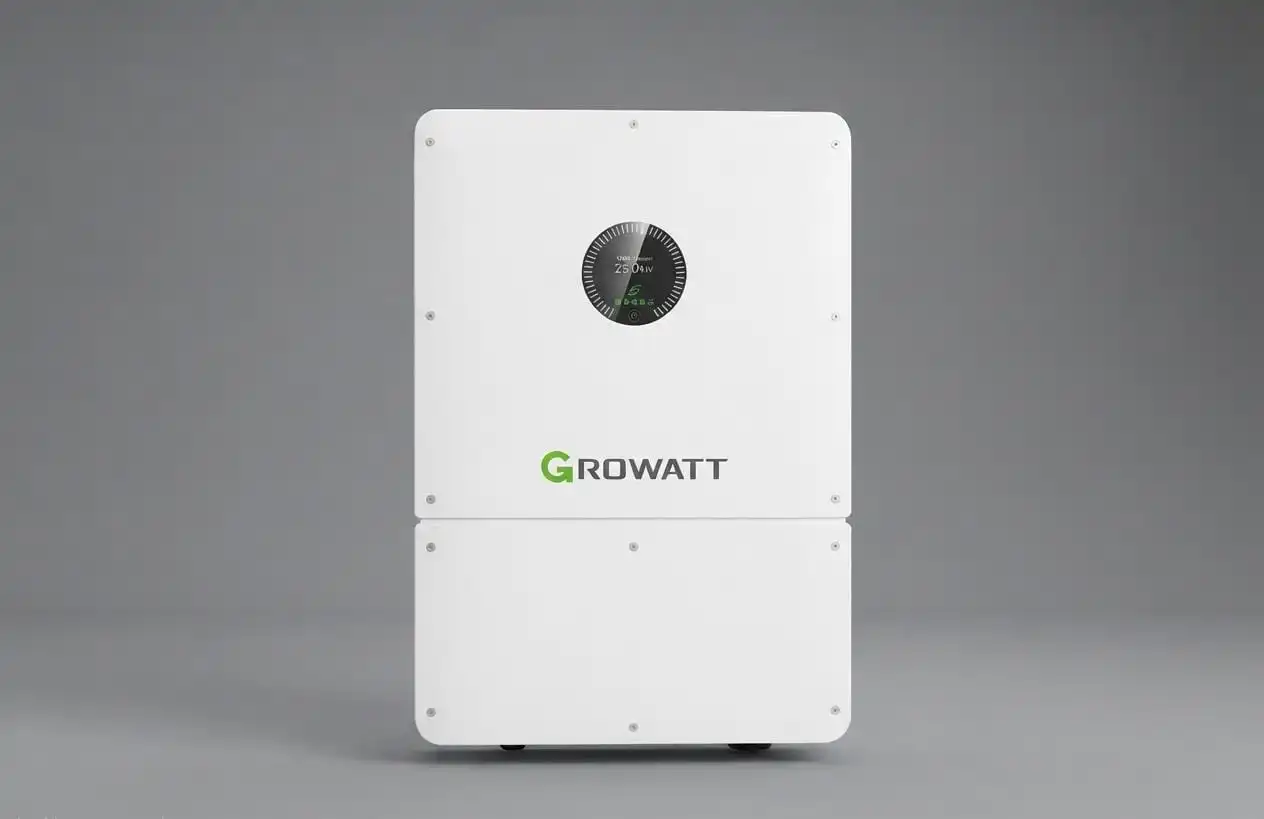
Growatt WIT 25K-HU: Four Trackers, Twice the Panels, and One Number Worth Checking
Two figures define the Growatt WIT 25K-HU, and they pull in opposite directions.
The first is generous: 50kW of solar input against 25kW of output, a two to one ratio, spread across four independent MPPT trackers. That is deliberate and aggressive oversizing, and it is the most capable DC side of anything in this brand’s low voltage range.
The second deserves scrutiny: the battery is limited to 420A. On a 48V nominal bank at 51.2V, 420A delivers about 21.5kW, not 25kW. The inverter will produce its full rating with solar contributing, but from the battery alone it tops out below the number on the label. Nobody selling this will tell you that, and it changes how the system should be designed.
This review covers both properly, along with where four trackers earn their place, the low voltage battery decision at this scale, and who should be looking at something else.
The 420A ceiling, and what it means in practice
Work the arithmetic from the inverter’s rating downward.
| To deliver | At battery voltage | Current required | Against the 420A limit |
|---|---|---|---|
| 25kW | 51.2V | Around 488A | Exceeds it |
| 25kW | 48V | Around 521A | Exceeds it |
| 25kW | 44V | Around 568A | Exceeds it |
| 21.5kW | 51.2V | 420A | Exactly at the limit |
So the honest description is this: 25kW is available when solar is producing and the battery is topping up the difference. Overnight, or during a daytime outage with heavy cloud, the ceiling is nearer 21.5kW and falls as the bank discharges and its voltage sags.
For most installations that is perfectly acceptable, because 21.5kW of battery backed output is still a great deal of power and few premises draw their full rating at three in the morning. But it matters if the reason for choosing a 25kW inverter was a specific load that must run on battery alone. In that case, size the inverter against what the battery can actually deliver rather than against the nameplate.
It also shapes the battery bank itself. Supplying 420A continuously needs serious hardware: five 100Ah class batteries in parallel, or three of the larger 314Ah units. The resulting bank lands somewhere between 25kWh and 48kWh, which is capacity you acquire because you needed the current, not because you wanted the storage.
Low voltage battery at 25kW, which is the real decision
Most three phase inverters at this size in the Kenyan market use high voltage battery stacks rather than 48V banks. The WIT 25K-HU takes the other path, and the trade is worth understanding because it affects what you can buy and what it costs.
What low voltage gives you. The 51.2V lithium batteries that dominate the Kenyan market are available from many suppliers, in many sizes, at competitive prices, and they can be added to over time. You are not locked into one manufacturer’s proprietary high voltage stack. If a battery fails in year four, replacing it is a normal purchase rather than a specialist order.
What low voltage costs you. Current. Everything above about current applies: 420A needs heavy conductors, short runs, careful termination and a bank built from several units in parallel. High voltage systems move the same power at a fraction of the current, which makes the cabling trivial by comparison.
For a Kenyan commercial site the low voltage route is often the better practical answer despite the cabling, precisely because battery availability and replaceability matter more here than cable cost. But it must be installed properly. A 420A DC circuit is not somewhere to economise.
Four MPPT trackers, and when they actually matter
Four independent trackers is unusual at this size and it solves a specific problem.
Each tracker finds the best operating point for the panels connected to it. With one tracker, panels on an east face and panels on a west face are averaged into a single compromise, and both underperform. With four, each roof face operates at its own optimum.
Commercial roofs in Kenya are rarely one clean rectangle. Factories have sawtooth roofs. Institutions grow by adding blocks at different angles. Farms mount on sheds, stores and workshops facing wherever they face. Four trackers turn that from a compromise into a non issue.
Four trackers also help with partial shading. A water tank, a chimney or a neighbouring building shading one section drags down only that tracker rather than the whole array.
If your array is a single unshaded plane, four trackers deliver nothing extra and the money is better spent elsewhere. The feature earns its place on complicated sites, which at this size is most of them.
Fifty kilowatts of panels on a twenty five kilowatt inverter
A two to one DC to AC ratio is aggressive. Conventional practice sits nearer 1.2 to 1.4. Growatt permits double, and the reasoning is sound in Kenyan conditions.
An inverter only reaches its rated output when the array is producing near its peak, which happens for a few hours around midday on a clear day. Oversize the array and the inverter reaches full output earlier in the morning, holds it later into the afternoon, and still produces usefully under cloud. The excess at midday is simply limited, which costs nothing.
Across a year, heavy oversizing substantially increases total harvest for the same inverter. Panels are the cheapest component per watt, so buying more of them to make better use of an expensive inverter is good economics.
| Configuration | Open circuit per string | Likely on a cold dawn | Array total | Verdict |
|---|---|---|---|---|
| 4 trackers, 1 string of 14 panels | Around 700V | Around 770V | 34.7kW | Comfortable |
| 4 trackers, 1 string of 16 panels | Around 800V | Around 880V | 39.7kW | Good balance |
| 4 trackers, 1 string of 18 panels | Around 900V | Around 990V | 44.6kW | At the voltage ceiling |
| 4 trackers, 2 strings of 16 panels | Around 800V | Around 880V | 79.4kW | Far exceeds the 50kW input limit |
Figures assume 620W panels at roughly 42V operating and 50V open circuit. Check the actual open circuit voltage and temperature coefficient on your own panels, because the 1000V ceiling is absolute and panel voltage peaks on a cold clear morning before the sun warms the glass.
Rated to 4000m, with no night time consumption
Two smaller specifications worth noting.
The altitude rating is 4000m, higher than the 3000m of the smaller models in the same family. Every location in Kenya sits comfortably inside it, which removes a question that has to be asked of a great deal of imported equipment here.
Night time power consumption is stated as zero. Inverters that draw standby power overnight quietly consume a meaningful amount across a year, and on a battery backed system that consumption comes straight out of storage. Zero is the right answer.
Where it falls short
Battery output is capped below the rating. The central finding of this review. 21.5kW from battery at nominal voltage against a 25kW nameplate.
The battery bank is substantial and expensive. 420A demands several units in parallel and a bank in the 25kWh to 48kWh range.
Heavy DC cabling. At 420A this is specialist work, not something to hand to a general electrician.
55kg on a wall. Two people and a structurally sound mounting surface.
Three phase only. Confirm the supply before anything else is specified.
Four trackers are wasted on a simple roof. If the array is one unshaded plane, you are paying for capability the site cannot use.
Published figures vary between sources. Weight and dimensions differ across supplier listings, as they do across this whole range. We publish manufacturer figures and measure stock on arrival. Warranty terms we confirm in writing at the point of sale rather than repeating a number from a reseller.
Where it is the right choice
- Commercial premises with complicated roofs. Four trackers turn multiple orientations from a problem into a design choice.
- Sites that want heavy array oversizing. The 2 to 1 ratio extends useful production across the whole day.
- Buyers who want standard 48V batteries at commercial scale. The main structural advantage over high voltage alternatives.
- Institutions, estates and large farms. Schools, hospitals, lodges, processing facilities.
- Premises with no equipment room. IP66 permits outdoor mounting.
- High altitude sites. 4000m covers everywhere in Kenya.
- Installations expected to grow. Parallel operation to 90kW.
Full specifications
| Specification | Value |
|---|---|
| Brand | Growatt, Shenzhen Growatt New Energy Technology |
| Model | WIT 25K-HU, from the WIT 17 to 25K-HU series |
| Type | Three phase hybrid, transformerless |
| Nominal AC output power | 25000W |
| Nominal AC voltage | 220/380V, 230/400V, 240/415V, -15% to +10% |
| AC grid connection type | 3P+PE or 3P+N+PE |
| Frequency range | 45Hz to 65Hz |
| Maximum efficiency | 97.6% |
| European efficiency | 97.0% |
| Maximum recommended PV power | 50000W |
| DC to AC ratio | 2 to 1 |
| Maximum DC voltage | 1000V |
| MPP trackers | 4 |
| Maximum input current per tracker | 40A |
| Maximum short circuit current per tracker | 50A |
| Maximum string current | 20A |
| Battery voltage range | 40V to 60V, low voltage |
| Battery types | Lithium or lead acid |
| Maximum charge and discharge current | 420A |
| UPS switchover time | Under 20ms |
| Zero export | Supported |
| Generator input | Yes |
| Parallel capability | Up to 90kW combined |
| Coupling | DC coupled and AC coupled supported |
| Topology | Transformerless |
| Protection degree | IP66, indoor or outdoor |
| Operating temperature | -30C to +60C |
| Relative humidity | 0 to 100% |
| Maximum altitude | 4000m |
| Night time consumption | Zero |
| Dimensions | 475 x 695 x 241mm |
| Weight | 55kg |
Installation notes
Design the battery against 420A, then check what that delivers. Size the bank for the current first, then confirm the resulting battery only output meets the requirement. If it does not, the answer is a different system architecture rather than a bigger battery.
Treat the DC side as specialist work. 420A conductors, terminations and protection are not general electrical work. Short runs, correct lugs, torqued connections and a DC breaker rated for the job.
Plan the four trackers around the roof, not around the panel count. The value is in giving each orientation its own tracker. Splitting one plane across four achieves nothing.
Size strings against a cold dawn. The 1000V ceiling is absolute and panel voltage peaks when cold.
Shade an outdoor mounting position. IP66 permits exposure, but a 55kg unit in direct equatorial sun runs hot, and heat costs output.
Confirm the grid connection type. 3P+PE and 3P+N+PE are different, and the installation must match what the supply actually provides.
At this size the question is rarely which inverter, it is whether the battery architecture suits the site. Low voltage keeps battery choice open and cabling heavy. High voltage does the reverse.
Tell us the three phase supply type, how the roof faces, and what has to keep running on battery alone, and we will work out which architecture fits before recommending any specific machine. For a full property assessment, begin with the Solar Calculator. Costed proposals covering inverter, battery bank, array and installation come back through My Quote.