Description
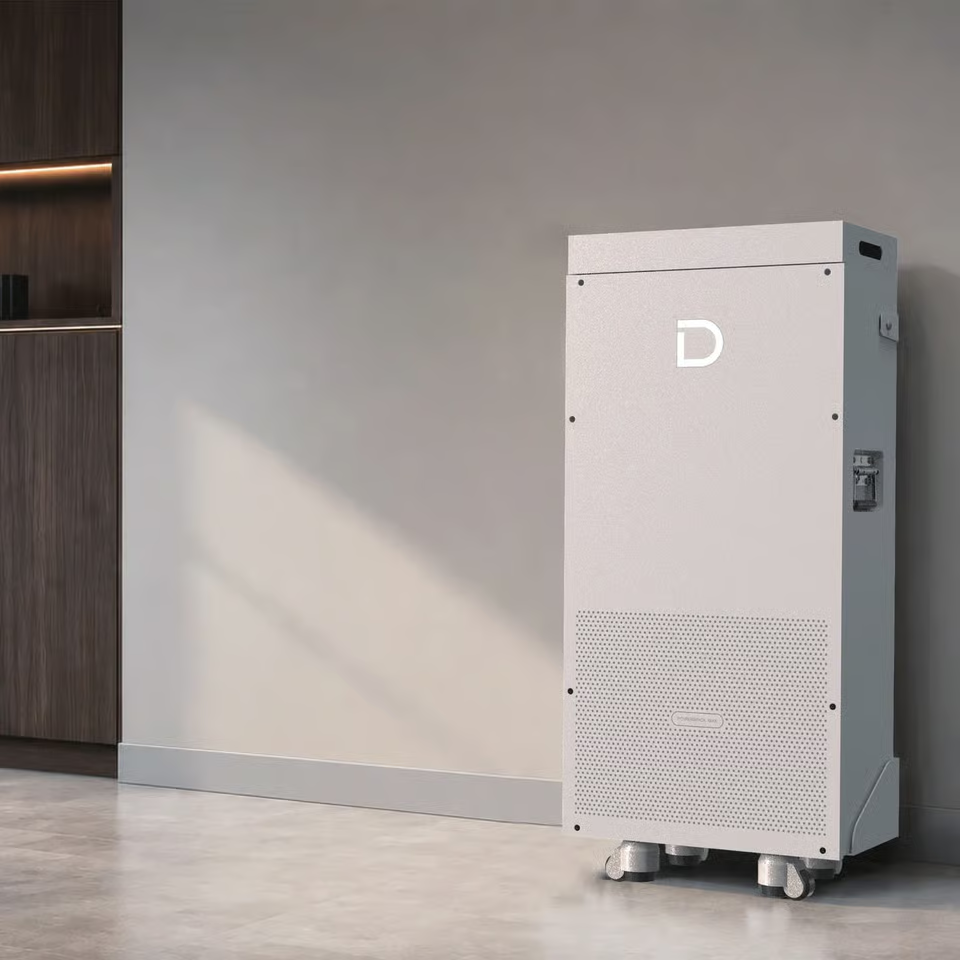
The Dyness PowerBrick Max is a 16.08 kilowatt hour lithium iron phosphate battery built on 314 ampere hour cells at 51.2 volts, standing on the floor rather than hanging on a wall. It suits larger homes, guest houses, clinics, workshops and small commercial premises running a 48 volt hybrid inverter.
Most batteries in this class publish different limits for charging and discharging, and the charging figure is usually the smaller of the two. That asymmetry is a trap when sizing a bank, because a battery specified to cover the evening load frequently cannot absorb the array at midday.
This one is symmetric. Two hundred amperes in either direction, which is 10.24 kilowatts going in and 10.24 kilowatts coming out. Whatever the array can deliver at noon, the battery can take at the same rate it will give it back after dark. There is no second calculation to run and no quiet shortfall to discover six months later.
Two further figures separate it from the smaller modules.
Its peak is 300 amperes held for two minutes. That is 15.36 kilowatts, and two minutes is a different kind of capability from the fifteen second bursts smaller packs publish. Fifteen seconds covers one motor starting. Two minutes covers several brought up in sequence, a welder working, or a borehole pump labouring against a head before it settles. That is commercial behaviour in a box sized for a utility room.
One unit carries a 10 kilowatt inverter. Producing 10kW from a 51.2 volt bank calls for about 195 amperes against the 200 available, so a single cabinet does the whole job where three or four smaller modules would otherwise be wired together. Section nine sets out what each inverter in the range actually needs.
Two things to settle before ordering. It is rated IP20, which means a dry indoor room and offers no water protection at all, not even against dripping. And it weighs 116 kilograms, which deserves more than a line in a specification table; section five covers what that actually involves.
Dyness PowerBrick Max Specifications and Inverter Pairing
1. System Architecture and Configuration
Cell and Capacity
- Lithium iron phosphate cells rated at 314 ampere hours
- 16.08 kilowatt hours of nominal energy in one cabinet
- 15.28 kilowatt hours of that genuinely usable
- Ninety five percent depth of discharge
- 51.2 volts nominal, working between 44.8 and 57.6 volts
- Up to fifty cabinets in parallel, reaching 803.8 kilowatt hours
Charge and Discharge
- Two hundred amperes maximum in each direction, which is 10.24kW either way
- One hundred and forty amperes recommended continuously, which is 7.168kW
- Three hundred amperes available for two minutes at 25C
- The charge and discharge ceilings identical, so one figure governs both
- Charging permitted from 0C, or from -20C where the low temperature option is specified
- Discharge available across a -20C to 55C span
Safety and Management
- Aerosol fire suppression built into the cabinet
- Reporting over CAN or RS485 to the inverter
- Wireless and app access supplied as part of the package
- Status readable from an indicator on the cabinet, and through a web portal
- Certified to UN38.3 for transport and IEC 62619 for stationary cells
Physical and Mounting
- One hundred and sixteen kilograms, standing 857mm tall
- 435mm wide and 233mm deep, so a narrow footprint for the capacity
- Floor standing or wall mounted, with no rack or bracket option
- Four wheels available as an extra, adding one kilogram
- A top cover available as an extra, adding two kilograms
- Rated IP20, so only a dry interior space will serve
2. Technical Specifications
| Parameter | Value |
|---|---|
| Battery type | Lithium iron phosphate |
| Nominal energy | 16.08kWh |
| Usable energy | 15.28kWh |
| Depth of discharge | 95% |
| Nominal capacity | 314Ah |
| Nominal voltage | 51.2V |
| Operating voltage range | 44.8V to 57.6V |
| Recommended charge and discharge rate | 0.45C, which is 140A |
| Maximum charge rate | 0.64C, which is 200A |
| Maximum discharge rate | 0.64C, which is 200A |
| Peak discharge current at 25C | 300A for 2 minutes |
| Recommended charge and discharge power | 7.168kW |
| Maximum charge power | 10.24kW |
| Maximum discharge power | 10.24kW |
| Charge temperature range | 0C to 55C, or -20C to 55C as an option |
| Discharge temperature range | -20C to 55C |
| Cycle life | 8000 cycles or more, on the published test conditions |
| Communication | CAN or RS485 |
| User interface | Wireless and application, fitted as standard |
| Safety protection | Built in aerosol fire extinguisher |
| Protection level | IP20, indoor positions only |
| Net weight | 116kg |
| Dimensions | 435mm wide, 233mm deep, 857mm tall |
| Installation methods | Floor standing or wall mounted |
| Optional wheels | 4 pieces, 1kg, 80mm |
| Optional top cover | 2kg, 435 by 233 by 60mm |
| Expansion | Up to 50 units in parallel, 803.8kWh |
| Warranty period | 10 years |
| Certification | UN38.3, IEC 62619 |
The cycle figure assumes a gentle 0.2C rate, a controlled 25C, the full 95% depth, and an end point defined as 70% of original capacity remaining. Cycled once daily that comes to roughly twenty two years of use, far beyond the ten year warranty term, which is therefore the promise that actually binds.
3. Key Features
- The same 200 ampere ceiling in both directions, so sizing needs one calculation rather than two
- Fifteen kilowatts and more held for two minutes, not fifteen seconds
- Enough current on its own for a 10 kilowatt inverter
- Ninety five percent of the nameplate usable
- Fire suppression built into the cabinet rather than specified around it
- Ten years of warranty as standard, with no upgrade required
- Wireless monitoring and the application included rather than optional
- A 435mm footprint, narrow for sixteen kilowatt hours
- Low temperature charging available where a site needs it
- Fifty cabinets in parallel, reaching beyond eight hundred kilowatt hours
- Communication by CAN or RS485, as hybrid inverters require
- Bicity Solar establishes how many cabinets your inverter needs before quoting
4. Applications and Use Cases
- Larger homes: a single cabinet where a wall of modules would otherwise go
- Guest houses and small lodges: one connection instead of four
- Clinics and surgeries: the two minute peak covers equipment starting together
- Workshops: welders and compressors inside the surge window
- Boreholes and pump houses: a pump working against a head for a minute or more
- Shops and supermarkets: refrigeration restarting after an outage
- Offices: a 10kW inverter served from one cabinet
- Sites short of wall space: it stands on the floor and needs 435mm of width
5. Installation and Engineering Notes
One hundred and sixteen kilograms is a planning item
This needs saying clearly, because the marketing is easy to misread. The cabinet weighs 116kg. Four wheels are available as an extra, and with them fitted one person can roll it across a flat, hard floor. That is a statement about moving it, not about lifting it, and the wheels are an option rather than standard equipment, so without them it does not roll at all.
- Specify the wheels at the time of order if the cabinet will ever need repositioning
- Plan the route in: doorways, thresholds, steps, and any soft or uneven ground
- Getting it off the vehicle and into the building is a lifting job, not a carrying job
- Wall mounting is listed as an option, and at 116kg that means a structural wall with engineered fixings, assessed by someone competent
- Floor standing is the straightforward choice for most installations
- Allow for 435mm of width, 233mm of depth and 857mm of height, plus clearance
- Confirm the floor itself is sound where several cabinets will stand together
A dry indoor position, and nothing less
The IP20 rating covers solid objects larger than about twelve millimetres and offers no protection against water at all, not even water dripping vertically. A covered veranda does not qualify. Nor does a store open along one side, nor an outbuilding that takes damp in the long rains.
- A dry indoor room, with air able to move around the cabinet
- Away from dust, or in its own enclosure where dust is unavoidable
- Not against a wall that takes direct afternoon sun on the far side
- Clear of stored goods, so the suppression system is not obstructed
Circuit sizing, and the two minute peak
Protective devices sit a quarter above the continuous current, then round up to a manufactured size. The peak rating adds a second requirement that is easy to miss.
| Circuit | Design current | Device | Cable, short run |
|---|---|---|---|
| One cabinet to the inverter | 250A | 250A DC | 95mm², or paired runs |
| Two cabinets combined | 500A | 500A DC | Paired 150mm² runs |
- Check the chosen device tolerates 300 amperes for two minutes without tripping
- That is a question about its time current curve, not about its rating alone
- A device that nuisance trips on the surge makes the peak capability worthless
- Where two or more cabinets share a busbar, give each its own run
- Match the cable lengths between cabinets so no one path carries more
- Use the correct die on every lug and tighten each joint to its stated torque
- Establish the data link and check the inverter is reading genuine cell figures
- Brought into service and signed off by a licensed installer
6. Care, Maintenance and Operations
- Keep the room dry, as the cabinet resists no moisture whatsoever
- Clear dust from the ventilation openings on a regular cycle
- Retighten terminations annually, more often where the bank works hard
- Track the health reading, not merely how full the cabinet shows
- Where cabinets are paralleled, compare their currents for any drift
- Keep the area around the cabinet clear of stored goods
- Note the figures at handover, giving later readings something to be judged against
- Check that the wheels, where fitted, are locked once it is positioned
7. Do’s and Don’ts
Do
- Order the wheels with the cabinet if it may ever need moving
- Plan the delivery route before the cabinet arrives
- Verify the protection will carry 300 amperes for two minutes
- Position it indoors, somewhere dry, with air around it
- Use the symmetric rating to size charging and discharging together
- Run a separate cable from every cabinet to the common busbar
- Specify the low temperature option where a site genuinely needs it
Don’t
- Treat 116 kilograms as a two person carry
- Wall mount it without a structural assessment of the wall
- Site it in any damp location, because IP20 offers zero water protection
- Connect it to a high voltage machine, since 51.2 volts is no use to one
- Assume the wheels are included, because they are an extra
- Size protection on the continuous figure and forget the surge
- Read eight thousand cycles as a promise of calendar years
8. Compatibility
- Any hybrid inverter built for a 40 to 60 volt bank, meaning the Solis models through to 18kW
- Growatt machines sharing that same low voltage architecture
- The majority of leading inverter makers, subject to confirming the exact model
- Communication over CAN or RS485
- Banks from one cabinet up to fifty, reaching 803.8 kilowatt hours
- Monitoring by application, web portal and the cabinet indicator
- Sites needing charging below freezing, where the option is specified
Verify your particular inverter against the manufacturer’s published compatibility list before placing an order. Approval is granted model by model, so seeing a familiar brand on that list is not an assurance that every product under it has been tested.
9. How Many Cabinets Your Inverter Needs
The count follows from current rather than from kilowatt hours. Delivering an inverter’s rated output takes a given current, and that can come from fewer cabinets worked at their maximum or more worked at the recommended rate.
| Inverter | Current at 51.2V | At the 200A maximum | At the 140A recommended rate | Usable energy at the minimum |
|---|---|---|---|---|
| 5kW | About 98A | 1 | 1 | 15.3kWh |
| 6kW | About 117A | 1 | 1 | 15.3kWh |
| 8kW | About 156A | 1 | 2 | 15.3kWh |
| 10kW | About 195A | 1, at its ceiling | 2 | 15.3kWh |
| 12kW | About 234A | 2 | 2 | 30.6kWh |
| 14kW | About 273A | 2 | 2 | 30.6kWh |
| 16kW | About 313A | 2 | 3 | 30.6kWh |
| 18kW | About 352A | 2 | 3 | 30.6kWh |
The 10kW case is the one worth reading twice. It needs about 195 amperes against a 200 ampere ceiling, so one cabinet does carry it, but with the battery at its limit whenever the inverter is at full output. For a site that regularly reaches 10kW we would quote two. Below that, a single cabinet is comfortable: an 8kW inverter asks about 156 amperes, which sits inside even the recommended continuous rate for much of the time.
10. One Large Cabinet, or Several Small Modules
Three of the smaller 5.12 kilowatt hour modules come to roughly the same energy as one of these, so the comparison is a fair one and the answer is a genuine trade rather than a clear win.
| Consideration | Three 5.12kWh modules | One PowerBrick Max |
|---|---|---|
| Usable energy | 14.59kWh | 15.28kWh |
| Continuous discharge | 300A, 15.36kW | 200A, 10.24kW |
| Continuous charge | 225A, 11.52kW | 200A, 10.24kW |
| Peak | 330A for 15 seconds | 300A for 2 minutes |
| Total weight | 123kg in three pieces | 116kg in one |
| Cable runs | Three | One |
| Warranty | 7 years, 10 optional | 10 years |
| Mounting | Wall, rack, bracket or floor | Floor or wall only |
| Buying in stages | Straightforward | One purchase |
The smaller modules win on continuous power. Three of them deliver 15.36 kilowatts where this cabinet delivers 10.24, and they charge faster too. If a site regularly pulls more than 10 kilowatts from storage for sustained periods, that difference is the deciding one and we would say so.
This cabinet wins on almost everything else. More usable energy, less weight, one set of cables instead of three, three more years of warranty as standard, and a surge that holds 15.36 kilowatts for two minutes rather than fifteen seconds, which covers most of the gap in practice.
The modules also allow phased buying, which is a real advantage where budget arrives in instalments. A cabinet is one purchase, whereas modules can be added one at a time as money allows.
11. Mini FAQ
Does it charge as fast as it discharges?
Yes. Two hundred amperes in both directions, which is 10.24kW each way. That removes the usual sizing trap.
How much of the 16.08kWh can I use?
15.28kWh, which is ninety five percent.
Can one cabinet run a 10kW inverter?
Yes, though at its ceiling. A 10kW inverter asks about 195 amperes against the 200 available.
What does the two minute peak cover?
Fifteen point three six kilowatts for two whole minutes, which rides a sustained surge rather than one motor start.
Can it go outdoors or in a store?
No. There is no water rating whatsoever at IP20, so it belongs in a dry room inside the building.
Can one person move it?
With the optional wheels, one person can roll it on flat hard flooring. Lifting 116 kilograms is a different matter.
Will it work with high voltage inverters?
No. It is a 51.2 volt cabinet and the larger three phase machines need hundreds of volts.
How long is the warranty?
Ten years as standard, with no upgrade needed to reach it.
12. Why Buy From Bicity Solar
- The number of cabinets derived from inverter current rather than estimated from output
- The honest comparison against smaller modules, including where they beat this one
- Protection checked against the two minute surge, not only the continuous rating
- Delivery route and lifting planned before a 116 kilogram cabinet arrives
- Wheels specified at order where the cabinet may need repositioning
- The intended position judged against a unit that will not tolerate damp
- Any wall mounting referred for a structural opinion rather than assumed
- The data link established and proven before we leave site
- A straight warning if the inverter already installed cannot accept this platform
- Authentic stock, its paperwork matching the cabinet delivered
- Fitted and signed off against a valid EPRA licence
- We pursue any warranty claim with the supplier instead of leaving it to you
- Carried to any part of the country, with spares and guidance to follow
Tell us your inverter and we will tell you whether one cabinet does the job. Up to 8kW it comfortably does. At 10kW it does, at its limit. Above that you are into two, and at that point it is worth comparing against a stack of smaller modules, which deliver more continuous power for the same energy.
Give us the inverter model, how large the array is, and the loads you expect to carry through the night. From there we derive the cabinet count from the current your inverter draws, verify the protection will ride a two minute surge without tripping, check the intended position against an indoor only rating, and plan how 116 kilograms gets through the door. Run your own load list in the Solar Calculator, or send the site through My Quote.