Description
Road Infrastructure-Grade Lighting for Public Sector Deployment
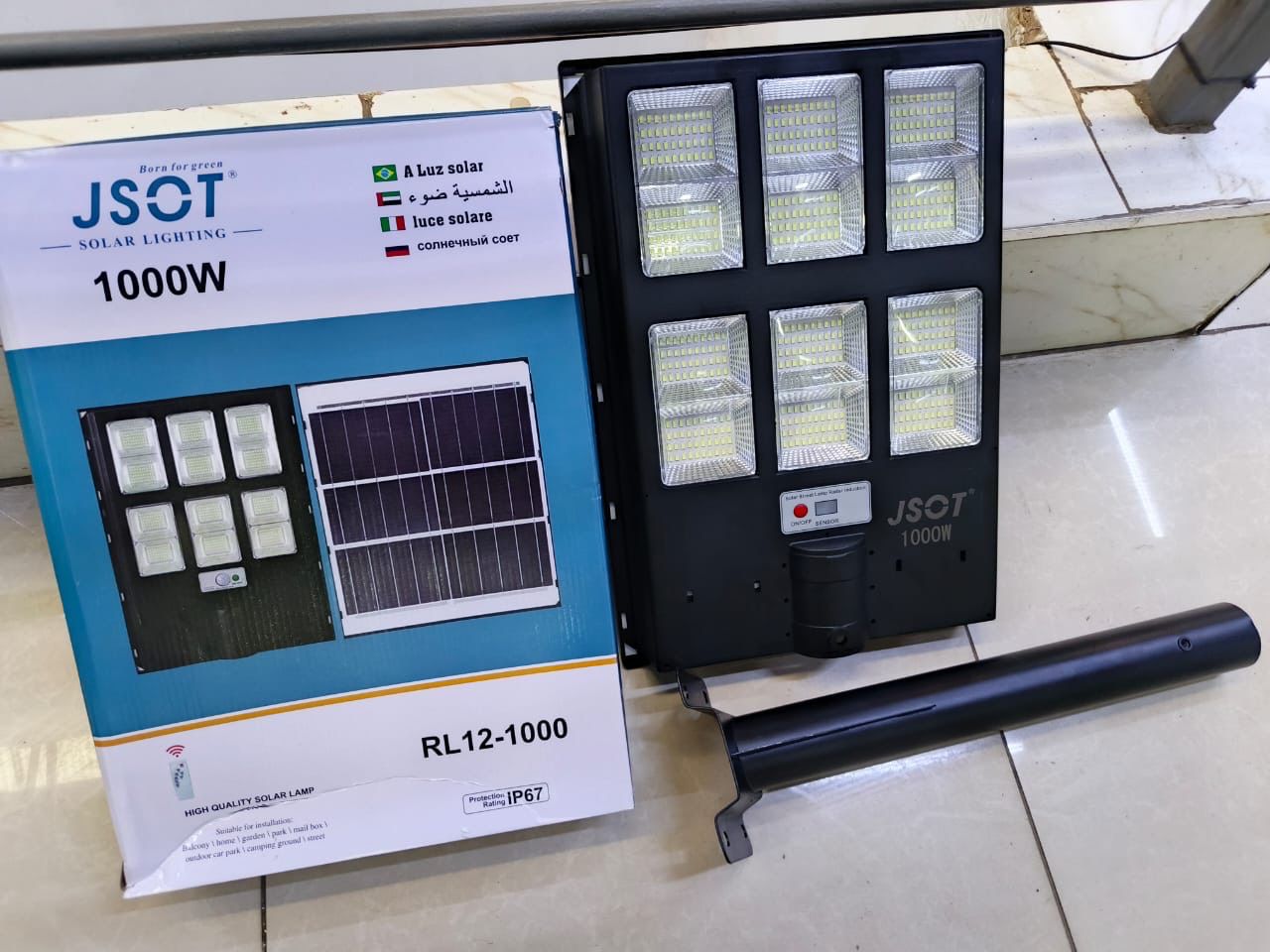
The Bicity Solar 1000W Solar Street Light is engineered for projects at the top of Kenya’s outdoor lighting market — county government road tenders, national highway segment lighting, arterial corridor deployments, and large institutional infrastructure projects where the lighting becomes part of permanent civic infrastructure rather than commercial property improvements. This is the wattage tier where projects move from procurement-officer purchase decisions into formal tender documentation, where bid specifications include detailed component requirements, and where the lighting installation will be inspected against public-sector standards before sign-off.
This unit covers approximately 1,000–1,400 square metres of usable nighttime brightness from a single mounting position at 12–16 metre road-infrastructure pole height. That coverage envelope replaces what would otherwise require 2–3 of our 500W industrial units, or 4–5 of our consumer-tier 300W units, while consuming substantially less mounting infrastructure per square metre illuminated. For county road lighting projects covering multiple kilometres of tarmac, the 1000W’s combination of high coverage per pole and long inter-pole spacing dramatically reduces project total cost of ownership compared to scaling up smaller units.
Technical Specifications
| Specification | Detail |
|---|---|
| Product Type | Integrated all-in-one solar street light, road infrastructure tier |
| Rated Wattage | 1000W system rating |
| LED Configuration | 18 LED pods, ~520 SMD chips total |
| Luminous Flux | 100,000+ lumens at full brightness |
| Colour Temperature | 6000K cool white daylight (5000K available on tender specification request) |
| Luminous Efficiency | 175 lm/W |
| Solar Panel | 200W monocrystalline, 24V |
| Panel Adjustment | 180° tilt with reinforced locking ratchet |
| Battery | LiFePO4 lithium iron phosphate, 3.2V 260Ah |
| Battery Cycle Life | 2,000+ deep cycles (5–7 years typical service) |
| Charging Time | 9–11 hours full sunlight |
| Working Time (Full Charge) | Up to 48 hours lab spec / 24–30 hours real-world Kenyan conditions at full mode |
| Motion Sensor | PIR, 18m radius, 180° detection arc |
| Ambient Light Sensor | Dual photocell with dawn-detection algorithm |
| Operating Modes | 4 standard modes plus optional schedule programming |
| Remote Control | Extended long-range model (40m operating distance) |
| Ingress Protection | IP66 — dust-tight and high-pressure water resistant |
| Housing Material | Die-cast aluminium alloy with PMMA optical lens and UV-stabilised polymer end-caps |
| Operating Temperature | -30°C to +65°C (extended thermal envelope) |
| Installation Height | 12–16 metres recommended (road infrastructure standards) |
| Pole Diameter Compatibility | 102mm minimum (road-infrastructure-grade pole required) |
| Net Weight | Approximately 24.5 kg |
| Product Dimensions | Approximately 1,680 × 510 × 145 mm |
| Warranty | 3 years standard, optional 5-year tender extension |
| Tender Certifications | CE, RoHS, ISO9001 documentation available; IEC 60598 compliance verified on request |
Built for Tender Compliance
Public-sector tenders for solar road lighting typically include detailed component specifications that go well beyond simple wattage and lumens. County engineers and procurement committees specify minimum battery capacity (in Ah, with chemistry requirement), minimum solar panel rating (in W, with type requirement), IP rating thresholds, operating temperature ranges, warranty terms, and increasingly — testing certificates demonstrating compliance with international lighting standards. The 1000W unit was specified specifically to meet these tender requirements out of the box:
| Tender Requirement Category | Typical Specification | Bicity 1000W Compliance |
|---|---|---|
| LED count and type | Minimum 400 SMD 5730 chips | 520 SMD 5730 chips with stated lm/W |
| Battery chemistry | LiFePO4 mandatory (lithium-ion typically rejected) | LiFePO4 specified and verified |
| Battery capacity | Minimum 200Ah for genuine 1000W operation | 260Ah specified, exceeds minimum by 30% |
| Solar panel rating | Monocrystalline minimum 150W for 1000W systems | 200W monocrystalline, exceeds minimum |
| IP rating | IP66 minimum for outdoor road installations | IP66 verified |
| Operating temperature | -20°C to +60°C minimum range | -30°C to +65°C (exceeds standard range) |
| Warranty | Minimum 2 years on all components | 3 years standard, 5 years optional |
| Certifications | CE and RoHS at minimum | CE, RoHS, ISO9001; IEC 60598 on request |
This compliance profile means submitting a Bicity 1000W bid against a county tender typically requires only completion of the standard tender documentation forms rather than negotiation about component substitutions. For procurement officers handling tender evaluations, this dramatically reduces the time spent on bid analysis — the unit either meets the spec or it doesn’t, and ours does.
Why Road Infrastructure Wattage Requires Different Engineering
The jump from 800W to 1000W isn’t just additional LEDs — it crosses an engineering threshold where the unit must be designed differently to handle the operational demands of road-infrastructure deployment. Three engineering shifts distinguish proper 1000W from inflated 800W:
| Engineering Dimension | 800W Bicity Unit | 1000W Bicity Unit (this product) | Why It Matters at Road Scale |
|---|---|---|---|
| Battery capacity | 200Ah LiFePO4 | 260Ah LiFePO4 (30% increase) | Road lighting can’t have dim weeks — battery margin handles 5-7 consecutive overcast days without runtime drop |
| Solar panel | 150W monocrystalline | 200W monocrystalline (33% increase) | Faster recovery from cloudy periods, restores full battery within 2-3 sunny days |
| LED pods | 14 pods (~400 chips) | 18 pods (~520 chips) | Wider light cone for road coverage, less concentrated than commercial-area illumination |
| Operating temperature range | -20°C to +60°C | -30°C to +65°C extended | Highland deployments (Mt Kenya region, Aberdares, Mau) hit sub-zero overnight; arid zone exceeds 60°C at midday |
| Pole diameter | 89mm heavy-duty commercial | 102mm road-infrastructure grade | Road wind loading at 14m+ height requires structurally heavier pole engineering |
| Sensor range | 15m PIR motion | 18m PIR motion | Vehicle-speed detection on access roads requires earlier motion recognition |
| Polymer end-caps | Standard ABS | UV-stabilised polymer | 15-year+ exposure to direct sunlight without polymer degradation |
The extended temperature envelope and UV-stabilised polymer components are particularly important for road deployment. A unit installed on a highway in Marsabit, Lodwar, or Garissa experiences thermal cycles between 8°C nighttime and 50°C+ midday temperatures, repeated 365 days a year for the project’s full service life. Standard commercial-grade components degrade noticeably under these cycles by year 7-8; the road infrastructure-grade components in the 1000W unit maintain performance through year 10-12.
Where 1000W Is the Correct Tier
The 1000W unit is specified for the very largest outdoor lighting projects in Kenya, where coverage exceeds 1,000 square metres per pole position and the project budget supports proper road-infrastructure pole engineering. Real deployment scenarios:
- County government road lighting tenders — kilometres of tarmac in peri-urban and rural road segments under county budget allocations
- National highway segment lighting — KENHA and KURA road authority tenders for high-traffic stretches
- Urban arterial corridor lighting — major roads connecting CBDs to suburban areas in Nairobi, Mombasa, Kisumu, Eldoret, Nakuru, and other major centres
- Regional bypass roads — county-funded ring roads and bypass corridors around major town centres
- Port and harbour service roads — Mombasa Port internal road networks, container terminal access lanes
- Airport runway-adjacent lighting (non-illumination zones) — JKIA service roads, Wilson Airport perimeter, regional airport access
- National park gates and access roads — major access points to Tsavo, Maasai Mara, Amboseli, Lake Nakuru, Aberdares NP
- Large industrial park internal road networks — Athi River EPZ, Konza Technopolis access roads, Tatu City internal roads
- Multi-hectare logistics and warehousing yards — major fulfilment centres, regional distribution hubs, agricultural produce aggregation points
- Container terminal areas — large vehicle movement zones requiring sustained overnight visibility
- Power station and substation perimeters — KETRACO and KenGen installations requiring tender-compliant security lighting
- Water authority pumping station compounds — major NCWSC and county water authority installations
- Refugee camp infrastructure projects — UNHCR-coordinated installations at Dadaab, Kakuma, and surrounding settlements
For commercial properties below 1,000 m² per position, our 800W major commercial unit or 500W industrial unit is more economical without sacrificing performance.
Schedule Programming and Smart Sensor Suite
At the road infrastructure tier, the operational requirements often include scheduled brightness changes that match traffic patterns. The 1000W controller supports optional schedule programming beyond the standard 4-mode controller found on smaller units:
- Time-of-night brightness scheduling — programme full brightness during peak traffic hours (e.g., 6pm-11pm), motion-sensor mode during overnight quiet hours (11pm-4am), gradual return to full brightness at dawn approach (4am-6am)
- Seasonal schedule variation — separate programmes for the long rains (April-May), short rains (October-December), and dry season operational patterns
- Holiday and event-day overrides — manual schedule overrides for known high-traffic events (national holidays, major sporting events, religious festival weekends)
- Centralised monitoring integration — optional RS485 module for SCADA platform integration allows county engineers to monitor unit status remotely from county-headquarters control rooms
- Self-diagnostic reporting — quarterly automated diagnostic cycle that reports battery health, sensor function, and LED array integrity via the monitoring link or to maintenance technicians during scheduled inspection visits
Road-Infrastructure Pole Engineering
The 24.5 kg fixture weight combined with wind loading at 14-16 metre installation height creates structural demands that require properly engineered road-infrastructure poles. Six engineering requirements:
Pole structural standards
Galvanised steel poles meeting ANSI/AASHTO or equivalent road-lighting standards. Wall thickness scales with height: 6mm at 12m, 7mm at 14m, 8mm at 16m. Top diameter 102mm minimum for the mounting bracket; base diameter scales appropriately (typically 165-180mm at base for 14m poles). Galvanisation thickness minimum 85 microns for 15-year corrosion protection.
Foundation engineering
Reinforced concrete foundation sized 150cm × 150cm × 180cm for 14m poles, scaled appropriately larger for 16m. Steel reinforcement cage with 16mm bar spacing per structural engineer’s design. Foundation cure time of 28 days minimum before pole erection — non-negotiable for road infrastructure projects where pole failure has road-safety implications.
Anchor bolt specification
Eight M24 (24mm diameter) galvanised threaded anchor bolts cast into the foundation, with minimum 800mm embedment depth. Anchor bolt patterns conform to relevant road authority standards. Torque-verified during pole erection to design specification.
Lightning protection
Mandatory for road infrastructure deployment. Earthing rod copper-clad minimum 2m driven length, resistance verified below 3 ohms at installation. Surge protection module on the fixture’s controller protects against grid-induced surges and direct lightning damage to internal electronics.
Vehicle impact considerations
For roadside installations, pole positioning should follow road authority guidelines for setback distance from carriageway edge. Breakaway base designs are available for installations on high-speed road segments where vehicle impact resilience is required by tender specification.
Pole spacing standards
For roadway lighting, spacing follows international road-lighting standards based on lane width and traffic classification. Typical single-lane country road: 40-50 metres pole spacing. Two-lane highway: 35-45 metres. Urban arterial: 30-40 metres. Specifically calculated spacing depends on the road authority’s lux level requirement at carriageway centre.
Tender Bidding and Project Procurement
- Tender response service: Our team prepares full tender documentation including technical specification compliance matrices, component certification packages, warranty terms, delivery timeline projections, and bid pricing
- Volume tier pricing: Distinct pricing tiers for 10, 25, 50, 100, and 250+ unit orders to support large public-sector deployments
- Free pre-bid site survey: Available for tender opportunities where site assessment is permitted during the bid preparation window
- Road-infrastructure pole supply: Galvanised steel poles in 12m, 14m, and 16m configurations meeting road authority standards
- Installation team services: Project installation crews available for road tender deployments — typical timeline 4–5 working days per 10-unit installation excluding foundation cure
- Component certifications: CE, RoHS, ISO9001 documentation provided with all tender bids; IEC 60598 lighting standard compliance verifications available on specific tender request
- Alternative wattages: Compare with our 800W major commercial unit or 500W industrial unit for projects below road-infrastructure scale
- Tender bid quote: Request a tender bid quote with the tender specification document, project location, unit count requirement, and submission deadline