Description
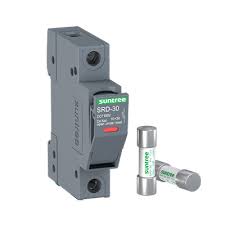
Single Pole DC MCB 10A Kenya — Suntree SL7N-63 1P 250VDC DC Circuit Breaker for LED, CCTV & Battery Systems
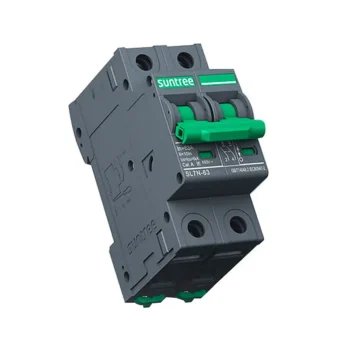
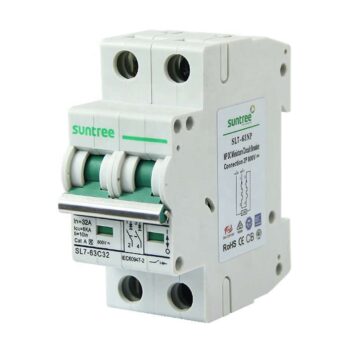
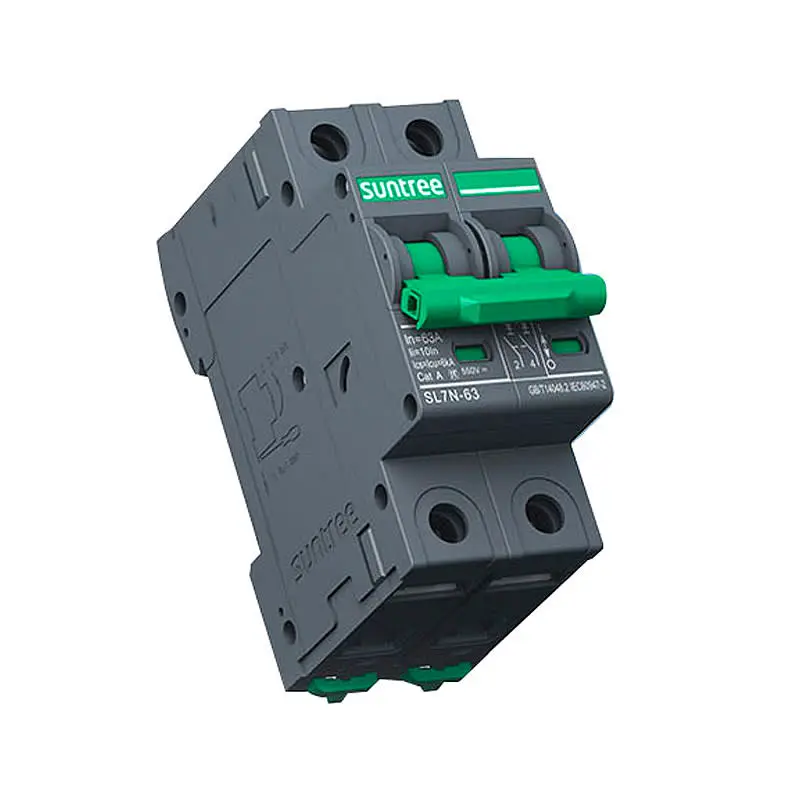
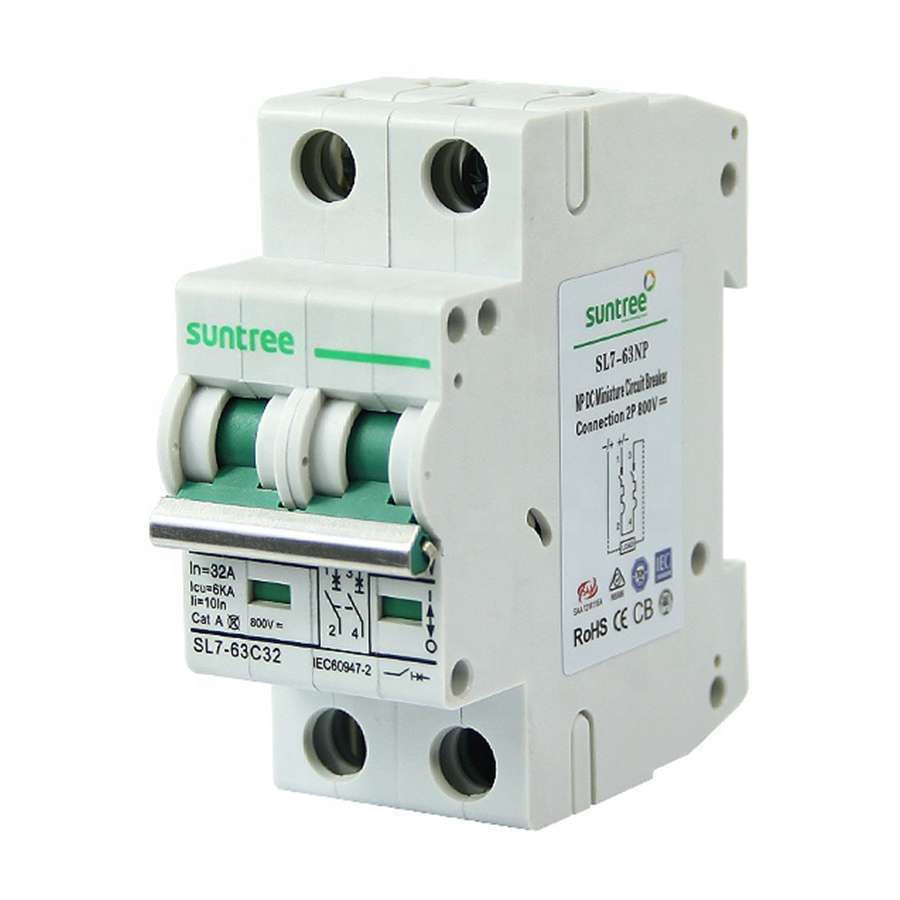
The Single Pole DC MCB 10A from Suntree — also referred to as the SL7N-63 1P 250VDC 10A DC Circuit Breaker, the Suntree 1 Pole DC MCB, the 250V Single-Pole DC Breaker, or simply the 10A 1P DC Isolator — is the entry-level single-pole specification in the SL7N-63 DC breaker family. Rated for 250V DC at up to 10 amperes through a single-pole switching channel, it is the right protective device for the substantial Kenyan market of low-voltage DC applications that exists alongside the larger solar PV market most attention focuses on.
This is not a solar PV string breaker. Solar panel strings in residential and commercial Kenyan installations operate at 400-1000V DC, well above the 250V envelope of this single pole DC MCB. The 1P 250VDC 10A is engineered for the much wider universe of low-voltage DC circuits that power Kenyan homes, businesses, and security infrastructure: solar-powered LED security lights, CCTV camera supplies, 12V/24V/48V battery systems in off-grid cabins and weekend homes, small DC water pumps on smallholder farms, gate motor controllers in residential compounds, and the protective circuits inside small off-grid solar charge controllers.
Specifying this single pole DC MCB correctly — and understanding why it sits in a different application category than the multi-pole higher-voltage variants in the SL7N-63 family — matters for getting the right protective coverage on your specific Kenyan installation.
Where the 1P 250VDC 10A breaker actually belongs in Kenyan installations
The fundamental positioning of the SL7N-63 1P 250VDC 10A is that it protects low-voltage DC circuits — not solar PV strings, not high-current battery banks, but the everyday DC circuits that power security and lighting infrastructure across Kenyan properties. Eight specific application categories cover the bulk of buyer use cases:
- Solar LED security lighting circuits: Outdoor LED security lights powered by small dedicated solar panels with integrated 12V or 24V battery storage. The 10A breaker isolates the LED driver from the battery for service or fault response.
- CCTV power supply protection: Security camera installations that distribute 12V or 24V DC to multiple cameras through a central power supply. The breaker protects the DC distribution against short circuits in any one camera cable while leaving the other cameras operational.
- 12V/24V/48V battery system isolation: Small off-grid battery banks (typically 100-200Ah lead-acid or LiFePO4) feeding DC loads directly without an inverter — common in remote sites, weekend homes, agricultural posts, and humanitarian compounds.
- Small DC water pump circuits: Solar-direct DC water pumps for smallholder farm irrigation, livestock watering, and rural water supply. The 10A breaker protects the pump motor circuit during start-up surges and fault conditions.
- Gate motor power feeds: Electric gate operators in residential compounds and commercial premises that run on 12V or 24V DC supplied by a small standby battery (often solar-charged). The breaker isolates the gate controller for maintenance.
- Off-grid solar charge controller protection: Between a small solar panel array (under 500W) and the battery bank, the breaker provides manual disconnection and short-circuit protection on the charge controller side.
- DC LED driver circuits: LED street lights, billboard lighting, and area lighting that use constant-current DC drivers fed from a battery or solar supply. The 10A breaker protects the driver from supply-side faults.
- Small off-grid solar inverter input protection: Compact 12V or 24V DC-to-AC inverters (under 500W output) used in remote sites, mobile shops, and weekend homes. The breaker isolates the battery from the inverter for service or fault response.
When NOT to use the 1P 250VDC 10A breaker
Getting the wrong protective device installed costs money and creates safety risk. Three specific scenarios where this breaker is the wrong choice:
- Solar PV string protection: Solar panel strings in residential and commercial installations operate at 400-1000V DC, well above the 250V rating of this breaker. Use the 2P 550VDC variants for residential strings, 4P 1000VDC for larger strings, or 4P 1500VDC for utility-scale installations. Operating any breaker beyond its voltage rating creates a serious safety hazard.
- AC mains circuits: This is a DC-rated device with arc-clearance geometry sized for DC service. Using it on an AC mains circuit (230V/400V) wastes money — AC-rated MCBs cost less and provide equivalent protection in AC service. Reserve the DC breaker for actual DC applications.
- Currents above 10A continuous: A higher-current application — typical of larger battery banks delivering substantial inverter loads — needs a higher-current variant. The 2P 550VDC 20A, 32A, or 63A variants in the SL7N-63 family handle the larger currents safely.
Where this 1P 250VDC 10A fits in the Bicity SL7N-63 DC breaker family
| SL7N-63 Variant | Voltage | Current | Poles | Best For |
|---|---|---|---|---|
| SL7N-63 1P 250VDC 10A (this page) | 250V | 10A | 1P | LED lighting, CCTV, 12V/24V/48V battery systems, small off-grid |
| SL7N-63 2P 550VDC 20A | 550V | 20A | 2P | Small residential solar PV strings (6-8 panels) |
| SL7N-63 2P 550VDC 32A | 550V | 32A | 2P | Medium residential solar PV strings, larger battery banks |
| SL7N-63 2P 550VDC 63A | 550V | 63A | 2P | Larger residential strings, hybrid inverter DC input protection |
| SL7N-63 4P 1000VDC 20A | 1000V | 20A | 4P | Light commercial solar PV with longer strings (12-15 panels) |
| SL7N-63 4P 1000VDC 32A | 1000V | 32A | 4P | Medium commercial solar PV strings |
| SL7N-63 4P 1000VDC 63A | 1000V | 63A | 4P | Larger commercial solar PV, commercial battery isolation |
| SL7N-125D 4P 1500VDC 80A | 1500V | 80A | 4P | Utility-scale and large commercial solar PV |
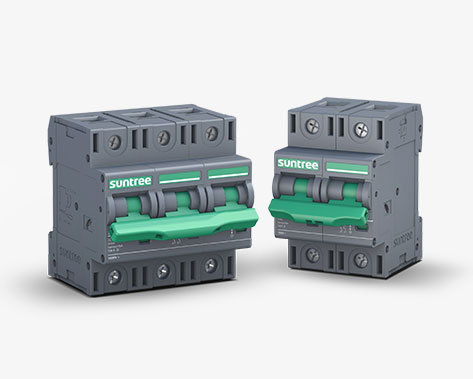
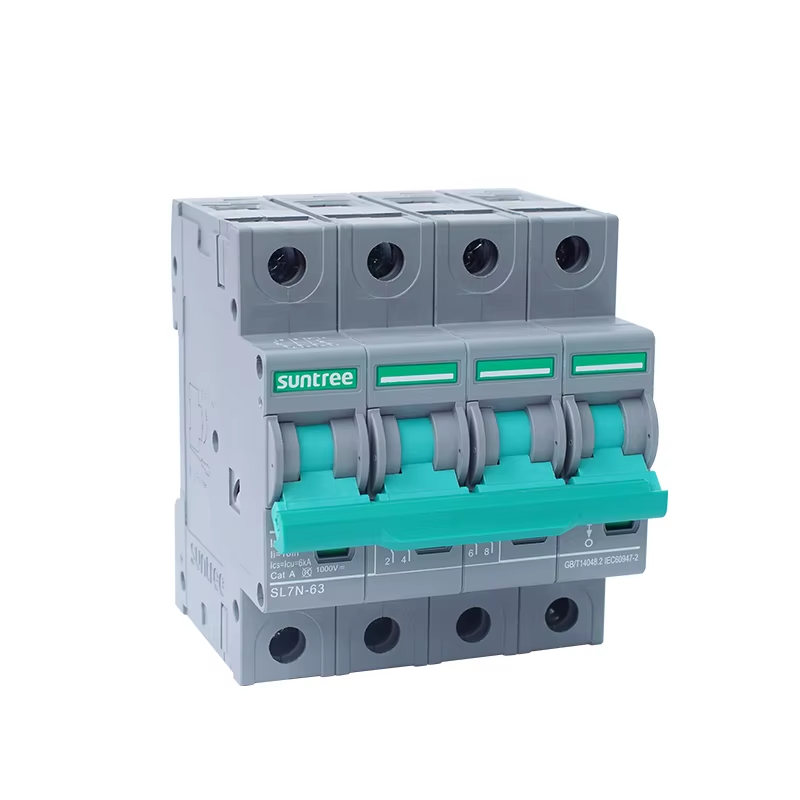
The 1P 250VDC 10A is genuinely a different product from its higher-voltage siblings — same SL7N-63 series, same manufacturer, but engineered for a completely different application category. A buyer who needs to protect a CCTV power supply distribution should buy this 1P 250VDC variant; a buyer who needs to protect a solar panel string should buy the 2P 550VDC or higher variants.
What makes the SL7N-63 different from cheap generic alternatives
Low-cost DC breakers in the Kenyan market vary substantially in quality. The SL7N-63 from Suntree is built to the specification that matters for actual DC service, where many cheap alternatives cut corners. Four specific build features distinguish the SL7N-63:
- True DC-rated arc-clearance geometry: The SL7N-63 contacts and arc-quench design are engineered for DC service at the rated voltage. Many low-cost competitors use AC-rated breaker bodies relabelled as “DC” — these cannot safely interrupt DC at rated voltage and may fail under fault conditions.
- Bi-directional polarity tolerance: The SL7N-63 family is specifically engineered to operate safely with current flowing in either direction. Many DC breakers require strict polarity orientation; getting it wrong damages the device on the first fault event. The SL7N-63 family accommodates either polarity, simplifying installation and reducing field errors.
- TUV and CE certification: Independent third-party testing verifies that the breaker meets published specifications for DC service. Cheap alternatives often have only manufacturer-claimed specifications with no independent verification.
- IEC 60947-2 compliance: The benchmark international standard governing industrial circuit breakers, including the type-test requirements that prove safe DC interrupting performance at the device’s full voltage rating. The compliance certification provides the paper trail any commercial inspection or insurance documentation might require.
Technical Specifications
| Specification | Value |
|---|---|
| Manufacturer | Suntree |
| Series | SL7N-63 |
| Product Type | DC-rated miniature circuit breaker (MCB) |
| Rated Operating Voltage (Ue) | 250V DC |
| Rated Current (Ie) | 10A continuous |
| Pole Configuration | 1-pole (single-pole) |
| Polarity Sensitivity | Bi-directional — installable in either current orientation |
| Tripping Characteristic | Thermal-magnetic, calibrated for DC service |
| Short-Circuit Breaking Capacity (Icu) | 6 kA |
| Mechanical Endurance | Rated for approximately 20,000 on-off operations |
| Electrical Endurance | Approximately 10,000 cycles at full rated DC load |
| Mounting Method | Snap-fit onto standard 35mm DIN rail |
| Acceptable Cable Size | 1.5mm² to 6mm² stranded copper |
| Operating Temperature | -25°C to +70°C ambient |
| Storage Temperature | -40°C to +80°C |
| Compliance Standards | IEC 60947-2, TUV certified, CE marked |
| Pollution Degree | 2 (industrial environment) |
| Insulation Class | II (double insulated) |
| Status Indication | Visible ON/OFF position window on front face |
| Lock-off Provision | Hole through operating handle accepts standard padlock |
| Width (DIN modules) | 1 module (18mm wide) |
Engineering Features That Matter
- Suntree SL7N-63 build quality: Established Chinese manufacturer with international distribution; TUV and CE certified for DC service at rated voltage; consistent build quality across production batches.
- Bi-directional polarity tolerance: Safe to install in either current direction — eliminates the field-error risk of polarity-sensitive DC breakers that other manufacturers produce.
- Thermal-magnetic tripping: Combined thermal element protects against sustained overloads while the magnetic element catches rapid short-circuit faults; both calibrated specifically for DC operation.
- 6 kA breaking capacity: Sufficient short-circuit interruption capability for the low-voltage DC applications this breaker targets, where fault currents are typically limited by the upstream source impedance.
- Compact 1-module footprint: Just 18mm wide, allowing high-density installation in compact distribution boxes typical of LED lighting controllers, CCTV power supplies, and small off-grid systems.
- Standard DIN rail mounting: Snap-on installation on the 35mm DIN rail found in every standard distribution box; no specialised mounting hardware needed.
- Lock-off provision: The operating handle has a padlock hole, allowing the breaker to be physically locked open while maintenance work proceeds downstream — supports the lockout/tagout discipline expected on commercial CCTV and security installations.
- Wide operating temperature range: -25°C to +70°C ambient covers Kenyan highland cool mornings and lowland hot midday operation across the full climate range.
- Visible position indication: Front face window clearly shows ON/OFF state without needing to operate the handle — useful when troubleshooting CCTV outages or LED lighting issues.
Typical Kenyan Installation Scenarios
- Solar LED security lighting at residential properties across Karen, Runda, Lavington, Muthaiga, Spring Valley, and other upmarket Nairobi suburbs where outdoor LED security lighting is standard
- CCTV camera supply protection in commercial premises along Mombasa Road, Industrial Area, Westlands, and CBD — where central DC supplies feed multiple camera locations
- Gate motor power circuits in residential compounds across Kiambu, Limuru, Tigoni, Karen, and Runda where electric gate operators run on 12V or 24V DC
- Small off-grid solar systems at weekend homes in Naivasha, Maasai Mara, Aberdares, and Mount Kenya foothills where battery-direct DC loads operate without inverters
- Borehole pump protection circuits at smallholder farms in Murang’a, Kiambu, Nyandarua, Meru, and other agricultural counties where solar-direct DC pumps deliver water for crops and livestock
- Solar-powered LED street lighting in private estates and community installations where centrally-fed DC distribution supplies multiple light fixtures
- Mobile shop and kiosk solar at markets and roadside trading sites where 12V or 24V battery systems power LED lighting, phone charging stations, and small DC loads
- Humanitarian compound solar at displaced persons camps, refugee operations, and emergency response sites where small DC distribution panels need reliable protection
- Telecommunications equipment protection at small repeater sites where 24V or 48V DC backup supplies need component-level isolation
- Marine and small boat DC circuits at Lake Victoria and Lake Naivasha fishing operations where 12V battery systems power navigation lights, fish finders, and small motors
- Solar irrigation controller protection at horticultural farms in Naivasha, Mount Kenya, and Loitokitok where small DC pumps and solenoid valves run from battery supplies
- Off-grid clinic and rural health post solar where 12V or 24V DC distribution supplies medical refrigeration, lighting, and small medical devices
Installation Notes for Kenyan Conditions
Installation of the SL7N-63 1P 250VDC 10A is straightforward enough for an EPRA-registered solar electrician or qualified electrical contractor to complete reliably. Six practical points govern correct installation across the typical Kenyan applications this breaker targets.
First, voltage envelope verification — confirm your DC circuit’s operating voltage sits below 250V continuous. For 12V, 24V, 48V battery systems and the loads they supply, this is comfortably within range. For solar PV strings operating at 400V or higher, the wrong breaker is being chosen; use the higher-voltage SL7N-63 variants instead.
Second, current rating margin — size the breaker at 1.25 times the continuous operating current of the circuit it protects. A CCTV distribution circuit with 8 cameras drawing 0.5A each (4A continuous total) is comfortably protected by the 10A breaker. A circuit drawing closer to 9-10A continuous needs to step up to a higher-current variant or split the load across multiple circuits.
Third, polarity orientation — the SL7N-63 family is bi-directional, but professional practice still labels line and load terminals consistently across an installation. Maintain consistent labelling so future fault investigation and maintenance work proceed efficiently without polarity confusion.
Fourth, terminal torque application — apply manufacturer-specified torque to both terminals during installation. At 10A continuous, loose terminals generate measurable resistive heating that progressively degrades the joint over months of operation. Re-torque annually as part of routine inspection.
Fifth, cable sizing — match the upstream and downstream cable cross-section to the actual operating current with appropriate voltage drop margin. For typical 10A applications with cable runs under 10 metres, 2.5mm² stranded copper handles the ampacity comfortably; for longer runs to outdoor LED fixtures or distant CCTV cameras, step up to 4mm² to limit voltage drop.
Sixth, DIN rail enclosure selection — mount the breaker in a sealed plastic or metal enclosure rated IP54 minimum for outdoor or wet-location installations (CCTV poles, solar lighting boxes, borehole shelters). Indoor controller cabinets and dry residential installations are fine with standard IP20 distribution boxes.
Designing solar LED lighting, CCTV protection, off-grid battery systems, or small DC installations in Kenya?
Match the Single Pole DC MCB 10A (Suntree SL7N-63 1P 250VDC) to your specific application alongside the right cables, battery isolation, and surge protection — start with our Solar Calculator for sizing the protective scheme, or describe your installation through My Quote for a complete DC protection specification.