Description
Solar 2 Pole DC MCB 20A Kenya — Suntree SL7N-63 2P 550VDC DC Circuit Breaker for Residential Solar PV Strings
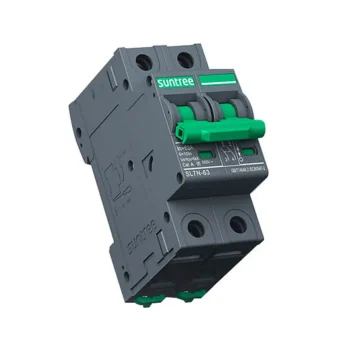
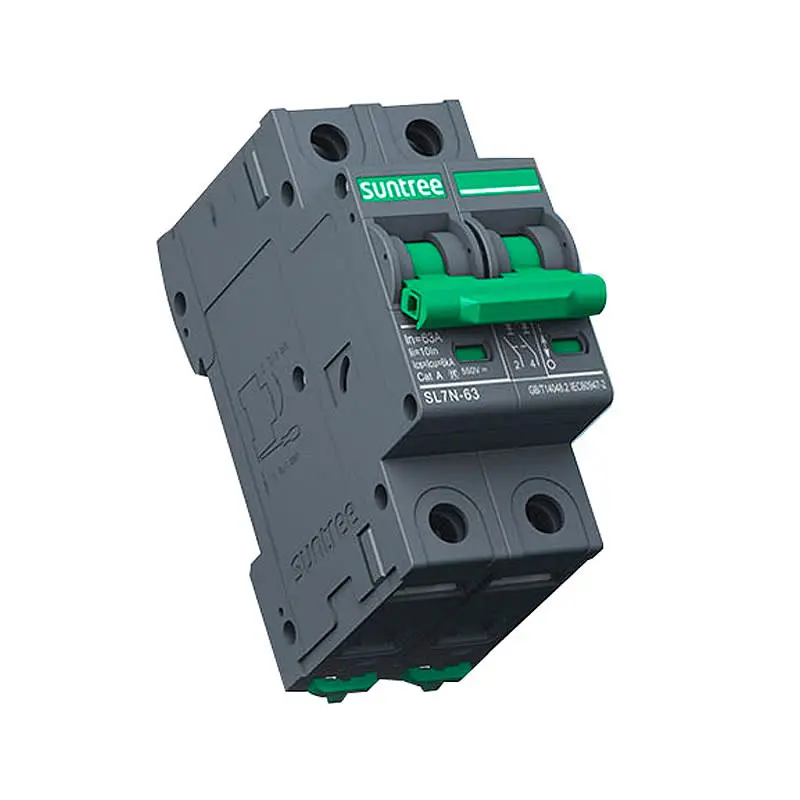
The Solar 2 Pole DC MCB 20A from Suntree — also marketed as the Suntree SL7N-63 2P 550VDC 20A DC Circuit Breaker, the Solar Double-Pole DC Breaker, or simply the 20A 2P Solar MCB — is the workhorse residential solar protection device that every modern Kenyan PV installation needs. Where the 1P 250VDC 10A sibling targets low-voltage DC applications (LED lighting, CCTV, 12V/24V battery systems), this 2P 550VDC 20A variant is engineered specifically for solar PV string protection: isolating residential panel strings of 6-8 modern panels from the inverter for service work, clearing string fault currents safely, and providing the DC-side protection that EPRA-compliant solar installations require.
This is a true solar PV breaker. The 550V DC voltage envelope handles the operating voltage of modern residential strings — 6 panels at typical 50V open-circuit voltage produces 300V rated Voc with cold-morning peaks around 320V; 8 panels produce 400V rated with cold-morning peaks around 425V. Both sit comfortably inside the 550V envelope with adequate safety margin for Kenya’s highland cool mornings. The 20A current rating handles modern 580-600W residential panels (typically 14-18A short-circuit current) with the standard 1.25× sizing margin, making it the natural specification for residential solar systems built around the Vestwood 5kW Hybrid Inverter and similar single-MPPT installations.
Most Kenyan solar installations get this breaker selection wrong by either over-specifying (using 4P 1000VDC commercial breakers on small residential systems, wasting money) or under-specifying (using 1P 250VDC low-voltage breakers on solar strings, creating safety hazards). The Solar 2 Pole DC MCB 20A — SL7N-63 2P 550VDC — sits exactly at the sweet spot for residential solar PV protection between these extremes.
Why your residential solar PV string genuinely needs this 2-pole breaker
Solar PV strings are bipolar circuits — they have a positive conductor and a negative conductor, both carrying significant DC voltage to earth. This is fundamentally different from grounded AC circuits where only the phase conductor is hot and the neutral sits at near-earth potential. For solar string protection, both conductors need to be switched simultaneously, which is why the 2-pole design is non-negotiable for this application. Four specific scenarios make this matter in practice:
- Service work on the inverter: Opening only the positive rail (1-pole breaker) leaves the negative rail still energised at full string voltage to earth. A technician working on the inverter is at risk if any inverter internal component has a fault path to earth. The 2-pole breaker removes both rails together, creating genuinely safe working conditions.
- Earth-fault isolation: If one rail develops a fault to earth (damaged panel insulation, chafed cable, rodent damage), single-pole switching leaves the faulted rail energised even when the breaker is open. The 2-pole breaker disconnects both rails simultaneously, breaking the fault circuit completely.
- Lightning and surge protection coordination: Surge protection devices in the combiner box need both rails disconnected during SPD replacement. A 2-pole breaker upstream of the SPD provides this; a 1-pole does not.
- EPRA compliance: Kenyan electrical regulations for solar PV installations require disconnection of both DC conductors at the array isolation point. Single-pole breakers do not meet this requirement on bipolar solar circuits.
Where the Solar 2 Pole DC MCB 20A actually belongs in Kenyan solar installations
This specific variant — 2-pole, 550V DC rating, 20A current rating — targets a clearly defined band of Kenyan residential solar installations. Eight specific application contexts cover the bulk of buyer use cases:
- Residential solar PV string isolation: Between the panel string and the inverter input, providing manual disconnection plus overcurrent and short-circuit protection on the DC side. The single most common application across Kenyan residential solar installations.
- SHLX 550V combiner box internal protection: Inside the SHLX-PV 1/1 550VDC combiner box, this 2P DC MCB provides the main disconnection device that switches both rails of the protected output simultaneously, complementing the dual fuses and the integrated SPD.
- Vestwood 5kW Hybrid Inverter DC input protection: Between the array output and the Vestwood inverter’s DC input terminals, providing local isolation for inverter service. The 20A rating comfortably handles the 5kW Vestwood’s MPPT current envelope.
- Off-grid solar charge controller DC side: Between the solar panel array and the charge controller input, allowing safe isolation of the panels for charge controller service or replacement without disconnecting the battery side.
- Hybrid solar system battery-side DC isolation: Between the battery bank and the hybrid inverter, providing isolation of the battery from the inverter for battery maintenance or replacement work.
- Residential solar PV string of 6-8 modern panels: The exact match between voltage envelope and string design — 6-panel strings produce 300V rated Voc, 8-panel strings produce 400V rated Voc, both well within the 550V breaker envelope.
- EPRA-compliant solar installation isolation: Provides the dual-pole DC disconnection that EPRA electrical regulations require at the array isolation point for residential solar PV systems.
- Small commercial rooftop solar (3-6 kW band): Shops, salons, clinics, and retail premises in the 3-6 kW capacity band where the array uses one or two parallel strings of 6-8 panels each.
When NOT to use the Solar 2 Pole DC MCB 20A
Wrong-specification breakers create either safety risks or wasted money. Three specific scenarios where this 20A 2P 550VDC variant is the wrong choice:
- Low-voltage DC applications (12V/24V/48V battery, LED, CCTV): The 550V rating is dramatically over-specified for these applications, and you’ll pay more than you need to. Use the SL7N-63 1P 250VDC 10A variant — sized correctly for low-voltage DC at lower cost.
- Larger residential solar strings (9+ panels) or small commercial: Strings of 9 or more modern panels reach cold-morning Voc above 450V, approaching the 550V breaker limit. For these installations step up to the SL7N-63 4P 1000VDC 32A or 4P 1000VDC 63A variants which handle longer strings with appropriate margin.
- Currents above 20A continuous: Larger panels (600W+ modern modules with Isc above 16A) or higher-current commercial inverters need a higher-current variant. The SL7N-63 2P 550VDC 32A or 2P 550VDC 63A variants handle the larger currents within the same voltage envelope.
Where this 2P 550VDC 20A fits in the Suntree SL7N-63 DC breaker family
| SL7N-63 Variant | Poles | Voltage | Current | Best For |
|---|---|---|---|---|
| SL7N-63 1P 250VDC 10A | 1P | 250V | 10A | LED lighting, CCTV, 12V/24V/48V battery, small off-grid |
| SL7N-63 2P 550VDC 20A (this page) | 2P | 550V | 20A | Residential solar PV strings (6-8 panels), Vestwood 5kW hybrid |
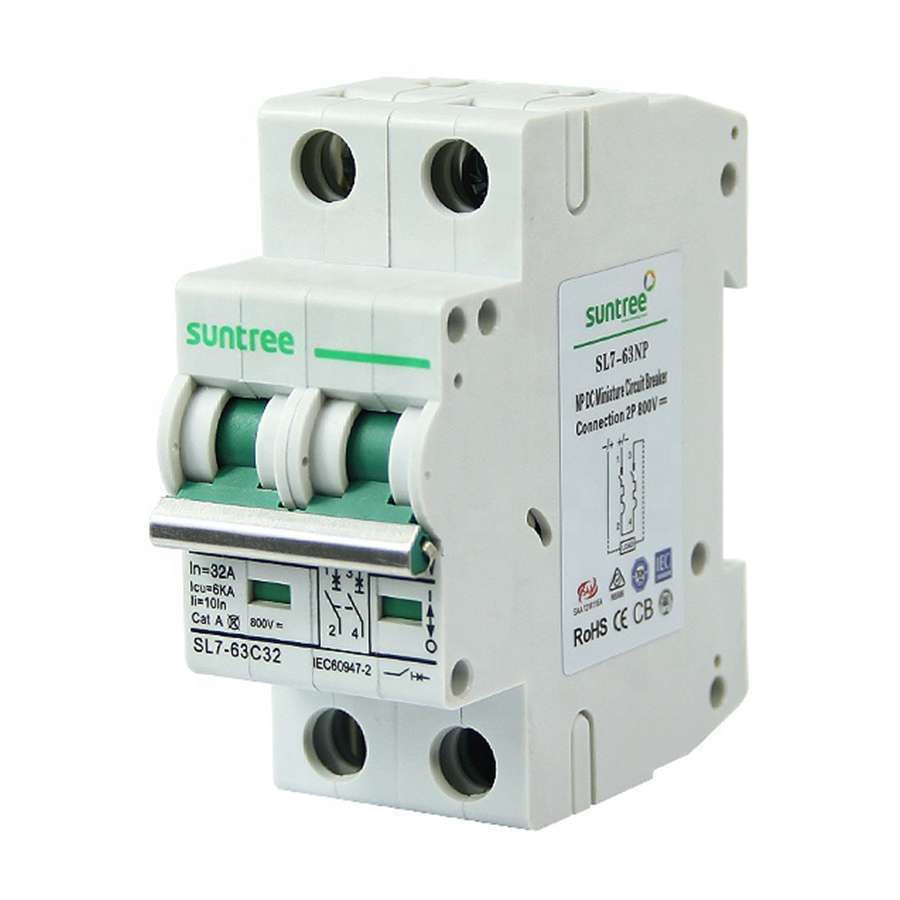
| SL7N-63 2P 550VDC 32A | 2P | 550V | 32A | Residential solar PV with higher-current panels, battery banks |
| SL7N-63 2P 550VDC 63A | 2P | 550V | 63A | Larger residential strings, hybrid inverter battery side |
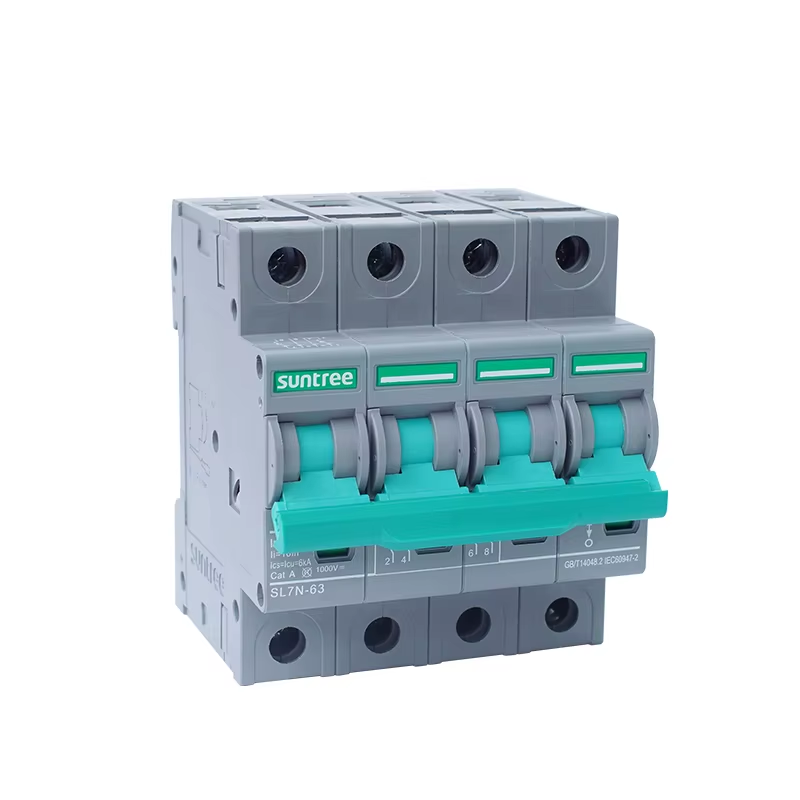
| SL7N-63 4P 1000VDC 20A | 4P | 1000V | 20A | Light commercial solar PV (12-15 panels), 1000V architecture |
| SL7N-63 4P 1000VDC 32A | 4P | 1000V | 32A | Medium commercial solar PV strings |
| SL7N-63 4P 1000VDC 63A | 4P | 1000V | 63A | Larger commercial solar PV, commercial battery isolation |
| SL7N-125D 4P 1500VDC 80A | 4P | 1500V | 80A | Utility-scale and large commercial solar |
The 2P 550VDC 20A is the entry-level solar PV string breaker — appropriate for the most common residential solar configuration in Kenya (6-8 modern panels feeding a 5kW class hybrid inverter). For larger residential systems or commercial installations, step up to the higher-current or higher-voltage variants.
What makes the Suntree SL7N-63 different from generic Kenyan alternatives
Solar DC MCBs in the Kenyan market range widely in build quality and underlying engineering. Many imported alternatives look superficially similar to the Suntree SL7N-63 but cut corners that only surface as problems years into the installation — often after the warranty has expired and the installer is no longer responsible. Four substantive build characteristics separate the Suntree from the budget alternatives:
- Genuine DC interruption capability: Suntree designs the SL7N-63 contact arrangement and the surrounding magnetic geometry specifically for breaking DC arcs at the marked voltage. Cheaper imports often reuse AC-rated breaker mechanisms inside a relabelled enclosure — the device looks the same but cannot reliably clear a DC fault at full operating voltage, and the first major fault event reveals the problem.
- Symmetric polarity engineering: The Suntree internal magnetic arc-blow design works equally in either current direction. Many DC breaker brands require strict positive/negative orientation at installation — get it wrong and the breaker is destroyed on its first opening event. The SL7N-63 forgives the kind of small wiring errors that arise when an installer is working at height in awkward conditions, which describes most Kenyan rooftop solar installations.
- Independent test verification: The SL7N-63 carries TUV Germany and CE European conformity marks — independent third-party verification that the device performs as the datasheet claims under actual DC fault conditions. Budget alternatives often display manufacturer-claimed ratings with no independent testing evidence.
- International standard compliance: Construction and performance meet IEC 60947-2 — the global benchmark covering industrial circuit breakers including the type-test regime that demonstrates safe DC interrupting capacity at the breaker’s rated voltage. EPRA inspectors recognise IEC 60947-2 compliance as evidence the protective scheme is properly specified.
Technical Specifications
| Specification | Value |
|---|---|
| Manufacturer | Suntree Electric Group |
| Series | SL7N-63 solar PV DC MCB family |
| Product Type | Solar-rated DC miniature circuit breaker |
| Rated Operating Voltage (Ue) | 550V DC continuous |
| Rated Current (Ie) | 20A continuous, thermal-magnetic |
| Pole Configuration | Double pole (2P) with common-trip linkage |
| Polarity Sensitivity | None — current can flow in either direction |
| Tripping Characteristic | Thermal + magnetic, tuned for solar PV duty |
| Short-Circuit Breaking Capacity (Icu) | 6 kA at rated DC voltage |
| Mechanical Operations | 20,000 on-off cycles before mechanism end-of-life |
| Electrical Operations | 10,000 cycles carrying full rated current |
| Contact Opening Gap | Greater than 9 mm — fast arc disruption |
| Arc Quenching | Labyrinth-style arc chute, optimised for DC interruption |
| Mounting | Click-mount onto 35mm standard DIN rail |
| Acceptable Cable Size | Solar PV cable from 2.5mm² up to 10mm² copper |
| Ambient Temperature | Operates from -25°C through +70°C |
| Storage Conditions | -40°C through +80°C off-state |
| Compliance | IEC 60947-2 type-tested; TUV (Germany) and CE marked |
| Environmental Classification | Pollution Degree 2 industrial use |
| Insulation Design | Class II double insulation throughout |
| Position Status | Front-face window indicating ON or OFF state |
| Maintenance Lockout | Handle accepts padlock for lockout/tagout |
| Footprint on DIN rail | Two modules wide (36mm total) |
Engineering Features That Matter for Kenyan Solar PV Installations
- True 2-pole common-trip mechanism: Both contacts open together when the breaker operates manually or trips automatically — essential for bipolar solar PV circuits where both rails must disconnect simultaneously to provide genuine isolation.
- 550V DC voltage envelope: Accommodates residential solar PV strings of 6-8 panels with safety margin for Kenya’s highland cool-morning voltage peaks, while remaining cost-effective compared to commercial 1000V variants.
- 20A current rating with 1.25× margin design: Handles modern residential panels with Isc up to 16A continuously, providing the standard solar industry sizing margin while clearing genuine fault currents promptly.
- Bi-directional polarity tolerance: Mountable with current flowing either direction through the breaker — removes the field-error category of installation mistakes common with polarity-sensitive DC breakers, particularly valuable when Kenyan rooftop installations are completed under time pressure or in awkward access conditions.
- Labyrinth arc-chute design: Specifically engineered for DC arc quenching, with opening distance greater than 9mm for rapid arc cutoff under fault conditions at full rated voltage.
- Pairs cleanly with SHLX 550V combiner box: Designed to work alongside the Suntree SHLX series of combiner boxes that share the 550V voltage envelope, supporting integrated protection schemes for residential solar.
- Matches Vestwood 5kW Hybrid Inverter envelope: The 550V voltage rating aligns with Vestwood 5kW Hybrid Inverter MPPT voltage range, and the 20A current handles the inverter’s DC input current envelope with margin.
- 2-module DIN rail footprint: 36mm wide, fitting cleanly in residential solar distribution boxes alongside AC consumer unit breakers without crowding.
- EPRA-compliant 2-pole isolation: Meets the dual-conductor disconnection requirement for solar PV installations under Kenyan electrical regulations, supporting EPRA inspection documentation.
Typical Kenyan Solar PV Installation Scenarios
- Residential solar PV installations across Kiambu, Limuru, Tigoni, Karen, Runda, Muthaiga, Spring Valley, and Lavington — the Nairobi and surrounding upmarket areas where Vestwood 5kW hybrid installations are increasingly common
- Highland residential solar in Murang’a, Nyeri, Embu, Meru, and Nyandarua counties where chilly dawn conditions drive panel string voltages toward the top of the safe operating envelope
- Coastal residential solar in Mombasa, Diani, Watamu, and Malindi properties where the 2-pole isolation supports salt-air environment maintenance requirements
- Lake Victoria basin solar in Kisumu, Siaya, Migori, Busia, and Bungoma counties where lightning frequency makes the bi-directional polarity tolerance and IEC 60947-2 compliance particularly valuable
- Off-grid weekend home solar in Naivasha, Maasai Mara, Aberdares, Mount Kenya foothills, and Lake Naivasha where 6-8 panel strings feed standalone hybrid inverters
- Small commercial solar installations on shops, salons, clinics, and retail premises across Nairobi CBD, Westlands, Mombasa, Kisumu, Nakuru, and Eldoret commercial districts
- Rural clinic and school solar installations sized between 3-6 kW with single-string residential-class hybrid inverters
- Religious institution solar at churches and mosques across Kenya using residential-class hybrid inverters for daytime self-consumption
- Agricultural processing solar at smallholder dairy operations and coffee processing centres using residential-class hybrid inverters
- Solar carport residential installations at upmarket properties using residential-class hybrid inverters with carport-mounted PV arrays
- EPRA-compliance retrofit installations where existing solar systems are being upgraded to meet current Kenyan electrical regulations
- Hybrid solar plus battery storage installations where the 2P 550VDC breaker provides both PV-side and battery-side isolation as required
Pairing the Solar 2 Pole DC MCB 20A with other Bicity Solar products
This breaker rarely operates in isolation — most Kenyan solar installations combine it with other protective components and system devices for complete coverage. Three common architectural patterns appear in residential solar installations:
- String + SL7N-63 2P 20A + inverter architecture: The simplest residential pattern, where a single solar PV string of 6-8 panels feeds directly through this 2P 20A breaker into a hybrid inverter such as the Vestwood 5kW Hybrid Inverter. The breaker provides manual disconnection plus overcurrent and short-circuit protection on the DC side.
- String + SHLX 550V combiner box + SL7N-63 2P 20A + inverter: A more comprehensive residential pattern, where the panel string feeds the SHLX-PV 1/1 550VDC combiner box (containing the SL7N-63 2P MCB internally as the main disconnection plus dual fuses and SPD), with the combined protected output then running to the inverter. Provides both fuse and surge protection alongside the main breaker.
- Multi-string installations with multiple 2P breakers: Larger residential installations with two or more parallel strings use one SL7N-63 2P 20A breaker per string at the combiner inputs, with a higher-current main breaker on the combined output to the inverter. Common in 6-10 kW residential systems with east-west split arrays.
Installation Notes for Kenyan Solar PV Conditions
Installation of the Solar 2 Pole DC MCB 20A must be carried out by an EPRA-registered solar electrician with documented solar PV installation experience. Seven practical considerations apply to residential solar installations using this breaker:
First, voltage envelope verification — calculate your specific panel string’s cold-morning open-circuit voltage from the panel datasheet’s Voc and temperature coefficient. For a typical 580W panel with 50V rated Voc and -0.27%/°C temperature coefficient, a 6-panel string produces 300V rated Voc with cold-morning peaks around 320V, comfortably within the 550V breaker rating. An 8-panel string produces 400V rated Voc with cold-morning peaks around 425V, also within rating. Strings of 9 or more panels approach the rating limit and warrant moving to a higher-voltage breaker variant.
Second, current rating verification — calculate the panel string’s short-circuit current (Isc) from the datasheet and multiply by 1.25 for the required breaker rating. Modern 580W panels typically have Isc around 14A, with 1.25 × 14 giving 17.5A — the 20A breaker provides appropriate headroom over normal operating peaks while still clearing genuine fault conditions. Larger 600-625W panels with Isc above 16A may warrant moving to the 2P 32A variant for adequate margin.
Third, polarity orientation — the SL7N-63 family is bi-directional, but professional practice still labels positive and negative consistently across an installation for clear future fault investigation. Maintain consistent line/load labelling even though the breaker tolerates either orientation.
Fourth, terminal torque application — apply manufacturer-specified torque to both terminals during installation. At 20A continuous operation in solar PV service, loose terminals generate measurable resistive heating that progressively degrades the joint over months. Document torque values in commissioning records and re-torque annually as part of EPRA-compliant maintenance.
Fifth, cable sizing — match the upstream and downstream solar PV cable to the actual operating current with appropriate voltage drop margin. For typical 20A operation with cable runs of 15-25 metres (rooftop array to ground-floor inverter), 4mm² solar PV cable handles the ampacity comfortably; longer runs above 25 metres warrant stepping up to 6mm². The cable must be solar-PV-rated (marked PV or TUV) for UV exposure and DC service.
Sixth, DIN rail enclosure selection — mount the breaker in a sealed IP65 enclosure for outdoor installations (typical for SHLX combiner box deployment at the array side) or IP54 enclosure for protected outdoor locations. Indoor inverter cabinet installations can use IP20 distribution boxes provided the cabinet itself maintains appropriate ingress protection.
Seventh, commissioning documentation — residential solar installations subject to EPRA inspection require documented commissioning including insulation resistance testing of the protected circuit, polarity verification at the breaker, breaker operation testing under no-load conditions, and earth-loop impedance measurement on the protective circuit. Retain documentation for EPRA inspection and any future warranty claims.
Designing a residential solar PV installation with Vestwood 5kW Hybrid Inverter or similar?
Match the Solar 2 Pole DC MCB 20A (Suntree SL7N-63 2P 550VDC) to your specific panel string, combiner box, and inverter alongside the right cables, surge protection, and earth bonding — start with our Solar Calculator for sizing the protection scheme, or describe your residential installation through My Quote for a complete EPRA-compliant DC protection specification.