Description
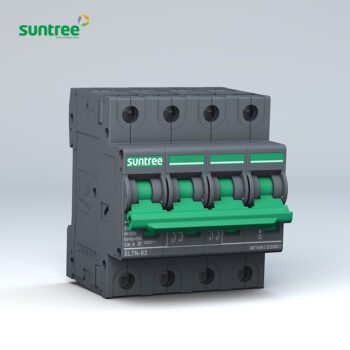
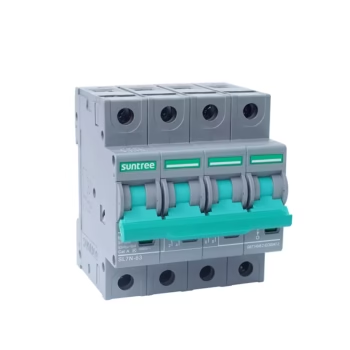
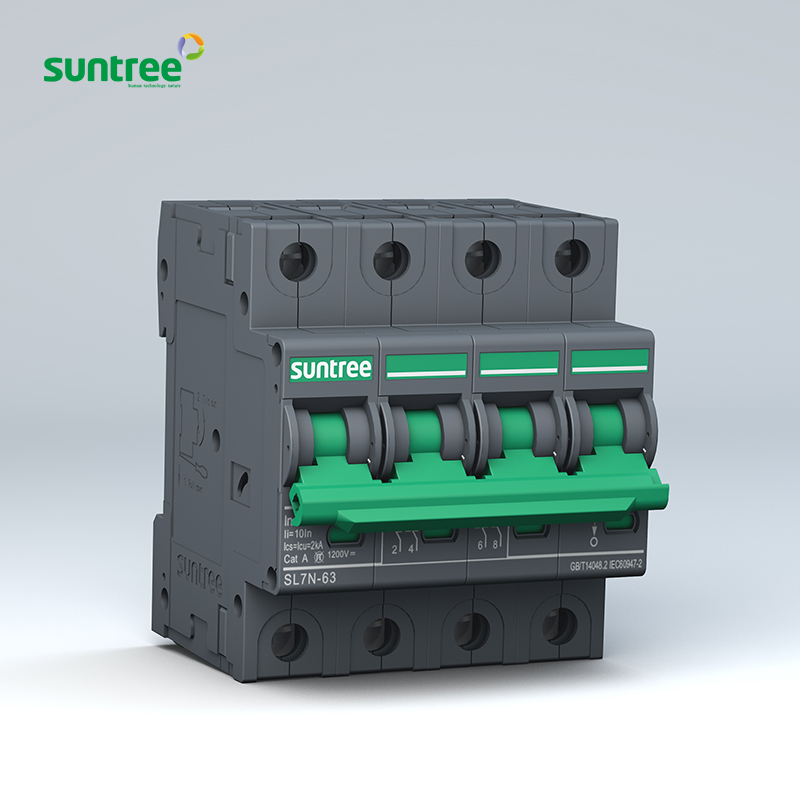
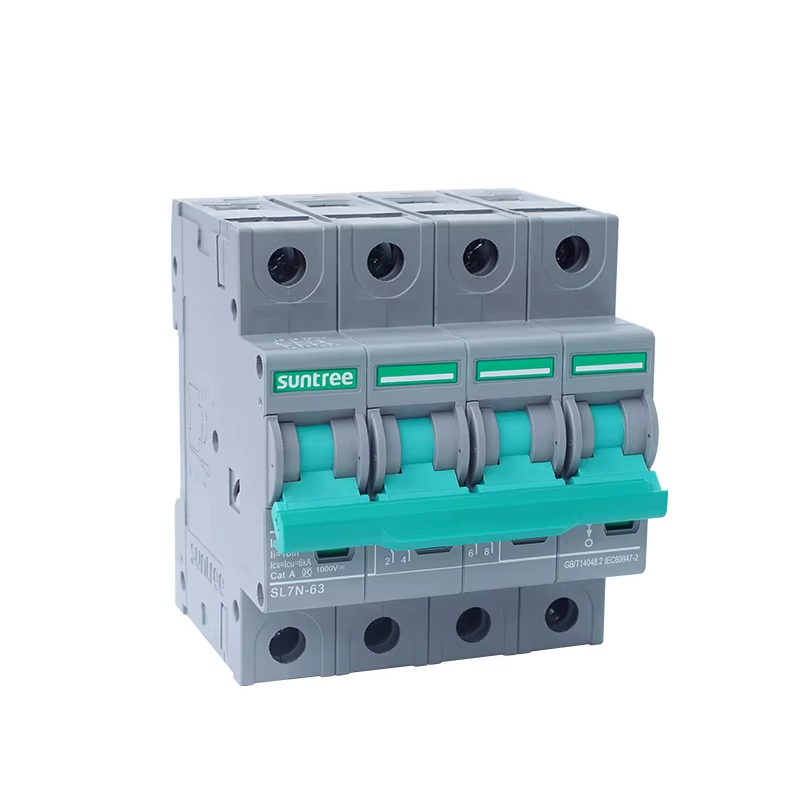
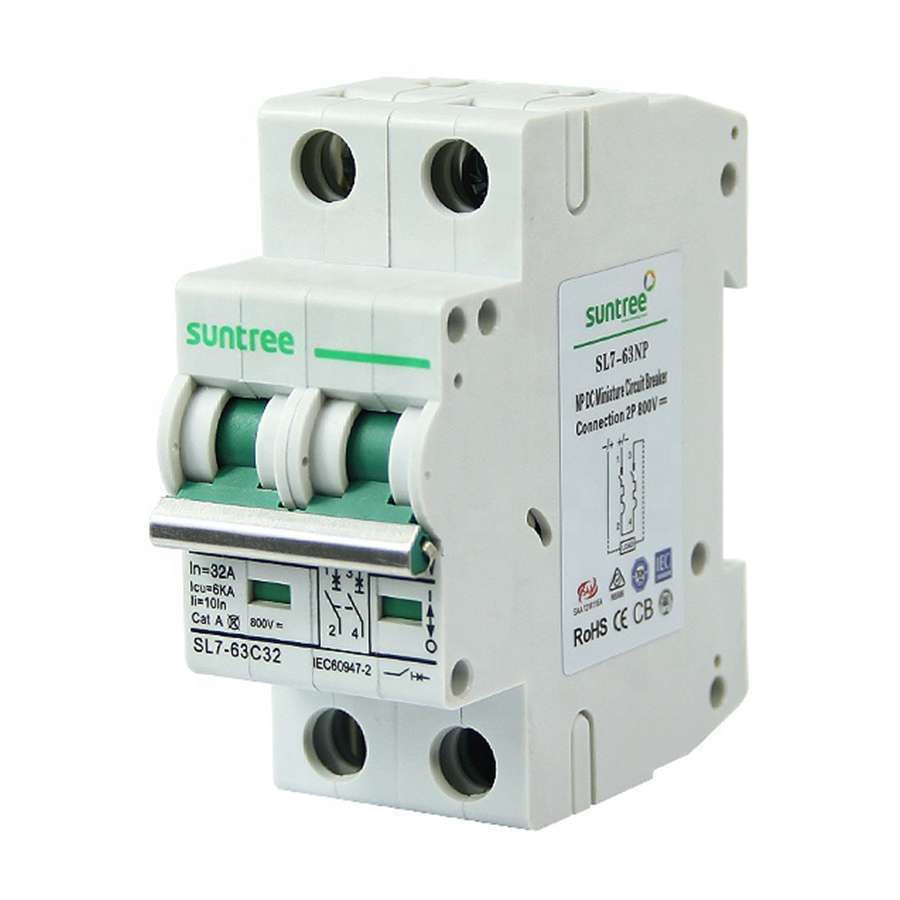
Solar 4 Pole DC MCB 32A Kenya — Suntree SL7N-63 4P 1000VDC DC Circuit Breaker for Mid-Commercial Solar & EV Charging
The Solar 4 Pole DC MCB 32A from Suntree — circulating across the Kenyan solar market under several names including Suntree SL7N-63 4P 1000VDC 32A DC Circuit Breaker, Suntree Quad-Pole DC MCB 32A, the 32A Four-Pole 1000V Solar Breaker, and the Mid-Commercial Solar DC Breaker — sits in the volume sweet spot of the commercial protection range. It addresses the mid-band of commercial Kenyan solar installations: systems too large for the 20A 4P entry variant but not yet at the scale that requires the heavier 63A 4P top-tier variant.
The product profile matches a specific buyer who has moved beyond first-attempt commercial installations toward more serious capacity. Where the 20A 4P 1000V handles single-string commercial PV in the 8-15 kW band with one cable feeding the inverter, this 32A 4P 1000V variant accommodates the next architectural step: commercial systems with two parallel strings combining at the inverter input, mid-commercial inverters in the 10-15 kW class, modern high-output panels with Isc above 16A pushing single-string currents toward 20A continuous, and the emerging Kenyan EV charging infrastructure where commercial-tier DC protection appears at workplace chargers and hospitality forecourts.
The 32A capacity within the 4P 1000V architecture matters because it covers the band where most growing Kenyan small businesses actually land when they invest seriously in solar generation. Below this range the 20A variant suffices; above it the 63A variant takes over. The 32A sits at the natural mid-point that fits the largest population of commercial buyers — established retailers expanding to multiple branches, restaurants moving from residential-grade backup to genuine commercial generation, clinics adding diagnostic capacity that warrants reliable daytime power, and institutional facilities upgrading from grid-only operation to solar self-consumption with battery backup.
Why 32A becomes the right specification within the 4P 1000V family
The transition from 20A 4P 1000V to 32A 4P 1000V happens at clear technical thresholds rather than vague capacity preferences. Six concrete scenarios push the answer toward this 32A variant:
- Commercial PV with two parallel strings combining: Installations where two strings of 12-15 modern panels each combine into a single inverter input. Each string carries 13-16A; the combined output reaches 26-32A continuous, requiring the 32A breaker rating with 1.25× margin.
- Higher-Isc commercial panels (Isc 16-22A): Modern 625-650W TOPCon and 700W HJT panels typical of newer commercial installations have short-circuit current values reaching 17-22A. The 1.25× sizing rule pushes the required breaker rating to 21-28A — well beyond the 20A envelope but within the 32A capacity.
- Larger commercial inverter DC input protection: Inverters in the 10-15 kW commercial class (Sungrow SG10-15K range, Solis larger commercial models, GoodWe mid-commercial range) handle DC input currents that approach 25-30A continuous at maximum operating point. The 32A breaker provides protection without nuisance tripping during sustained high-irradiance operation.
- EV charging infrastructure DC-side protection: Commercial EV charging installations at workplace car parks, hotel forecourts, restaurant car parks, and emerging EV charging networks use DC-side protection at the 20-30A range, fitting the 32A breaker capacity. The 2-pole arrangement on bipolar 1000V circuits provides genuine isolation during charger service.
- Industrial DC process loads: Light industrial Kenyan operations using DC-process equipment (electroplating control circuits, certain motor drives, DC machinery in food processing) often run at currents in the 20-30A range on 1000V architecture, matching the 32A breaker envelope.
- Mid-commercial multi-roof PV installations: Commercial premises with multiple roof sections each carrying a separate string typically combine 2-3 strings into a single inverter through this 32A breaker on the combined output, with individual smaller 20A breakers protecting each parallel string upstream.
Where the 32A 4P 1000V is the wrong choice
Wrong-specification breakers either waste money or create coverage gaps. Four scenarios where this variant is not the right answer:
- Smaller commercial installations under 10 kW: Small commercial systems with single-string operation at 13-16A continuous fit the 20A 4P 1000V variant cleanly. Buying the 32A variant for these installations wastes money without providing additional protection benefit. Use the 20A variant for the 8-15 kW capacity band.
- Larger commercial systems above 18 kW: Commercial installations exceeding 18 kW continuous load or using three or more parallel strings combining at the inverter need the 63A variant in the 4P 1000V family. The 32A breaker may technically operate at boundary loads but nuisance-trips during peak generation.
- Residential systems on 550V architecture: Smaller homes running 6-8 panel strings inside the 550V voltage band get the right protection from the 2P 550V variants at noticeably lower cost. Putting the 4P 1000V 32A onto a 550V residential circuit is dramatic over-specification with no real safety or performance benefit.
- Utility-scale installations on 1500V architecture: Modern utility-scale solar farms operate at 1500V architecture exceeding the 1000V breaker envelope. The SL7N-125D 4P 1500VDC 80A variant handles these installations; the 4P 1000V family cannot safely interrupt 1500V circuits.
How this 32A relates to the rest of the SL7N protection range
The SL7N protection range spans eight distinct models covering low-voltage DC through utility-scale solar. Pole count and voltage class together define the application tier; the current rating then defines capacity within that tier. The position of the 32A 4P 1000V variant becomes clear when mapped against the family:
| Variant | Application Band | Typical System Capacity |
|---|---|---|
| 1P / 250V / 10A | Low-voltage DC auxiliary protection | LED lighting, CCTV, 12V-48V battery isolation |
| 2P / 550V / 20A | Residential PV entry tier | 3-5 kW homes with Vestwood 5kW Hybrid |
| 2P / 550V / 32A | Residential PV mid-range | 5-8 kW homes, Vestwood 6kW, hybrid battery duty |
| 2P / 550V / 63A | Residential PV top tier | 8-12 kW homes, large lithium banks, combiner outputs |
| 4P / 1000V / 20A | Small commercial PV entry tier | 8-15 kW single-string commercial systems |
| 4P / 1000V / 32A — this product | Mid-commercial PV tier | 10-18 kW with two-string combining; EV charging; light industrial DC |
| 4P / 1000V / 63A | Larger commercial PV tier | 18-30 kW commercial systems with multi-string combining |
| 4P / 1500V / 80A (SL7N-125D) | Utility-scale solar | Solar farms and the largest commercial rooftop installations |
The 32A 4P 1000V occupies the volume centre of the commercial range — appropriate for the largest population of Kenyan commercial buyers who have moved past entry installations but stay within the mid-commercial band that 1000V architecture serves cleanly.
EV charging infrastructure: an emerging Kenyan application
The Kenyan EV charging market has begun moving from concept to operational deployment over the past 18 months. Workplace chargers at corporate offices in Westlands, Upper Hill, and Karen-Lavington commercial zones; hotel and restaurant forecourt chargers along the major tourism corridors; petrol station forecourt installations at fuel retailer pilot sites; and shopping centre chargers at upmarket retail destinations are all beginning to appear. Most install Level 2 AC chargers drawing 7-22 kW AC from the building electrical supply, frequently backed by solar generation plus battery storage to manage demand charges and provide outage resilience.
The DC-side protection on these solar-fed EV charging installations sits at the commercial 1000V tier — the solar array uses 1000V architecture for cable cost efficiency at the larger commercial scale, and the DC bus between the array, battery, and inverter feeding the charger operates at currents in the 20-28A range during sustained charging operation. The 32A 4P 1000V breaker handles this duty cycle while providing the 4-pole isolation that commercial-tier service work requires.
Specific installation positions in solar-fed EV charging architectures include: between the panel array (or combiner box output) and the hybrid inverter DC input on the PV side; between the lithium battery bank and the hybrid inverter on the battery side; and on the DC bus between the inverter and any auxiliary DC components (DC-coupled charge controllers, certain DC fast-charge interfaces). The same 32A breaker variant works in all positions with proper sizing calculation for each specific circuit.
Why the 4-pole architecture is mandatory at the 32A 1000V combination
The 4-pole configuration in this 32A breaker handles the same fundamental engineering challenge that all 4P 1000V variants address: safe interruption of DC arcs at 1000V circuit voltage. At the lower voltage classes (250V and 550V) a 2-pole arrangement extinguishes arcs reliably within the contact gap and labyrinth quench geometry. At 1000V the arc grows beyond what 2-pole quench can handle — the plasma path persists across the gap, contacts remain conductively connected even when mechanically separated, and the breaker fails to provide actual isolation.
The 4-pole arrangement solves this through series voltage division. Four contact pairs arrange as two pairs in series, dividing the 1000V bus voltage so each pair handles approximately 500V during opening. Each pair operates within the safe envelope of its individual labyrinth arc-chute and magnetic blowout system. The common-trip mechanism opens all four contacts together, providing complete galvanic isolation of the 1000V bus through the four series-arranged contact pairs.
The 32A current rating doesn’t change this fundamental requirement — the 4-pole architecture is mandatory at 1000V regardless of the current rating. A 2-pole 1000V 32A device would fail catastrophically on its first major fault clearance event. The 4-pole arrangement is engineering necessity, not feature differentiation.
Technical Specifications
| Parameter | Value |
|---|---|
| Bicity SKU | BC-DCB-1000V-32A-4P |
| Manufacturer name | Suntree Electric Group (China) |
| Series | SL7N-63 commercial 1000V solar DC breaker platform |
| Category | Miniature circuit breaker rated for commercial solar PV DC service |
| Maximum operating voltage | 1000V DC sustained continuous |
| Continuous current | 32A thermal — mid-tier rating in the 4P 1000V series |
| Pole structure | Four poles arranged as two pairs in series per polarity |
| Per-pair voltage handling | Approximately 500V during opening — within safe arc-quench envelope |
| Polarity requirement | None — install in either current direction safely |
| Trip curve | Thermal slow-overload element plus magnetic instant-trip element, tuned for solar duty |
| Icu interruption rating | 6 kA at rated 1000V DC |
| Manual operation life | 20,000 cycles typical before mechanism wear-out |
| Operation under load | 10,000 cycles at full rated current typical |
| Contact gap per pair | More than 9 millimetres separation when open |
| Arc clearance approach | Magnetic blowout deflects arc into labyrinth chute geometry, sized for 500V per pair |
| Installation | Standard 35mm DIN rail snap-mount |
| Cable acceptance | Solar PV stranded copper from 4mm² through 16mm² |
| Operating ambient | -25°C through +70°C |
| Storage | -40°C through +80°C de-energised |
| Type test compliance | IEC 60947-2 industrial; TUV Germany mark; European CE conformity |
| Pollution class | Pollution Degree 2 industrial |
| Insulation construction | Class II — double-insulated housing |
| Front panel indicator | Position window shows OFF or ON clearly |
| Lockout provision | Padlock hole through operating handle for lockout-tagout |
| DIN rail width | 4 modules total (72mm) |
| Approximate net weight | 0.52 kg |
Engineering Features That Matter for Mid-Commercial Kenyan Solar
- Quad-pole common-trip mechanism for 1000V interruption: The four contact pairs in series handle the 1000V bus through voltage division, with each pair within its safe arc-quench envelope — the only architecture that reliably interrupts 1000V DC in compact DIN-rail mountable format.
- 32A continuous capacity for mid-commercial duty: Internal current-carrying parts dimensioned for sustained 32A operation without thermal runaway, with the standard 1.25× margin protecting circuits drawing up to 26A continuous — matching two-parallel-string commercial arrays and higher-Isc panel installations.
- 1000V envelope for commercial 12-15 panel strings: Accommodates the voltage range of commercial solar arrays operating on 1000V architecture, where panel strings of 12-15 modern modules produce 600-750V rated Voc with cold-morning peaks reaching 800V — well within the 1000V envelope with substantial safety margin.
- Bi-directional installation flexibility: The breaker accepts current in either direction without compromising arc clearance or fault interruption capability — removes one entire category of installation error that affects polarity-sensitive DC breakers from competing manufacturers.
- Heavy cable terminal capacity up to 16mm²: Larger terminal openings than the 20A 4P variant accommodate the heavier conductor cross-sections that 32A continuous duty in long commercial cable runs (often 30-50 metres in commercial premises) may require for voltage drop control.
- Compatible with Sungrow SG10-15K and similar mid-commercial inverters: The 1000V voltage envelope, 32A current capacity, and 4-pole interrupting capability align with the protection requirements of mid-commercial string inverters from Sungrow, Huawei, Solis, GoodWe, and similar mainstream manufacturers serving the Kenyan commercial market.
- EV charging infrastructure DC-side protection: Suitable for the emerging Kenyan EV charging market at workplace, hospitality, and retail forecourt installations where DC-side currents on solar-fed charging architectures sit in the 20-28A continuous range.
- Industrial-grade lockout/tagout provision: The padlock hole supports the formal lockout/tagout discipline that commercial maintenance procedures require during service of mid-commercial solar installations.
- 72mm DIN footprint for commercial distribution architecture: The 4-module width integrates cleanly with commercial-grade DC distribution boards used in 10-18 kW solar installations, providing physical separation from adjacent breakers and adequate ventilation around the device body.
- EPRA inspection compliance: IEC 60947-2 type-test compliance plus TUV and CE marks support the formal commercial inspection documentation that mid-commercial Kenyan solar installations require for EPRA approval and commercial insurance.
Typical Kenyan Installation Scenarios for the 32A 4P 1000V Variant
- Mid-commercial solar installations at larger retail premises across Nairobi Westlands, Upper Hill, Karen-Lavington-Hurlingham commercial corridor, Mombasa Nyali-Bamburi commercial strip, Kisumu Milimani and Kondele commercial zones, Nakuru Section 58 and Kenyatta Avenue corridor, Eldoret town centre, and Thika trading area in the 10-18 kW capacity band
- Larger hotel and hospitality solar at coastal and inland properties (Diani Beach hotels, Watamu resort properties, Malindi seafront hotels, Naivasha lakeside lodges, Maasai Mara camps, Aberdares lodges, Nanyuki and Mt Kenya tourism properties) using 10-18 kW systems with two-string combining
- Restaurant solar at larger establishments where kitchen equipment, refrigeration, lighting, and HVAC create substantial daytime loads matched to 10-18 kW solar generation profiles
- Larger educational facility solar at universities, colleges, and private school campuses where 10-18 kW systems power administration blocks, computer laboratories, dormitory utility loads, and weekend congregational events
- Hospital and larger clinic solar where medical refrigeration, diagnostic imaging, lighting, and HVAC justify 10-18 kW capacity systems with battery backup for outage resilience
- Religious institution solar at larger cathedrals, central mosques, and Hindu temples where mid-week and weekend congregations create peaks managed through solar generation plus battery storage
- Larger residential installations migrating to 1000V architecture — premium 12-18 kW homes where the run between elevated rooftop arrays and a ground-floor inverter cabinet is long enough that the cable-cost arithmetic favours stepping up the voltage class
- EV charging workplace installations at corporate offices in Westlands, Upper Hill, Karen-Lavington commercial zones where employees and visitors use Level 2 chargers backed by solar plus battery
- EV charging hospitality and forecourt installations at hotels, restaurants, and petrol station pilot sites where charger backup uses 10-18 kW solar plus battery infrastructure
- Solar carport installations at office buildings, shopping centres, hospital car parks, and institutional facilities where canopy-mounted arrays use 1000V architecture for component cost optimisation
- Light industrial solar at smaller factories, processing facilities, agricultural cold storage operations (smaller tea factories, coffee mills, dairy processing centres), and small manufacturing premises with 10-18 kW capacity systems
- NGO and humanitarian facility solar at displaced persons camp central facilities, larger refugee operations headquarters, and emergency response coordination centres using 10-18 kW capacity
- Off-grid larger commercial installations at eco-lodges, conservation facility headquarters, remote tourism camps, and wildlife sanctuary operations using 10-18 kW capacity with 1000V DC links
Pairing the 32A 4P 1000V with Bicity Solar ecosystem components
This mid-commercial breaker integrates with several Bicity Solar products across the commercial solar architecture. Four integration patterns dominate the 10-18 kW commercial installations:
- Two parallel 1000V strings + 32A combiner output + commercial inverter: The most common mid-commercial architecture. Two parallel strings of 12-15 modern panels each combine through a SHLX 1000V combiner box, with this 32A breaker on the combined output running to the commercial string inverter DC input. Individual 20A breakers may protect each parallel string upstream within the combiner.
- Single 1000V string + 32A MCB + larger commercial inverter: Mid-commercial installations using a single longer string (15 panels) with modern high-Isc panels where the single-string continuous current reaches 20-25A, requiring the 32A breaker rating that the smaller 20A variant cannot handle.
- Solar carport array + 32A MCB + commercial hybrid inverter + EV charger: Workplace and hospitality solar carport installations where canopy-mounted arrays feed through this 32A breaker to a commercial hybrid inverter, which in turn supplies workplace EV chargers with solar-derived AC power.
- Mid-commercial hybrid system + 32A MCB on battery side: Commercial installations with substantial lithium battery banks (15-25 kWh capacity) where battery-side currents reach 25-30A continuous during high-load periods, requiring the 32A breaker rating for nuisance-trip-free operation.
Installation Notes for Mid-Commercial Kenyan Solar
The 32A 4P 1000V handles installations that sit clearly above residential complexity. Commercial commissioning must be performed by an EPRA-licensed solar electrician with documented mid-commercial solar installation track record. Seven practical considerations apply specifically to 32A 1000V architecture work:
First, current capacity calculation — determine the actual continuous current of the protected circuit from panel string Isc, combiner output sum, or inverter DC input rating depending on the specific installation position. For 1000V string installations with modern 600W+ panels of Isc around 16-18A, the 1.25× factor gives required breaker rating of 20-22.5A — comfortably within the 32A breaker. For two-string combiner outputs combining 13-15A per string, the combined current reaches 26-30A — at the upper end of the 32A rating but within capacity.
Second, voltage envelope verification at the 1000V class — work out the worst-case cold-morning open-circuit voltage of the string from datasheet Voc and the published temperature coefficient. For 15-panel strings of 50V Voc modern panels, rated string Voc is 750V with cold-morning peaks around 800V — well within the 1000V envelope. Strings of 16-18 panels approach the rating limit and warrant explicit cold-temperature verification before specification.
Third, polarity labelling discipline — the SL7N-63 platform tolerates current flowing in either direction, so the breaker installs safely regardless of orientation. Commercial practice still demands consistent positive/negative tagging across the entire installation, because future fault investigation depends on the rest of the protection scheme following predictable conventions.
Fourth, terminal torque application at the higher current level — apply manufacturer-specified torque to all four conductor terminations using a calibrated torque wrench. At sustained 32A operation in commercial premises that may run from sunrise to sunset, loose terminals generate progressive heating that damages cable insulation within months at the higher current level. Document torque values in commissioning records.
Fifth, cable selection scaled for 32A 1000V duty — every conductor in the protected loop, from the array down to the inverter terminal, must be solar PV cable carrying the PV or TUV marking on its sheath along with an explicit 1000V DC voltage rating. For 25A continuous duty over 30-40 metre commercial cable runs, 6mm² stranded copper PV cable handles ampacity with voltage drop within target. Longer runs above 40 metres warrant stepping up to 10mm² to limit losses.
Sixth, commercial-grade enclosure selection — for direct outdoor combiner mounting at the array end of the system, install in an IP65 industrial-class enclosure; for protected outdoor locations sheltered from rain, IP54 is adequate; for indoor inverter cabinets in a controlled building environment, commercial IP20 distribution boards work. Residential consumer units lack the insulation clearances required for 1000V DC operation at the higher current level.
Seventh, mid-commercial commissioning documentation — installations subject to EPRA inspection and commercial insurance assessment require formal commissioning paperwork covering insulation resistance testing at the 1000V class on the protected circuit, polarity verification at each of the four breaker terminations, manual operation testing under no-load conditions to verify smooth four-pole common-trip operation, current measurement under operating load to confirm the actual circuit current matches design expectations, and earth-loop impedance measurement on the protective conductor path. Keep records on file through warranty and beyond for commercial insurance, fault investigation, and potential resale due diligence.
Designing a 10-18 kW mid-commercial solar installation, EV charging infrastructure with solar backup, or larger institutional solar project in Kenya?
Specify the Solar 4 Pole DC MCB 32A (Suntree SL7N-63 4P 1000VDC, SKU BC-DCB-1000V-32A-4P) within a complete protection scheme covering combiner architecture, solar-PV-rated cables at the 1000V class, commercial-grade inverter pairing, and EPRA-ready commissioning documentation — open the Solar Calculator to scope the mid-commercial protection requirements, or describe your specific project through My Quote for a complete bill of materials with installation guidance.