Description
Solar 4 Pole DC MCB 20A Kenya — Suntree SL7N-63 4P 1000VDC DC Circuit Breaker for Small Commercial Solar PV
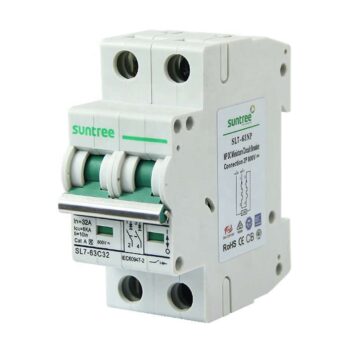
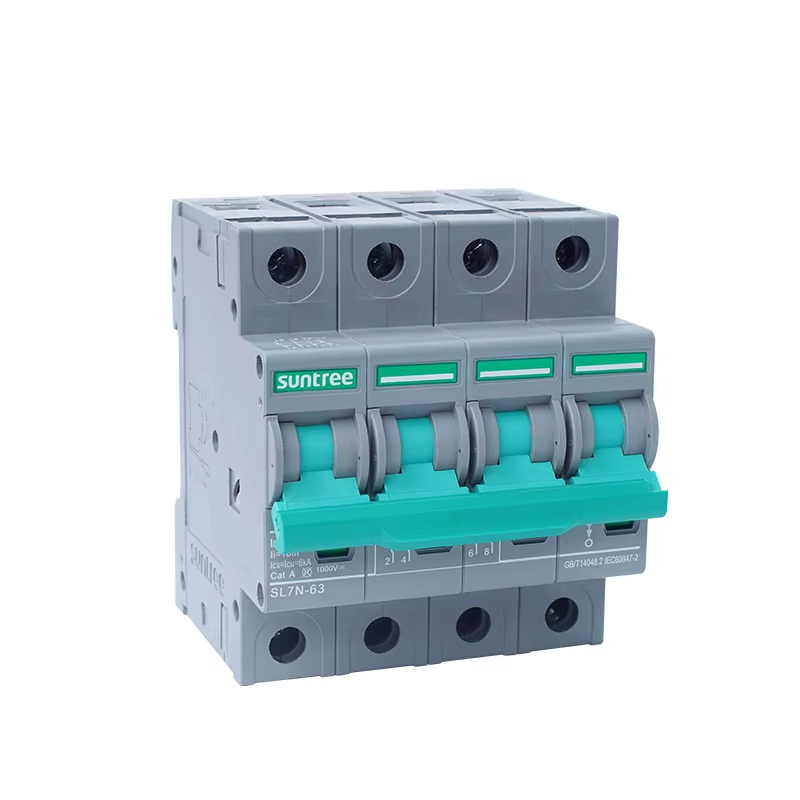
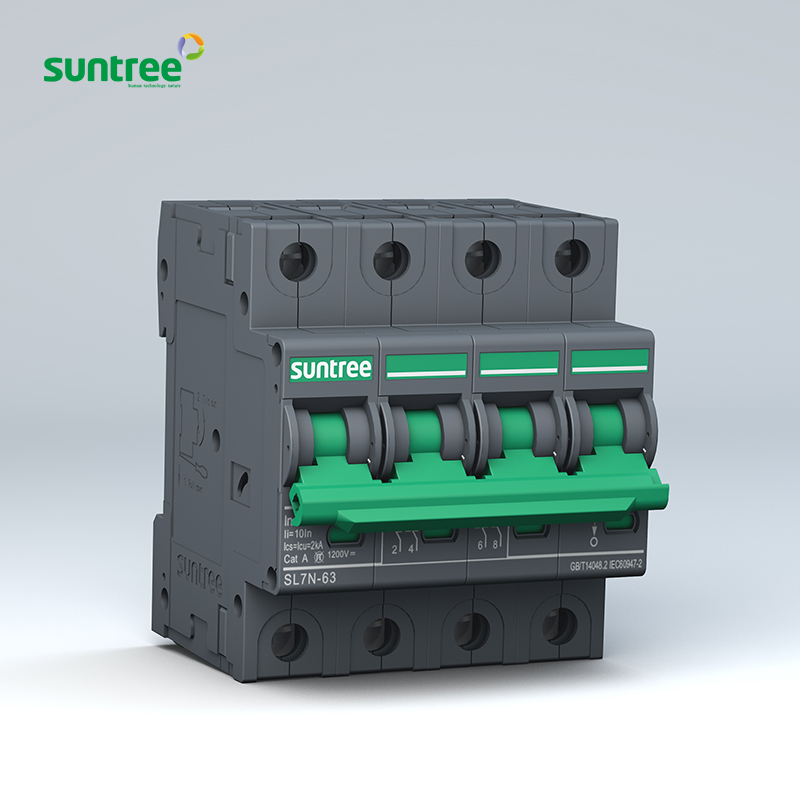
The Solar 4 Pole DC MCB 20A from Suntree — also known across the Kenyan solar market as the Suntree SL7N-63 4P 1000VDC 20A DC Circuit Breaker, the Suntree Quad-Pole DC MCB, the 4 Pole 1000V Solar Breaker, or simply the Commercial Solar DC MCB — sits at the entry of the commercial-tier protection range. It is engineered for the small commercial Kenyan solar market where installations have moved from the residential 550V architecture to the modern 1000V architecture that allows longer panel strings, reduced cable costs, and lower transmission losses across the typical larger commercial roof areas.
This is the breaker for the threshold between residential and commercial solar — the 8-15 kW capacity band where 1000V architecture starts to make economic sense. Where the 2P 550V family handles residential strings of 6-8 modern panels, this 4P 1000V variant handles commercial strings of 12-15 panels per string, with the corresponding cable cost savings that justify the architecture migration. The 20A current rating represents the entry point for the commercial 4P 1000V family — appropriate for installations using single strings or two parallel strings of moderate-current panels, where the 1000V envelope is needed but the continuous current stays within the 20A capacity.
The 4-pole architecture is not a marketing differentiator — it is engineering necessity at 1000V. The four contact pairs arrange in series with each pair seeing approximately 500V during opening, allowing the arc-quench geometry to operate within its safe envelope even at the full 1000V bus voltage. A 2-pole breaker designed for 550V cannot safely interrupt a 1000V DC circuit; the arc grows beyond what the quench can reliably handle, leading to potential contact welding and failed clearance. Specifying this 4P 1000V variant matters when the installation actually operates at the higher voltage architecture — under-specifying creates safety risk that may not surface until the first major fault event arrives.
Why 1000V architecture changes the breaker selection
Modern Kenyan commercial solar installations have systematically migrated to 1000V DC architecture for three economic and engineering reasons. Understanding these drivers helps clarify when the 4P 1000V breaker becomes the right protection device rather than the cheaper 2P 550V alternative:
- Cable cost reduction at the commercial scale: A 10 kW solar system at 400V DC bus voltage draws 25A; the same 10 kW at 800V draws only 12.5A. The 50% current reduction translates directly into thinner cables, lower copper costs, and reduced cable mass to install. Across a typical commercial installation with 30-50 metre cable runs from rooftop array to ground-floor inverter, the savings are substantial enough to influence project economics.
- Lower transmission losses: Cable resistance dissipates power proportional to current squared. Reducing operating current from 25A to 12.5A cuts I²R losses by 75% for the same power transmission. Over a 20-25 year project life, the additional energy harvested through this loss reduction represents meaningful long-term value.
- Longer panel strings reduce combiner complexity: The 1000V envelope accommodates strings of 12-15 modern panels in series rather than the 6-8 panels of 550V architecture. Longer strings mean fewer parallel circuits to combine, smaller combiner boxes, simpler wiring, and fewer points of failure. For a 12 kW installation, 1000V architecture may need only one string instead of two parallel strings, halving the protection device count.
For installations that justify the 1000V architecture, the 4P 1000V breaker becomes the only safe protection choice. Reusing the cheaper 2P 550V breakers on 1000V circuits creates a safety hazard that may operate normally for years before the first cold-morning fault scenario reveals the inadequate arc-clearance capability.
When the 4P 1000VDC 20A is the right specification
The 20A current capacity at the 4P 1000V class targets the entry of the commercial solar tier. Six specific application scenarios push the answer toward this variant:
- Small commercial solar installations (8-15 kW capacity): The classic small commercial Kenyan solar size — larger retail premises, restaurants, hotels in the 8-15 kW band — where the array uses 12-15 panel strings on 1000V architecture, with continuous current in the 12-18A range comfortably within the 20A breaker rating.
- Single-string 1000V commercial installations: Installations where a single long string of 12-15 modern panels feeds the inverter directly, without parallel string combining. Operating currents stay within 13-18A continuous, fitting the 20A breaker capacity with appropriate 1.25× sizing margin.
- Larger residential systems migrating to 1000V architecture: Some larger residential systems (8-12 kW) move to 1000V architecture for the same cable cost reasons that drive commercial migration. The 4P 1000V 20A protects these residential 1000V installations where the 2P 550V variants cannot safely operate.
- Commercial inverter DC input protection: Small commercial string inverters in the 8-15 kW range (Sungrow, Huawei, Solis, and similar manufacturers) standardise on 1000V DC input architectures. The 4P 1000V 20A provides the DC input isolation these inverters require for service and fault response.
- Light industrial solar systems: Small factories, processing facilities, agricultural cold storage, and similar light industrial Kenyan operations using 8-15 kW solar systems with 1000V architecture.
- Institutional facility solar (8-15 kW): Larger churches, mosques, schools, colleges, and religious community centres where solar systems power weekend congregational loads and weekday administrative operations through 1000V architecture installations.
When 4P 1000VDC 20A is the wrong choice
Wrong-specification breakers waste money or create safety risk. Four scenarios where this variant is not the right answer:
- Small residential systems on 550V architecture: Residential installations using 6-8 panel strings within the 550V envelope don’t need 1000V protection. The 2P 550V variants (20A, 32A, or 63A depending on current) handle these installations at lower cost. Buying the 4P 1000V breaker for residential 550V applications wastes money without adding any protection.
- Commercial installations with higher continuous currents: Commercial installations drawing more than 20A continuous from the DC bus need the higher-current variants in the 4P 1000V family — the 4P 1000V 32A or 4P 1000V 63A. Using the 20A variant on a 25A continuous circuit causes nuisance tripping during normal operation.
- Utility-scale installations on 1500V architecture: Modern utility-scale solar farms have moved beyond 1000V to 1500V architecture. The 1500V envelope requires the SL7N-125D 4P 1500VDC 80A variant; the 4P 1000V breaker cannot safely interrupt 1500V circuits.
- Low-voltage DC battery and LED applications: 12V/24V/48V battery systems, LED lighting circuits, CCTV power supplies, and similar low-voltage DC applications use the Single Pole DC MCB 10A variant. The 4P 1000V breaker is dramatically over-specified for these applications.
How this 4P 1000V 20A relates to the rest of the SL7N protection range
The Suntree SL7N protection range covers eight distinct variants spanning residential through utility-scale applications. The pole configuration and voltage class together define the application tier, while the current rating defines the system capacity within that tier. The table below maps each variant to its intended deployment band:
| Tier | Model spec | Where it belongs |
|---|---|---|
| Low-voltage DC (auxiliary) | 1P / 250V / 10A | Lighting circuits, security cameras, isolated battery systems below 60V |
| Residential PV entry | 2P / 550V / 20A | Smaller homes around 3-5 kW with Vestwood 5kW Hybrid pairing |
| Residential PV mid-range | 2P / 550V / 32A | Mid-sized homes 5-8 kW; hybrid battery isolation duty |
| Residential PV top tier | 2P / 550V / 63A | Top-end homes 8-12 kW; large lithium banks; combiner outputs |
| Small commercial PV entry — this product | 4P / 1000V / 20A | Small commercial 8-15 kW running 1000V architecture; light industrial PV |
| Commercial PV mid-range | 4P / 1000V / 32A | Medium commercial systems carrying higher-current 1000V strings |
| Commercial PV top tier | 4P / 1000V / 63A | Larger commercial PV; commercial-scale battery isolation |
| Utility-scale | 4P / 1500V / 80A (SL7N-125D) | Solar farms and the largest rooftop commercial installations |
The 4P 1000VDC 20A serves as the entry point to the commercial 1000V tier — appropriate for the smallest commercial installations migrating to 1000V architecture. For commercial installations with higher continuous currents, the 32A or 63A variants in the same 4P 1000V family provide upsized protection within the same voltage envelope.
Why the 4-pole architecture is mandatory at 1000V
The 4-pole configuration in this breaker is not a feature — it is a structural requirement of DC arc-clearance physics at 1000V. The arc that develops when contacts open under load needs to be interrupted by physically breaking the conductive plasma path between the contacts. At 550V, a 2-pole breaker with adequate gap and quench geometry can interrupt the arc reliably. At 1000V, the arc holds across the gap that a 2-pole arrangement provides — the arc gets too long for the quench chambers to extinguish, and the contacts remain conductively connected through the plasma even when mechanically opened.
The 4-pole design solves this problem through series voltage division. The four contacts arrange as two pairs in series, with the full 1000V bus voltage divided across the pairs. Each pair sees approximately 500V during opening — exactly the voltage that 2-pole quench geometry can reliably handle. The arc that develops at each pair operates within the safe envelope of the labyrinth arc-chute and magnetic blowout system, extinguishing reliably under fault conditions.
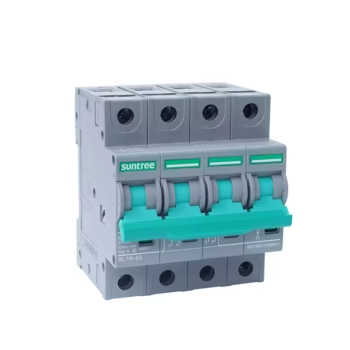
The common-trip mechanism ensures all four contacts open together when the breaker is operated manually or trips automatically. This provides complete galvanic isolation of the 1000V bus — both positive and negative rails of the bipolar solar circuit disconnect simultaneously through the four series-arranged contact pairs. The Suntree SL7N-63 4P 1000V variant implements this architecture in a DIN-rail mountable industrial form factor compatible with mainstream commercial solar distribution boards.
Technical Specifications
| Specification | Value |
|---|---|
| Bicity SKU | BC-DCB-1000V-20A-4P |
| Manufacturer name | Suntree Electric Group (China) |
| Product series | SL7N-63 commercial 1000V solar DC breaker line |
| Device type | Miniature circuit breaker rated for solar PV DC service at commercial voltage class |
| Maximum operating voltage | 1000V DC under continuous load conditions |
| Continuous current capacity | 20 amps thermal — entry rating in the 4P 1000V series |
| Pole structure | Quad-pole design, two contact pairs wired in series per polarity |
| Per-pair voltage burden | About 500V during opening — keeps each pair within safe arc-quench envelope |
| Polarity requirement | None — install in either current direction |
| Trip curve | Thermal element handles slow overloads; magnetic element catches fast short-circuit faults |
| Icu fault interruption rating | 6 kA at rated 1000V DC |
| Manual operation endurance | 20,000 cycles before mechanism end-of-life (typical) |
| Operation under load endurance | 10,000 cycles at full rated current (typical) |
| Contact gap per pair on opening | Exceeds 9 millimetres separation |
| Arc clearance technology | Magnetic blowout deflects arc into labyrinth chute, sized for 500V per pair |
| Installation method | Standard 35mm DIN rail snap-mount |
| Terminal capacity | Solar PV stranded copper conductor from 2.5mm² through 10mm² |
| Working ambient | Between -25°C and +70°C |
| Off-state storage | Between -40°C and +80°C |
| Type test certifications | IEC 60947-2 industrial standard; carries TUV Germany mark and European CE conformity |
| Environmental class | Industrial pollution degree 2 |
| Construction insulation | Class II — double-insulated housing |
| Position indicator | Window on front face displays OFF or ON state clearly |
| Maintenance lockout | Handle hole accepts padlock for lockout-tagout procedures |
| Module width on DIN rail | 4 modules (72mm total) — double the 2P 550V variants |
| Net weight | Around 480 grams |
Engineering Features That Matter for 1000V Commercial Solar Duty
- 4-pole common-trip mechanism for 1000V interruption: The four contact pairs arrange in series with each pair handling approximately 500V during opening — the only architecture that reliably interrupts 1000V DC arcs in compact DIN-rail mountable format.
- Series labyrinth arc-quench across four pairs: Each contact pair has its own dedicated labyrinth arc-chute with magnetic blowout, sized for the 500V envelope each pair handles. The combined four-pair arrangement reliably interrupts fault currents at the full 1000V bus voltage.
- 20A continuous capacity for commercial entry tier: Heavy current-carrying parts handle 20A continuous without thermal runaway, with the standard 1.25× margin protecting circuits drawing up to 16A continuous — matching modern 12-15 panel strings with Isc in the 13-16A range.
- 1000V voltage envelope supports 12-15 panel strings: Modern commercial solar panels with 50V open-circuit voltage produce 600-750V rated Voc in 12-15 panel strings, with cold-morning peaks reaching 640-800V — well within the 1000V envelope with safety margin.
- Bi-directional polarity tolerance: Mountable with current flowing in either direction — removes one entire category of installation error that affects polarity-sensitive DC breakers, an especially valuable property in commercial installations where several conductors of similar appearance arrive at the same DIN rail.
- 72mm DIN rail footprint accommodates commercial distribution boards: The 4-module width integrates cleanly with commercial-grade distribution boards used in 8-15 kW solar installations, providing clear physical separation from AC consumer unit breakers and adequate ventilation around the breaker body.
- Compatible with Sungrow, Huawei, Solis, and similar commercial inverters: The 1000V voltage envelope, 20A current capacity, and 4-pole DC interrupting capability all align with the protection requirements of mainstream small commercial string inverters.
- Padlock provision for commercial lockout/tagout: The 1000V circuits this breaker protects warrant formal lockout/tagout discipline during commercial maintenance and service. The padlock hole through the operating handle supports this requirement.
- EPRA-recognised commercial compliance: IEC 60947-2 type-test compliance with TUV and CE certification supports the formal commercial inspection documentation that small commercial solar installations require.
- Heavy cable terminal capacity up to 10mm² conductor: Accommodates the cable cross-sections required for cable runs typical of commercial installations from rooftop arrays to ground-floor inverter rooms.
Typical Kenyan Installation Scenarios for the 4P 1000VDC 20A Variant
- Small commercial solar installations on larger retail premises in Nairobi CBD, Westlands, Kilimani, Lavington, Hurlingham, Karen shopping centres, Mombasa Nyali and Bamburi commercial strips, Kisumu town, Nakuru CBD, Eldoret town, Thika, Nyeri, Meru, and Kakamega trading centres in the 8-15 kW capacity band
- Restaurant and hospitality solar at larger establishments where 8-15 kW solar systems using 12-15 panel strings power kitchen equipment, refrigeration, lighting, and HVAC loads through the daytime operating envelope
- Small hotel and guest house solar at coastal and inland properties (Diani, Watamu, Malindi, Kilifi, Naivasha, Maasai Mara, Aberdares, Nanyuki) where 8-15 kW systems offset air-conditioning and lighting loads
- Larger educational facility solar at tertiary colleges, private secondary schools, and primary school networks where 8-15 kW systems power administration blocks, computer laboratories, and dormitory utility loads
- Religious institution solar at larger churches, mosques, and Hindu temples where weekend congregations create substantial AC capacity demand that solar generation plus battery storage helps meet
- Private clinic, dental practice, optician, and small hospital solar at 8-15 kW capacity where medical refrigeration, diagnostic equipment, and HVAC justify the small commercial system tier
- Larger residential installations migrating to 1000V architecture for cable cost reduction — typically 10-15 kW residential homes with long cable runs from elevated rooftop arrays to ground-floor inverter cabinets
- Telecommunications tower backup solar at remote sites using 8-15 kW capacity with 1000V architecture for the cable cost benefits across rural deployment
- Solar carport installations at offices, shopping centres, hospitals, and educational institutions where canopy-mounted arrays in the 8-15 kW band use 1000V architecture
- Small factory and processing facility solar at agricultural processing centres (smaller tea factories, coffee processing, dairy operations) and small manufacturing premises with daytime electrical loads matched to solar generation profiles
- NGO compound and humanitarian facility solar at displaced persons camps, refugee operations, and emergency response sites using larger 8-15 kW systems with 1000V architecture for component cost optimisation
- Off-grid commercial installations at eco-lodges, conservation facilities, remote tourism camps, and wildlife sanctuary headquarters using 8-15 kW capacity systems with 1000V DC links
Pairing the 4P 1000VDC 20A with Bicity Solar ecosystem components
This commercial-tier breaker integrates with several Bicity Solar products across the small commercial solar architecture. Three integration patterns dominate Kenyan small commercial installations:
- 1000V string + 4P 20A MCB + small commercial inverter: The most common architecture for 8-15 kW small commercial installations. A single string of 12-15 modern panels in series on 1000V architecture feeds through this 4P 20A breaker into a 1000V-rated commercial string inverter. The breaker provides manual disconnection plus overcurrent protection for the entire 1000V DC path.
- 1000V combiner box + 4P 20A MCB + commercial inverter: For installations using a SHLX 1000V combiner box at the array side, this 4P 20A breaker is the internal main disconnection device combined with internal fuses and SPD. The combined protected output runs through the breaker to the commercial inverter DC input.
- Multi-string 1000V architecture with parallel breakers: Larger small commercial installations using two parallel 1000V strings each carrying 10-15A use one 4P 20A breaker per string at the combiner inputs, with a higher-current breaker (4P 32A or 4P 63A) on the combined output. This protects each parallel string independently while providing safe combined-output isolation.
Installation Notes for Kenyan Small Commercial Solar
The 4P 1000VDC 20A operates at the commercial-tier voltage class and the installation work it demands sits clearly above what residential contractors typically handle. Only an EPRA-licensed solar electrician with documented small commercial solar installation experience should commission this device. Seven practical considerations apply specifically to 1000V architecture installations:
First, voltage envelope verification — calculate the panel string’s cold-morning open-circuit voltage from the panel datasheet’s Voc and temperature coefficient. For 12-panel strings of modern 50V Voc panels, rated Voc is 600V with cold-morning peaks around 640V; 15-panel strings produce 750V rated Voc with cold-morning peaks around 800V. Both sit comfortably within the 1000V breaker rating. Strings of 16-18 panels approach the rating limit; strings of 19+ panels exceed the safe margin and warrant moving to the SL7N-125D 4P 1500VDC variant.
Second, current rating verification — confirm the actual operating current of the protected circuit. For 1000V string installations with modern panels of Isc around 13-15A, the 1.25× sizing factor gives required breaker rating of 16-18.75A — comfortably within the 20A breaker. For installations using higher-Isc panels above 16A, evaluate whether the 4P 1000V 32A variant provides better operating margin.
Third, polarity labelling — the SL7N-63 platform tolerates current flowing in either direction, so the breaker itself is happy regardless of which conductor enters which terminal. Field practice still demands consistent positive/negative tagging across the whole installation, because future fault diagnosis depends on the rest of the system following predictable conventions even when the breaker is indifferent.
Fourth, terminal torque application — apply manufacturer-specified torque to all four conductor terminations. At commercial-tier installations, loose terminal connections generate measurable resistive heating that progressively degrades the joint and may compromise cable insulation around the breaker terminals. Document the torque values in commissioning records.
Fifth, cable selection for 1000V DC service — the cables connecting the array to the breaker and the breaker to the inverter must be solar-PV-rated (marked PV or TUV on the insulation) with voltage rating of at least 1000V DC. Standard 600/1000V building cable is inadequate for 1000V DC service — use cable specifically rated for solar PV applications at the higher voltage class.
Sixth, enclosure selection for the commercial tier — mount the breaker in an IP65 industrial-grade enclosure for outdoor combiner deployment, an IP54 enclosure for protected outdoor positions, or an industrial-grade IP20 box inside the inverter cabinet for indoor protected installations. Residential-grade consumer units lack the insulation clearances required for 1000V DC operation — use dedicated DC distribution boxes or commercial-grade enclosures.
Seventh, commercial commissioning documentation — small commercial installations subject to EPRA inspection and insurance documentation require formal commissioning records. Required tests include measuring insulation resistance of the live circuit at its working voltage class, confirming polarity at every breaker terminal, exercising the breaker open-close with no load on the line, verifying trip characteristics where the test gear allows, and recording earth-loop impedance through the protective conductor. Keep the records on file through the warranty term and beyond — they become critical evidence if later fault analysis is required or commercial insurers request retrospective documentation.
Planning an 8-15 kW small commercial solar system, light industrial PV installation, or larger residential migration to 1000V architecture in Kenya?
Specify the Solar 4 Pole DC MCB 20A (Suntree SL7N-63 4P 1000VDC, SKU BC-DCB-1000V-20A-4P) with the right combiner architecture, solar-PV-rated cabling at the 1000V class, and commercial-grade inverter pairing — open the Solar Calculator to size the small commercial protection scheme, or send your project requirements through My Quote for a full EPRA-ready commercial solar DC protection bill of materials.