Description
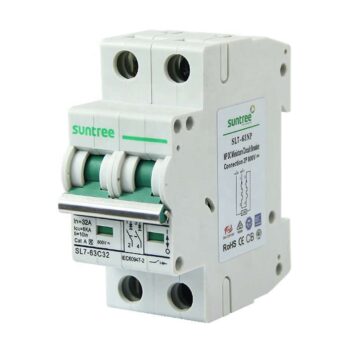
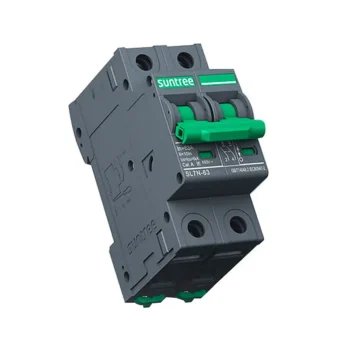
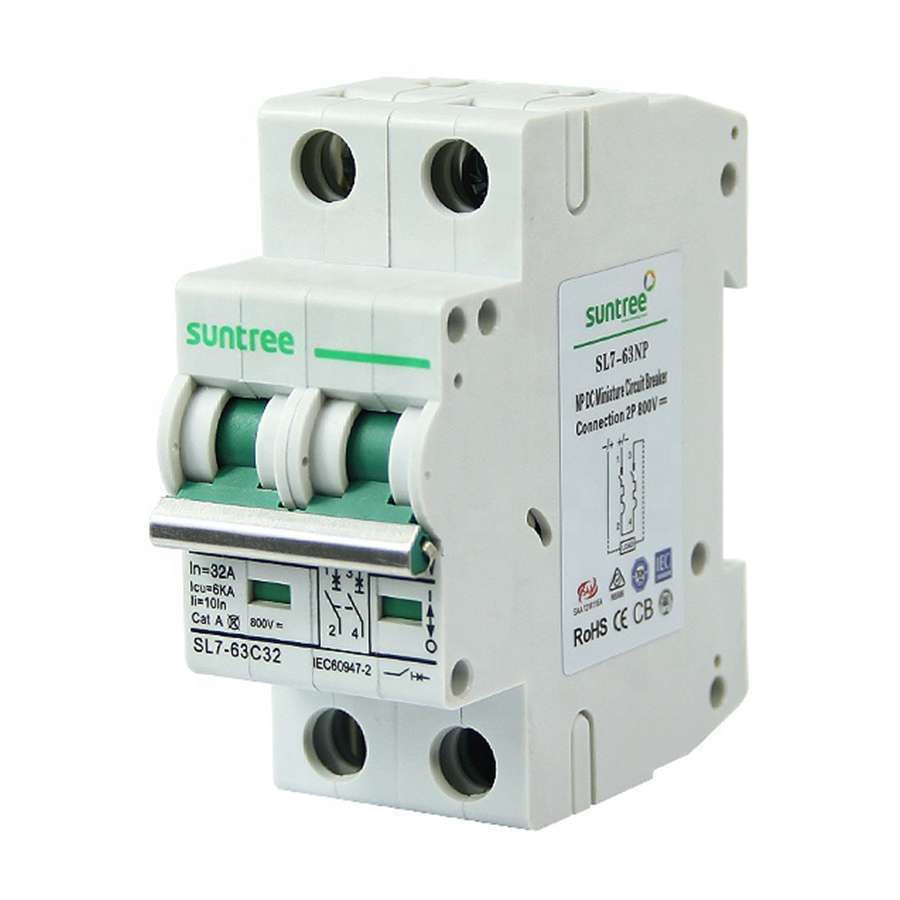
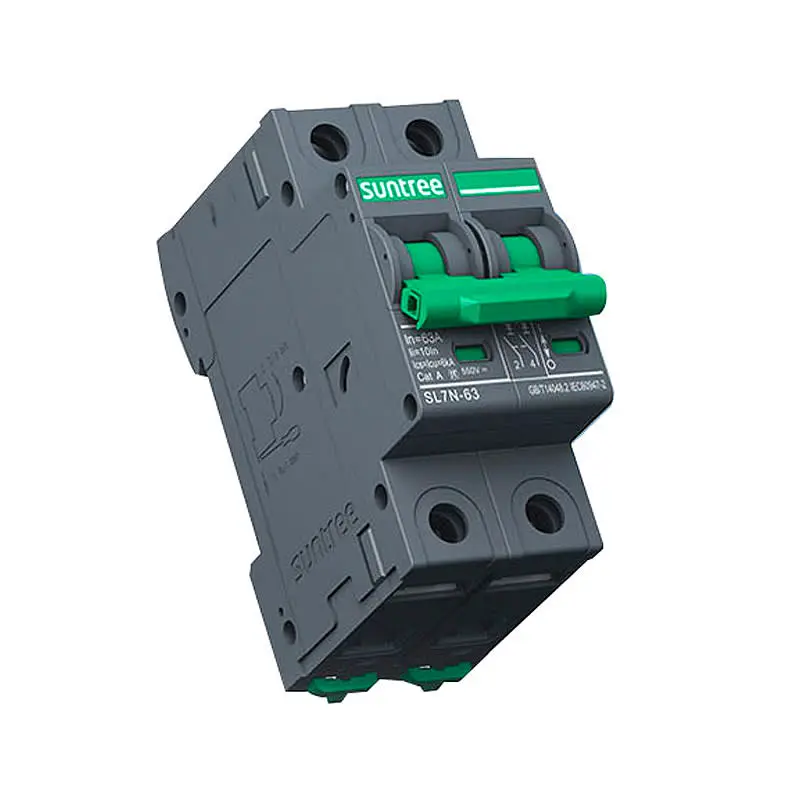
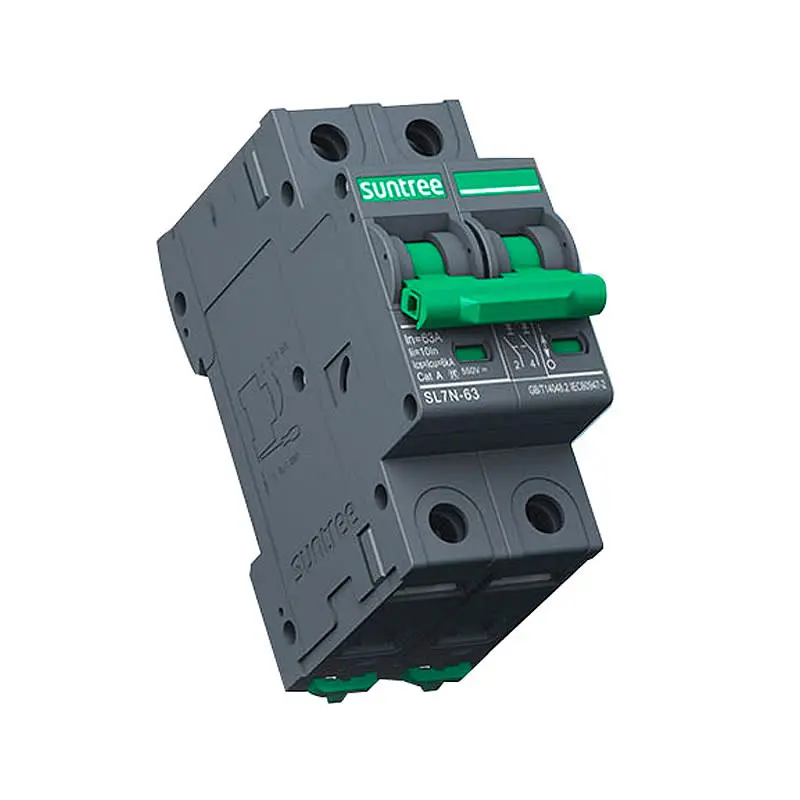
Solar 2 Pole DC MCB 63A Kenya — Suntree SL7N-63 2P 550VDC DC Circuit Breaker for Larger Hybrid Solar & Battery Systems
The Solar 2 Pole DC MCB 63A from Suntree — also identified across the Kenyan solar market as the Suntree SL7N-63 2P 550VDC 63A DC Circuit Breaker, the Suntree Solar DC MCB 63A, the 63A Double-Pole Solar Breaker, or simply the 63A 2P 550V DC MCB — sits at the top of the SL7N-63 2-pole 550V family. It targets the largest residential solar systems in Kenya, the larger hybrid solar-plus-battery installations where DC bus currents climb past what the 32A variant can handle, multi-string combiner outputs where three or more parallel strings combine into a single inverter input, and small-to-medium commercial solar installations in the 6-10 kW capacity band.
This is the breaker for installations that have outgrown the 32A variant but stay within the 550V voltage envelope of typical residential and small commercial PV architecture. The voltage rating handles panel strings of 6-8 modern modules — the same string lengths the smaller 2P 550V variants support — but the current capacity moves up to 63 amperes, sufficient for large lithium battery banks discharging at high current, three-string combiner outputs reaching 45-54A, and the higher continuous DC bus currents of 8-12 kW residential systems pairing the larger Vestwood inverters with substantial battery storage.
For installations that genuinely need the 63A capacity, this breaker provides the protective margin that smaller variants cannot deliver. For installations that draw less than 32A continuous, the smaller 32A variant is the correct choice and the 63A is over-specified. Right-sizing matters at this current level — both for cost efficiency and because oversized breakers may fail to trip on genuine fault currents that fall below their threshold.
Where 63A becomes the right specification rather than 32A
The decision point between “use 32A” and “use 63A” depends on the actual continuous current of the protected circuit. Six specific scenarios push the right answer toward this 63A variant:
- Largest residential solar systems (8-12 kW capacity): Systems in this capacity band frequently pull 25-32A continuous DC from the inverter side during midday peak generation, or supply 35-45A continuous to the inverter from battery banks during high-load evening operation. The 63A breaker provides operating margin that the 32A variant simply cannot match at sustained high currents.
- Larger hybrid battery banks (10-15 kWh capacity): Lithium battery banks in this range deliver continuous discharge currents of 35-50A in residential hybrid systems with substantial daytime and evening loads. The 32A breaker would nuisance-trip during normal high-load operation; the 63A handles it cleanly.
- Multi-string combiner output protection: Installations where three or more parallel solar PV strings combine into a single inverter input produce combined currents reaching 45-54A continuous (three strings of 6-8 modern panels at 14-18A Isc each). The combined output requires the 63A breaker; individual string currents within the combiner can use smaller 20A or 32A breakers upstream.
- Vestwood 8kW or 10kW Hybrid Inverter installations: Larger Vestwood inverters handle higher DC input currents than the 5kW or 6kW models. Their PV-side and battery-side DC protection requires the 63A breaker for proper operating margin during sustained high-load periods.
- Off-grid systems with substantial daily energy budgets: Off-grid installations powering full residential loads (refrigeration, water pumping, lighting, electronics, occasional resistive heating) frequently pull 30-45A continuous from the battery bank during evening operation. The 63A breaker protects this primary load circuit.
- Small commercial solar with backup loads: Retail premises, restaurants, and small institutional facilities (clinics, dental practices, small offices) in the 6-10 kW capacity band where continuous DC currents on the battery or inverter side reach the 35-45A range during normal operation.
Specific Kenyan applications for the 63A 2P 550VDC variant
This breaker addresses a clearly defined and growing band of Kenyan solar and hybrid energy installations. Ten specific application contexts make up the bulk of buyer demand:
- Vestwood 8kW and 10kW Hybrid Inverter DC isolation: Between the panel array (or combiner output) and the larger Vestwood inverter DC input terminals, providing isolation for inverter service on systems that justify the larger inverter capacity.
- Hybrid battery-side DC isolation for 10-15 kWh banks: Between the lithium battery bank and the hybrid inverter battery terminals, where continuous discharge currents during high-load evening operation reach 35-50A. The 63A breaker handles this sustained duty without nuisance tripping.
- Three-string and four-string combiner outputs: At the combined output of multi-string combiner boxes where three or four parallel solar PV strings combine into a single high-current cable to the inverter. Each individual string within the combiner may use smaller breakers (20A or 32A) at its input terminal, with this 63A breaker on the combined output.
- Largest residential solar systems (8-12 kW band): Upmarket Kenyan residential properties in Karen, Runda, Spring Valley, Loresho, Lavington, Muthaiga, Westlands, and similar Nairobi suburbs where 8-12 kW solar systems power substantial daily consumption with battery backup.
- Highland larger residential installations: Properties in Tigoni, Limuru, Kiambu, Ridgeways, Nyari, and similar areas where 8-12 kW systems power large modern homes with electric heating and cooking loads.
- Coastal residential solar at scale: Larger properties in Nyali, Bamburi, Diani, Watamu, and Malindi where year-round high irradiance combined with substantial daytime and evening loads (air conditioning, swimming pool circulation, water heating) justifies the 8-12 kW system tier.
- Small commercial solar on retail premises (6-10 kW): Larger shops, restaurants, supermarkets, butcheries, hardware stores, and similar retail premises across Nairobi CBD, Westlands, Mombasa town centre, Kisumu, Nakuru, and Eldoret commercial districts.
- Institutional facility solar: Larger churches and mosques, school administration blocks, private clinics, dental practices, veterinary surgeries, and tertiary college facilities in the 6-10 kW band where solar generation combined with battery storage provides daytime and outage backup capability.
- EV charging infrastructure DC-side protection: Solar-fed DC fast-charge installations at residential properties (single Level 2 home chargers backed by solar plus battery) and at small commercial sites (restaurants, hotels, and forecourts beginning to install EV charging as a customer service). The 63A breaker provides DC-side protection on the solar generation circuit feeding the EV charging architecture.
- Off-grid larger systems with high evening loads: Weekend homes, lodges, conservation facilities, and remote sites in Naivasha, Maasai Mara, Aberdares, Mount Kenya foothills, Loitokitok, and similar areas with 15-20 kWh battery banks powering full residential and small commercial loads through evening operating hours.
Positioning the 63A within the full Suntree SL7N-63 protection range
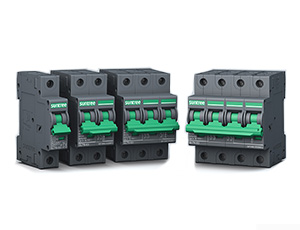
| SL7N Variant | Configuration | Voltage | Current | Application Tier |
|---|---|---|---|---|
| SL7N-63 single-pole 250VDC 10A | 1P | 250V | 10A | LED lighting, CCTV, 12V/24V/48V battery, low-voltage DC |
| SL7N-63 dual-pole 550VDC 20A | 2P | 550V | 20A | Entry residential solar (3-5 kW), Vestwood 5kW Hybrid |
| SL7N-63 dual-pole 550VDC 32A | 2P | 550V | 32A | Larger residential (5-8 kW), Vestwood 6kW, hybrid battery |
| SL7N-63 dual-pole 550VDC 63A — this product | 2P | 550V | 63A | Largest residential (8-12 kW), large battery banks, small commercial, multi-string combiner outputs |
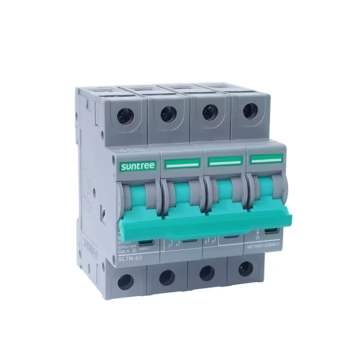
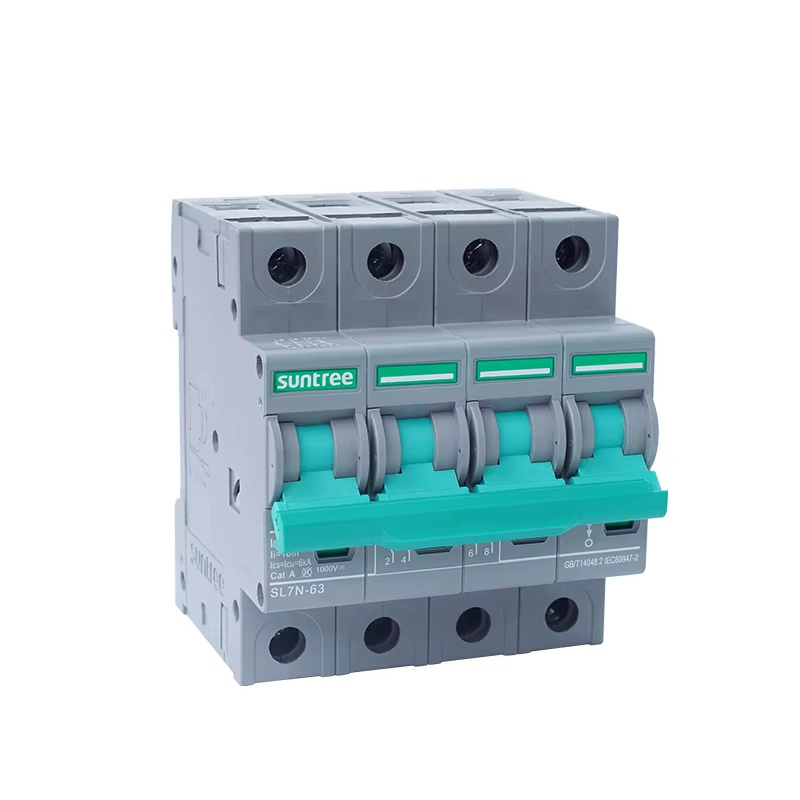
| SL7N-63 quad-pole 1000VDC 20A | 4P | 1000V | 20A | Light commercial PV (12-15 panel strings on 1000V architecture) |
| SL7N-63 quad-pole 1000VDC 32A | 4P | 1000V | 32A | Medium commercial solar with higher-current 1000V strings |
| SL7N-63 quad-pole 1000VDC 63A | 4P | 1000V | 63A | High-current commercial PV systems and commercial battery banks at 1000V architecture |
| SL7N-125D quad-pole 1500VDC 80A | 4P | 1500V | 80A | Utility-scale solar and the largest commercial rooftop installations |
The 63A 2P 550VDC sits at the top of the 2-pole residential and small commercial tier. For installations requiring higher voltage (12-15 panel strings on 1000V architecture), step across to the 4P 1000VDC family. For installations requiring higher current at 1000V (larger commercial PV), the 4P 1000VDC 63A is the equivalent variant in the commercial tier. For utility-scale or the largest commercial rooftop installations, the 4P 1500VDC 80A variant provides top-tier protection.
Why Suntree’s SL7N-63 outperforms cheap competitors at the high-current end
Current rating matters most for cheap-vs-quality differentiation in DC breakers — and the 63A end of the SL7N-63 family is where build quality differences become most consequential. Suntree’s engineering investment in the SL7N-63 platform delivers four specific advantages over budget alternatives, particularly at the higher current ratings:
- Heavy contact assembly for sustained 63A duty: Internal contact surfaces, contact pressure springs, and conductor bus bars are sized to carry 63A continuously without thermal runaway over years of service. Cheap alternatives that scale up only the labelling without scaling the internal current-carrying parts develop progressive heating that eventually compromises the joint between the contact and the terminal — a slow failure mode that may take 2-3 years to manifest but ultimately requires breaker replacement.
- Adequate arc-chute capacity for 63A fault clearance: Fault currents at 63A continuous-rated breakers can reach 6 kA peak during short-circuit events. The Suntree labyrinth arc-chute is sized to dissipate the corresponding arc energy without contact destruction. Budget alternatives with undersized arc chambers may successfully clear the first major fault but degrade progressively with each subsequent event.
- Stiff mechanism for accurate trip characteristics: The thermal-magnetic trip mechanism must operate accurately at the higher current levels. Suntree’s mechanism uses calibrated bimetallic strips for thermal sensing and a properly-sized magnetic coil for instantaneous fault detection. Budget alternatives often use undersized magnetic coils that develop drift over time, causing nuisance tripping or worse, failure to trip on genuine fault conditions.
- Verified breaking capacity throughout the rated current range: The TUV and CE certifications cover the device across its full current rating envelope, including the high-current end where breaking capacity is most stressed. Budget alternatives may claim breaking capacity ratings at their lowest current setting but fail to verify at the highest rating — a subtle but consequential gap in third-party verification.
Technical Specifications
| Specification | Value |
|---|---|
| Brand | Suntree Electric Group |
| Product Family | SL7N-63 series solar PV DC MCB platform |
| Device Class | Solar-rated DC miniature circuit breaker — highest current in the 2P 550V family |
| Rated Voltage Ue | Up to 550V DC continuous |
| Rated Current Ie | 63A continuous — top of the 2P 550V SL7N-63 range |
| Pole Arrangement | Two poles linked by common-trip handle mechanism |
| Polarity Behaviour | Bi-directional — current may flow either way through the breaker |
| Tripping Profile | Combined thermal element and magnetic element, tuned for solar PV and battery duty |
| Breaking Capacity (Icu) | 6 kA at full rated DC voltage |
| Mechanical Life | Approximately 20,000 manual operations |
| Electrical Life | Approximately 10,000 operations at rated load |
| Opening Distance | Greater than 9 mm contact separation on opening |
| Arc Chamber | Labyrinth-style arc chute with magnetic blowout |
| Mounting | Click-mounts onto standard 35mm DIN rail |
| Cable Acceptance | Solar PV cable from 6mm² up to 25mm² stranded copper (sized for 63A duty) |
| Operating Range | -25°C through +70°C ambient temperature |
| Storage Range | -40°C through +80°C de-energised |
| Standards Compliance | IEC 60947-2 industrial; TUV (Germany) and CE marks |
| Environment Rating | Pollution Degree 2 industrial environment |
| Insulation | Class II double-insulated construction |
| Status Window | Front-face indicator showing clear ON or OFF position |
| Lockout Feature | Operating handle accepts standard padlock for safe maintenance isolation |
| DIN Rail Width | Two modules wide (36mm total footprint) |
| Approximate Weight | 0.36 kg |
Engineering Features That Matter at the 63A Current Level
- True dual-pole common-trip linkage: Both DC conductors open together simultaneously when the breaker is operated manually or trips automatically on overcurrent or short circuit — providing complete galvanic isolation of the bipolar circuit downstream regardless of which fault rail initiates the trip.
- 63A continuous capacity sized for largest residential and small commercial duty: Heavy internal current-carrying parts handle 63A continuous without thermal runaway, with the standard 1.25× sizing margin protecting circuits drawing up to 50A continuous load current.
- Heavy cable terminal capacity (up to 25mm² conductors): Terminals accommodate the substantial conductor cross-sections that 63A continuous duty requires, particularly in installations where cable runs exceed 25 metres and require larger conductor sizing for voltage drop control.
- Compatible with Vestwood 8kW and 10kW Hybrid Inverters: The voltage envelope, current capacity, and DC arc-clearance specification align with the protection requirements of larger Vestwood hybrid inverters where smaller breakers leave inadequate operating margin.
- Compatible with larger lithium battery banks (10-15 kWh): The 63A continuous rating accommodates the sustained battery discharge currents of larger residential lithium banks during high-load evening operation, eliminating the nuisance-tripping problem that smaller variants face when applied to these duty cycles.
- Multi-string combiner output protection: Drops into combiner box main breaker positions where the combined output of three or more parallel strings reaches the 45-54A continuous range, providing the upsized main MCB that multi-string combiner architectures require.
- Bi-directional installation: Field installation in either polarity orientation without performance compromise — eliminates polarity-orientation field errors particularly common at the larger conductor sizes the 63A breaker accepts.
- Substantial padlock provision for high-stakes lockout: The 63A circuits this breaker protects typically warrant formal lockout/tagout procedures during commercial maintenance. The padlock hole through the operating handle supports this discipline at the higher-stakes installation tier.
- Heavy labyrinth arc-chute for 6 kA fault clearance at 550V: The arc-quench geometry is sized for the higher fault current levels that 63A-class installations may produce — particularly important on the battery side of hybrid systems where short-circuit fault currents can be substantial.
- EPRA-recognised type-test compliance: IEC 60947-2 compliance documentation supports the formal inspection that larger residential and small commercial installations face from EPRA and from insurance assessors.
Typical Kenyan Installation Scenarios for the 63A Variant
- Larger residential solar installations in upmarket Karen, Runda, Spring Valley, Lavington, Westlands, Muthaiga, Lower Kabete, Loresho, Nyari, and Ridgeways properties powering modern homes with electric cooking, water heating, and substantial entertainment loads
- Hybrid solar-plus-battery installations at residential properties with 10-15 kWh lithium battery banks providing evening backup capacity through high-load household operating hours
- Highland larger residential solar across Tigoni, Limuru, Kiambu, Ngong Hills, Karen Hardy, and Kitisuru where 8-12 kW systems anchor full-replacement domestic electrical supply
- Coastal residential installations at Nyali, Bamburi, Shanzu, Mtwapa, Diani, Watamu, Malindi, and Kilifi where high year-round irradiance pairs with substantial cooling and pool circulation loads
- Lakeside larger residential solar at Naivasha, Elementaita, Nakuru, Lake Victoria shoreline properties around Kisumu, and Lake Baringo properties with 8-12 kW capacity systems
- Small-to-medium commercial solar installations on larger retail premises across Nairobi CBD, Westlands, Kilimani, Lavington shopping centres, Mombasa Nyali and Bamburi commercial zones, Kisumu town centre, Nakuru CBD, Eldoret town, Nyeri, Meru, and Kakamega commercial districts
- Restaurant and hospitality solar at larger establishments where kitchen equipment, refrigeration, and HVAC create substantial daytime loads that solar plus battery storage can offset
- Private clinic, dental practice, and small hospital solar where medical refrigeration, diagnostic equipment, lighting, and HVAC justify 8-12 kW capacity systems with battery backup
- Tertiary college and private school solar at administration blocks, science laboratory facilities, and dormitory utility loads
- Religious institution solar at larger churches and mosques where weekend congregations create peaks managed through solar generation plus battery storage
- EV charging infrastructure at residential properties (home Level 2 chargers backed by solar plus battery) and small commercial sites (restaurants, lodges, forecourts beginning to deploy EV charging as guest amenities)
- Larger off-grid installations at conservation facilities, eco-lodges, weekend homes, agricultural processing centres, and remote sites where 15-20 kWh battery banks support full residential and light commercial loads through evening hours
- Cold storage solar at smallholder dairy cooperatives, fish landing site operations on Lake Victoria, and horticultural pre-cooling facilities where compressor loads create sustained DC bus currents
Pairing the 63A 2P 550VDC with Bicity Solar ecosystem components
This breaker integrates with several products across the Bicity Solar residential and small commercial ecosystem. Four integration patterns appear repeatedly across larger Kenyan installations:
- Multi-string combiner + 63A MCB + larger hybrid inverter: The natural architecture for 8-12 kW residential installations using three or more parallel panel strings. Individual strings combine inside a SHLX 550V combiner box (with internal 20A or 32A breakers per string), with this 63A breaker on the combined output running to the hybrid inverter DC input.
- Larger battery bank + 63A MCB + hybrid inverter battery input: In hybrid systems with 10-15 kWh lithium battery banks, this breaker isolates the battery from the inverter for service or emergency response. Battery discharge currents during high-load evening operation reach 35-50A continuous, comfortably within the 63A rating with appropriate margin.
- Off-grid array + 63A MCB + charge controller + battery + inverter: In off-grid architectures, the 63A breaker may appear at multiple points: between the array and charge controller (for systems with combined array currents reaching 45-50A), between the battery bank and the inverter (for the high evening load currents), or both. The same breaker variant works in either position with proper sizing calculation.
- Solar carport + 63A MCB + EV charger feed + grid-tie inverter: Emerging Kenyan residential and small commercial installations combining solar carports with EV charging infrastructure. The 63A breaker provides the high-current DC-side protection on the solar generation circuit feeding the EV charging architecture.
Installation Notes for Kenyan Large Residential and Small Commercial Solar
The 63A variant handles the most demanding service in the 2P 550V family. Installation must be executed by an EPRA-registered solar electrician with documented experience on the larger residential and small commercial systems this breaker targets. Seven practical considerations apply specifically to 63A installations:
First, comprehensive current calculation — the actual continuous current of the protected circuit must be calculated rather than estimated, since the 63A capacity sits at the limit of what 2P 550V protection devices can deliver. For PV strings, multiply panel string Isc by 1.25 to find the required breaker rating. For battery-side protection, calculate the maximum continuous discharge current of the battery bank during peak household or commercial operating periods. For multi-string combiner outputs, sum the individual string currents and apply the 1.25× factor to the combined total. The 63A breaker suits circuits drawing 35-50A continuous; circuits drawing less than 32A should use the smaller variant; circuits drawing close to 63A may benefit from stepping up to the 4P 1000VDC variants for additional margin.
Second, conductor sizing — cable sizing must accommodate the high continuous current and the longer cable runs typical of larger installations. For typical 50A continuous duty in residential cable runs of 20-30 metres, 10mm² stranded copper handles the ampacity with appropriate voltage drop. For longer runs above 30 metres, step up to 16mm² conductors. The breaker terminals accept up to 25mm² to accommodate the heaviest cable sizes that larger commercial installations may require.
Third, lug versus direct termination — at 63A continuous duty in larger conductor sizes, professional installation practice may use crimped lug terminations on the cables before insertion into the breaker terminals, rather than direct conductor insertion. Lug terminations provide better mechanical security at the higher current levels and accommodate stranded conductor terminations more reliably. Use insulated crimp lugs sized to match the cable conductor and the breaker terminal opening.
Fourth, voltage envelope verification — confirm the protected circuit operating voltage stays below 550V continuous. For PV-side protection on residential strings of 6-8 panels, this is automatic. For battery-side protection at typical 48V nominal lithium banks, the voltage compliance is automatic by a wide margin. The voltage envelope only becomes a concern if the application accidentally attempts to use this 2P 550V variant on a longer 1000V architecture string — for those circuits, move to the 4P 1000VDC variants instead.
Fifth, terminal torque at higher current levels — applying manufacturer-specified torque becomes more consequential at 63A than at 20A, because the higher continuous current generates more heat at any given joint resistance. A loose terminal at 63A continuous may reach temperatures that damage cable insulation within months rather than years. Use a calibrated torque wrench, document the torque value, and verify the connection again after the first six months of operation.
Sixth, enclosure selection for the higher-stakes installation tier — mount the breaker in an enclosure appropriate for the deployment environment and the installation criticality. Larger residential installations typically use IP65 outdoor combiner boxes or IP54 protected outdoor positions; small commercial installations may warrant IP65 industrial-grade enclosures with security provisions; off-grid larger systems often need IP65 with additional rodent protection at cable glands. The 2-module DIN rail footprint integrates cleanly with the larger commercial-tier distribution architecture.
Seventh, formal commissioning documentation — installations using the 63A breaker typically warrant more rigorous commissioning than smaller residential systems. Insulation resistance testing at the operating voltage on the protected circuit, polarity verification at the breaker terminals, manual operation testing under no-load conditions, earth-loop impedance measurement on the protective conductor path, and current measurement under operating load to verify the actual current matches the design expectation. Documented commissioning records support EPRA inspection, insurance documentation, and any future fault investigation or warranty claim.
Planning an 8-12 kW residential solar system, larger hybrid solar-plus-battery installation, or small-to-medium commercial PV project in Kenya?
Specify the Solar 2 Pole DC MCB 63A (Suntree SL7N-63 2P 550VDC) alongside matching combiners, properly-sized solar PV cables, lithium battery isolation components, and the inverter pairing your project requires — open the Solar Calculator to scope the larger-system protection scheme, or submit your project requirements through My Quote for a full EPRA-ready DC protection bill of materials with commissioning recommendations.